Guides / Choosing a Supplier
5S in a Sawmill Yard and Sticker Shed: A Practical First Round for Mill Managers
March 26, 2027
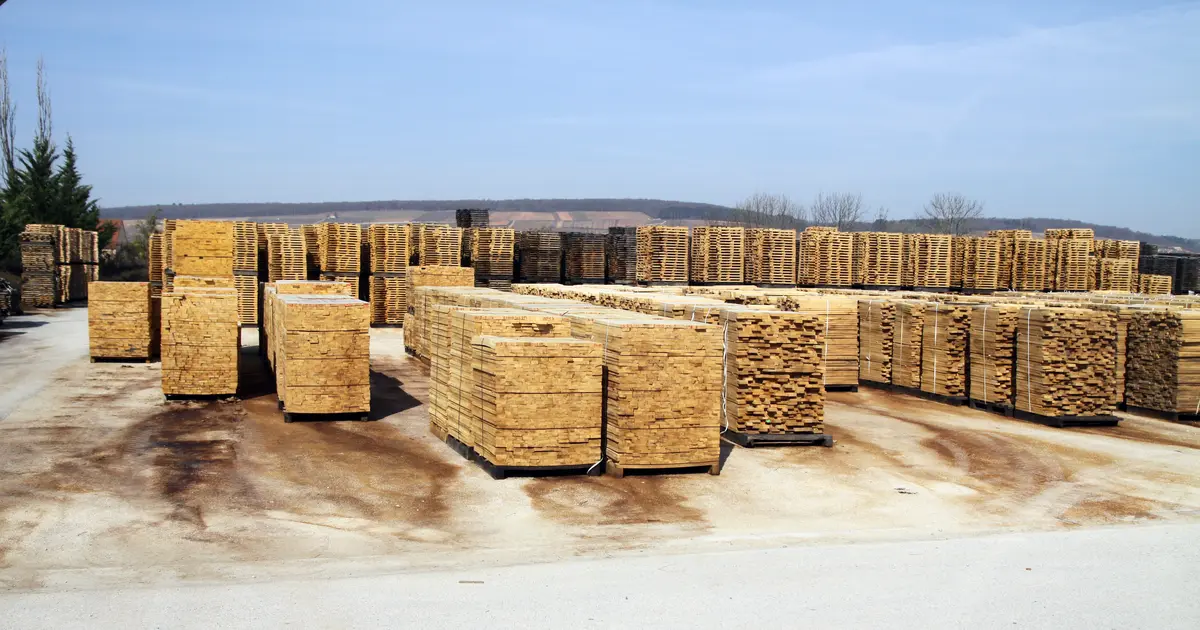
5S for a sawmill is a routine that keeps the yard, the green chain, the sticker shed and the dry shed organized so every bundle can be found, grades stay separated and sticker piles stay dry. It is not a cleaning campaign. A first round takes one area, scores it, fixes the lowest scores and then repeats on a weekly walk. This guide gives the five steps in mill terms, a yard map with bundle IDs and an audit sheet to copy.
It is written for mill managers and yard supervisors who sell hardwood lumber and are tired of lost bundles, mixed grades and stain that starts in the yard. This is general information as of October 2026. It is not safety or legal advice: check the rules that apply to your site.
What 5S means in a sawmill (not a cleaning campaign)
The Lean Enterprise Institute’s lexicon describes 5S as five Japanese terms beginning with an S sound, for workplace practices that support visual control and lean production. The terms and their plain meanings:
- Seiri, sort: keep what is needed and remove the rest.
- Seiton, straighten or set in order: put what remains where it is easy to find and use.
- Seiso, shine: clean the work area, equipment and tools.
- Seiketsu, standardize: keep the order and cleanliness the first three created, by doing them the same way every time.
- Shitsuke, sustain: build the discipline to keep the first four going.
The lexicon notes that some practitioners add a sixth S for safety, and that Toyota traditionally uses four, dropping the fifth because its daily, weekly and monthly audits of standardized work already maintain the discipline. That last point matters for a mill: the routine of checking is the 5S, not the poster on the wall.
A sawmill has its own reasons to use it. The USDA Dry Kiln Operator’s Manual lists sorting by species, moisture content, heartwood and sapwood, wetwood, grain, grade, thickness and length. Every one of those sorts is lost if the bundle cannot be found or identified. And stain, the quiet cost of a wet or dirty yard, starts in the places 5S looks at.
Sort: what leaves the yard and the sheds
Walk the area with a camera and a stack of red tags. Anything that does not belong gets a tag with a date and goes to a held area. After a set time, untagged-by-owner items leave. Typical candidates in a mill:
- Broken, split or wet stickers, and sticker bundles of mixed sizes.
- Offcuts, odd lengths and short ends with no order or grade.
- Bundles with no tag, no grade or no species. If nobody can say what they are, they cannot ship.
- Debris and weeds in the air-drying yard. The manual says drying yards should be kept sanitary and as open as possible to air circulation, on well-drained ground, with debris and weeds removed.
- Damaged kiln trucks and loose strapping.
OSHA’s sawmill rule, 29 CFR 1910.265, says work areas under mills shall be free from unnecessary obstructions and that floors and passageways be kept in good repair. A sort that clears the area under the mill serves that requirement and the 5S at the same time.
Set in order: bundle locations, tags and sticker stacks
The aim is that anyone can find any bundle from the tag in a minute. Four things do most of the work:
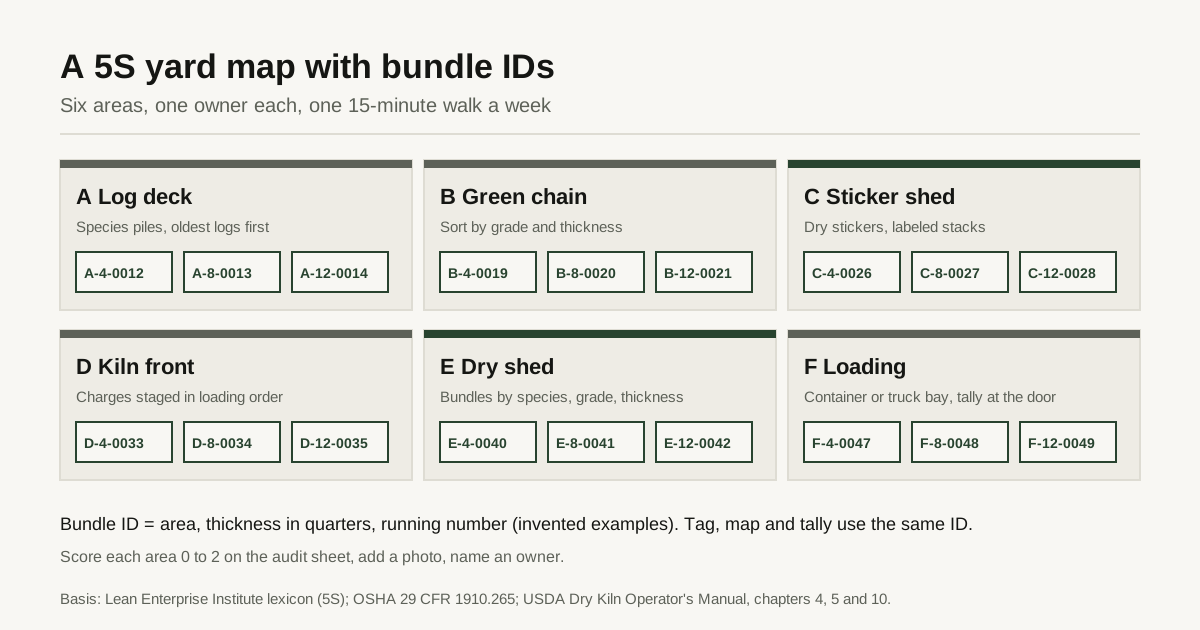
- A yard map with named areas, as in the diagram above: log deck, green chain, sticker shed, kiln front, dry shed and loading.
- A bundle ID that appears on the tag, the map and the tally. The format below is an invented example: area letter, thickness in quarters and a running number, so
E-8-0041is the 41st bundle in the dry shed, 8/4 thick. Use whatever format your mill can keep consistent. - One location per sort. The manual’s sorts by species, thickness and grade become marked bays. Grades that share a bay get mixed.
- Marked aisles and pickup points. OSHA 1910.265 requires aisles, passageways and roadways to be sufficiently wide for safe side clearance and pickup and unloading points to be plainly marked. The manual’s yard checklist asks whether alleys are adequate for maneuvering a lift truck and whether yard grading gives good drainage away from the kilns.
Sticker handling and sticker stain
The sticker shed is where 5S meets lumber quality. The manual says stickers should be made from kiln-dried lumber and protected from regaining moisture while stored or held between kiln charges. That reduces the chance of sticker stain, a discoloration at the point where the sticker touches the lumber. Kiln drying the stickers kills the mold spores that cause the stain, and protection limits new spores. For hardwoods the manual gives sticker widths of 1 1/4 to 1 1/2 inches, not more than 1 1/2.
In 5S terms: dry stickers in a labeled covered place, sorted by size, with a rule that sticker bundles left open for a set time go back to the kiln. See our guide to sticker stain in hardwood lumber for the causes and what a buyer asks for.
Moisture regain is the same issue on a larger scale. The manual says lumber kiln dried to 12 percent or less can be stored outdoors in dry weather for a short time, and that extended storage will cause excessive moisture regain. It also says dried lumber that regains moisture above 20 percent again becomes susceptible to stain and decay. The dry shed is where that moisture rule is kept, so assign each dried bundle to the shed, not to whichever corner has space. The Wood Handbook adds that warm, humid periods with little air movement may encourage fungal stains and aggravate chemical stains, which is another reason to keep piles open to air and the yard clear of weeds.
Shine: sawdust, bark and dust control
Shine means cleaning and inspecting. In a mill that includes the daily removal of sawdust and bark, and an inspection of what the cleaning reveals. OSHA 1910.265 requires mills with dust-creating machines in use for a quarter of the working day or more to have a collecting system, and requires provision for daily removal of refuse in operations that are not required to have an exhaust system or whose refuse is too heavy or bulky for it. It also says exhaust pipes must not discharge into an unconfined outside pile if uncontrolled fire or explosion hazards result.
For combustible dust, NFPA publishes the standard for preventing fires and explosions in wood processing. According to a summary page of the 2025 edition of NFPA 660, that edition consolidates six earlier standards, one of which is NFPA 664 on wood processing and woodworking facilities. I could not open the NFPA text, so this guide gives no dust depth limits or cleaning intervals. Ask your insurer and local fire authority which edition applies and set the weekly walk to match.
The manual’s yard checklist gives a shine inspection: are kiln trucks in good condition, is the control room neat and clean, are kilns and the surrounding area neat and clean. Cleaning while inspecting is how a worn kiln truck or a blocked drain is found before it costs lumber.
Standardize and sustain: the weekly 15-minute walk
Standardize means the first three steps follow written rules: where each sort goes, how stickers are stored, what clean looks like in each area. Sustain means somebody checks. The suggestion of 15 minutes a week is mine, not a published figure: it is long enough to walk six areas with a camera and short enough that it happens.
- One owner per area. The owner scores their own area and the manager walks it.
- Score 0 to 2 per item. Photograph anything that scores 0.
- Fix the lowest scores first, then reset the standard.
- Keep the sheets. A trend of rising scores shows the habit has taken.
The manual’s yard checklist also asks whether good kiln records are kept. Records are a standard like any other: if kiln sheets and tally sheets are filed where the shed is checked, they get kept.
A 5S audit sheet for a mill
Copy this table for each area walk. Score 0 for not done, 1 for partly done and 2 for the standard met. Edit the items to match your mill.
| Area | Item checked | Score 0 to 2 | Photo | Owner |
|---|---|---|---|---|
| Log deck | Logs sorted by species, oldest first; no loose debris or weeds | [name] | ||
| Green chain | Sorting bays marked by grade and thickness; no unlabeled boards | [name] | ||
| Sticker shed | Stickers dry, covered, sorted by size; green stacks tagged with species and thickness | [name] | ||
| Kiln front | Charges staged in loading order; kiln trucks in good order; aisles clear | [name] | ||
| Dry shed | Bundles tagged with ID, grade and thickness; no bundles outside their bay; floor drained | [name] | ||
| Loading | Pickup points marked; tally and packing list match tags; aisles clear | [name] |
Link the bundle IDs on the tags to the tally so the grading and the count can be checked against the same record. Our guide to pre-shipment lumber grading shows what buyers ask for at that step.
I found no published figure for how much 5S saves in a sawmill, so I give none. The check is simple: after a month, can you find any bundle from its tag, and has the number of unlabeled bundles gone down?
Next step
If you sell hardwood lumber to buyers who care how their lumber is stored and tagged, register your mill or yard. Tell us the species and grades you sell, your drying and tally basis and the paperwork you can issue. We pass a buyer’s spec to you only when it fits. Each request goes to 3 suppliers at most and the buyer deals with you directly. We reply within 24 business hours and we make no promise of orders.
Sources
- Lean Enterprise Institute, Lean Lexicon: 5S
- USDA Forest Service, Dry Kiln Operator’s Manual, Agriculture Handbook 188 (revised August 1991)
- OSHA, 29 CFR 1910.265, Sawmills
- USDA Forest Products Laboratory, Wood Handbook, Chapter 13: Drying and control of moisture content and dimensional changes, FPL-GTR-282 (2021)
- Fire-Police-EMS, NFPA 660 2025 edition summary (a secondary summary, not the NFPA text)
Frequently asked questions
What does 5S mean in a sawmill?
It is five habits of workplace organization: sort out what is not needed, set the rest in fixed places, shine by cleaning and inspecting, standardize so the first three repeat, and sustain them through routine checks. In a mill the target is findable bundles, separated grades and sticker piles that stay dry, not a one-time cleanup.
Where should a sawmill start a first 5S round?
Start where lost time or lost lumber shows up: the sticker shed, the green chain sorting area and the dry shed. A bundle that cannot be found, a grade that was mixed or stickers that picked up moisture all start in those places. Pick one area, score it, fix what scored lowest and walk it weekly before adding another.
How does sticker handling relate to sticker stain?
The USDA Dry Kiln Operator's Manual says stickers should be kiln dried and protected from regaining moisture, which reduces the chance of sticker stain. Kiln drying kills the mold spores that cause the stain, and protection limits new spores. Stickers kept in a dry, labeled place are a 5S item with a direct effect on lumber quality.
Does 5S replace safety and fire rules for a sawmill?
No. OSHA 29 CFR 1910.265 sets requirements for sawmills, including dust collection and the daily removal of refuse where no exhaust system is required. NFPA publishes the fire and explosion standard for wood processing. 5S routines help you keep to them, but they do not replace them. Check which edition and rules apply to your site.
Know what you need? Send the spec.
Tell us the species, grade, thickness and board feet. We pass it to up to 3 mills or yards that carry it and reply within 24 business hours.
Send my lumber RFQ