Guides / Choosing a Supplier
Forced Labor Due Diligence on a Hardwood Lumber Supplier: What to Ask Before the EU Ban Applies on 14 December 2027
April 18, 2027
The EU Forced Labour Regulation does not make a buyer audit a lumber supplier, but from 14 December 2027 the European Union bans selling or exporting any product made in whole or in part with forced labor, and a buyer who cannot show where lumber came from has little to answer an authority with. The Commission’s guidelines of 26 June 2026 call due diligence “a useful tool” and list the records an authority may ask for. This guide turns that list into questions you can put to a sawmill, concentration yard or exporter of hardwood lumber today. It describes the rules as of 25 October 2026 and is not legal advice, so confirm details with a customs broker or lawyer.
What the EU rule says about lumber
The European Commission’s page states that from 14 December 2027 no product made with forced labour may be sold in or exported from the EU market, that the rule covers companies of all sizes and that how a company makes sure is left to the company. The guidelines add detail that matters to a lumber buyer.
| Question | What the guidelines say |
|---|---|
| Which products? | All products “made in whole or in part” with forced labor at any stage of extraction, harvesting, production or manufacturing, whatever the sector or origin. Wood is not carved out |
| What share counts? | Any share. Products are in scope regardless of how small the part made with forced labor is |
| What about stock bought earlier? | Products made available from 14 December 2027 are in scope even if produced or imported before that date. Products already sold to the end user are not withdrawn |
| Is due diligence mandatory? | No. The Regulation imposes an obligation of result and “does not impose any due diligence obligations”, but recognizes due diligence as useful. Traceability, responsible purchasing, certification and worker-driven monitoring are named as other approaches |
| Who investigates? | The Commission when the suspected forced labor is outside the EU, otherwise the competent authority of the member state where it occurs |
| What can follow? | A decision banning the product, an order to withdraw it from the market and an order to dispose of it, with no profit allowed from disposal |
| Does a small company escape? | No, but authorities must consider size and resources when requesting information and when setting deadlines |
Forced labor here means the ILO Convention No 29 definition: work exacted from a person under coercion, for which the person has not offered themselves voluntarily. The guidelines list indicators such as deception, debt, withheld wages or identity documents, threats, isolation and abusive working hours.
Nothing in the guidelines says that hardwood from any country is made with forced labor. The point is that a lumber chain has several steps, and the rule applies to any of them. If you ship into the EU, or sell to a company that does, the question will reach you through your customer.
Where the risk sits in a hardwood chain
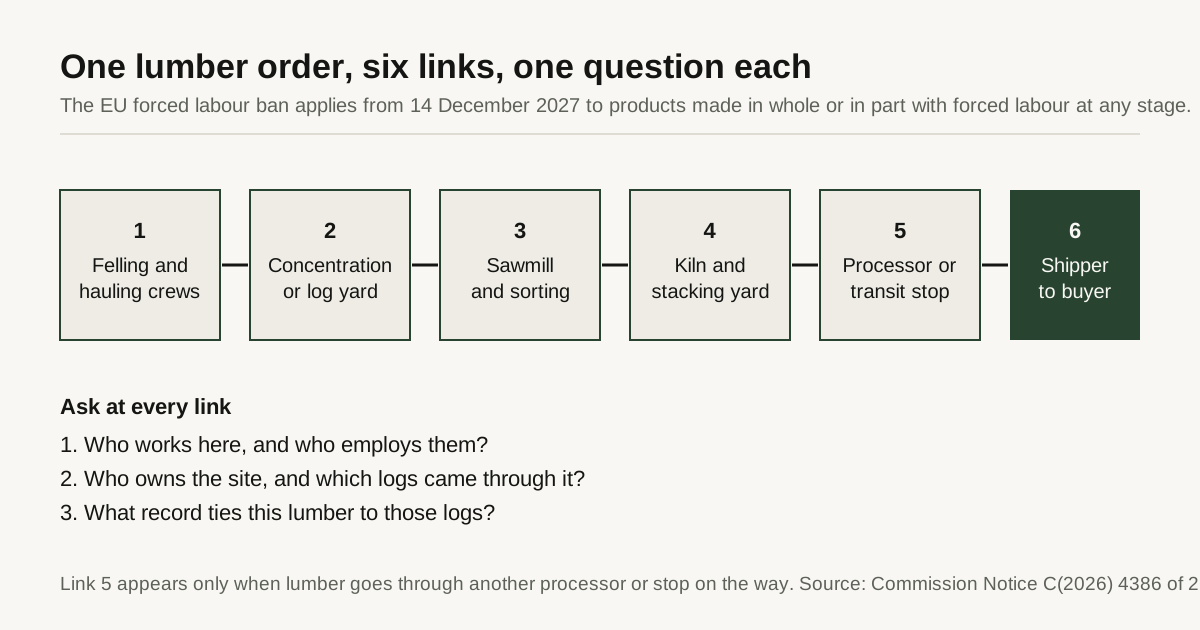
Lumber starts as standing timber and passes through people at each stage. The guidelines tell authorities to look first at operators closest to the suspected forced labor and to expect complex chains, with “multiple stages of production” and “transits and transhipments”, to be harder to trace. A typical hardwood order has these links:
- Felling and hauling. Logging crews can be contractors of the mill or of a log buyer rather than its employees. Ask who employs them.
- Concentration or log yard. Logs from many landowners are sorted here. Ask which logs came through.
- Sawmill and sorting. The mill’s own crew, plus any temporary or agency labor.
- Kiln and stacking yard. It can be a separate company from the mill.
- Processor or transit stop. Re-sawing, planing, treating, or a stop in a third country on the way to you.
- Shipper and consolidator. Loading, container stuffing and forwarding. The guidelines exclude transport and warehousing services from the scope of the rule, but the lumber moving through them is a product in scope.
For lumber sold as rough or surfaced boards the chain is shorter than for furniture or flooring made from it, which is a reason to ask early. Lumber that goes to a third-country processor and then comes back is where a plain statement of origin becomes hard to give.
Questions to ask a mill or yard
The guidelines give a list of information an authority may request, and the same items work as a supplier questionnaire. Group them into policy, people, product and paper.
Policy and management
- Do you have a written policy against forced labor and a supplier code of conduct? Ask to see them, not just to hear about them.
- Who in the company is responsible, and is there a grievance channel workers can use?
- Do your contracts with log suppliers and logging contractors say forced labor is prohibited?
People
- Who cuts and hauls your logs: your own employees, contractors or log buyers? Name each.
- How many people work at the mill, kiln and yard, and are any of them provided by an agency?
- How are wages paid, and does anyone hold workers’ identity documents or charge recruitment fees?
Product and origin
- Which species, and which region or forest did these logs come from? The same data supports your EUDR file if the lumber is going to the EU.
- Do you have a chain-of-custody record linking this lumber to its logs, such as the tally, log tickets or a certificate covering the shipment? See the FSC chain of custody guide.
- Did any of this lumber pass through another processor or country? Name the company and the site.
Paper
- Can you provide invoices, packing lists, bills of lading and the exporter’s EORI number where it has one? The guidelines list these among the records an authority may ask for.
- Do you have a third-party audit report, and when was it done? The guidelines list independent audit reports among the evidence, and the supplier records for the Lacey Act cover similar ground.
Match the depth to the risk. The guidelines expect a company to scope its general risk first, then assess the highest-risk suppliers in more depth, in a way “commensurate to their size and resources”. A buyer of a few containers a year from a mill in a low-risk area can keep this short. A buyer sourcing from an unknown yard that consolidates from many sellers should go deeper.
What counts as proof
No single paper settles the question. The guidelines list many kinds of evidence and say that giving information does not guarantee that a product escapes a ban decision. They also warn that contract clauses “should not be treated as sufficient on their own” and need follow-up and verification.
| Evidence | What it shows | Limit |
|---|---|---|
| Written policy and supplier code | The supplier has a stated position | Says nothing about practice |
| Contract clause on forced labor | You asked for it | Not enough alone, per the guidelines |
| Third-party audit | A check at a point in time | Weak where workers cannot speak freely, and the guidelines say traditional audits are deeply compromised in state-imposed contexts |
| Chain-of-custody record or certificate | Which logs became this lumber | Tracks origin of wood, not working conditions, unless the scheme covers labor |
| Supplier self-assessment | The supplier’s own account | Needs a second source |
| Worker grievance records | Whether workers can report | Absence of complaints is not proof |
| Invoices, tallies and shipping papers | The path the product took | Shows route, not conditions |
Use more than one. The guidelines list these kinds of evidence without ranking them, and they say that failure to cooperate is in principle relevant evidence against the company.
The US side: the UFLPA
The US rule works differently. Under the Uyghur Forced Labor Prevention Act, CBP applies a rebuttable presumption, in place since 21 June 2022, that goods mined, produced or made wholly or in part in the Xinjiang Uyghur Autonomous Region, or by an entity on the UFLPA Entity List, are barred from import under 19 U.S.C. 1307. The importer must show by clear and convincing evidence that the goods were not made wholly or partly with forced labor, and must answer CBP’s information requests fully. CBP’s page, last modified 14 September 2026, does not mention wood or timber, so this is a question of route, not species. If your hardwood passes through a processor in China, ask where that processor sources and who it supplies. Our guide to Lacey Act and legal timber papers covers a different law, and one document does not answer the other.
What to do before December 2027
- List your lumber suppliers and mark which ones consolidate from other sellers or send lumber through another processor.
- Send the questions above to the highest-risk ones first and keep the answers in a file per supplier.
- Write the duty into the order. Add a clause to the purchase order that the seller supplies origin and labor records within a set time, and who pays if a shipment is held.
- Add a line to your scorecard. The supplier scorecard works better if “records provided on time” is one of the measures.
- Check stock held for EU customers. Lumber in a warehouse on 14 December 2027 is in scope even if you bought it years earlier.
- Keep the file. In a formal investigation an authority sets a reply deadline of 30 to 60 working days, according to the guidelines, so records that exist already are far easier to hand over than records you must build.
For the dates of the other rules landing in the same year, see the 2027 hardwood lumber compliance calendar. To get offers from mills that will give origin and labor statements with the quote, send your lumber RFQ with species, grade, thickness, board feet, destination and the records you need. We pass it to up to 3 mills or yards that say they can supply it, and they reply to you directly.
Sources
- European Commission, Forced Labour Regulation
- European Commission, Guidelines on the application of Regulation (EU) 2024/3015, Commission Notice C(2026) 4386 final, 26 June 2026 (copy of the notice)
- European Parliament, procedure file 2022/0269(COD), Regulation (EU) 2024/3015
- CBP, Uyghur Forced Labor Prevention Act (page modified 14 September 2026)
- US Department of Labor, List of Goods Produced by Child Labor or Forced Labor (lists lumber and timber among its goods; check the countries you buy from)
The official text of the Regulation on EUR-Lex was not reachable from my tools on 25 October 2026, so the rules above come from the Commission’s page, the Commission’s guidelines and the Parliament’s procedure file.
Frequently asked questions
Do I have to do due diligence on my lumber supplier under the EU forced labour ban?
No rule in Regulation (EU) 2024/3015 requires due diligence as such. The Commission's guidelines say the Regulation imposes an obligation of result, that no product made with forced labour may be sold in or exported from the EU, and that due diligence is a useful way to show your lumber is clean. Other approaches, such as traceability and certification, can also work.
Does the EU forced labour ban apply to lumber already in my warehouse?
Yes, for lumber still being made available on the market. The guidelines say the Regulation applies to products placed or made available from 14 December 2027 even if they were produced or imported before that date. It does not require withdrawal of products that already reached the end user.
Is there a company size or turnover threshold for the EU forced labour ban?
No. The Commission says the ban covers companies of all sizes. Authorities must weigh a company's size and resources when they ask for information, and they may grant more time to a small company, but a small yard or importer is not outside the rule.
Does the US Uyghur Forced Labor Prevention Act affect hardwood lumber?
It can if any part of the chain touches Xinjiang or an entity on the UFLPA Entity List. CBP presumes such goods are barred from import and an importer must show by clear and convincing evidence that they were not made with forced labor. The CBP page I read does not single out wood.
Know what you need? Send the spec.
Tell us the species, grade, thickness and board feet. We pass it to up to 3 mills or yards that carry it and reply within 24 business hours.
Send my lumber RFQ