Guides / Choosing a Supplier
EUDR and Hardwood Lumber: What Importers Must File Under the New Rules
January 3, 2027
The EU deforestation regulation (EUDR) applies to large and medium operators from 30 December 2026, and sawn hardwood lumber is inside its scope. An importer who places lumber on the EU market must have a due diligence statement submitted first, and that statement needs the species, quantity, country of production, harvest plot geolocation and harvest date for the lumber in the shipment. A mill outside the EU does not file the statement, but it has to supply that data in time. This guide explains who does what, what data the order must carry and how to write it into the RFQ.
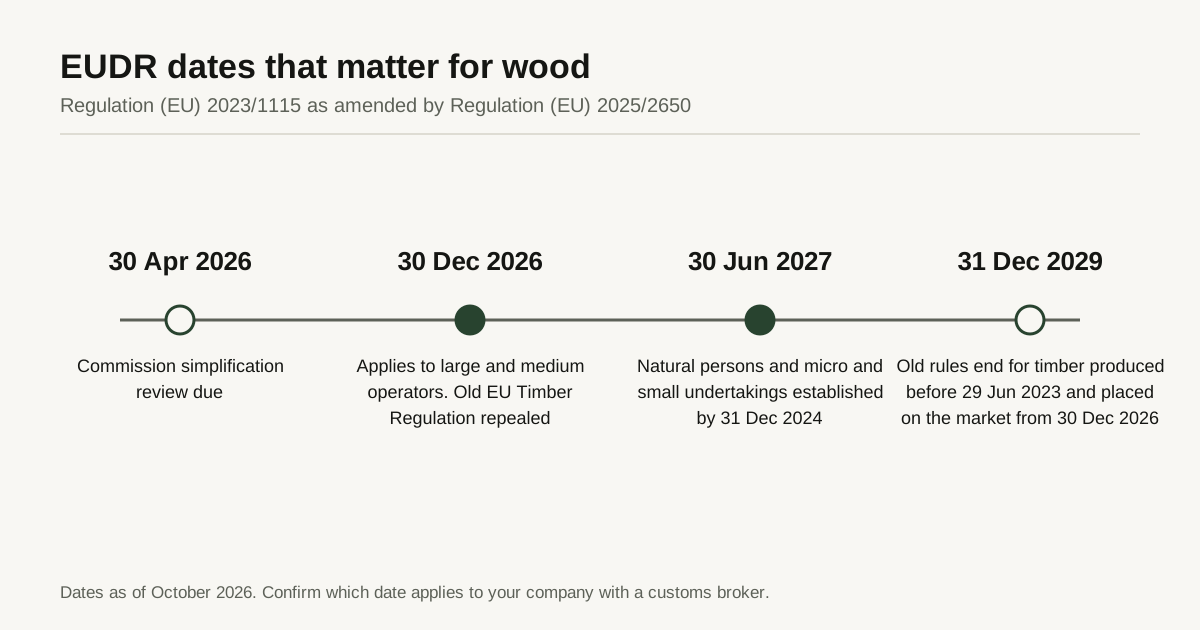
This is general information as of October 2026, not legal advice. The regulation has been amended twice since it was adopted and the Commission’s simplification review was due in April 2026, so confirm the current text and your own deadline with a customs broker or counsel before you rely on it.
What the regulation requires
Regulation (EU) 2023/1115, as amended in December 2025 by Regulation (EU) 2025/2650, bars relevant products from the EU market or from export unless three conditions are met. The product must be deforestation-free, must be produced in line with the laws of the country of production, and must be covered by a due diligence statement.
For wood, “deforestation-free” means the wood was harvested without inducing forest degradation after 31 December 2020. The regulation covers cattle, cocoa, coffee, oil palm, rubber, soya and wood, plus products made from them. Annex I lists wood in chapter 44, for example sawn wood in heading 4407, and furniture in chapter 94. Pulp and paper in chapters 47 and 48 are also listed.
The 2025 amendment moved the main date to 30 December 2026 and also repeals the old EU Timber Regulation from that day. Under Article 37 of the amended text, the old rules keep applying until 31 December 2029 to timber produced before 29 June 2023 that is placed on the market from 30 December 2026. The Commission was also required to run a simplification review by 30 April 2026. Check the Commission’s EUDR pages for what came out of it, because the rules for your shipments may have moved since this article was written.
Who files: operator, downstream operator, trader
The amended regulation splits the supply chain into roles, and the role decides the workload:
| Role | Who it is | What it must do |
|---|---|---|
| Operator | Places the product on the EU market or exports it from the EU | Collect the data, assess risk, submit the due diligence statement before placing the product, keep records for 5 years |
| Downstream operator or trader | Buys from an operator and resells or processes in the EU | Hold the supplier information and the reference numbers it received, and register if it is not an SME |
| Non-EU mill or exporter | Ships the lumber | Not a filer, but supplies the data the operator needs |
In a typical import, the EU buyer who clears the lumber is the operator. A distributor who buys from that importer is a downstream operator or trader. If you buy from an EU distributor, you are usually in that second group and your supplier gives you the reference number to carry forward. The 2025 amendment also lets micro and small primary operators file a one-time simplified declaration instead of a statement per shipment, but that route is for primary producers and not for importers of foreign lumber.
If you sell finished furniture, flooring or millwork into the EU, the same logic applies to the wood inside it, because many chapter 94 and chapter 44 products are on the list.
The data a mill must supply
Article 9 sets the information that goes with each product. For hardwood lumber it means:
- The trade name and type of product, with the common name of the species and its full scientific name. “Oak” is not enough, since the statement needs the genus and species.
- The quantity in kilograms of net mass, not board feet or cubic meters, so a conversion step belongs in the order paperwork.
- The country of production, and parts of it where relevant.
- The geolocation of all plots of land where the wood was harvested, and the date or time range of harvest.
Geolocation means latitude and longitude with at least six decimal digits. For plots over four hectares, the regulation requires a polygon that outlines the plot perimeter, not a single point.
This is where hardwood differs from many other commodities. A sawmill may buy logs from dozens of small landowners and mix them in one kiln charge. To give you plot-level data, the mill must keep intake records that tie each log lot to a harvest site, and must keep that link through sawing, drying and bundling. Ask how the mill does it. A mill with log-yard tickets and bundle tags tied to lots is better placed to answer. A mill that tracks only species and grade may not be able to. Our guide to bundles and tally on hardwood loads shows where lot and bundle identifiers already sit on the paperwork.
Country risk and what low risk changes
The Commission has classified countries into low, standard and high risk. Implementing Regulation (EU) 2025/1093 lists four high-risk countries (Belarus, North Korea, Myanmar and Russia) and 140 low-risk countries, including the United States, Canada and the EU member states. Any country not listed is standard risk.
Article 13 allows simplified due diligence when all the wood comes from low-risk countries. The operator then does not have to carry out the risk assessment and risk mitigation steps in Articles 10 and 11, but must document that the risk of circumvention or mixing is negligible. It still has to collect the Article 9 data and submit the statement. So a mill in a low-risk country saves you analysis work, not the data request.
Mixing is the real exposure. If a shipment blends lumber from a low-risk country with lumber from a source outside that group, the simplified route is gone, because Article 13 needs all the wood to come from low-risk countries. Segregation by lot should be written into the contract.
How to put EUDR into the RFQ and the contract
A workable RFQ line has six parts:
- Species by scientific name for every line item.
- Net weight in kilograms per bundle or per shipment, with the conversion basis stated.
- Harvest geolocation for every lot in the shipment, in a stated file format such as a spreadsheet with polygons or coordinates, delivered before shipment so the statement can be filed before the lumber is placed on the market.
- Harvest date or range per lot.
- Segregation: no mixing of lots from different harvest sites within a bundle unless the data covers every site.
- A right to ask for supporting records, such as log intake tickets, and a duty to correct data that proves wrong.
Add the legal-timber paper that the destination also expects. Our guide on phytosanitary and fumigation rules covers the plant-health papers, which are a separate set of documents from EUDR data.
Ask each supplier early, in the same message as the price request. A mill that has a data sheet ready is a different supplier from one that needs three months to assemble plot data. Our nine checks for choosing a hardwood supplier is a good place to add traceability to your list. If you want mills that can answer on traceability, send your lumber RFQ with the species, grade and EUDR data you need, and we pass it to up to 3 mills or yards that say they can supply it. They reply to you directly.
What to do now
- Confirm your role in the chain and which date applies to your company.
- Register in the EU information system if you are an operator or a non-SME downstream operator or trader.
- List your lumber lines by species and HS code and mark which ones have lot-level origin data today.
- Send your suppliers the data list above and ask for a sample data file for one real past shipment.
- Add a clause that makes shipment release depend on receiving the data, and decide who bears the cost if a statement cannot be filed.
- Keep records for five years.
Suppliers who read this and want buyers who ask these questions can register as a supplier.
See also: importing hardwood lumber into the EU, which adds plant health, CITES and grading to the EUDR steps.
Sources
- Regulation (EU) 2023/1115, consolidated text on EUR-Lex
- Regulation (EU) 2025/2650 amending the EUDR, EUR-Lex
- Implementing Regulation (EU) 2025/1093, country benchmarking, EUR-Lex
- European Commission, Regulation on deforestation-free products
- EU Green Forum, deforestation regulation implementation
Frequently asked questions
When does the EUDR apply to hardwood lumber?
For large and medium operators the EU deforestation regulation applies from 30 December 2026. Natural persons and micro or small undertakings established by 31 December 2024 get until 30 June 2027, with a separate date for some micro and small operators already under the old timber regulation. Confirm which date fits your company with a customs broker.
Is sawn hardwood lumber covered by the EUDR?
Yes. Wood is one of the seven commodities, and Annex I of the regulation lists chapter 44 products including sawn wood under heading 4407. Furniture in chapter 94 and pulp and paper are covered too. Pallets and packing that only support another product are outside the list.
Does a low-risk country of origin remove the paperwork?
No. A low-risk origin allows simplified due diligence, which drops the risk assessment and risk mitigation steps. The operator still collects the Article 9 data, including species, quantity, harvest plot geolocation and date, and still submits a due diligence statement before placing the lumber on the EU market.
Who submits the due diligence statement, the importer or the mill?
The operator submits it, meaning the person who places the product on the EU market or exports it, not a downstream operator. A non-EU mill does not file, but it must give its EU customer the data the statement needs. Downstream operators and traders keep the supplier information and pass reference numbers on.
Know what you need? Send the spec.
Tell us the species, grade, thickness and board feet. We pass it to up to 3 mills or yards that carry it and reply within 24 business hours.
Send my lumber RFQ