Guides / Choosing a Supplier
Buying Hardwood Lumber as a Plant QA Manager: Spec, Supplier Checks, Incoming Inspection and Records
April 19, 2027
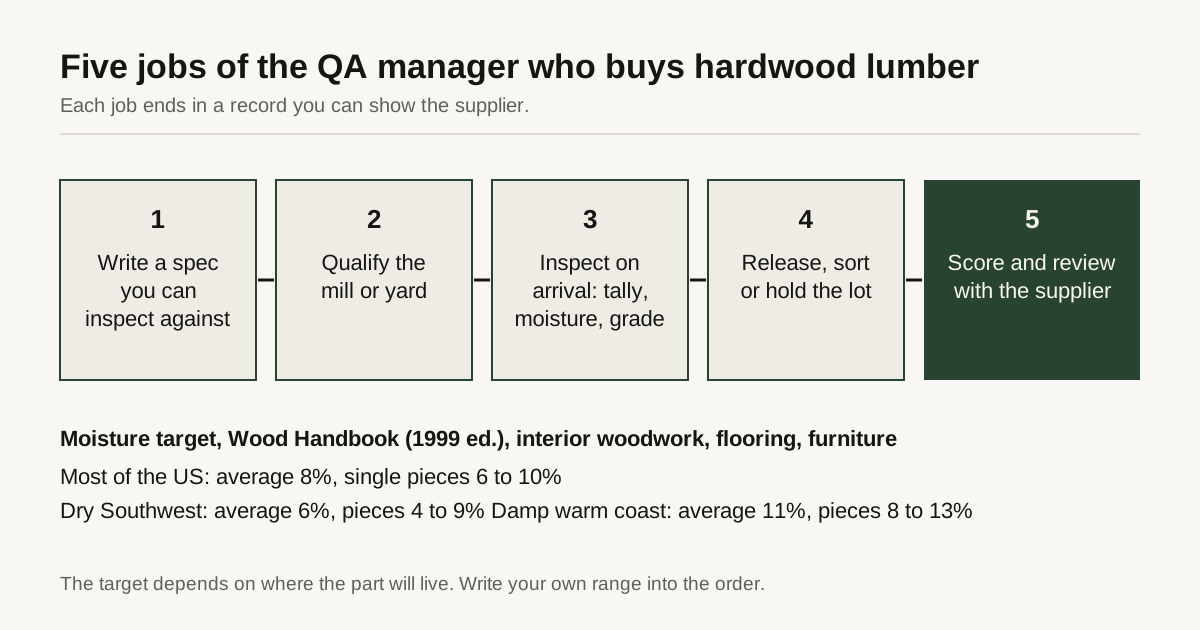
A plant QA manager who buys hardwood lumber has five jobs: write a spec that can be inspected, qualify the mill or yard, inspect each lot on arrival, decide whether to release, sort or hold it, and score the supplier afterward. Each job ends in a record you can show the supplier. This guide routes each job to the page that covers it in depth and adds the one decision that most often goes unwritten: the moisture target for your own plant and region. Numbers are typical and sourced as of 25 October 2026. Your order and the grading rule it names govern in a dispute.
The five jobs at a glance
| Job | The decision you own | Where to read more |
|---|---|---|
| 1. Spec | Species, grade rule and grade, cut, thickness in quarters, surfacing, moisture range, tally basis, defect limits | Hardwood lumber specifications, terms glossary, defects and grade limits |
| 2. Qualify | Which suppliers may ship to your plant, and on what evidence | How to choose a supplier, supplier red flags, kiln drying records, NHLA inspection certificate |
| 3. Inspect | Sample size, methods and what you photograph | Tally, moisture meters, moisture test methods, photos |
| 4. Disposition | Release, sort, hold or reject, and who is told when | Quality claim, purchase order clauses |
| 5. Review | The measures and the quarterly conversation | Supplier scorecard |
Job 1: a spec you can inspect
An inspector cannot reject a board against a word like “good.” Every line of the order needs a test someone can run at your dock: a grade under a named rule, a thickness in quarters with a surfacing code, a moisture range with a method, and a tally basis. The specifications guide lists the lines. Two additions are worth making as the person who will inspect against it:
- Name the rule book edition and the sample method. Say which grading rule governs (see NHLA grades and grading rules compared) and how many boards you will pull, from where in the load.
- Write defect limits in the terms your line cares about. If a cutting is lost to wane or heart center, the order should say what share your process tolerates. The defects guide shows how grades treat each defect.
Job 2: qualify before the first load
Qualification is a paper check you run before the first order and repeat when something changes. The useful questions are about what the supplier can show: how the lumber is graded and by whom, how kilns are run and logged, and whether claims have a named contact. Read the red flags before a deposit for the warning signs and kiln drying records for the record set to request. A supplier that can supply an NHLA inspection or kiln drying certificate is giving you a third-party document to file; the certificate guide says what it covers and what it does not.
If lumber is bound for the EU or the US, add the legal papers to the file. The 2027 compliance calendar lists dated changes, and the forced labor due diligence guide turns the EU rule into supplier questions.
Job 3: inspect on arrival
Do the checks in the order the lumber is most likely to change. Tags and photos first, then tally, then moisture, then grade samples.
- Photograph before opening. The tags, the wrap, the whole bundle from the side. Our photo guide has the shot list.
- Match tags to the tally and invoice. Re-tally two or three bundles using the rounding rule and basis in the order. The tally guide explains net against gross.
- Take moisture readings across the load. Use a calibrated meter with the species setting right, read several spots per board and record every number.
- Pull grade and size samples from several bundles, not just the outer ones, and grade the poorer face under the rule the order names.
Moisture: set the target for your plant
The most common gap in a hardwood spec is a moisture range copied from a supplier’s quote. The Wood Handbook is clear that the right number depends on where the wood will end up. Its 1999 edition, chapter 12, says wood should be installed at a moisture content as close as possible to the average it will see in service, and gives these recommended values for interior woodwork, flooring and furniture:
| Region | Average | Individual pieces |
|---|---|---|
| Most areas of the United States | 8% | 6 to 10% |
| Dry southwestern area | 6% | 4 to 9% |
| Damp, warm coastal area | 11% | 8 to 13% |
The same chapter says hardwood lumber for furniture, cabinets and millwork is usually dried to 6 to 8%, and that general commercial practice is to dry flooring and furniture stock slightly below the service value, expecting a moderate rise during processing. It also gives a lot test: if the average is within 1 point of the recommended value and every piece falls inside the individual limits, the whole lot is probably satisfactory. For a realistic average it says to test at least 10% of each item.
Use these as a starting point, not a pass mark. They describe wood at installation in well-ventilated buildings without unusual moisture sources, and the chapter itself notes that air-conditioned buildings, basements, crawl spaces and attics can differ. A plant that ships cabinets to a humid coast and a plant that ships to an arid state should not carry the same range. This edition is older than the revised chapter in the current Wood Handbook, which I could not open, so check the current table before you put numbers in a contract.
Meter pitfalls the handbook warns about
- A resistance meter with uninsulated pins reads the wettest zone along the pins. If the reading rises as the pins go deeper, the board is wetter inside, and the handbook says to drive the pins about one fifth to one quarter of the thickness to approximate the average.
- Dried wood can regain moisture in the surface fibers. In that case uninsulated pins read the wet surface and can overstate the average. Insulated pins read only at the tips.
- A dielectric (pinless) meter is influenced mostly by the surface layers, so a wet core in thick stock can be missed.
- Apply the species correction and the temperature correction supplied with the instrument, and read soon after inserting the pins.
- Electrical readings carry uncertainty. For a dispute, the oven-dry method is the reference; see moisture test methods.
Job 4: release, sort, hold or reject
A lot that fails one check is not always a lot that fails everything. Decide the options before the first problem load so the dock does not improvise.
| Finding | Typical action | Evidence to keep |
|---|---|---|
| Tally short by rounding or basis | Release, note the difference, settle on the invoice | Re-tally sheet, order clause on basis |
| Tally short beyond rounding | Hold the short bundles intact, send notice | Photos of tags, recount |
| Moisture outside the range in some boards | Segregate the lot, re-test, consider sorting or conditioning by agreement | Dated readings, meter and species setting |
| Grade below the order on a sample | Hold the lot untouched, request reinspection under the named rule | Sample boards, tags, the rule and clause |
| Visible damage or stain | Photograph, note on the delivery receipt, hold | Photos before opening, carrier details |
These actions are suggestions, not rules. Two things are fixed by the law and the order, not by plant practice. First, notice: the quality claim guide sets out the sales-law defaults and the one published softwood rule as an example, and says plainly that for hardwood your contract and the rule book it names decide. Second, alteration: the softwood rule quoted in that guide relieves the seller of grade complaints once the lumber is worked or dried, and a hardwood contract may say the same, so a lot on hold should stay on hold. Write the notice period and the pass mark into the purchase order.
Job 5: score and review
A scorecard turns lot records into a conversation. The supplier scorecard uses five measures: grade accuracy, moisture within spec, tally accuracy, on-time loading and document completeness. Review it with the supplier each quarter, and read the lines before the total, because an average hides the shipment that failed.
The lot record to keep
One record per lot, filled at the dock, is the difference between a claim you can document and one you argue from memory.
| Field | Example entry |
|---|---|
| Order, invoice and lot numbers | As on the paperwork |
| Date, time and unloading location | Dock and weather note if wet |
| Seal, bundle and tag numbers | Photographed |
| Tally basis and re-tally result | Board feet counted against stated |
| Meter, species setting, temperature, depth, readings | Every reading, not the average |
| Samples pulled | Which bundles, how many boards, who graded |
| Disposition and date | Released, sorted, held or rejected |
| Notice sent | Date, method, recipient |
Keep the photos named to match the tags. When the supplier asks what you saw, you can answer with the record.
Next step
If you need offers from mills or yards that will quote to a written spec with moisture range and tally basis stated, send your lumber RFQ with species, grade, thickness, board feet and delivery place. We pass it to up to 3 mills or yards that say they can supply it, and they reply to you directly.
Sources
- Simpson, W.T., Wood Handbook chapter 12, Drying and Control of Moisture Content and Dimensional Changes (1999 edition, USDA Forest Products Laboratory, PDF hosted by WoodWeb)
- Forest Products Laboratory, Wood Handbook chapter on drying and control of moisture content (introduction, WoodWeb)
- The site guides linked above for the tally, claim, scorecard and moisture meter routines, each with its own source list.
I could not open the current NHLA rule book or the revised Wood Handbook chapter on 25 October 2026, so the grading and re-inspection terms of the rule book and the current moisture table need to be checked by you before you write them into an order.
Frequently asked questions
What should a QA manager check when hardwood lumber arrives?
Match bundle tags to the tally and invoice, re-tally a few bundles, take moisture readings across the load, pull sample boards for grade and size, and photograph the tags and any problem before anything is planed or restacked. Write each result in a lot record so a later claim can quote it.
What moisture content should incoming hardwood lumber have?
It depends on where the finished part will live. The Wood Handbook says hardwood lumber for furniture, cabinets and millwork is usually dried to 6 to 8%, and its table for interior woodwork, flooring and furniture gives an 8% average for most of the United States, 6% for the dry Southwest and 11% for damp warm coastal areas. Write your own range into the order.
How many boards should I test for moisture?
The Wood Handbook says to test at least 10% of each item to get a realistic average. For a quick dock check of a mixed load, our moisture meter guide suggests at least 10 to 20 boards from the top, middle and bottom of several lifts. Record every reading, not only the average.
Who decides if a disputed lumber lot is accepted?
The order does. If it names a grading rule, a tally basis, a moisture range and a claim window, those terms lead, and an independent inspector both sides accept can settle the grade. Keep the disputed lumber untouched until that is agreed.
Know what you need? Send the spec.
Tell us the species, grade, thickness and board feet. We pass it to up to 3 mills or yards that carry it and reply within 24 business hours.
Send my lumber RFQ