Home / Lumber papers and certificates / Testing Lumber Moisture: Oven-Dry, Resistance and Capacitance Methods
Testing Lumber Moisture: Oven-Dry, Resistance and Capacitance Methods
Reference page · Last reviewed 28 February 2027
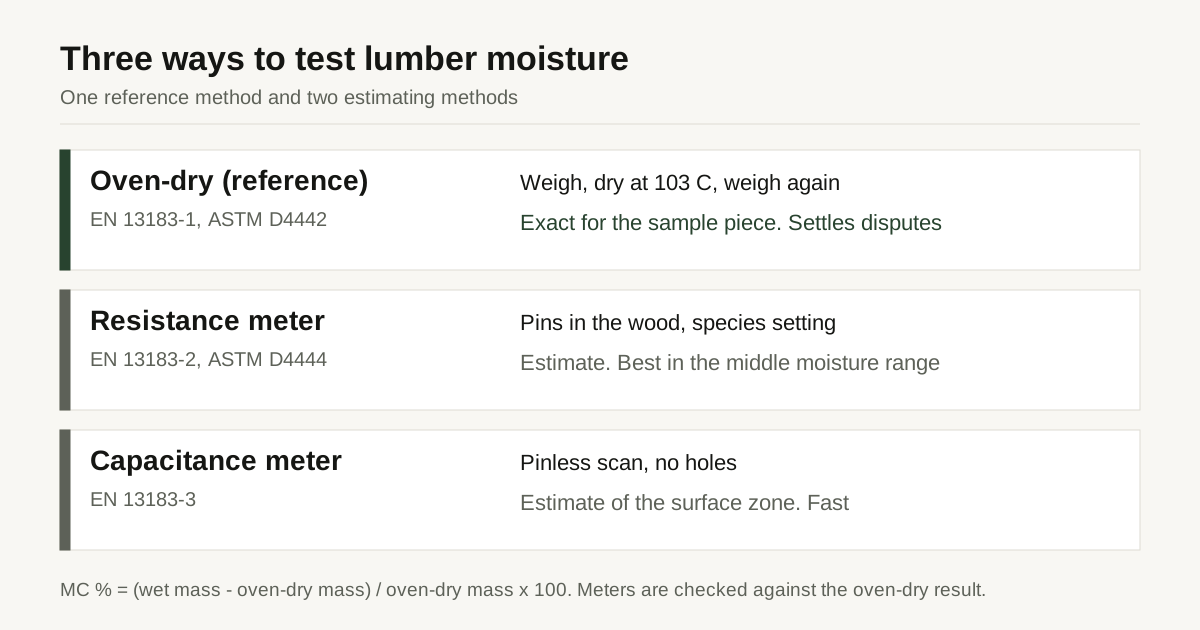
Lumber moisture is measured three ways in trade. The oven-dry method weighs a sample before and after drying and is the reference. Electrical resistance meters and capacitance meters estimate moisture from the wood’s electrical behavior and are checked against it. A contract that names a target range should also name the method, the sampling and the tolerance, because the three methods do not give identical numbers.
| Method | Standard (check the edition) | What it gives | Typical role |
|---|---|---|---|
| Oven-dry | EN 13183-1:2002 (with corrigendum AC:2003). ASTM D4442 method A, current edition D4442-20 reapproved 2025 | Exact moisture of the sample piece | Reference and disputes. Destroys the sample piece’s use as a test |
| Oven-dry, secondary | ASTM D4442 method B | Close but less precise result | Used when method A is not justified |
| Electrical resistance | EN 13183-2:2002. Meter calibration: ASTM D4444-25 | Estimate from pins driven into the wood | Daily checks at the kiln and on receipt |
| Capacitance | EN 13183-3:2005 | Non-destructive estimate for a single piece | Fast scanning of many pieces |
| Small clear specimens | ISO 13061-1:2014 (replaced ISO 3130:1975) | Moisture for physical and mechanical tests | Laboratory research, not trade checks |
Standards and editions change. This page is general information as of October 2026. Confirm the edition with the standards body before you cite it in a contract.
What moisture content means
Moisture content (MC) is the water in the wood as a share of the oven-dry mass of the wood. The formula is simple:
MC % = (wet mass - oven-dry mass) / oven-dry mass x 100
Because the divisor is the dry mass, green wood from light species can read above 100 percent. For kiln-dried hardwood, buyers usually talk about a narrow low range such as 6 to 8 percent (a typical target, not a rule). What counts as kiln dried or air dried differs by contract and by region. A trade guide from the tropical timber trade points out that “kiln dried” should always be written with a moisture figure, because the acronym alone is vague.
Oven-dry method
The reference procedure takes a sample piece, weighs it, dries it in an oven and weighs it again.
- Temperature. EN 13183-1 dries at 103 plus or minus 2 degrees C. ASTM D4442 method A also uses an oven at 103 degrees C.
- When the piece is dry. In the European method, the oven-dry mass is reached when two weighings two hours apart differ by less than 0.1 percent. The ASTM method accepts a stated mass loss over a three-hour interval relative to the balance sensitivity.
- Equipment. A ventilated oven, a balance with suitable resolution and a way to cool and weigh the sample without it taking up moisture.
- Why it is slow. Drying to constant mass can take a day or more. The sample piece is then no longer usable as the original lumber.
The method suits claims, certificate checks and calibration of meters. It is not practical for scanning a whole kiln charge.
Electrical resistance meters
Resistance meters push two pins into the wood and measure the electrical resistance between them. Moisture lowers resistance, so the meter converts the reading to MC through a species table. The method is slightly destructive because of the pin holes.
Points to control:
- Species setting. Meters are calibrated to a reference species. Use the correction for the species being tested.
- Temperature. Wood temperature changes the reading, so use the correction supplied with the meter.
- Depth. Readings reflect the zone between the pins. Check the meter maker’s guidance on pin length and depth if you need to read the core and not only the shell.
- Range. Resistance meters are most reliable within a middle range of moisture content. The tropical timber trade guide quotes 8 to 25 percent. Outside that range readings are rough.
- Calibration. ASTM D4444 sets laboratory standardization and calibration of hand-held meters. ASTM D7438 is the companion practice for field calibration and use.
See our guide to pin and pinless moisture meters for the buying side.
Capacitance meters
Capacitance (or dielectric) meters measure how the wood changes an electrical field. EN 13183-3 sets the conditions that a capacitance measuring system must meet to estimate the moisture of a single piece of sawn or planed timber without damaging it. Their strength is speed and no holes. Their weakness is sensitivity to density, surface moisture and the species setting, so a pinless reading is an estimate of the surface zone and not a core reading.
Sampling a load
The standards describe how to measure a piece. They do not fix how many pieces to test for a trade load. That is for the contract. A workable clause usually covers:
- Sample size and spread. A set number of pieces per bundle, from several bundles across the load, with pieces taken from the middle of the length as well as near the ends.
- Which kiln charge. One kiln charge per lot, with the charge number written on the tally.
- Acceptance. The average and the highest single reading allowed, for example an average inside the target range and no single piece beyond an agreed limit. The numbers belong to the contract.
- Meter and method. Which meter, set to which species, checked against which reference, with a tie-breaker oven-dry test on a small number of sample pieces if the two sides disagree.
- Who tests, where and when. At the mill before loading, at the port or at the buyer’s yard, within a stated number of days of receipt.
Read our kiln drying schedules guide for how the drying run sets the spread, and the lumber quality claim guide for what to do when a shipment arrives wet.
Red flags
- A quote that says “kiln dried” with no moisture range.
- A meter reading shown with no species setting or temperature note.
- Only one reading per bundle, taken near the end of one board.
- A mill that offers an oven-dry result but not the sample size or the method.
- A dispute with no agreed reference method.
What to write on the RFQ
State the moisture target as a range, the method of check (meter at loading, oven-dry for disputes) and the reference standard. Send your lumber RFQ and we pass it to up to 3 mills or yards that can meet that range.
RFQ line: Soft maple (Acer rubrum), No.1 Common, 4/4 rough, kiln dried to 6-8%, checked with a pin meter at loading, oven-dry test (EN 13183-1 or ASTM D4442 method A) for disputes.
Frequently asked questions
Which method settles a moisture dispute?
The oven-dry method. EN 13183-1 calls it the reference method, and ASTM D4442 names its oven-drying method A as the primary one. Meters give estimates that are checked against it. Name the method in the contract so both sides know what decides a claim.
How is moisture content calculated?
It is the mass of water in the piece divided by its oven-dry mass, times 100. Water mass is the wet mass minus the oven-dry mass. Because the base is the dry mass, the figure can exceed 100 percent for very light woods in the green state.
Can I trust a hand-held meter reading?
As an estimate, yes, if the meter is set for the species, corrected for temperature and checked against known samples. ASTM D4444 covers laboratory calibration of hand-held meters and ASTM D7438 covers field calibration and use. A meter reading is not the oven-dry result.
Why does the ISO 3130 standard not appear here?
ISO 3130:1975 was withdrawn in 2014 and replaced by ISO 13061-1:2014. That standard is for small clear specimens in physical and mechanical tests, not for trade checks of a lumber load.
Sources
- EVS-EN 13183-1:2002 Moisture content of a piece of sawn timber, part 1: oven-dry method (reference method)
- EN 13183-2:2002 part 2: estimation by electrical resistance method (status listing)
- EVS-EN 13183-3:2005 part 3: estimation by capacitance method
- ASTM D4442: direct moisture content measurement of wood and wood-based materials (D4442-20, reapproved 2025)
- ASTM D4444: laboratory standardization and calibration of hand-held moisture meters (D4444-25)
- ASTM D7438: field calibration and application of hand-held moisture meters (D7438-20, reapproved 2025)
- ISO 3130:1975 withdrawn, replaced by ISO 13061-1:2014 (small clear specimens)
- ATIBT pamphlet 4: wood moisture content and drying levels (oven-dry definition, 103 degrees C, meter range)
Standards and rules are cited as references, not as claims about Hardwood Vendor or any mill. Editions and status change: confirm with the issuing body, your customs broker or the regulator.
Know what you need? Send the spec.
Tell us the species, grade, thickness and board feet. We pass it to up to 3 mills or yards that carry it and reply within 24 business hours.
Send my lumber RFQMore in lumber papers and certificates
- Lacey Act Declaration (PPQ 505) for Hardwood Lumber, Field by Field
- FSC Certified Hardwood Lumber: Certificate Codes, Claims and Scope
- NHLA Inspection Reports for Hardwood Lumber: What a Graded-Lot Report Should Show
- Kiln Drying Quality: Moisture Spread, Gradient and Case Hardening Checks
- Hardwood Lumber Import Documents: The Set an Importer Should Receive
- CITES Permits for Timber: Export, Import and Re-export Steps