Guides / Choosing a Supplier
How to File a Hardwood Lumber Quality Claim: Photos, Tallies, Deadlines and Evidence
February 11, 2027

A hardwood lumber quality claim is won or lost on three things that happen before anyone argues: what the order said, what you kept untouched and what you can show. Report the problem in writing as soon as you see it, hold the disputed bundles as they arrived, photograph them with their tags and ask for a reinspection under the grading rules the order names. This guide is the checklist: what the legal defaults and published rules say about timing, what to photograph, how to word the notice and what to write into the next order so the next dispute is shorter.
This is general information as of October 2026, not legal advice. I could not open the current NHLA rule book, so the only claim deadlines quoted here come from a softwood association and from the legal texts, and each is labeled. For hardwood, your contract and the rule book it names decide.
What decides a claim
Three layers apply, in this order.
- The order. If it names a grading rule (for example the NHLA rules, covered in our guide to NHLA grades), a tally basis, a moisture range and a notice period, those terms lead. A rule book or sales code normally binds only when the contract says it governs, so check that your order or the seller’s confirmation says so.
- The sales law default. In a US domestic sale the Uniform Commercial Code gives the buyer a right to inspect goods at any reasonable place and time and in any reasonable manner (section 2-513), and section 2-607(3)(a) says the buyer must notify the seller of a breach within a reasonable time after discovering or when it should have discovered it, or be barred from any remedy.
- International sales. The UN sales convention (CISG) may apply to a cross-border sale unless the contract excludes it, so check with counsel. Article 38 says the buyer must examine the goods within as short a period as is practicable in the circumstances, and for carried goods the examination may wait until arrival. Article 39 says the buyer loses the right to rely on a lack of conformity unless it gives notice specifying the nature of the problem within a reasonable time after it discovered or ought to have discovered it, and in any event within two years of actual handover, unless a contractual guarantee period says otherwise.
“Reasonable time” is not a number. Courts read it case by case, which is why the safe move is the fast one.
Deadlines in published rules
I found no public hardwood claim deadline I could open and quote. The clearest published example is from the Northeastern Lumber Manufacturers Association (NELMA), whose rules cover softwood. Use it only to see the typical shape of such a clause.
| Item | NELMA rule (softwood) | What it means for a hardwood buyer |
|---|---|---|
| Moisture complaint | Tell the shipper within 72 hours after the lumber is unloaded | Test on the first day |
| Grade or size complaint | Hold the disputed portion intact and file with the seller within 10 days of receipt | Check grade before restacking |
| Tally complaint | Hold the entire item intact for retally | Do not break bundles to recount |
| Holding period | Disputed material held intact and protected for not more than 30 days after the request for inspection | Have space to store it |
| Wrapped or strapped units | Grade reinspection allowed if requested within 90 days of receipt, only on traits that time does not change | Keep factory wrap on until you need it |
| Result test | An item counts as the invoiced grade if 95% or more is of that grade or better on reinspection | Know the pass mark before you argue |
| Changes after shipment | Later manufacture, working or kiln drying relieves the seller of grade complaints | Do not plane, rip or dry the disputed wood |
For hardwood, a forum answer from wood scientist Gene Wengert on WoodWeb (2006) says the NHLA usually sends a grader to settle a buyer and seller dispute, and recalls that the loser pays when the difference exceeds 5%, with an “I think” attached. Treat that as a lead to confirm in the rule book, not as a rule. He also notes national inspector services are expensive and that you want to resolve issues before that stage if you can.
On the day it arrives
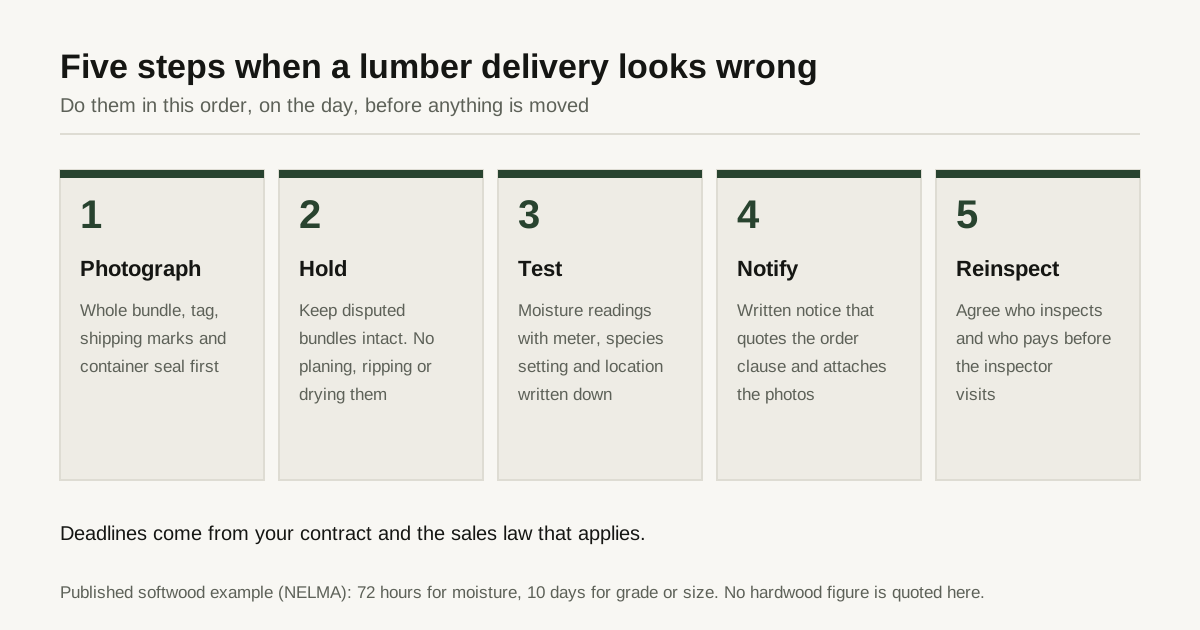
Most claims are decided in the first hour, because that is when the lumber is still as shipped.
- Photograph before opening. Take the whole bundle from the side, the end tag or shipping marks, and for a container the container and seal numbers. A Swedish softwood contract (Appendix A to its claims instructions) asks for at least three photos per package on receipt and at least five, video if possible, when damage is found: the entire side of the package, the package specification (package number, bill of lading marking, shipping mark), the damage itself, and all damaged pieces together with the whole package. It gives examples of photos it will not accept, such as a few pieces or a few knots out of a whole package. That is a softwood contract, but the logic holds for any lumber.
- Note it on the delivery paper. Write “received subject to inspection” and any visible damage or shortage on the receipt before the driver leaves. This is a practical habit, not a rule I could source.
- Do not restack, sticker or mix. Keep the arriving bundles as they are. The NELMA rule above and the sticker-stain problem described in our guide to sticker stain both show how a stain or a degrade found after planing is hard to pin on the seller.
- Take moisture readings. Record the meter model and type, the species setting, where on the board and at what depth you measured and a photo of the reading. Our guide to moisture meters explains the difference between pin and pinless readings. The Swedish instructions ask for resistance meter spot checks, measured 300 mm from the end of the piece, with the meter checked on a calibration block first. Your contract may name another method, so follow it.
- Count and compare the tally. Match bundle tags to the tally sheet and recount two or three bundles using the rounding rule the order names. Our guide to hardwood lumber tally shows why two honest counts differ by rounding and shrinkage, and our guide to container loading and tally covers the sheet itself.
Match the evidence to the type of claim
| Claim type | What to prove | Core evidence | Do not do |
|---|---|---|---|
| Grade | Boards fall below the invoiced grade | Sample of the worst bundles, tag numbers, the grade rule and clause, count of off-grade pieces | Plane or sort before the seller sees it |
| Tally or quantity | Fewer board feet than invoiced | Piece-by-piece recount with the agreed rounding, bundle tags, tally basis (net or gross) | Compare your count to the invoice without checking net against gross |
| Moisture | Moisture outside the range ordered | Dated readings, meter details, board locations, photos | Take readings after days in a damp yard |
| Size and surfacing | Thickness, width or surfacing off the order | Calipers or tape on a sample of pieces, with photos | Measure only the best boards |
| Damage | Water, breakage or handling damage | Photos of the bundle before opening, delivery receipt note, carrier details | Remove the wrap before photographing |
| Species or color mix | Wrong species or color sort | Close photos with a reference sample, order spec | Judge color under yard light only |
Write the notice
Send the notice by email or another written method the contract allows, the same day if you can. A good one is short and complete.
- Order number, invoice number, delivery date and bundle or container numbers affected.
- The clause or spec you say was not met, quoted from the order, not paraphrased.
- The quantity affected, in board feet and in bundles, and how you counted it.
- Photos and readings attached, with file names that match the bundle tags.
- A statement that the disputed lumber is being held intact at a named address.
- The remedy you ask for: credit, replacement, return or a joint reinspection first.
- A date by which you ask the seller to reply, and who from your side will meet the inspector.
Ask for an independent reinspection by an inspector both sides accept, and settle who pays before the inspector visits. Keep the tone factual. A claim that quotes the order and shows the bundle tag tends to be answered; a claim that says the lumber is “bad” tends to be argued.
If the seller offers a credit, check that it covers the whole difference, including freight and any rehandling you can document, and write what it settles so it does not reopen later.
Write the next order so the claim is shorter
Put these lines in every lumber order:
- Grading rule and edition. Name the rule book and the version.
- Notice period. For example, written notice within a stated number of days of receipt for grade and tally, and a shorter one for moisture.
- Hold requirement. The buyer holds disputed bundles intact and protected for a stated number of days after requesting inspection.
- Reference sample. Agree photos or a sample board for color and appearance grades, especially for visible parts.
- Inspector and cost. Name the inspection body or a method for choosing one, and say who pays if the claim is upheld and who if it is not.
- Tally basis. Net after kiln drying, measured, with the rounding rule stated.
- Tolerance. A stated percentage on quantity before a credit is due.
The claim steps close the sequence described in wholesale hardwood lumber.
Our payment terms guide covers how to keep leverage while a claim is open, for example paying only against a clean inspection. If you are planning a new lumber order, send your lumber RFQ with the grade, tally basis and moisture you need. We pass it to up to 3 mills or yards that say they can supply it, and they reply to you directly.
Sources
- CISG Article 38, examination of the goods (cisg-online.org)
- CISG Article 39, notice of lack of conformity (cisg-online.org)
- Uniform Commercial Code 2-607, notice of breach (Cornell LII)
- Uniform Commercial Code 2-513, buyer’s right to inspection (Cornell LII)
- NELMA grading rules, moisture content and inspection provisions, section 2 (softwood)
- Swedish Wood, photo instructions for claims handling (Softwood Contract appendix A)
- WoodWeb, Lumber Grader Qualifications and Reimbursement (2006)
Frequently asked questions
How soon must I report a lumber quality problem?
As soon as you see it. Published softwood rules give 72 hours for a moisture complaint and 10 days for a grade or size complaint, and the legal default is notice within a reasonable time. I found no public hardwood deadline, so read your contract and send written notice within days, not weeks.
Should I keep using the lumber while a claim is open?
Keep the disputed bundles intact and protected, and use only the part that is clearly fine. Published rules say a change in manufacture, working or kiln drying can end a grade complaint, and the buyer holds the disputed lumber for a limited time while the inspection is arranged.
What photos does a lumber claim need?
At least the whole bundle, its tag or shipping marks, and close views of the defect with a tape or marker for scale. For moisture, add the meter reading on a board. One Swedish softwood contract asks for three photos per package on receipt and five when damage is found.
Who pays for a third-party reinspection?
It depends on the contract. NELMA's softwood rules say the cost may be split or borne by either party by agreement, and the party calling the inspection answers to the inspector for the fee. A hardwood forum answer recalls the loser paying above a 5% difference, which is unverified, so agree the split first.
Know what you need? Send the spec.
Tell us the species, grade, thickness and board feet. We pass it to up to 3 mills or yards that carry it and reply within 24 business hours.
Send my lumber RFQ