Guides / Cost and Ordering
Hardwood Lumber Tally: Net or Gross, Green or Dry, and How to Compare Quotes
February 2, 2027
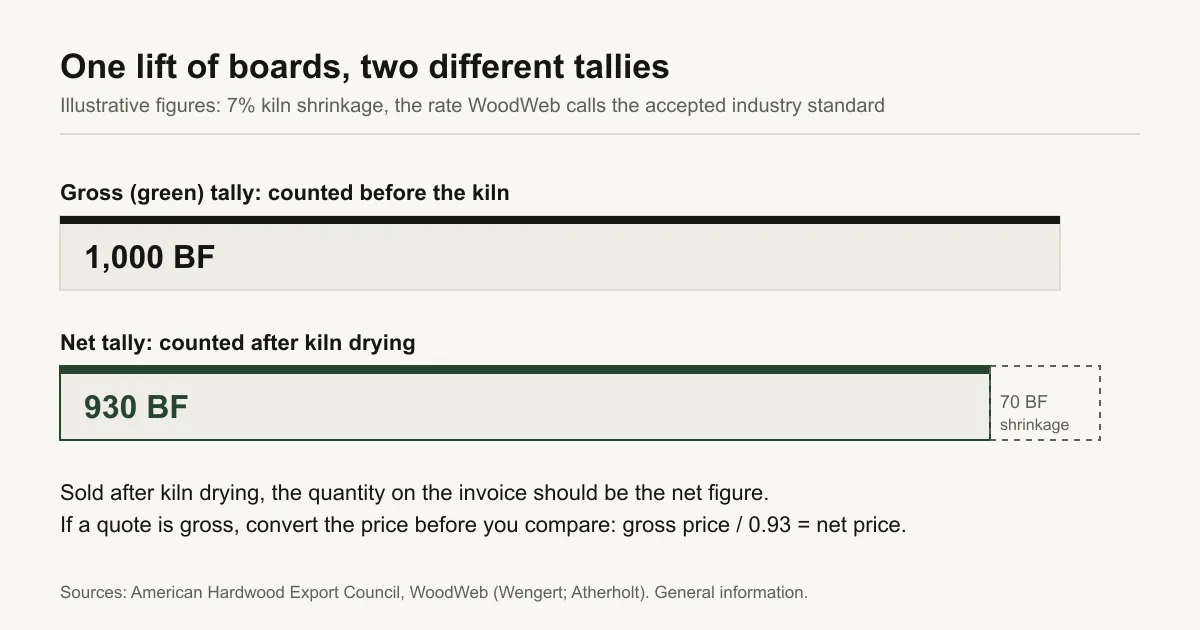
Hardwood is sold by the board foot, and the tally decides how many board feet you pay for. Net tally counts the footage after kiln drying. Gross, or green, tally counts it before drying, when the boards are wider, so the same lift shows a higher number. The gap is typically around 7%, which means a quote that looks $100 per MBF cheaper can cost more once you put both on a net basis. This guide shows the two measures, the rule behind them, the arithmetic for comparing quotes, the rounding rules that make two honest tallies differ and what to write on the order.
This is general information as of October 2026. The NHLA rule book and your contract govern. I could not open the full text of the 1977 weights and measures statement, so it is cited as WoodWeb reports it.
Net and gross tally defined
The American Hardwood Export Council (AHEC) defines both in its grading guide. Net tally is the actual board feet measured after kiln drying. Gross, or green, tally is the actual board feet measured before kiln drying, and AHEC says the buyer can expect roughly 7% fewer board feet than the gross figure. WoodWeb author Keith Atherholt, president of a lumber products firm, puts it the same way: net means the lumber was counted after it finished drying and gross means it was counted before it went to the kiln.
| Gross (green) tally | Net tally | |
|---|---|---|
| Counted | Before the kiln | After kiln drying |
| Board feet for the same boards | Higher | Lower, about 7% on the usual rate |
| What the invoice covers | Wood that no longer exists at that size | The wood you receive |
| Price per MBF for the same value | Lower | Higher |
| Question to ask | What shrinkage rate was used? | Was it measured, or calculated from gross? |
Why the gap exists
Wood shrinks as it dries. Atherholt says drying shrinks boards 5% to 9% along the tangential plane, which is generally the board width, that kilns typically leave lumber at 6% to 8% moisture content and that 7% is accepted as the industry standard. Shrinkage also costs grade. Wood scientist Gene Wengert wrote in 2000 that shrinkage can lower the grade a little or a lot, which makes buying on a green tally like buying blind.
What the rule says
According to Wengert, the National Conference on Weights and Measures adopted a standard in 1977 saying hardwood lumber sold after kiln drying should be sold on net board footage with no addition for kiln drying shrinkage. He says the NHLA also subscribes to it and that it is the law in most states. The same pages show that the practice of adding shrinkage back kept going. In 2015 Wengert said the add-back had been about 6% years earlier and had reached 9% recently, though fewer mills used gross footage by then.
Two cautions. The statement describes sales measured after kiln drying, mostly a domestic matter. I found no public rule for how an export contract must count. Your order is the rule, so write the basis into it.
Compare two quotes on one basis
To compare a gross price with a net price, divide, do not add. Atherholt’s own example: at $1,800 per MBF gross and 7% shrinkage, 1,000 board feet billed should deliver about 930. If 1,000 are delivered, the bill should be $1,935.48, which is $1,800 divided by 0.93. Adding 7% gives $1,926, which he calls close but not exact.
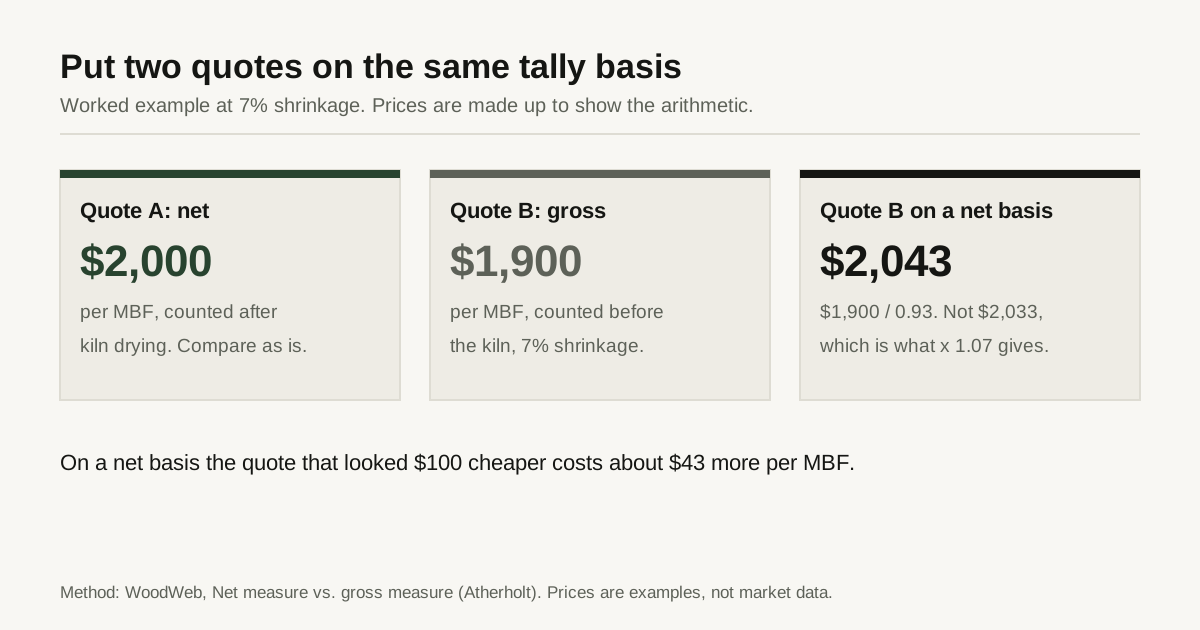
Worked example with made-up prices, to show the arithmetic:
- Quote A: $2,000 per MBF, net tally.
- Quote B: $1,900 per MBF, gross tally at 7% shrinkage.
- Quote B on a net basis: $1,900 / 0.93 = $2,043 per MBF.
Quote B looked $100 cheaper and costs $43 more per MBF. The quantity side works the same way. If you need 10,000 board feet net and the seller counts gross at 7%, you need the seller to tally 10,000 / 0.93, about 10,753 board feet gross. Order 10,000 gross and you receive about 9,300.
Rounding: two honest tallies of one bundle
Even on a net basis, two tallies of one bundle can differ. AHEC’s tally rules for export bundles:
- Widths are recorded in whole inches. Fractions above or below the half inch round to the nearest inch.
- Widths exactly on the half inch alternate between rounding up and down.
- Lengths between whole feet always round down. A 5 1/4 in by 8 1/2 ft board is tallied as 5 in by 8 ft.
A WoodWeb thread from 2015 shows the effect. A bundle was tallied at 263 board feet and the buyer’s own calculation gave 240. Wengert explained that per-piece counting and block counting differ. A block tally of a 48 in wide, 10 ft long bundle is 48 x 10 / 12 = 40 board feet per layer. Counting piece by piece gave 36 board feet per layer for six 7 3/4 in boards and 42 for seven narrower ones. A contributor added that regional habits differ: Northeast suppliers often round a 5 1/2 in board up to 6 in. The questioner’s vendor later confirmed the tally and credited the difference. The lesson is to agree the method before shipping, not to assume a mistake.
Green and dry sizes, and cubic meters
AHEC notes that the minimum widths and thicknesses in the grading rules are based on green or air dried lumber. Its description of the NHLA standard kiln dried rule allows scant sizes after drying:
| Rough kiln dried item | Allowed scant of nominal |
|---|---|
| Thickness 3/8 to 1 3/4 in | Up to 1/16 in |
| Thickness 2 in and thicker | Up to 1/8 in |
| Width, all grades | Up to 1/4 in |
A board tallied as 4/4 is counted at 1 in, yet it may be 15/16 in, or about 23.8 mm, after drying. That matters when a European or Asian supplier quotes in cubic meters. AHEC gives 1 m³ as 424 board feet and 1,000 board feet as 2.36 m³. So 10,000 board feet counted at nominal thickness is 23.6 m³, while the same boards at 15/16 in actual hold about 22.1 m³, my arithmetic, a gap of roughly 1.5 m³. I found no public rule for which thickness a hardwood export invoice must use. Ask whether volume is counted on nominal or measured dimensions, and keep the quote and the invoice on the same rule. Our guide to board feet and pricing covers the formula.
Check the tally on arrival
AHEC gives a quick estimate for a bundle: surface measure of one layer is the bundle width minus gaps times the length divided by 12, multiplied by thickness, then by the number of layers. Its example, 40 in wide, 10 ft long, 2 in thick and 10 layers, gives 33.33 board feet per layer times 2 in is 66.67, times 10 is about 667 board feet.
- Count bundles and match the tags to the tally sheet before opening anything.
- Re-tally two or three bundles with the estimate above and the rounding rule in the order.
- Compare the total with the invoice on a net basis. Differences of a few percent can be rounding, shrinkage method or both.
- Photograph the tags and any shortfall the same day. For the full routine see inspecting a hardwood delivery and, for loads in containers, bundles, tally and weight.
What to write on the order
- Tally basis: net after kiln drying, measured, not calculated from a green count. If the seller insists on gross, write the shrinkage percentage and the formula.
- Rounding rule: widths to the whole inch with half inches alternating, lengths rounded down, per piece or block.
- Thickness basis: nominal rough quarters, with the allowed scant for dried stock.
- Unit: board feet or MBF, or cubic meters with the thickness the volume uses.
- Tolerance: a stated plus or minus percentage on quantity, and who pays or credits beyond it.
- Where and when it is measured: at the mill after drying, or on arrival, and by whom.
Write the tally basis into the order with the other lines in hardwood lumber specifications. Once both quotes are on a net basis, continue with the buying sequence in wholesale hardwood lumber.
The RFQ checklist covers the other lines. To get quotes that state the tally basis, send your lumber RFQ with the grade, thickness and volume. We pass it to up to 3 mills or yards that say they can supply it, and they reply to you directly.
See also: NHLA measurement rules for surface measure, board feet and rounding.
Sources
- American Hardwood Export Council, board feet, tally and kiln dried measurement
- WoodWeb, Net measure vs. gross measure (Atherholt, 2001)
- WoodWeb, Gross tally vs net tally (Wengert, 2000)
- WoodWeb, Hardwood Lumber Tallies (2015)
Frequently asked questions
What is the difference between net and gross lumber tally?
Net tally is the board feet counted after kiln drying. Gross, or green, tally is counted before drying, when the boards are wider and the count is higher. The American Hardwood Export Council says a buyer should expect roughly 7% fewer board feet than a gross figure. Always ask which one a quote uses.
How much does lumber shrink in the kiln?
WoodWeb reports 5% to 9% shrinkage along the width as lumber dries, with 7% accepted as the industry standard. Mills use different rates, so a quote on a gross basis needs the shrinkage percentage stated. AHEC also uses about 7% in its own guide, and the exact rate for your lot is a point to settle in writing.
Can a seller add shrinkage to a kiln dried tally?
A 1977 statement of the National Conference on Weights and Measures says hardwood sold after kiln drying should be on net board footage with no addition for shrinkage, per WoodWeb. It describes retail sales. For an export contract, write the tally basis into the order.
How do I convert a gross price to a net price?
Divide the gross price by one minus the shrinkage. At 7%, a gross price of 1,900 dollars per MBF equals 1,900 divided by 0.93, about 2,043 dollars net. Adding 7% to the price gives 2,033 and understates the net cost.
Know what you need? Send the spec.
Tell us the species, grade, thickness and board feet. We pass it to up to 3 mills or yards that carry it and reply within 24 business hours.
Send my lumber RFQ