Home / Lumber grades and size rules / NHLA Measurement Rules: Surface Measure, Board Feet and Tally Rounding
NHLA Measurement Rules: Surface Measure, Board Feet and Tally Rounding
Reference page · Last reviewed 2 March 2027
NHLA measurement turns a board into two numbers. Surface measure (SM) is the face area in square feet, rounded to a whole number, and it decides how many cuttings a grade allows. Board feet (BF) is SM multiplied by the thickness in inches, and it is what you pay for. Everything on a tally follows from those two steps and from the rounding rules in the NHLA rulebook.
| Item | Typical rule (as of October 2026) |
|---|---|
| Rulebook | NHLA Rules for the Measurement and Inspection of Hardwood and Cypress |
| Rule review | Every four years. Approved changes take effect 1 January of the following year |
| Latest edition confirmed | 2023, effective 1 January 2023 (publication listings; the rulebook text was not available for this review). Check nhla.com for a newer edition |
| Surface measure | Width in inches x length in feet / 12, whole number |
| Board feet | Surface measure x thickness in inches |
| Thickness | Named in quarters on rough lumber: 4/4 = 1 in, 8/4 = 2 in |
| Grade basis | Surface measure, not board feet, so thickness does not change the grade |
The NHLA rulebook governs. Figures below are typical and come from published summaries of the rules, not from the rulebook text.
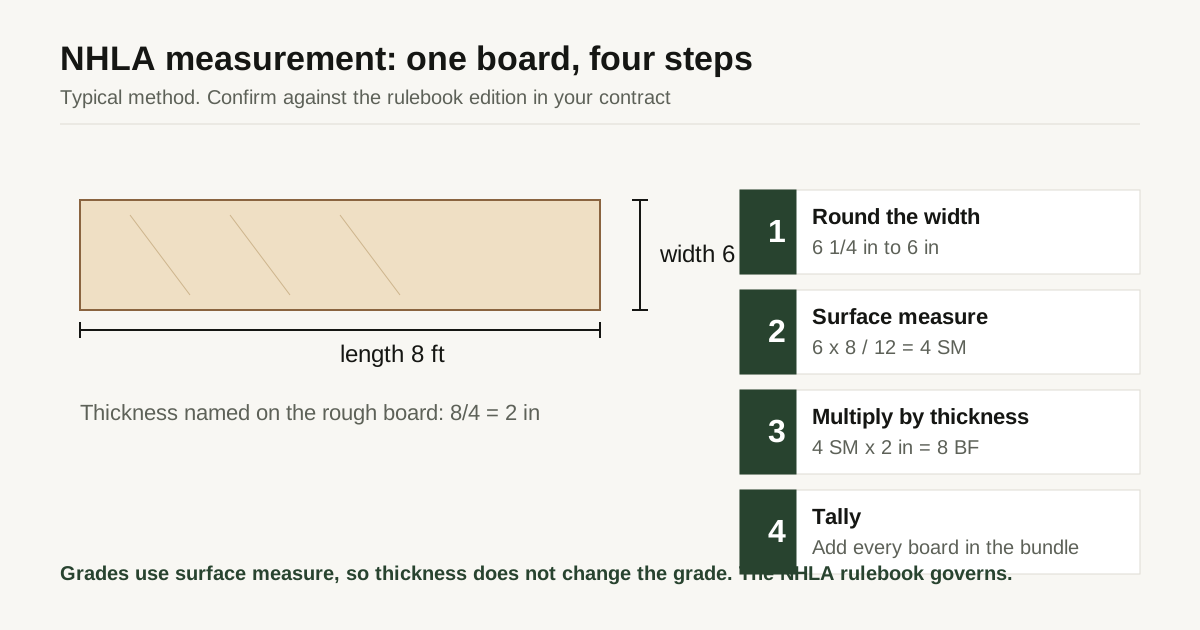
From board to tally in four steps
- Measure the width. The board is measured in inches and fractions. In the usual summary of the rule, fractions are rounded to the nearest whole inch, and a fraction of exactly one half is rounded up one time and down the next, so the count does not favor either side over a large lot.
- Measure the length. Lengths are counted in whole feet. For export tallies the American Hardwood Export Council describes lengths as always rounded down to the whole foot. The rulebook has its own wording for odd lengths and for short grades, so do not assume the export summary covers a domestic contract.
- Work out surface measure. Width x length / 12, rounded to a whole number. A board 6 1/4 in wide and 8 ft long gives 4 SM.
- Multiply by thickness. SM x thickness in inches gives board feet. At 8/4 the 4 SM board is 8 BF. At 4/4 it is 4 BF.
The tally adds the board feet of every board in a bundle or load. Because each board is rounded on its own, a tally total is not the same as total volume divided by 144 cubic inches. When a buyer checks a quote by multiplying a pack’s average width by its length, small differences are normal. A large difference points to a different rounding rule, a different thickness basis or a counting error.
Thickness is measured on the rough board
| Quarters | Rough thickness | Metric |
|---|---|---|
| 3/4 | 3/4 in | 19.0 mm |
| 4/4 | 1 in | 25.4 mm |
| 5/4 | 1 1/4 in | 31.8 mm |
| 6/4 | 1 1/2 in | 38.1 mm |
| 8/4 | 2 in | 50.8 mm |
| 10/4 | 2 1/2 in | 63.5 mm |
| 12/4 | 3 in | 76.2 mm |
| 16/4 | 4 in | 101.6 mm |
Surfaced lumber is still tallied on the nominal rough thickness in the usual trade practice. The American Hardwood Export Council summary gives the typical surfaced thickness as 3/16 in less than nominal for lumber up to 1 1/2 in and 1/4 in less for lumber 1 3/4 in and thicker. A 4/4 board surfaced on two sides therefore arrives near 13/16 in and is still tallied as 1 in. If your part must finish at a full inch, order 5/4. Our guide to board feet and quarter thickness works through the price side of this.
Green tally and net tally
Lumber shrinks as it dries, and the tally changes with it. A gross or green tally measures the boards before drying. A net tally measures them after kiln drying. The same source puts the loss at roughly 7 percent fewer board feet after drying, which is why a green quote and a kiln-dried quote cannot be compared until both are on the same basis. Kiln-dried stock also carries a scant allowance in thickness and width in the rules. The hardwood lumber tally guide shows the arithmetic.
What a tally must show
A tally that a buyer can check carries these lines, whatever format the mill uses:
- Species by botanical name and the trade name.
- The grade and the rule it was graded to, with the edition.
- Thickness in quarters, and whether it is rough or surfaced.
- Moisture condition: kiln dried, air dried or green, with the target range.
- Each bundle with its piece count, widths and lengths or a width and length summary, and its board feet.
- The totals per bundle and per load, and whether they are gross or net.
- The rounding rule used for widths and lengths.
Our lumber tally sheet guide shows a sample layout.
Where tally disputes start
| Cause | What happens | Fix |
|---|---|---|
| Rough versus surfaced basis | One quote counts the 13/16 in thickness, another counts 1 in | State the thickness basis on the quote |
| Gross versus net | Green board feet compared with dried board feet | Ask for the net tally after drying |
| Rounding rule | Two mills round half inches differently | Name the rule and edition in the contract |
| Unit | Board feet against cubic meters | Convert once, on the quote: 1 MBF is about 2.36 cubic meters |
| Edition | Rule changes between editions | Name the edition |
What to write on the RFQ
State the rule and edition for measurement and grading, the thickness basis, and whether you want a net tally after drying. Ask for a tally by bundle that matches the packing list. Then send your lumber RFQ and we pass it to up to 3 mills or yards that say they can quote on that basis.
RFQ line: Red oak (Quercus rubra), No.1 Common, 4/4 rough, KD 6-8%, measured and graded to NHLA rules, edition named, net tally by bundle.
Frequently asked questions
What is surface measure in NHLA grading?
Surface measure is the face area of a board in square feet, rounded to a whole number. You multiply the width in inches by the length in feet and divide by 12. Grades are set from surface measure, so a 4/4 board and an 8/4 board of the same size are graded the same way.
How do you get board feet from surface measure?
Multiply the surface measure by the thickness in inches. Thickness is named in quarters of an inch on the rough lumber, so 8/4 is 2 inches. A board with a surface measure of 4 and a thickness of 8/4 is 8 board feet.
How are widths rounded?
Summaries of the rules say widths are rounded to the nearest whole inch and that a fraction of exactly one half is rounded up one time and down the next. The rulebook governs the details and the edition your contract names.
Which NHLA rulebook edition should a contract name?
Name the edition. NHLA reviews the rules every four years and approved changes take effect on 1 January of the following year. The latest edition found in publication listings is the 2023 edition, effective 1 January 2023. Check nhla.com for a newer one before you sign.
Sources
- NHLA: grading rules (Rules for the Measurement and Inspection of Hardwood and Cypress, four-year review cycle)
- American Hardwood Export Council: how sawn hardwood lumber is measured (surface measure, quarters, surfaced thickness, tally)
- Purdue Extension FNR-130: Lumber grades (surface measure and fraction rounding, summarizing the 1998 NHLA rules)
Standards and rules are cited as references, not as claims about Hardwood Vendor or any mill. Editions and status change: confirm with the issuing body, your customs broker or the regulator.
Know what you need? Send the spec.
Tell us the species, grade, thickness and board feet. We pass it to up to 3 mills or yards that carry it and reply within 24 business hours.
Send my lumber RFQMore in lumber grades and size rules
- FAS Lumber: What the Firsts and Seconds Grade Allows
- Selects and F1F Hardwood Lumber: When One Clear Face Is Enough
- EN 1313-2: Permitted Deviations and Preferred Sizes for Hardwood Sawn Timber
- EN 13556 Timber Names: How to Read Trade Names and Codes on a European Quote
- Hardwood Flooring Stock Grades: NWFA and NOFMA Names, Lengths and the EN 14342 Note
- Hardwood Dimension Stock: Cut Size Specs, Face Rules and Yield Math