Home / Lumber grades and size rules / EN 1313-2: Permitted Deviations and Preferred Sizes for Hardwood Sawn Timber
EN 1313-2: Permitted Deviations and Preferred Sizes for Hardwood Sawn Timber
Reference page · Last reviewed 24 February 2027
EN 1313-2 is the European standard for the sizes of hardwood sawn timber. It lists preferred sizes and the deviations that are permitted around them, stated at a reference moisture content. It does not grade the timber. Buyers in the EU use it to write a size clause that two parties can measure the same way, and exporters of American hardwood meet it when a European customer asks for sizes in millimeters.
| Item | What to know (as of October 2026) |
|---|---|
| Title | Round and sawn timber, permitted deviations and preferred sizes, part 2: hardwood sawn timber |
| Edition listed | BS EN 1313-2:1999, published 15 March 1999, identical to EN 1313-2:1998 |
| Status in the BSI catalog | Current, under review |
| Softwood counterpart | EN 1313-1, with a 2010 edition |
| What it controls | Preferred sizes, permitted deviations, dimensional changes with moisture |
| What it does not control | Appearance grade, strength class, moisture target |
| Reference moisture | 20 percent, per catalog summaries. Confirm in the text |
| Where to get the text | National standards bodies (BSI, DIN, AFNOR and others). It is a paid standard |
The deviation values are not reproduced here. They are in the standard, which is copyrighted. Buy the current edition before you quote numbers in a contract.
What the standard does
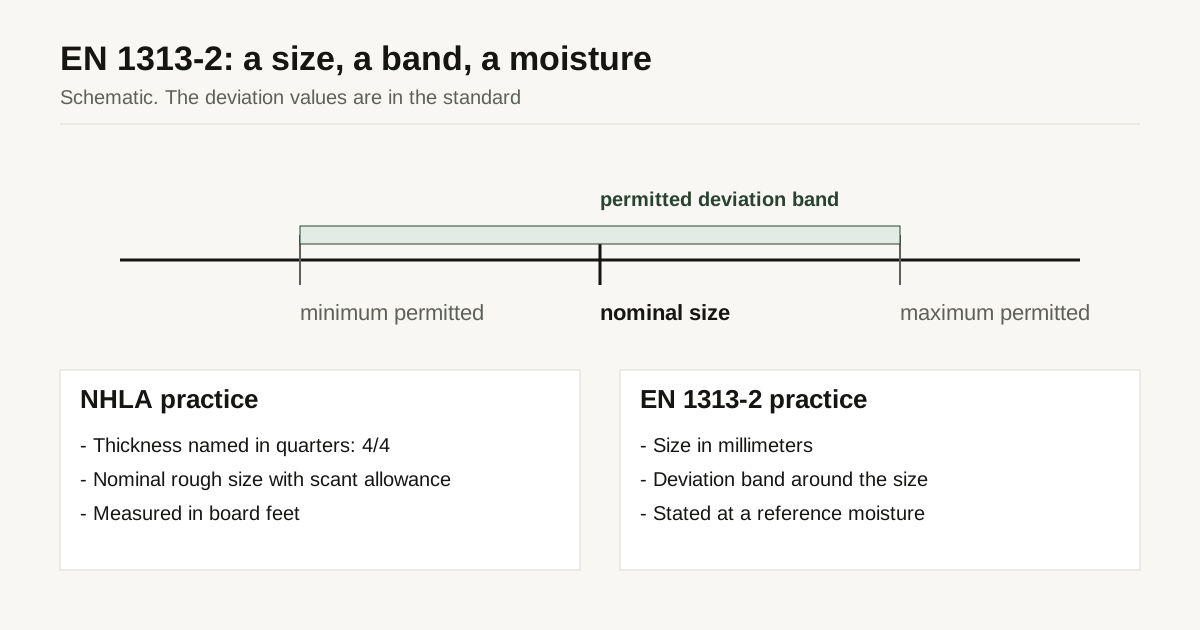
A sawn board is never exactly its nominal size. Saws wander, wood shrinks as it dries and boards move. A size standard answers three questions:
- Which sizes are normal? The preferred sizes tell sawmills and buyers which thicknesses, widths and lengths to use first, so that stock is easy to match and trade.
- How far off may a board be? The permitted deviations are the band around a nominal size inside which the board still counts as that size.
- At what moisture? Timber shrinks and swells. A size means little unless it is measured at a stated moisture content. The catalog descriptors for EN 1313-2 include moisture, size reduction and dimensional changes, which shows the standard links the size to the moisture state.
The tolerance bands are typically different for thickness, width and length, and can differ for timber of different thickness ranges. That is why the standard has tables, and why a summary is not enough to write a claim clause.
Reading a European quote
European mills quote sawn hardwood in millimeters and in cubic meters. A line might read: oak, 27 mm, 1st grade, 2.20 m and up, kiln dried. The quote is only complete when it also says:
- The grade system (for example EN 975-1:2009 for appearance grading of oak and beech, or a mill’s own grade).
- The moisture at which the thickness is measured.
- Whether sizes follow EN 1313-2 and which edition.
- Whether the thickness is the sawn size or the planed size.
Our guide to European oak lumber grades explains the grading side.
NHLA quarters and EN millimeters side by side
| NHLA name | Nominal rough thickness | Nearest conversion |
|---|---|---|
| 4/4 | 1 in | 25.4 mm |
| 5/4 | 1 1/4 in | 31.8 mm |
| 6/4 | 1 1/2 in | 38.1 mm |
| 8/4 | 2 in | 50.8 mm |
| 10/4 | 2 1/2 in | 63.5 mm |
| 12/4 | 3 in | 76.2 mm |
These are conversions of a name, not of a tolerance. An American mill sells 4/4 lumber as a nominal 1 in rough board with its own scant allowance, graded in board feet under NHLA rules. A European mill sells a thickness in millimeters with permitted deviations and measures in cubic meters. A buyer who mixes the systems should state which one governs the size and the grade:
- Grade by NHLA, size by EN 1313-2. The grade follows NHLA surface measure and cuttings. The size follows the EN band at the stated moisture.
- Grade by EN 975, size by EN 1313-2. A European system end to end.
- Grade by NHLA, size by NHLA. The usual US practice. The measurement rules page explains it.
Do not assume that one board meets both. A 4/4 board can sit at one end of an American scant allowance and outside a European band for a nominal 25 mm. If the same lot must be accepted under both, say so in the contract and measure both ways.
Moisture and size
The reference moisture matters more than the table values. A piece measured wet is larger than the same piece kiln dried. Two buyers can disagree on thickness only because one measured at arrival and the other at the mill. Agree:
- The moisture state at which size is judged (at loading, at arrival or at a stated moisture range).
- The method for the moisture reading. See moisture test methods.
- The number of pieces measured and from where in the load.
What to write on an EU RFQ
- Species by botanical name and the trade name.
- Thickness in mm, with a statement that deviations follow EN 1313-2 (edition named) or the mill’s own written tolerance.
- The grade and the rule (EN 975 or NHLA, with edition).
- The moisture range and the point at which size is measured.
- Length and width rules: random or specified, minimum, and how they are rounded.
- Unit: cubic meters or board feet, and how the volume is calculated.
Send your lumber RFQ with the size system you want and we pass it to up to 3 mills or yards that can supply it.
RFQ line: Oak (Quercus robur or petraea), 1st grade, 27 mm sawn, KD 8-10%, sizes per EN 1313-2 (edition named) measured at loading, volume in m3.
Checks before you rely on it
- Buy the current edition from your national standards body.
- Ask the mill which edition it works to and whether it tests size against it.
- Keep a measured sample from each lot with its moisture reading.
- Confirm the status of the standard, since the catalog listing is under review.
Frequently asked questions
What does EN 1313-2 cover?
It sets permitted deviations and preferred sizes for hardwood sawn timber. Part 1 is the softwood counterpart. Neither part grades the timber for appearance or strength: grading is done by other standards, such as the EN 975 series for oak and beech appearance.
Is EN 1313-2 still current?
BSI lists BS EN 1313-2:1999 as current but under review, and lists it as identical to EN 1313-2:1998. The softwood part was replaced by a 2010 edition. A catalog listing is not the CEN register, so confirm the status with your national standards body before you cite it.
Does EN 1313-2 replace NHLA rules for American hardwood?
No. NHLA rules grade American hardwood lumber and measure it in board feet. EN 1313-2 is a European size standard. A contract can combine them: NHLA grade for appearance, EN 1313-2 for size deviations, if both sides agree.
At what moisture are the sizes stated?
Catalog summaries describe the sizes and deviations of EN 1313-2 at a reference moisture content of 20 percent. Confirm in the standard text, because the size you receive changes as the timber dries or takes up moisture.
Sources
- BSI: BS EN 1313-2:1999 Round and sawn timber, permitted deviations and preferred sizes, hardwood sawn timber (status: current, under review)
- SAI Global listing: BS EN 1313-2:1999
- EVS: EN 975-1:2009 Sawn timber, appearance grading of hardwoods, oak and beech
- American Hardwood Export Council: how sawn hardwood lumber is measured (quarters and metric conversions)
Standards and rules are cited as references, not as claims about Hardwood Vendor or any mill. Editions and status change: confirm with the issuing body, your customs broker or the regulator.
Know what you need? Send the spec.
Tell us the species, grade, thickness and board feet. We pass it to up to 3 mills or yards that carry it and reply within 24 business hours.
Send my lumber RFQMore in lumber grades and size rules
- FAS Lumber: What the Firsts and Seconds Grade Allows
- NHLA Measurement Rules: Surface Measure, Board Feet and Tally Rounding
- Selects and F1F Hardwood Lumber: When One Clear Face Is Enough
- EN 13556 Timber Names: How to Read Trade Names and Codes on a European Quote
- Hardwood Flooring Stock Grades: NWFA and NOFMA Names, Lengths and the EN 14342 Note
- Hardwood Dimension Stock: Cut Size Specs, Face Rules and Yield Math