Guides / Grades and Specs
European Oak Lumber Grades: What QBA, ABC and Rustic Mean on a Quote
January 16, 2027
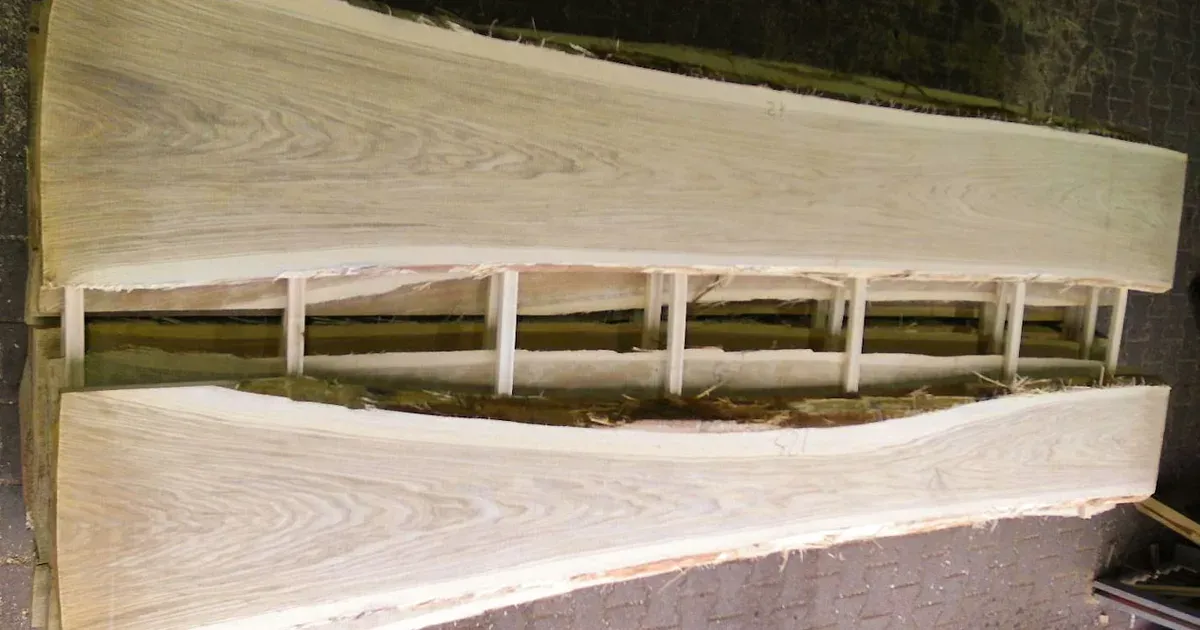
European oak lumber is graded under the European standard EN 975-1, and its codes read like QBA, QS1 or QF2: Q for oak, a letter for the product type, then a quality letter or number. The names that come with flooring stock, such as Prime AB, Select ABC, Natural ABCD and Rustic CD, are a different thing. They are trade labels that each seller defines for itself. This guide shows how to read both on a quote, where the numbers published by suppliers come from and what to write on the order so the grade you pay for is the grade that arrives.
This is general information as of October 2026. I could not open the full text of the standard, which is sold by national standards bodies, so the knot limits below come from supplier guides and should be checked against the standard or the supplier’s written rules before you rely on them.
What EN 975-1 covers
The BSI listing gives the title as “Sawn timber. Appearance grading of hardwoods. Oak and beech”, edition of 30 April 2009, current and under review. The standard sets quality rules for appearance-graded temperate hardwood that is rough sawn or regularized, green or dried. For oak it covers un-edged boards and boules, square-edged timber and strips up to 41 mm thick, and baulks. It does not cover strength grading of structural timber or sawn timber for pallets. The French standards body AFNOR lists the 2009 text as the current edition and the November 1995 edition as replaced.
Two points follow for a buyer. First, the standard is about appearance: the supplier guides I read turn its grades on knot size, sapwood, wane and grain, and none of them lists color as a grading factor. Second, the thickness limit in the scope matters. If you order thick square-edged stock, ask the supplier which rule the grade is based on, because the standard text speaks of strips and square-edged timber up to 41 mm.
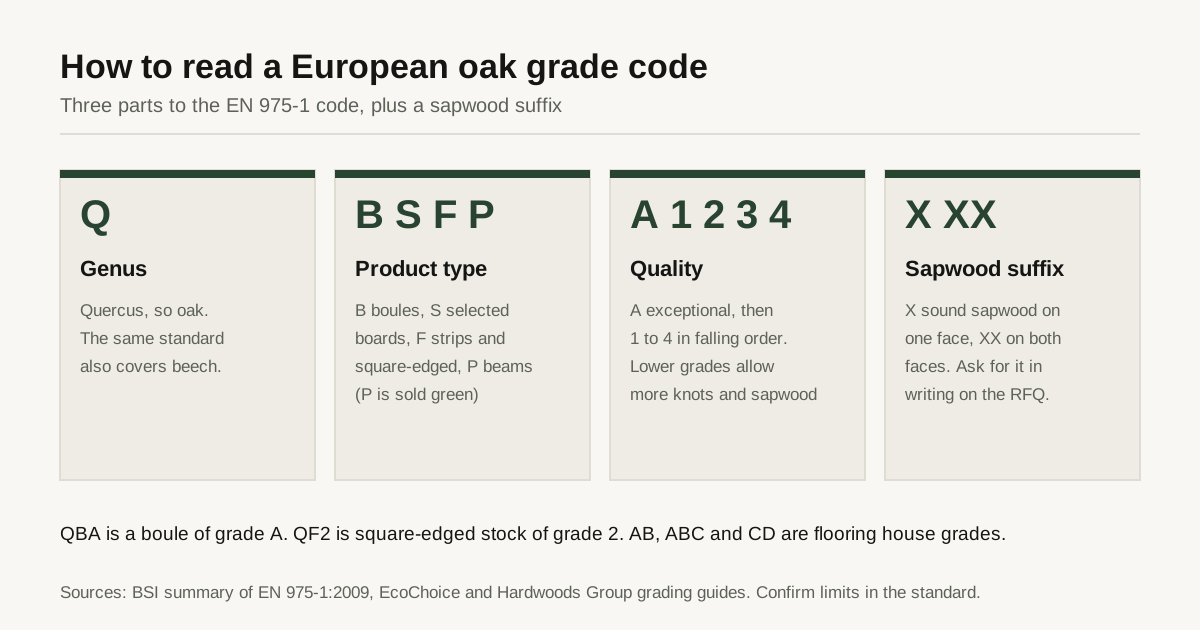
How to read the code
Supplier guides from EcoChoice and the Hardwoods Group give the same structure:
| Part | Letter | Meaning |
|---|---|---|
| First | Q | Quercus, oak |
| Second | B | Boules: waney-edged boards sawn lengthwise from one log, kept together |
| Second | S | Selected boards: un-edged boards that look like boules but may come from different trees |
| Second | F | Strips and square-edged timber |
| Second | P | Beams, usually sold freshly sawn |
| Third | A | Exceptional quality |
| Third | 1 to 4 | Decreasing quality, 4 the poorest |
| Suffix | X or XX | Sound sapwood on one face, or on both faces |
So QBA is a boule of the top quality, QS1 is a selected board of grade 1 and QF2 is square-edged stock of grade 2. For boules, the Hardwoods Group says all boards come from the same tree and must be at least 2 m long, and that at least 65% of the boule must meet the grade named. EcoChoice adds the sorting tolerances: at least 65% at the grade, less than 25% one grade lower and less than 10% two grades lower. For selected boards, no more than 10% may fall below the stated grade.
That tolerance is the part buyers miss. A boule graded QB1 is a lot of boards cut from one log, and the grade describes the whole set, not each board. If your parts need a clear face on every board, a boule is the wrong product or the wrong grade.
What the grades allow
EcoChoice, a UK merchant, gives knot limits for strips and square-edged timber. These are its paraphrase of the standard, so treat them as directional:
| Grade | Knots as published by the supplier |
|---|---|
| QF1a | Straight grain, sound knots under 10 mm, about 20% of boards may carry one extra sound knot |
| QF1b | Sound knots under 5 mm disregarded, up to three knots of 12 mm or less |
| QF2 | Sound knots under 5 mm disregarded, up to three knots of 25 mm or less |
| QF3 | Sound knots under 10 mm disregarded, up to three knots of 40 mm or less, one dead knot under 20 mm, wane under 3 mm |
| QF4 | Sound knots under 70 mm, two dead knots (one under 20 mm, one under 35 mm), wane up to 10% of the width and 20% of the length |
The Hardwoods Group describes the top grade, which it calls Prime, as having very few knots, with one bark pocket and only small sap bands allowed. It also lists a Pippy sort, which is ungraded and shows clusters of small knots. For a cabinet plant, QF1 and QF2 are the usual range for visible parts, and QF3 and below suit parts that are hidden, painted or cut around.
Why ABC and rustic are not the same system
Walk into a flooring quote and you will see Prime AB, Select ABC, Natural ABCD and Rustic CD. These are not EN 975-1 grades, and they are not defined anywhere you can look up.
- Havwoods says its grades are its own definitions and “merely a guide”, because wood from many countries comes under different rules. It describes Prime as few or no knots of minimal size, Select as mostly near-prime boards plus some with more knots of limited size and some sapwood contrast, and Natural or Rustic as a grade with no limit on knot size or number.
- The Solid Wood Flooring Company states that it developed its own system over more than ten years. Its AB is prime with no knots, ABC is select with a few small knots and ABCD allows more color change, sapwood and knots.
- Embelton Flooring describes its ABCD European oak as including filled knots larger than 40 mm, sapwood and checking, with filler matched to the wood and possibly varying between batches.
Three sellers, three definitions. The letter ladder reads as a ranking inside one seller’s catalog, not as a measure you can carry between suppliers. I found no single published table of knot sizes for AB, ABC or CD that more than one seller uses, so the safe rule is to ask for the written limits: maximum knot diameter, whether knots are filled, sapwood allowance, checks and who decides.
European grading against NHLA
If you are used to American hardwood, keep the two systems apart. NHLA grades are a calculation. The American Hardwood Export Council describes it as the clear wood a board yields when cut up: FAS needs 83 1/3% clear, No. 1 Common 66 2/3% and No. 2 Common 50%, with minimum clear piece sizes for each grade. European oak grading, by contrast, is a visual judgment by a grader against a list of permitted features. AHEC, which promotes American hardwoods and should be read that way, says supplying countries such as France, Ukraine and Croatia can interpret the same grade differently. A merchant who equates its grade 1 with FAS is using a trade label, not an equivalence.
You can still compare. Ask for photos of a typical lift and a cutting list, and calculate your own yield. Our guide to NHLA hardwood grades shows the cutting-unit logic, and rough lumber, S4S and dimension parts helps you decide what state to order the stock in.
What to write on the RFQ
- Species: Quercus robur or Q. petraea, or “European oak” if you accept either, with the botanical name for the paperwork.
- Grade: the full EN 975-1 code, for example QF2, with the product type letter and any X or XX suffix. If you order a flooring grade instead, attach the supplier’s written limits.
- Thickness and width in millimeters, and whether the stock is rough, planed or regularized.
- Drying: kiln dried, with the target moisture and how it is checked. See kiln dried against air dried hardwood.
- Sorting rule: for boules, whether you accept the 65% tolerance or want selected boards.
- Tally and unit: cubic meters or board feet, and the measuring rule.
For where an EN 975-1 code sits in a complete order, read hardwood lumber specifications.
The RFQ checklist covers the rest of the order lines. For other species and uses, see the hardwood species hub. To get quotes that state the grade system up front, send your lumber RFQ with the grade code, thickness and volume. We pass it to up to 3 mills or yards that say they can supply it, and they reply to you directly.
Sources
- BSI, BS EN 975-1:2009 Sawn timber. Appearance grading of hardwoods. Oak and beech
- AFNOR, NF EN 975-1 listing, replaced edition of 1995 and scope
- EcoChoice, guide to oak grading (supplier guide, directional)
- Hardwoods Group, timber grades explained (supplier guide, directional)
- Havwoods, wood flooring grades explained (supplier definitions, directional)
- Solid Wood Flooring Company, grading of oak (supplier definitions, directional)
- American Hardwood Export Council, hardwood lumber grading
Frequently asked questions
What does QBA mean on European oak lumber?
QBA is a grade code from the European standard EN 975-1. Q stands for Quercus, so oak. B means boules, which are whole logs sawn lengthwise into waney-edged boards and kept in sequence. A is the top quality letter. QB1 to QB4 follow in falling quality.
Are ABC and rustic oak grades part of a standard?
No. Prime AB, Select ABC, Natural ABCD and Rustic CD are trade grades used mainly for flooring, and each merchant defines its own. Havwoods calls its limits only a guide, and the Solid Wood Flooring Company says it built its own system. Ask for the written limits, not the letters.
Is European oak graded like NHLA hardwood?
No. NHLA grades measure the clear wood a board yields: FAS needs 83 1/3% clear cuttings. EN 975-1 describes which features are allowed, such as knot size and sapwood, by product type. The two systems do not convert one to one, so a quote has to name the system.
What should I write on the RFQ for European oak?
Write the species, the full EN 975-1 code with the product type letter and any sapwood suffix, the thickness in millimeters, the drying and the quantity. If you want a house grade instead, attach the supplier's written limits and photos of the lot.
Know what you need? Send the spec.
Tell us the species, grade, thickness and board feet. We pass it to up to 3 mills or yards that carry it and reply within 24 business hours.
Send my lumber RFQ