Guides / Grades and Specs
Powderpost Beetles in Hardwood Lumber: Which Boards Are at Risk and What to Ask
April 23, 2027
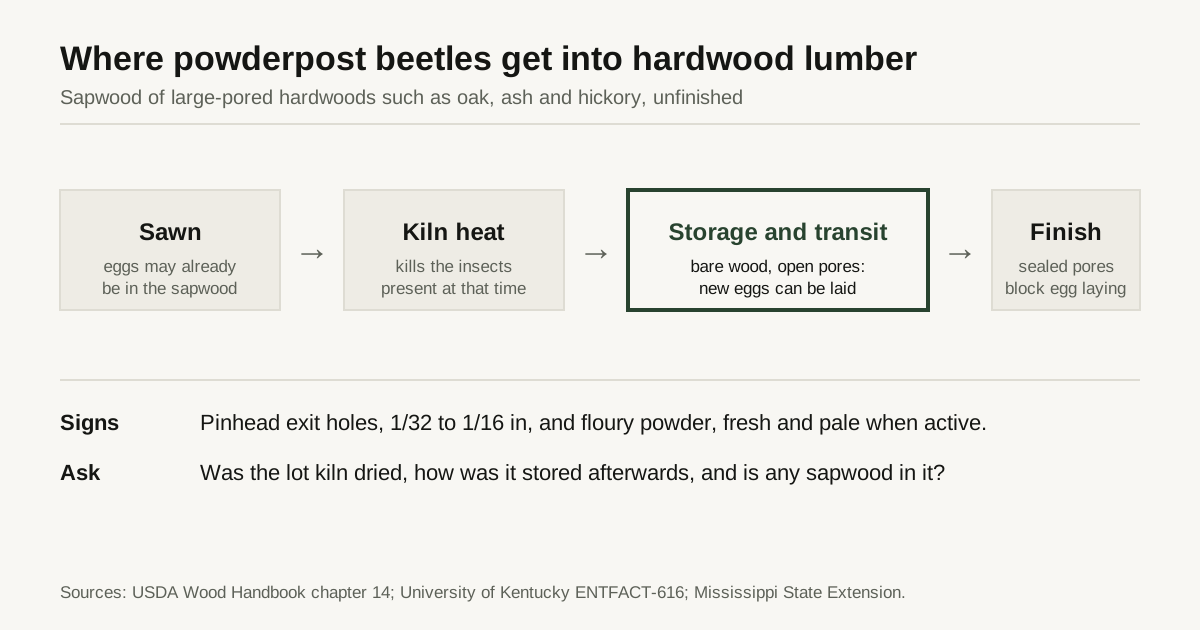
Lyctid powderpost beetles are the beetles that do most of the damage to dry hardwood lumber. They lay eggs in the open pores of sapwood in oak, ash, hickory and other large-pored hardwoods, and the larvae turn the sapwood to fine powder. Kiln heat kills what is already in the wood, but unfinished boards can be infested again in storage and transit. A buyer’s protection is to know how much sapwood is in the lot, how it was stored after drying and what the supplier does about sanitation. Heat treatment records and our kiln drying schedules guide cover the first part of that.
This is general information as of October 2026, taken from the USDA Wood Handbook and three university extension sources. They do not agree on the exact moisture range that beetles need, so I give each source’s figure.
Which boards are at risk
The Wood Handbook says the powderpost beetles that cause most damage to dry hardwood lumber belong to the genus Lyctus. They attack the sapwood of ash, hickory, oak and other large-pored hardwoods as it begins to season. The eggs are laid in the pores and the larvae tunnel through the wood, leaving tunnels about 1.5 to 2 mm across packed with fine powder. The handbook’s insect table lists lyctid damage as in the sapwood of large-pored hardwoods and says reinfestation continues until the sapwood is destroyed.
Starch matters. University of Kentucky extension says females test wood before laying eggs and skip wood with less than about 3% starch, and that starch declines as wood ages, so infestations slow down and eventually die out. Mississippi State extension says most heavy infestations occur in wood less than ten years old. Purdue extension names oak, hickory, ash and walnut as examples and says a generation can take from a few months to several years.
Kentucky extension also says tropical hardwoods are especially prone and that softwoods such as pine are avoided. For a hardwood buyer that means species and sapwood content both matter: a lot with a lot of sapwood is the exposed one.
Signs on a lumber lot
- Holes. Round holes about the size of a pinhead. The Wood Handbook gives 0.8 to 1.6 mm (1/32 to 1/16 in) exit holes for lyctids. Mississippi State says about 1/16 in.
- Powder. Very fine, flour-like powder, which Kentucky extension says feels like flour or fine talc and collects in small piles.
- Fresh or old. Active infestations show fresh powder the color of freshly sawed wood, unweathered holes and no stain inside the holes. Old powder is typically yellowed, caked or dusty.
- Where in the pack. Mississippi State extension says boards on the outside of a stack or bundle, where females can reach them, are often the most heavily infested.
The Wood Handbook adds a warning for buyers: any evidence of powder-post infestation should not be overlooked when selecting hardwood lumber, because the beetles may continue to be active long after the wood is put to use.
Powderpost beetle families compared
| Beetle | Typical exit hole | When it attacks | Notes |
|---|---|---|---|
| Ambrosia beetles | 0.5 to 3 mm (1/50 to 1/8 in) | Living trees, unseasoned logs and lumber, ends during seasoning | Holes often centered in a dark streak |
| Lyctid powderpost beetles | 0.8 to 1.6 mm (1/32 to 1/16 in) | During or after seasoning | Sapwood of large-pored hardwoods, floury powder |
| Anobiid powderpost beetles | 1.6 to 3 mm (1/16 to 1/8 in) | Usually after the wood is in use in buildings | Slow damage, pellets in tunnels |
| Bostrichid powderpost beetles | 2.5 to 7 mm (3/32 to 9/32 in) | Before seasoning or if the wood is rewetted | Tightly packed powder |
Source: USDA Wood Handbook FPL-GTR-190, chapter 14, Table 14-2, types of damage caused by wood-attacking insects. The table is condensed and the hole sizes are typical. Ambrosia beetle holes are not powderpost damage; they are listed because they also show as pin holes. The pin-hole grading of the lumber follows the NHLA rules, which I did not open.
How reinfestation happens after the kiln
Kiln drying kills the stages present in the wood. The Wood Handbook says heat sterilization needs the center of the wood held at 56 degrees C (133 degrees F) for 30 minutes, and that the time needed to reach that depends on thickness and moisture. Kentucky extension says kiln drying at about 125 to 140 degrees F for several hours kills all stages. Purdue extension says heating wood to 150 degrees F for 4 hours also works.
Heat is not a barrier. Mississippi State extension names the risk points as exposed or unfinished stock at the production site, in transit, in storage at retailers and at delivery. Because lyctids lay eggs in the open pores, the Wood Handbook notes that covering the entire surface with a suitable finish prevents infestation. Kentucky extension agrees that stained, varnished, waxed or painted surfaces are protected from egg-laying. Mississippi State warns that females can still lay through old emergence holes or cracks that expose unfinished wood.
Moisture is part of it. Mississippi State says wood below about 8 to 10% moisture is not very susceptible and 10 to 20% is ideal for the beetles. Kentucky says infestations can persist at moisture content as low as about 8%, though under 10% slows larval maturity. So well dried wood is lower risk, not no risk.
What to ask and what to write
- Ask how much sapwood the grade or the lot contains for oak, ash and hickory, and whether the species and thickness are at risk.
- Ask whether the lot was kiln dried and for the drying records. A kiln that reaches the temperatures above kills what is present.
- Ask how long the lot sat afterwards and where: closed storage, covered, off the ground. The Wood Handbook says good plant sanitation is extremely important and that wood reused from older structures often carries lyctid or anobiid larvae, so keeping new lumber away from reclaimed wood is a sensible precaution (my reading, not a handbook rule).
- On delivery, check the outer boards of each bundle for holes and powder, as in our note on lumber quality claims and the defects and grade limits guide.
- Write it on the order: no live infestation at delivery, and the remedy if powder appears within an agreed period. Tell the supplier how the stock will be stored on your side.
For a lumber spec that includes a no-infestation rule, send one lumber spec and we pass it to up to 3 mills or yards that carry it, with a reply within 24 business hours. For drying records and how kilns are run, see kiln drying schedules for hardwood.
Sources
- USDA Forest Products Laboratory, Wood Handbook FPL-GTR-190, chapter 14: biodeterioration of wood (insects, Table 14-2)
- University of Kentucky Extension, Powderpost Beetles, ENTFACT-616 (Potter)
- Mississippi State University Extension, Powderpost Beetles in Hardwood Floors
- Purdue Extension Entomology, Powderpost Beetles, E-73 (Bennett, 2017)
Frequently asked questions
Which hardwood lumber do powderpost beetles attack?
The beetles that do most damage to dry hardwood lumber are lyctid powderpost beetles. The USDA Wood Handbook says they attack the sapwood of ash, hickory, oak and other large-pored hardwoods as it begins to season. Heartwood is rarely attacked. Kentucky extension adds that tropical hardwoods are especially prone.
Does kiln drying get rid of powderpost beetles?
It kills the insects and eggs present at that time. University of Kentucky extension says kiln drying at about 125 to 140 degrees F for several hours kills all life stages. Mississippi State extension warns that reinfestation can occur after the wood leaves the kiln and before it is installed and sealed.
How do I recognize an active infestation?
Look for round holes about the size of a pinhead, 1/32 to 1/16 inch, with powder that feels like flour or fine talc. Active infestations show fresh, pale powder and clean, unweathered holes. Old powder is yellowed or caked.
Know what you need? Send the spec.
Tell us the species, grade, thickness and board feet. We pass it to up to 3 mills or yards that carry it and reply within 24 business hours.
Send my lumber RFQ