Guides / Grades and Specs
End Sealing Hardwood Lumber: What It Prevents, Which Coating and When It Pays
April 24, 2027
End sealing is a thick coat of wax emulsion, paint or similar material on the end grain of freshly sawn boards, so the ends dry no faster than the faces. It pays when the boards are valuable and will air dry or wait for a kiln, because end checks are cut off and lost, and a 4 in split on each end of an 8 ft board costs 8% of its volume. For a buyer the question is not how to apply it. It is whether the mill protects the ends during drying and how much length you lose to trim. Our kiln drying schedules guide covers the drying side.
This is general information as of October 2026. The main source is a 2024 USDA Forest Products Laboratory test on one species at one site, so treat the results as direction, not a rule for every board.
Why the ends check first
Lumber dries from the surface inward. Surface cells lose moisture first and shrink first, and that sets up drying stress. The Forest Products Laboratory says the stress shows first at the ends, because ends dry faster than faces. It begins when the lumber is first sawn and continues until about one third of the moisture has evaporated, and the surface and end checks may worsen later but all are created in that early stage.
The reason is the grain. The same paper says moisture moves 10 to 15 times faster along the grain than across the grain, so wood dries much more quickly from the end. That gives end checks and splits. The USDA Wood Handbook explains it in the same terms: the rapid longitudinal movement of moisture makes the end dry very quickly and develop high stress, so it fractures. The handbook calls end coatings on the log or on freshly sawn lumber an effective preventive measure, and says in its air drying section that end coating may alleviate end checking and splitting.
The loss is length. The Forest Products Laboratory gives an example: a 4 in end split on both ends of an 8 ft piece causes an 8% volume loss, and severe loss can lower the grade.
What the 2024 USDA test found
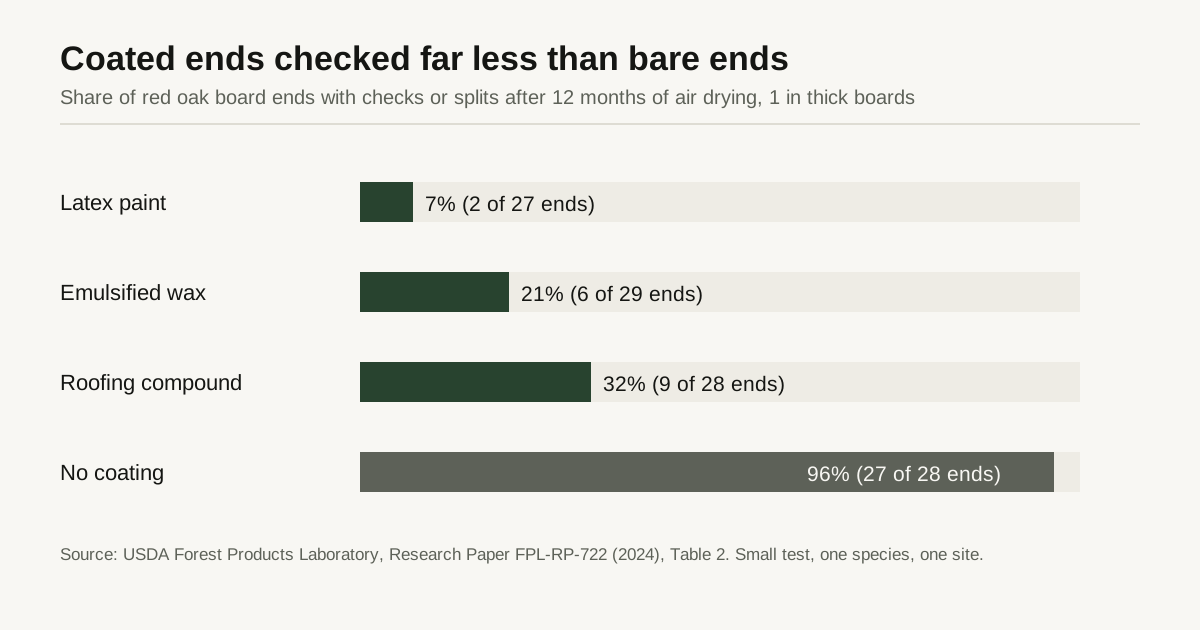
Researchers sawed thirty No. 1 Common red oak boards 1 in thick and 8 ft long, cut them in half to 4 ft and used 56 of the half boards: 42 had both ends coated with one of three products and 14 were left bare as controls. The boards were stacked with stickers at the very ends under a plywood roof and air dried for 12 months in Wisconsin to an average of 11.8% moisture. They were checked by trimming thin wafers off each end.
| Treatment | Board ends | Ends with no defect | Ends with a defect | Defects over 2 in long | Share with a defect (%) |
|---|---|---|---|---|---|
| Exterior latex paint | 27 | 25 | 2 | 0 | 7 |
| Emulsified wax | 29 | 23 | 6 | 0 | 21 |
| Roofing compound | 28 | 19 | 9 | 3 | 32 |
| No coating | 28 | 1 | 27 | 9 | 96 |
Source: USDA Forest Products Laboratory, Research Paper FPL-RP-722 (Lyon, Buntrock, Wiemann and Bowe, December 2024), Table 2. The percentage column is calculated by Hardwood Vendor.
All three coatings cut the amount and severity of defects compared with bare ends. The statistical test found no significant difference among the three coatings. The authors note that roofing compound was the hardest and messiest to apply and, being black and oil based, may have absorbed heat or not stuck to wet end grain, though most of its boards still showed no defect. The study did not test other species, thicker boards or a kiln.
Which coating and what about the kiln
The paper says large-scale lumber manufacturers today use a commercial emulsified wax that is brushed, rolled or sprayed on, sold in formulations for cold and hot weather. Smaller producers use exterior latex paint, roofing compound or their own recipes. The authors tell producers to weigh ease of application, the weather at application and, if the lumber goes into a kiln afterwards, whether the coating can handle high temperature and steam.
A WOODWEB forum summary from 2014 adds that the wax product it discusses melts at about 130 degrees F, and that Gene Wengert, the forum’s technical advisor, said a wax applied heavy enough and as soon as possible is nearly 100% effective. That is a practitioner’s opinion, and the 2024 test did not reach that figure.
When it pays
The 2024 test used 1 in red oak. I found no source that sets a species or thickness cutoff, so the following is practitioner advice, not a rule. In the WOODWEB summary, Wengert said even 4/4 stock is worth coating for expensive species such as hard maple, cherry and oak, and that the benefit is less clear for cheaper species in winter. Another contributor advised coating lumber that is mostly Select and Better or FAS grade, especially with a lot of wide stock.
The arithmetic is simple. A 1 in end check on an 8 ft board is 1 in out of 96 in, about 1% of the length if cut off. The Forest Products Laboratory’s 8 ft example of 4 in per end is the 8% case. The more valuable the stock, the more a mill loses by not sealing, which is the forum view. Thick stock and slabs raise the same question; see our notes on live edge slabs and thick stock.
What to ask and what to write
- Ask whether ends are sealed at sawing, and with what. A mill that seals ends and trims after drying can tell you its trim allowance.
- Ask how long air drying lasted before the kiln. The longer boards sit outdoors, the more the ends matter.
- On the order, state whether ends must be free of end checks and splits in the tally length, or whether you accept trim loss from the supplier’s scale. That is a contract term, not a rule from the sources.
- Coated ends can carry wax, paint or compound residue. Plan to trim the ends before machining, which is common sense rather than a sourced rule.
If end checks matter to your use, send one lumber spec and we pass it to up to 3 mills or yards that carry it, with a reply within 24 business hours. For how a kiln run is set up, see kiln drying schedules for hardwood.
Sources
- USDA Forest Products Laboratory, Research Paper FPL-RP-722: Effects of end coatings on defects during air-drying of lumber (December 2024)
- USDA Forest Products Laboratory, Wood Handbook FPL-GTR-190, chapter 13: drying and control of moisture content and dimensional change
- WoodWeb, Economics of end-coating to prevent checking (2014, forum summary with Wengert)
Frequently asked questions
What does end sealing do to hardwood lumber?
It slows moisture loss through the end grain. The USDA Forest Products Laboratory says moisture moves 10 to 15 times faster along the grain than across it, so bare ends dry first and shrink first, which splits and checks them. A coating on the ends of freshly sawn boards slows that drying and reduces checking and splitting.
Which end coating works best?
In the 2024 USDA test on red oak, wax emulsion, exterior latex paint and roofing compound all reduced end defects against bare ends, and the differences among the three were not statistically significant. Roofing compound was the messiest to apply. If boards go into a kiln afterwards, the coating must withstand high temperatures and steam.
Is end sealing worth it on thin or cheaper lumber?
Forum advice summarized by WOODWEB says it is worth coating even 4/4 stock of expensive species such as hard maple, cherry and oak, and that the benefit is less clear for cheaper species in winter. Those are practitioners' views, not test results. The arithmetic: each inch of end check on an 8 ft board is about 1% of its length.
Know what you need? Send the spec.
Tell us the species, grade, thickness and board feet. We pass it to up to 3 mills or yards that carry it and reply within 24 business hours.
Send my lumber RFQ