Guides / Cost and Ordering
Live Edge Slabs and Thick Hardwood Stock: Drying, Sizes and Wholesale Sourcing
November 17, 2026
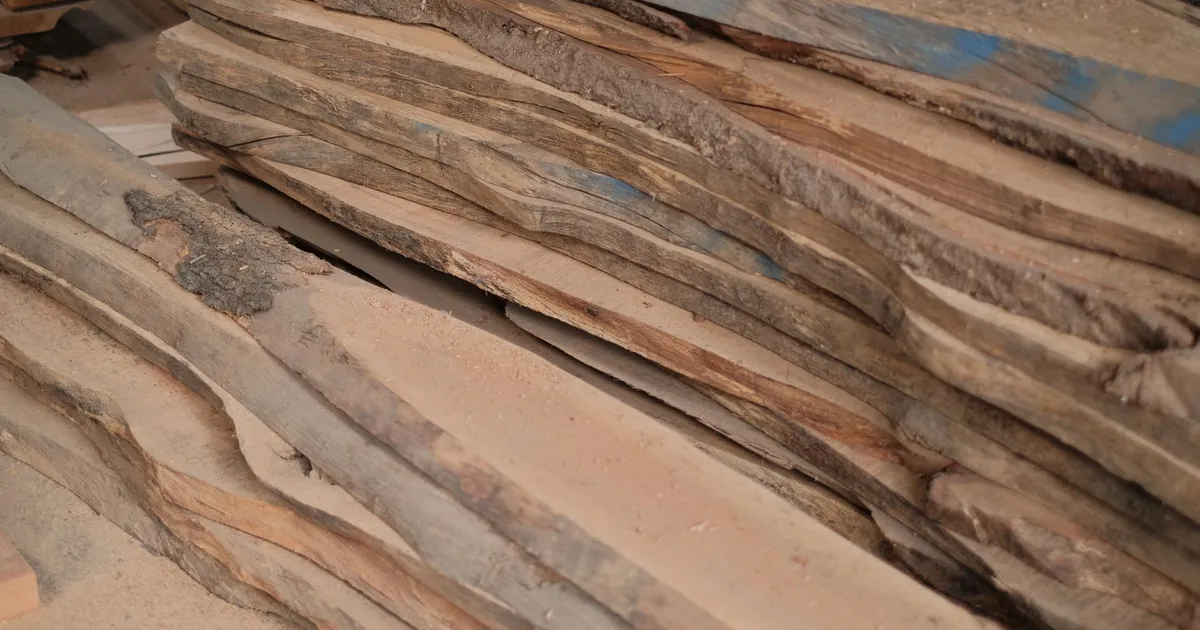
Live edge slabs and thick stock sit outside the usual lumber trade. There is no standard grade, the pieces are one of a kind and drying takes years instead of weeks. Table makers, furniture studios, bar and restaurant builders and designers all buy them, and wholesale buyers who handle them in volume need to understand what is different.
This guide covers what slabs and thick stock are, how drying works, how to read size and quality terms, what rules apply to bark and shipping, and what to put on an RFQ so you can compare suppliers.
What the terms mean
- Live edge. The natural outer edge of the tree, with or without bark, left on the board. The edge may be smooth wood, rough wood or covered in bark.
- Slab. A thick, wide cut taken lengthwise from a log, normally 2 in or thicker, usually 8/4 to 16/4 and sometimes more. Slabs from the center of a log may include the pith and have cracks.
- Flitch. A stack of slabs from the same log, kept in the order they were sawn, so you can bookmatch them.
- Bookmatch. Two adjacent slabs opened like a book, with mirrored grain, for a wide table top.
- Thick stock. Squares and boards thicker than normal lumber, for example 8/4 to 16/4, for legs, beams, bar tops and benches.
- Crotch and burl pieces. Highly figured sections from where limbs meet the trunk or from growths on the tree. They are priced separately.
Typical sizes
| Item | Typical thickness | Typical width | Typical length |
|---|---|---|---|
| Table slab | 2 to 3 in | 20 to 40 in or more | 6 to 12 ft |
| Thick slab | 3 to 4 in or more | 24 to 50 in or more | 6 to 10 ft |
| Thick lumber | 8/4 to 12/4 | 6 to 14 in | 8 to 12 ft |
| Squares and legs | 3 to 6 in square | 3 to 6 in | 3 to 8 ft |
Sizes depend on the species and the log. A walnut log gives slabs in a different size range from a sycamore log. The seller’s catalog lists sizes by slab, and the width can change along the length.
Why drying is the central issue
Thick wood dries from the outside in. Water in the core travels slowly to the surface, and the surface can reach low moisture while the core is still wet. The mismatch creates stress, which shows as cracking, cupping and twisting as soon as the slab is cut, flattened or finished.
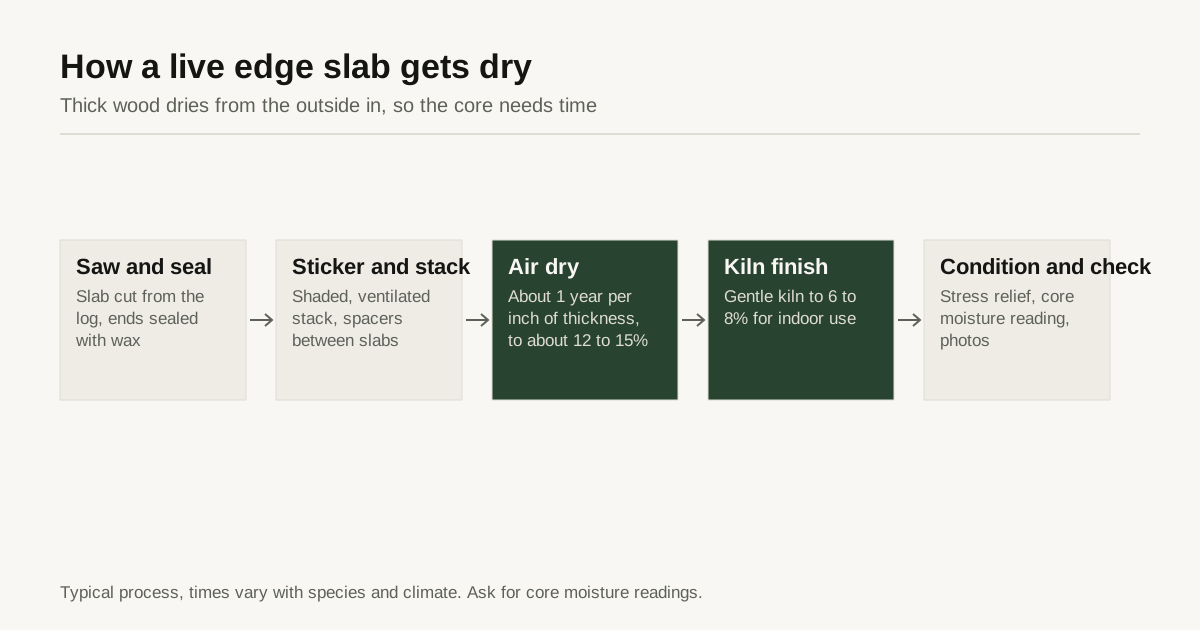
Typical drying path:
- End sealing. Wax or sealer on the ends slows water loss at the ends, where checks start first.
- Air drying. The slabs are stickered and stacked in a shaded, ventilated shed or yard. A common rule is about one year per inch of thickness in a temperate climate. Air drying usually stops at about 12 to 15 percent in many regions.
- Kiln finishing. The slabs go into a kiln to reach the final moisture content for indoor use, normally 6 to 8 percent. Many kilns for slabs are dehumidification or vacuum kilns, which dry more gently than a conventional kiln. Thick slabs often need weeks of kiln time.
- Conditioning. A conditioning step reduces stress after drying. Without it the slab may cup or twist when cut.
| Thickness | Air dry (rule of thumb) | Kiln time (typical range) |
|---|---|---|
| 8/4 (2 in) | about 1 to 2 years | a few weeks |
| 12/4 (3 in) | about 2 to 3 years | several weeks |
| 16/4 (4 in) | about 3 to 4 years | many weeks, often two months or more |
Times vary widely with species and the drying method. The figures are typical and not guarantees.
Our kiln drying guide explains schedules and stress in more detail.
Checking moisture in a thick slab
A surface reading on a slab says little about the core. For a thick slab:
- Use a pin meter with insulated pins and drive them to the center, or take readings through the thickness from the end.
- Take readings in several places along the length, and at the ends and the middle.
- Compare the core with the surface. A wide gap signals stress and a risk of movement.
- For disputes, oven-dry a small sample cut from the slab, as described in our moisture meter guide.
Ask the supplier for readings at depth, with photos, and for a statement of the drying method and the time.
Quality terms and defects
There is no NHLA grade for slabs. Suppliers use their own words, often something like select, table grade, character and rustic. These terms are not standard, so ask what each one means at this seller. Check:
- Cracks. Surface checks, through cracks and end splits. Fill with epoxy is common, so ask what is acceptable.
- Voids and inclusions. Holes from knots, insects and rot.
- Bark and the edge. Whether the bark is on or off, whether it is stable or loose, and the shape of the live edge.
- Sapwood. Wide sapwood bands change the look, especially in walnut.
- Flatness. How much cup, bow and twist the slab has, and whether it has been flattened.
- Thickness consistency. A slab can be thicker at one end.
- Grain and figure. Curl, spalting, burl or other features that add value.
Photos of the actual slab, in good light with a tape measure, are the only dependable way to buy at a distance. For wholesale lots, ask for a photo of each slab or a contact sheet with an ID number that matches the invoice.
Species
Typical species in the slab and thick stock trade include black walnut, maple (including big-leaf maple), white and red oak, sycamore, cherry, ash, elm, locust and several others. Walnut is the premium slab species in most markets. Species with high color contrast, such as walnut and spalted maple, command a premium. Our guide to steamed vs unsteamed walnut explains color treatment for walnut slabs.
Pricing and wholesale terms
Slabs are priced in different ways:
- By the board foot, with a price per board foot that depends on thickness, width, species and quality. The volume uses the nominal thickness, so a slab measured at 3 in is 12/4.
- By the slab, with a price for each piece after sorting.
- By the lot, with a mixed set at a discount. Lots are cheaper per board foot and need more sorting on arrival.
- By the cubic foot or meter, in export trade.
Check how the board foot is measured. Slab width is not constant, so suppliers use an average or the widest or narrowest point. Our guide to board feet and pricing explains tally methods. The same slab can show a different board foot figure with a different method, so agree on one in the contract.
Shipping, weight and paperwork
Slabs are heavy and awkward. A dry walnut slab 3 in thick, 30 in wide and 8 ft long holds about 5 cubic feet of wood, which at a typical 40 pounds per cubic foot comes to about 200 pounds. A container load of slabs is often limited by volume, since slabs stack with air gaps, and by the need to protect the edges.
Practical points:
- Slabs ship on A-frames, in crates or stacked on pallets with spacers, and are wrapped to protect from damp.
- Crates and pallets used for export need the ISPM 15 mark.
- Bark is an important point. Many countries treat bark-covered wood as higher risk, and live edge slabs may need treatment, debarking or both. Heat treatment of a thick slab takes longer than for a thin board, because the core must reach temperature. See our guide to phytosanitary rules.
- Legality documents apply as for other lumber, with species and country of harvest.
Our container loading guide shows how bundles and tally work for ordinary lumber, and slabs need more care with spacers and bracing.
What to put on the RFQ
- Species and the figure or feature you want
- Form: slabs, flitches, thick boards or squares
- Thickness, width range and length range
- Live edge rules: bark on or off, edge condition
- Drying: air dried, kiln dried, final moisture at the core, and the method
- Defect limits: cracks, voids, sapwood, flatness
- Photos: of each slab or a contact sheet with ID numbers
- Tally method and the unit
- Packing and shipping: crates, spacers, documents, treatment for bark
Closing checklist
- Decide the thickness and size range for your products
- Ask for core moisture readings and the drying history
- Agree on terms for quality, since there is no standard grade
- Buy from photos of the actual slabs
- Check bark and treatment rules before export
If you want slabs and thick stock quoted by several suppliers, send your lumber RFQ with the species, thickness range and moisture requirement. We pass it to up to 3 mills or yards that supply slabs, and they reply to you directly.
Frequently asked questions
How long does it take to dry a thick slab?
A common rule of thumb is about one year of air drying per inch of thickness in a temperate climate, followed by kiln finishing to reach 6 to 8 percent for indoor furniture. Real times vary with species, climate and stacking. Ask a supplier how long the slabs were dried and how the core moisture was checked.
What moisture content should a table slab have?
For indoor furniture most makers want 6 to 8 percent in the core, not only at the surface. Air dried slabs typically stop around 12 to 15 percent in many climates and need kiln finishing. A slab that is dry on the outside and wet inside will crack or move after it is flattened.
Is there a grade for live edge slabs?
Not under the NHLA rules, which grade standard boards. Sellers use their own terms such as table grade, character or select. Ask for photos of the actual slabs with a tape measure, and agree on limits for cracks, bark, voids and sapwood.
Know what you need? Send the spec.
Tell us the species, grade, thickness and board feet. We pass it to up to 3 mills or yards that carry it and reply within 24 business hours.
Send my lumber RFQ