Guides / Cost and Ordering
Hardwood Lumber Market in 2027: What Supply, Demand and Policy Mean for a Buying Plan
April 6, 2027
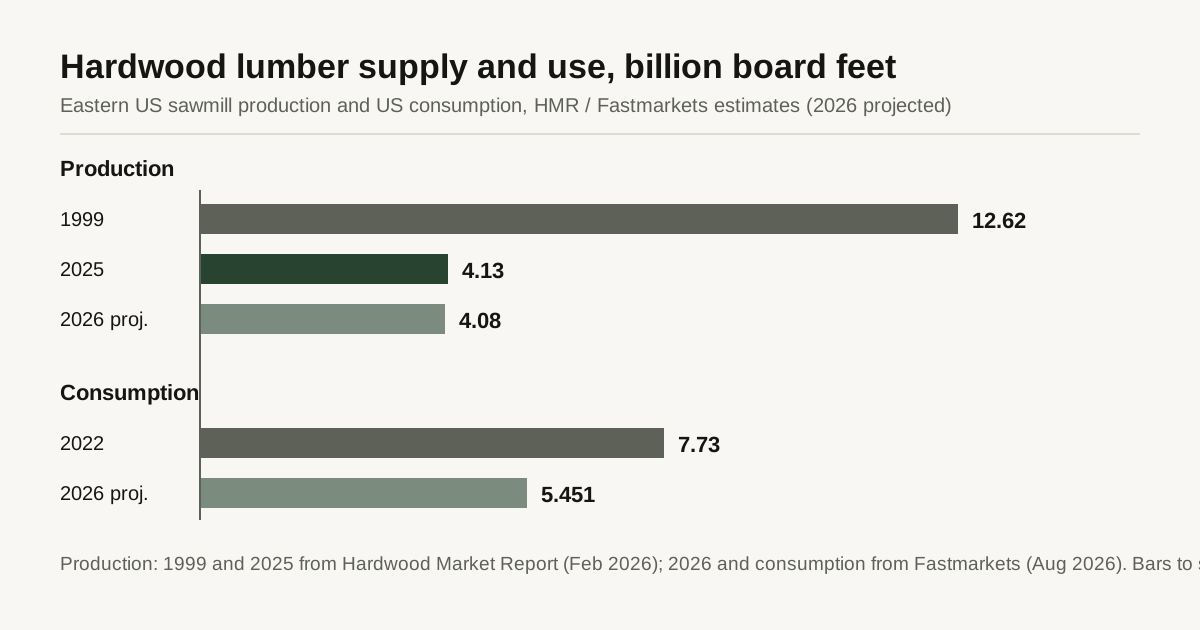
As of 22 October 2026, no trade body or research group has published a 2027 forecast for hardwood lumber prices that I could open. What is published points one way on supply and the other on demand. Eastern US hardwood sawmill output is projected at 4.08 billion board feet (BBF) in 2026, the lowest since the Hardwood Market Report began tracking in 1960. Consumption is flat near 5.45 BBF, and the National Association of Home Builders (NAHB) expects single-family building to fall again in 2027. This guide sets out the numbers, who made each one and how to plan buying around the gaps.
What is known and who said it
| Item | Figure | Source and date |
|---|---|---|
| Eastern US sawmill output, 2025 | 4.13 BBF, lowest in at least 65 years, 16.5% below 2024 | Hardwood Market Report (Fastmarkets), February 2026 |
| Output, 2026 | 4.08 BBF projected, lowest since tracking began in 1960 if the trend holds | HMR and Fastmarkets, July 2026 estimates |
| Consumption, 2026 | 5.451 BBF projected, roughly flat on 2025, 7.73 BBF in 2022 | HMR and Fastmarkets, July 2026 estimates |
| Sawmill closures | 35 hardwood sawmills closed in 2025 | NHLA estimate, quoted by Fastmarkets |
| Jobs | about 40,000 hardwood jobs lost since 2022 | NHLA estimate, quoted by Fastmarkets |
| Exports, January to June 2026 | just over $841 million, volume down just over 2% and value down 3% on 2025 | AHEC, on the NHLA site, 6 October 2026 |
| Single-family starts | 2026 the second straight yearly decline, further decline expected in 2027 | NAHB, 1 October 2026 |
| Home improvement spending | $523 billion by early 2027, up 0.5% on a year earlier | Harvard Joint Center LIRA, May 2026 |
| 30-year mortgage rate | 7.03% on 24 September 2026, highest since January 2025 | NAHB, 1 October 2026 |
Forecasts are labeled with whoever made them. The Fastmarkets article of 13 August 2026 gives no 2027 numbers at all, and neither does the NAHB post beyond the direction of single-family starts. I did not find a free hardwood price index to cite, and the Hardwood Review price tables are behind a subscription I do not have, so the price section below uses commentary, not a series.
Supply: thin because mills are closing
Production in the Eastern US fell to a 65-year low in 2025. The Hardwood Market Report put the annualized rate through November at 4.12 BBF, down 45.7% from the pre-Covid year 2019 and 67.3% from the 12.62 BBF record of 1999. The August 2026 projection of 4.08 BBF for 2026 is a further small fall. Grade and industrial lumber output is at record lows, according to the same Fastmarkets article.
Behind the number are closures. NHLA counts 35 mills closed in 2025 and Fastmarkets says the 2026 count is probably higher, with sawmills and concentration yards in the Southern, Appalachian and Northern regions closing or announcing closure within six months in early June. Owners interviewed cited a lack of family succession and a lack of buyers. For a buyer this means two checks: whether your mill or yard is still in business in a year, and whether the one you rely on has a successor.
Total supply, including imports and Western production, has been below demand since 2022, Fastmarkets says, yet the same article reports no severe shortage of any species and a weak market for most green grades. Both are true because demand has dropped further than supply.
Demand: flat, and structurally lower
Consumption was 7.73 BBF in 2022 and is projected at 5.451 BBF in 2026. Over the longer run the Hardwood Market Report shows where the volume went between 1999 and 2025:
| End use | Change in consumption, 1999 to 2025 |
|---|---|
| Pallets | down 2.7 BBF |
| Furniture | down 2.4 BBF |
| Moulding and millwork | down 985 million board feet |
| Cabinets | down 949 million board feet |
| Flooring | down 866 million board feet |
The article also says pallet and container makers moved from about 80% hardwood to about 80% softwood. Fastmarkets adds that consumers are shifting to engineered and look-alike products.
The two end uses that matter most to a buyer of grade lumber, cabinets and flooring, depend on housing and remodeling. On 1 October 2026 NAHB reported that the 30-year mortgage rate averaged 7.03%, builder sentiment fell to 32, and NAHB said 2026 would be the second straight year of decline in single-family building. The Remodeling Input Price Index rose 6.6% over the year. In May 2026 the Harvard Joint Center projected home improvement spending of $523 billion in early 2027, growth of 0.5%, which is below inflation. For the full picture on grade demand see our guides to what moves hardwood lumber prices and what cabinet shops expect from a vendor.
Prices: low on the mill side, rising costs behind them
On prices, I can only report commentary. Fastmarkets said in August that green 4/4 FAS and 1F white oak was at its lowest in at least 2.5 years in all three producing regions, and that most green grades and species were in the doldrums. NHLA’s liaison wrote in September that log costs are high and lumber prices low, leaving mills little margin, and that inspectors reported buyers scrutinizing grades more closely and sometimes asking for price cuts. White oak and stave markets were described as under severe pressure.
Costs are going the other way. An NHLA article cites producer prices up 3.4% on the year and diesel up 13.9% in one month, and Fastmarkets says diesel has risen sharply since February 2026 because of the US and Iran conflict. High mill costs and weak selling prices together are the reason more mills close, which can make supply thinner later even if demand does not recover. This is an inference, not a forecast I found.
Trade and policy that could change a 2027 order
- Exports. Exports in the first half of 2026 were about $841 million and the slowest January to June since 2010. See our export data page for markets and species.
- EU deforestation rules. The European Commission, as cited by NHLA, lists 30 December 2026 as the date the EU Deforestation Regulation applies to timber and wood products. Our EUDR guide for hardwood importers covers what is filed.
- Section 232 duties. Under the December 2025 amendment, the duty on kitchen cabinets and vanities rises from 25% to 50% on 1 January 2027 and on upholstered wooden seating from 25% to 30%, unless an agreement exempts a country. The text I read covers softwood timber and lumber at 10% and does not name hardwood lumber. See the Section 232 guide.
- Cabinet trade case. NHLA reports that the Kitchen Cabinet Manufacturers Association backs a trade case over cabinet imports from several Asian countries, as of 22 July 2026. I did not read the case filing.
A buying plan for a year with no forecast
- Buy by program, not by spot price. With weak mill prices and no public forecast, a short list of species and grades with set volumes per quarter, quoted on one basis, is easier to defend than chasing the lowest offer. Our guide to board feet and hardwood pricing sets the basis.
- Check mill viability. Ask a supplier how long it has run, its log supply and who owns it. Our supplier red flags guide lists the checks.
- Keep a second source for each species. A closure can remove a source with a few months of notice.
- Add tariff and rules clauses. A purchase order should say who pays if a duty or document rule changes between order and entry.
- Read white oak both ways. Green white oak prices are at a 2.5-year low, which favors a buyer, but a mill or stave producer under that pressure may also be a supplier at risk.
To get quotes from mills that say they can supply your species and grade, send your lumber RFQ with the species, grade, thickness, board feet and destination. We pass it to up to 3 mills or yards, and they reply to you directly.
Sources
- Fastmarkets, Hardwood industry decline deepens (Ben Stanley, 13 August 2026)
- Building Products Digest, US hardwood lumber supply contracts to historic low (Andy Johnson, HMR, 10 February 2026)
- NHLA, Where Hardwood is Losing Value (Brennah Hutchison, September 2026)
- NHLA, In a Tightening Market, Connection is Your Advantage (5 May; the page shows no year, the site footer reads 2026)
- NHLA and AHEC, Uncharted Territory: Hardwood Exports in a Chaotic World (6 October 2026)
- NAHB, Housing Headwinds Intensify Heading Into 2027 (1 October 2026)
- Hardwood Floors magazine, Remodeling Growth to Slow Sharply in Early 2027 (Harvard LIRA, 15 May 2026)
- White House, Amendments to the timber and lumber proclamation (31 December 2025)
Frequently asked questions
What is the outlook for the hardwood lumber market in 2027?
No public 2027 forecast for hardwood production or prices was found as of October 2026. What is known: Eastern US sawmill output is projected at 4.08 billion board feet in 2026, a record low, consumption is flat near 5.45 billion, and NAHB expects single-family building to decline again in 2027.
Is hardwood lumber supply short in 2026?
Production is at a record low, and Fastmarkets says total supply has been below demand since 2022, yet it also reports no severe shortages of any species and weak green lumber prices. Supply is thin because mills have closed, while demand has fallen even further.
Are hardwood lumber prices going up in 2027?
No published forecast says so. As of August 2026 Fastmarkets reported green 4/4 FAS and 1F white oak at its lowest price in at least 2.5 years in all three producing regions, with most green grades and species weak. Costs for logs, fuel and labor are rising, which squeezes mills more than it lifts prices.
What policy dates matter for hardwood lumber buyers in 2027?
The EU Deforestation Regulation applies from 30 December 2026 for large operators according to the European Commission as cited by NHLA, and the Section 232 duties on cabinets and vanities are scheduled to rise to 50% on 1 January 2027. Hardwood lumber itself is not on the Section 232 list in the texts I read.
Know what you need? Send the spec.
Tell us the species, grade, thickness and board feet. We pass it to up to 3 mills or yards that carry it and reply within 24 business hours.
Send my lumber RFQ