Guides / Cost and Ordering
Hardwood Lumber Purchase Order: The Clauses to Fix Before You Place the Order
March 6, 2027
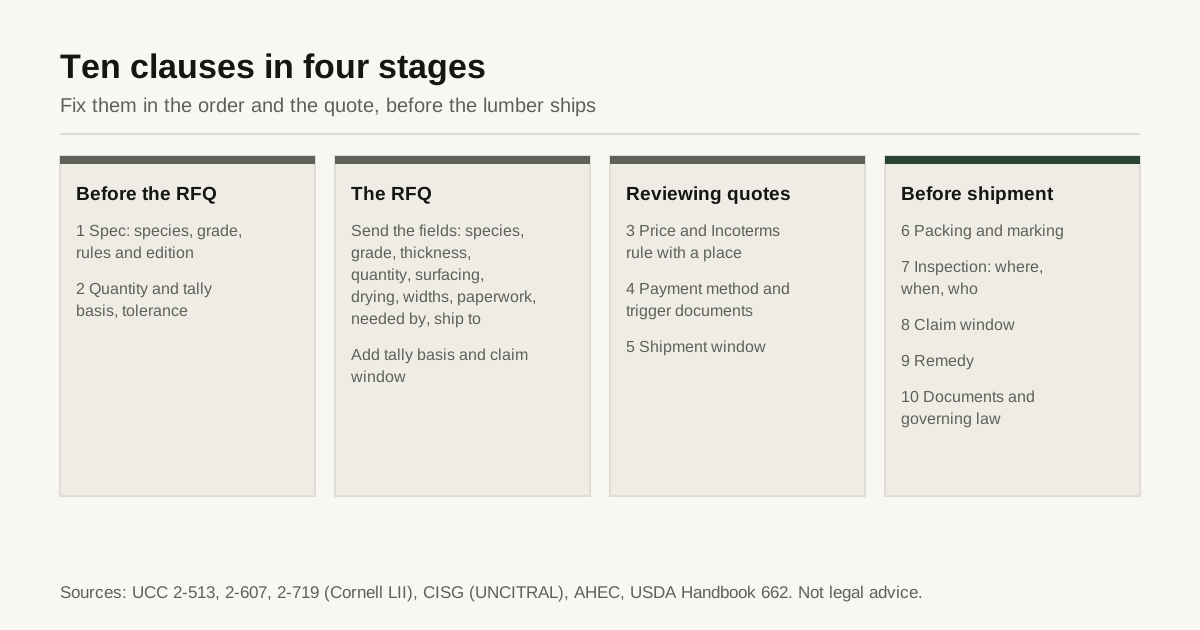
A hardwood lumber purchase order is the written offer that turns a quote into a contract, and it should fix ten things before anyone cuts or ships a board: the spec, the quantity and tally basis, the price and delivery term, the payment, the shipment window, packing and marking, inspection, the claim window, the remedy and the documents and governing law. This post is part of our guide to wholesale hardwood lumber. It follows four stages, from before the RFQ to before shipment, and gives wording you can adapt.
Hardwood Vendor is a matching service, not a sawmill. We own no mills, kilns or stock and we name no seller. Buyer and supplier deal directly. This is general information as of October 2026, not legal advice. The rule texts I quote are US and international sales law, and your contract and the law that governs it decide what applies.
The clauses at a glance
| Clause | What to write | Why it matters |
|---|---|---|
| Spec | Species, grade and rule book with edition, cut, thickness, surfacing, widths and lengths, drying target | A description that is part of the bargain creates a promise that the goods match it (UCC 2-313); the CISG asks for the quality and description the contract requires (Article 35) |
| Quantity and tally | Unit, net or gross, rounding rule, tolerance | A gross tally can mean about 7% fewer board feet after drying (AHEC) |
| Price and term | Price per unit, currency, Incoterms rule with a named place | Fixes who carries cost and risk where |
| Payment | Method, dates, documents that trigger payment | Credit descriptions and dates must match the order (USDA) |
| Shipment window | Ready to load by a date, partial shipments allowed or not | Lets you plan the plant |
| Packing and marking | Bundles, strapping, wrap, tags, tally sheet | Bundles should be clearly marked and secured (USDA) |
| Inspection | Where, when, by whom, at whose cost | A place or method fixed by the parties is presumed exclusive (UCC 2-513) |
| Claim window | Days for written notice, hold-intact duty | Notice within a reasonable time, or the remedy is lost (UCC 2-607, CISG 39) |
| Remedy | Credit, replacement or return, and limits | Parties may set remedies and limit consequential damages (UCC 2-719) |
| Documents and law | Invoice, tally, transport and legality papers; governing law | The CISG may apply unless excluded (Article 6) |
Caption: Cornell LII for UCC sections 2-313, 2-513, 2-607 and 2-719, the UNCITRAL text of the CISG, AHEC and USDA Agricultural Handbook 662 (2002). The UCC text is a model; each state adopts its own version.
Stage 1: before the RFQ
Settle what your plant needs before a supplier sees it. For each item the “why” is below it.
- The spec, line by line. Species and sorts, grade with the rule book and edition, cut, thickness in quarters, surfacing, widths and lengths and the drying target. Why: the order has to describe the goods before it can be breached. Good looks like: “4/4 red oak, plain sawn, NHLA grade No.1 Common and better under [rule book and edition], rough, random widths and lengths, kiln dried to [range] percent.”
- The tally basis you will accept. Net after drying, measured, with the rounding rule. Why: AHEC says a buyer on a gross tally can expect about 7% fewer board feet. Our guide to the hardwood lumber tally shows the arithmetic.
- The quantity and the tolerance. A volume, the unit and a plus or minus percentage. Why: the Purdue summary of the NHLA sales code, from the 1998 rules, uses thresholds in a national inspection, such as a lost claim when the value is within 4% of the invoice and a right to reject when more than 20% of the footage fails the order. Those figures belong to that code, apply to a national inspection and bind only if your contract says so. Write your own.
- The delivery point and the documents you need. Port or plant, and any plant health, legality or origin papers your route requires. Why: the seller has to know before pricing.
Stage 2: the RFQ
Our RFQ form asks for the fields that feed the clauses above: species, grade, thickness, quantity and unit, surfacing, drying, widths and lengths and any limits, paperwork you need, needed by, ship to and a region. Add a note on tally basis and the claim window. Attach photos or a sample if appearance matters. Send your lumber RFQ when the list is complete. We pass it to up to 3 mills or yards that say they carry it and they quote you directly.
Stage 3: reviewing quotes
Put each quote on the same basis, then check the clauses it leaves out.
- Tally and tolerance. Is the footage net or gross, and does the quote state the rounding rule? Why: gross and net quotes are not comparable.
- Incoterms rule with a place. Write the rule and the exact place, for example “FCA [mill yard]”, never “FOB” alone. Our hardwood export price quote guide explains FCA, FOB and CIF. Why: they fix who carries cost and risk.
- Validity. How long does the price hold? Why: an open price can change before you order.
- Payment. If the supplier asks for a letter of credit, the USDA export handbook’s checklist asks whether the credit describes the goods and unit prices as in the sale contract and whether shipping and expiry dates allow time to present documents. Our guide to lumber import payment terms compares credits, collections and deposits. Why: a mismatched credit can fail.
- Landed cost. Compare offers per usable board foot, not per quoted board foot. Our hardwood lumber landed cost guide shows how. Why: the lowest quote can carry extra freight or waste.
- Lead time. Ask for a ready-to-load date and what it depends on; see our guide to hardwood lumber lead time. Why: drying sets the real date.
Stage 4: before shipment
- Issue the order. Refer to the quote by number and date and attach the spec as part of the order. Under the UCC an express warranty comes from a description that is part of the basis of the bargain, and a sample or model that is part of the bargain creates a warranty that the whole of the goods will match it. Keep the sample reference with the order. Why: the promise attaches to the description.
- Fix inspection. Under UCC 2-513 a buyer may inspect before payment or acceptance at any reasonable place and time, except where the contract calls for payment against documents or on C.I.F. terms, and a place or method fixed by the parties is presumed exclusive. Name an independent inspector if you want one. Why: a fixed place or method is presumed exclusive. Purdue’s summary says the NHLA offers an inspection service on a fee plus expenses basis for members and non-members.
- Ask for the tally and photos before the container is sealed. The USDA export handbook says bundles should be securely strapped and clearly marked. Why: you cannot check after sealing.
- Match the documents. The order, the invoice, the tally and any credit should use the same species, grade, unit and quantity wording. The USDA handbook lists mismatched documents among the common reasons a credit payment fails. Why: a mismatch can hold payment.
Claim window and remedy
Write the claim terms into the order, because the default is a reasonable time with no number. UCC 2-607 says that after acceptance the buyer must notify the seller of a breach within a reasonable time after discovering or when it should have discovered it, or be barred from any remedy, and that the burden of proving the breach is on the buyer. CISG Article 38 says the buyer must examine the goods within as short a period as is practicable and, when the goods are carried, examination may wait until they arrive. Article 39 says the buyer loses the right to rely on a lack of conformity unless it gives notice specifying its nature within a reasonable time, and in any event within two years of actual handover unless a guarantee period says otherwise.
The Purdue summary of the NHLA sales code (1998 rules) gives 14 days from receipt to file a claim with the lumber left intact, and says the code binds only if the contract names it. I found no current public NHLA text I could open to check the numbers, so use them only as a model. Our lumber quality claim guide differs: it found no public hardwood deadline and quotes a 5% loser-pays figure from a forum answer, while the Purdue summary gives 14 days and 4%, both from the 1998 rules. Our guide to the lumber quality claim shows the evidence to keep.
Sample wording to adapt: “Buyer will give written notice of any grade, tally or moisture nonconformity within [number] days of receipt and will hold the disputed lumber unaltered at [address] for [number] days. Remedy is, at the buyer’s choice, credit, replacement or return at seller’s cost. An independent inspector agreed by both parties decides disputed grade or tally, and the party whose position is not upheld pays the inspector.”
Parties may set remedies and limit consequential damages under UCC 2-719, unless the limit is unconscionable or the remedy fails of its essential purpose.
Law, documents and red flags
The CISG applies to sales between businesses in different Contracting States, and the parties can exclude it (Article 6) or choose another law. Say which law governs and where disputes are heard. Ask counsel.
The USDA handbook’s list of shipping documents includes the pro forma invoice, the export packing list, the bill of lading, the insurance certificate and, where needed, a phytosanitary certificate. Name which of these the seller issues and which legality records you need.
Red flags before you sign:
- The grading rule is named without an edition, or not at all.
- “MBF” appears with no net or gross label.
- The quote says “FOB” with no place.
- Payment is due before any document or photo is shared.
- The claim window is shorter than the time the lumber takes to arrive.
- The seller will not put the spec into the order.
Check the order before you sign
Read the order out against the table at the top. If a clause is missing, ask for it in writing. When the spec is final, send your lumber RFQ with the same fields. The full buying sequence is in our guide to wholesale hardwood lumber. We reply within 24 business hours, and the suppliers quote you directly.
Sources
- Cornell LII, UCC 2-313 Express warranties by affirmation, promise, description, sample
- Cornell LII, UCC 2-513 Buyer’s right to inspection of goods
- Cornell LII, UCC 2-607 Effect of acceptance; notice of breach
- Cornell LII, UCC 2-719 Contractual modification or limitation of remedy
- UNCITRAL, United Nations Convention on Contracts for the International Sale of Goods (CISG), text
- Purdue Extension, FNR-130 Hardwood lumber grades (summary of the 1998 NHLA rules and sales code)
- USDA Foreign Agricultural Service, A Guide to Exporting Solid Wood Products, Agricultural Handbook 662 (revised January 2002)
- American Hardwood Export Council, measurement: board feet, tally and kiln dried
Frequently asked questions
What should a hardwood lumber purchase order include?
The full spec with the grading rules and edition, quantity with the tally basis and tolerance, price and currency, an Incoterms rule with a named place, payment terms, shipment window, packing and marking, where and how the lumber is inspected, the claim window and remedy, the documents the seller issues and the governing law. Each one removes a dispute.
How long do I have to claim on a lumber order?
It depends on the contract. The NHLA sales code binds only when the contract says it governs, and Purdue's summary of the 1998 rules gives 14 days from receipt with the lumber left unaltered. Under the UN sales convention notice is due within a reasonable time, and never later than two years after handover unless a guarantee period says otherwise.
Does the UN sales convention apply to my lumber purchase?
It can. The UNCITRAL page says it covers sales of goods between businesses in different Contracting States, and Article 6 lets the parties exclude it. Many contracts choose another law instead. Ask counsel which law applies and write the choice into the order.
Should the purchase order match the letter of credit?
Yes. The USDA export handbook's checklist for reviewing a credit asks whether goods descriptions and unit prices match the sale contract and whether shipping and expiry dates leave time to present documents. Copy the species, grade and unit wording from the order into the credit and the invoice exactly.
Know what you need? Send the spec.
Tell us the species, grade, thickness and board feet. We pass it to up to 3 mills or yards that carry it and reply within 24 business hours.
Send my lumber RFQ