Guides / Cost and Ordering
Hardwood Lumber Lead Time: Stock, Sawn to Order and Kiln Wait, Step by Step
March 5, 2027
Hardwood lumber lead time is the time from your order to the day the lumber is ready to load, and it depends on one question first: is the item already dried, graded and packed in the yard? If yes, lead time is days. If it must be sawn, dried and graded for you, the drying step alone takes weeks, and the sourced figures below show why. This post is part of our guide to wholesale hardwood lumber. It walks the steps from stock check to loading and tells you what to ask at each one.
Hardwood Vendor is a matching service, not a sawmill. We own no mills, kilns or stock and we name no seller. This is general information as of October 2026. I found no public survey of sawing queues, kiln backlogs or end-to-end lead times, so for those steps the post says so instead of giving a number.
Before you start
You need your spec (species, grade, thickness, quantity), the date you need the lumber ready to load and a supplier who will answer in writing. Allow about an hour to read a quote and write the questions. You do the asking and the supplier answers; no one else is required until the container booking, where a freight forwarder helps.
What sets the time at each step
| Step | What sets the time | Public figure | Source |
|---|---|---|---|
| Stock check | Whether the item is in the yard now | None needed: days | The supplier’s dated stock list |
| Sawing to order | Log supply and the mill’s sawing queue | I found no public figure | Ask the supplier |
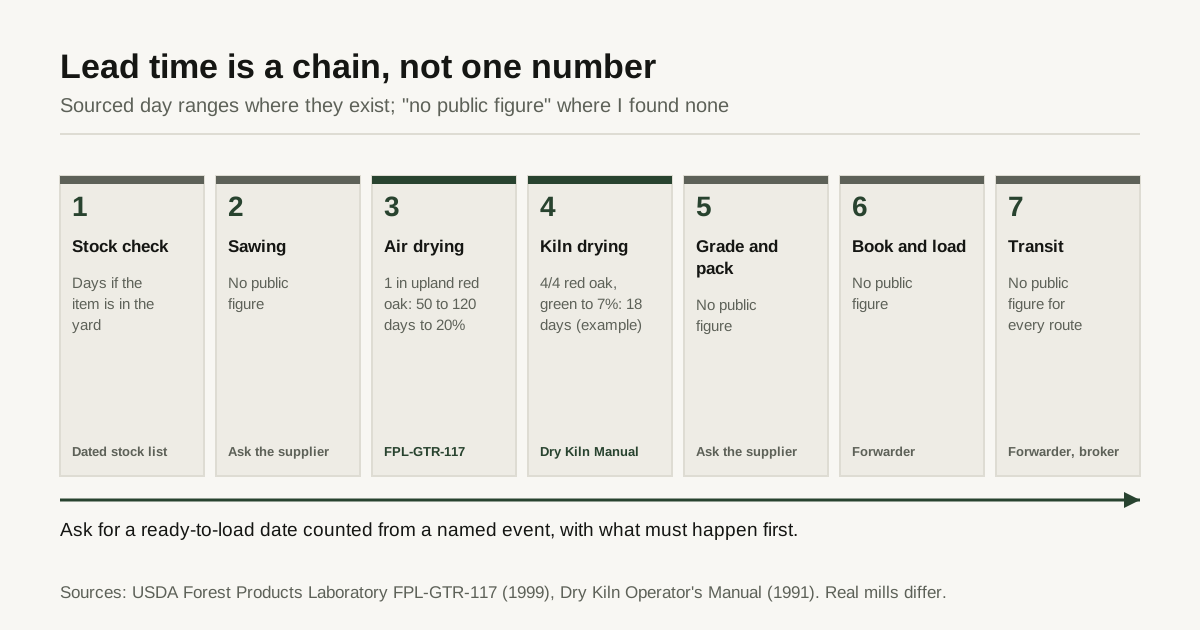
| Air drying | Species, thickness, season and region | 1 in upland red oak: 50 to 120 days in the South, Mid-South and Central regions, up to 165 in the Mid-North; 2 in: 190 to 360 days | FPL-GTR-117 (1999) |
| Kiln drying | Species, thickness, starting moisture, schedule | 4/4 red oak green to 7%: 18 days; 6/4: 32 days; 8/4: 55 days (examples) | Dry Kiln Operator’s Manual (1991) |
| Grading, surfacing and packing | Mill workload and the sorting you ask for | I found no public figure | Ask the supplier |
| Container booking and loading | Space on a vessel and loading arrangements | I found no public figure | Forwarder |
| Ocean transit and clearance | Route, carrier and customs | I found no public figure that fits every route | Forwarder and broker |
Caption: FPL-GTR-117 tables 7 and 8 give approximate times to reach 20% moisture; the Dry Kiln Operator’s Manual (Agriculture Handbook 188, revised August 1991) gives kiln examples for red oak. Both are old government documents and real mills differ. “No public figure” means I found none I could open.
Step 1: is it in stock now
Ask for the current stock list, its date and the footage for your item. A public kiln dried stock list from April 2026 shows some lines with a month beside them, which I read as stock still being accumulated, though I found no definition of the code. Treat such a line as not ready until the supplier confirms a date. Which seller type holds dried stock varies; our guide to sawmills, concentration yards and distributors compares the types.
Failure point: counting on a line that is not in the yard. Good output: “In stock now, 1,000 board feet, counted on [date].”
Step 2: sawing to order
If the item is not in stock, the mill has to saw it from logs it holds or buys. The time depends on log supply and the mill’s own queue, and I found no public figure. Ask what the mill holds now and what it would have to buy.
Failure point: a promise of a date with no mention of where the logs come from. Good output: a named date for the start of sawing and what it depends on.
Step 3: air drying, if the supplier uses it
The Dry Kiln Operator’s Manual says hardwood producers had typically air dried their lumber 60 to 90 days or longer before final drying in the kiln, and describes predryers as an alternative. Not every mill air dries, so ask. The USDA Forest Products Laboratory’s report Air Drying of Lumber (1999) gives approximate times to reach 20% moisture for green 1 inch lumber: 70 to 200 days for northern red oak in its species table, and for upland red oak by region 60 to 120 days in the South, 55 to 100 in the Mid-South and 50 to 90 in the Central region, with up to 165 days in the Mid-North. For 2 inch upland oak the report gives 190 to 360 days. Its text says 1 inch northern red oak is often air dried to about 20% in about 60 days in southern Wisconsin when piled in June or July, and that stock piled in late fall and winter must stay on sticks for 120 days or more.
The American Hardwood Export Council gives a different rule of thumb in its kiln drying note: air drying oak takes roughly a year per inch of thickness. The two do not agree, and the government report measures a target of 20% rather than the final moisture. I did not reconcile them. Use them as a range, and ask the mill how long its own yard takes for your species and thickness.
Failure point: a date that ignores the season the lumber was piled. Good output: “Piled [date], expected at 20% by [date].”
Step 4: kiln drying
The Dry Kiln Operator’s Manual (Agriculture Handbook 188, revised August 1991) gives an example from its figure on thickness: kiln drying red oak from green to 7% moisture might take 18 days for 4/4 lumber, 32 days for 6/4 and 55 days for 8/4. It adds that 4/4 oak can be dried green from the saw to 7% in 18 days instead of 21 to 28 days with an accelerated schedule for presurfaced stock. Our own guide to kiln drying schedules lists a typical range of 25 to 35 days for 4/4 red oak, which is above the manual’s 21 to 28 days; kilns, schedules and wet pockets explain differences, so ask the mill for its own schedule.
The manual also says 4/4 red oak can be kiln dried from 25 to 7% moisture in about one quarter of the time it takes from green. Air drying therefore shortens the kiln step but adds yard weeks. AHEC says American hardwoods are typically kiln dried to around 7 to 9%, given as 8% plus or minus 2; our kiln drying schedules guide lists 6 to 8 percent as the usual interior target, so the two differ by about a point. Write the range you need into the order, because a lot dried to the wrong range restarts the clock.
I found no public figure for kiln backlogs. Ask whether a kiln slot is booked for your lot, and what happens to your date if the kiln is full.
Failure point: confusing days in the kiln with days to deliver. Good output: “Kiln charge starts [date], target [range] percent, checked by [method].”
Step 5: grading, surfacing and packing
After drying, the lumber is graded, surfaced or ripped if you ordered that, bundled, strapped and tagged. The time depends on the workload and the sorting you ask for. I found no public figure. Ask for the tally and photos before the container is sealed, and see our purchase order guide for the clauses that fix packing and marking.
Step 6: booking, loading and transit
The 2002 USDA export handbook says a booking contract is mandatory to reserve space for cargo on a specified vessel and that the carrier can charge for reserved space that is not used or for cancellations without adequate notice. It also says a freight forwarder can help with the details. Its exporting checklist for a sale under a confirmed letter of credit puts the buyer’s purchase order, accompanied by a copy of the letter of credit when one is used, before the exporter prepares the order and the forwarder books a vessel. I found no public transit time that fits every route, so ask your forwarder for the sailing schedule on the day.
Failure point: promising a ready date before the booking is known. Good output: “Ready to load [date], cut-off for the vessel [date].”
What good output looks like
A good answer has a date, a trigger and a dependency for each step. Example wording to put in the quote or the order:
“Seller confirms the lumber described in the order will be ready to load at [place] on [date], counted from [receipt of deposit or signed order]. If the lumber is not in stock, sawing starts [date], air drying ends [date], kiln charge starts [date] and the target moisture is [range] percent. Seller will notify buyer in writing within [number] days if any date moves.”
Lead time checklist
- Is the item in stock now? Ask for the dated stock list.
- If not, which steps remain: sawing, air drying, kiln, grading, packing?
- What is the starting event for the clock, and does it include the deposit or credit?
- Which season will the lumber be piled in, and how long does the mill air dry?
- Is a kiln slot booked, and what is the target moisture?
- Who books the container, and what is the vessel cut-off?
- What happens to the date if the supplier slips, and who pays?
If you already know your spec and need a ready-to-load date, send your lumber RFQ. We pass it to up to 3 mills or yards that say they carry it, they quote you directly and we reply within 24 business hours. The whole buying sequence is in our guide to wholesale hardwood lumber.
Sources
- USDA Forest Products Laboratory, Air Drying of Lumber, FPL-GTR-117 (1999)
- USDA Forest Service, Dry Kiln Operator’s Manual, Agriculture Handbook 188 (revised August 1991)
- American Hardwood Export Council, Technical Matters 3: kiln drying
- USDA Foreign Agricultural Service, A Guide to Exporting Solid Wood Products, Agricultural Handbook 662 (revised January 2002)
- A sawmill’s public kiln dried stock list, April 2026 (format reference only, no prices used)
Frequently asked questions
How long does hardwood lumber take to ship?
It depends on whether the item is in stock. Stock lumber can load once the container is booked. Lumber sawn to order must be sawn, dried, graded and packed first, and drying alone takes weeks. I found no public figure for the whole chain, so ask each supplier for a ready-to-load date and what it depends on.
How long does it take to air dry hardwood?
The USDA Forest Products Laboratory estimates 50 to 120 days to reach 20% moisture for 1 inch upland red oak in the South, Mid-South and Central regions, longer in the Mid-North and for 2 inch stock. It adds that lumber piled in fall or winter usually waits until spring. AHEC gives a rule of thumb of about a year per inch for oak.
How long does kiln drying take?
The USDA Dry Kiln Operator's Manual gives 18 days from green to 7% moisture for 4/4 red oak, 32 days for 6/4 and 55 days for 8/4 as examples. It says red oak air dried to 25% needs about one quarter of the green kiln time. Real schedules vary by kiln, species and load.
What should a supplier put in writing about lead time?
A ready-to-load date counted from a named event such as the deposit or the signed order, what must happen first (sawing, drying, grading, packing), whether the lumber is in stock now and who pays if the date slips. Without a date and a trigger, the figure is only a hope.
Know what you need? Send the spec.
Tell us the species, grade, thickness and board feet. We pass it to up to 3 mills or yards that carry it and reply within 24 business hours.
Send my lumber RFQ