Guides / Choosing a Supplier
Sawmill, Concentration Yard or Distributor: Which Hardwood Lumber Seller Fits Your Order
March 7, 2027
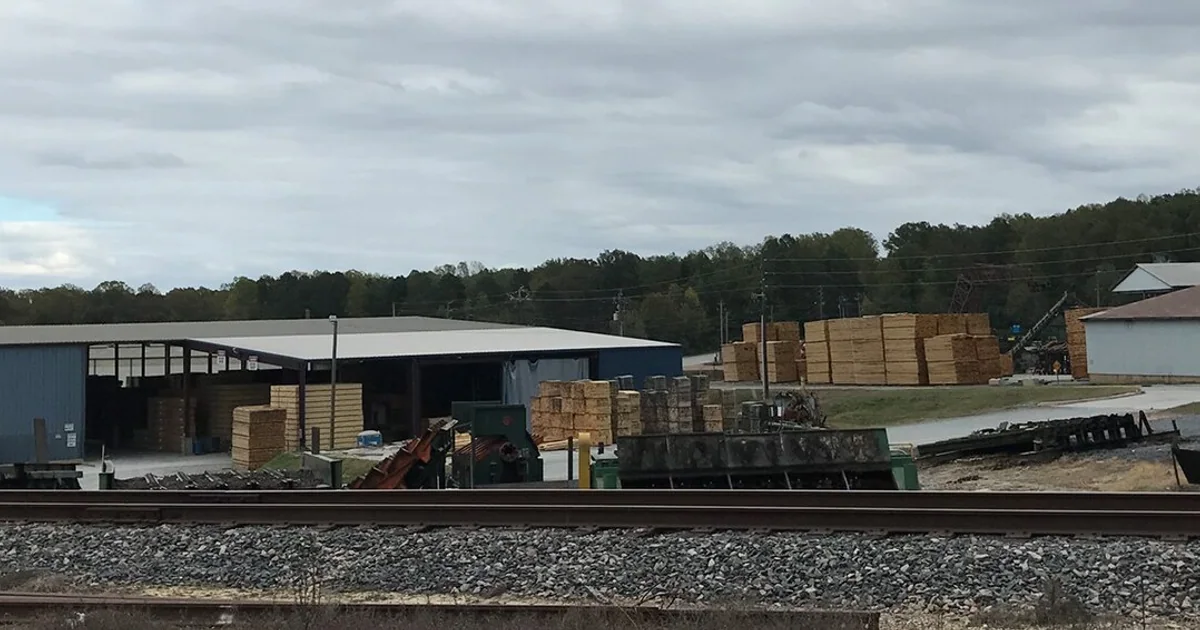
Pick the seller type from your order, not from a price list. A sawmill suits full lifts or truckloads of one species, grade and thickness. A concentration yard suits volume across several species and mills. A distribution yard suits mixed lots, surfaced or ripped stock and short delivery. This post is part of our guide to wholesale hardwood lumber and compares the three on order size, mix, sorting, drying, delivery and paperwork.
Hardwood Vendor is a matching service, not a sawmill. We own no mills, kilns or stock and we name no seller here. I found no public survey that defines these seller types or compares their prices, so the comparison below is trade usage, labeled as such, and the only seller page I quote is used as an example of one company’s own description.
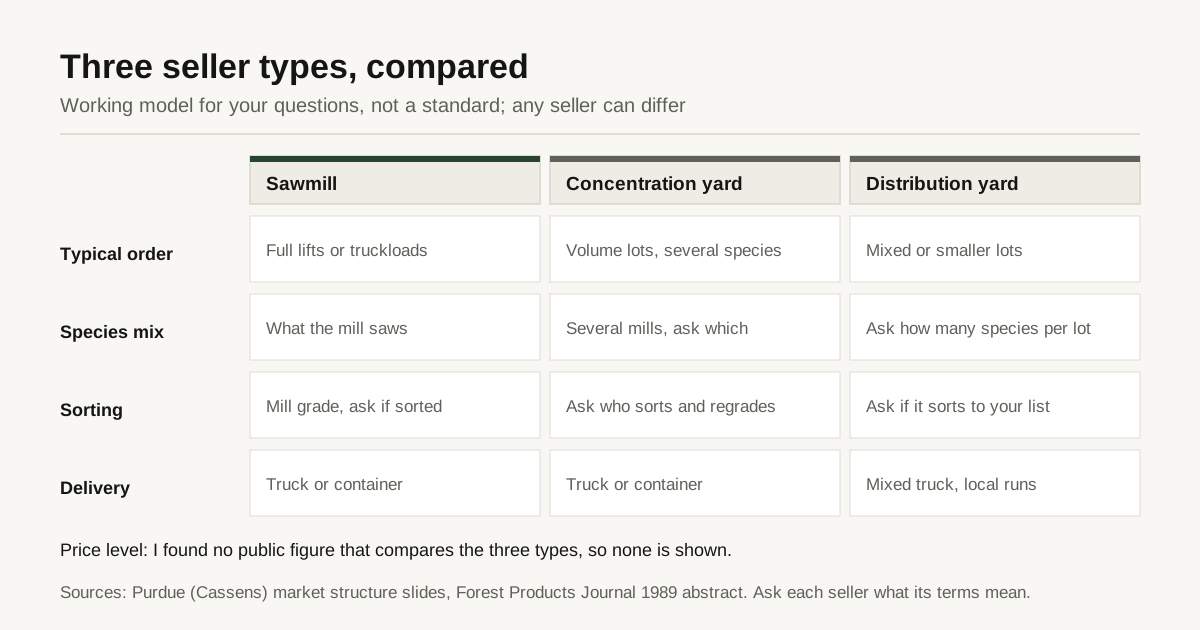
The three types side by side
The table is a starting point for your questions, not a rule book. Where no source supports a typical pattern, the cell says what to ask, and any seller can differ.
| Criterion | Sawmill | Concentration yard | Distribution yard |
|---|---|---|---|
| Typical order | Full lifts or truckloads | Volume lots, often several species | Mixed or smaller lots |
| Species and grade mix | What the mill saws locally | Several mills, ask which species | Ask how many species it carries per lot |
| Sorting and regrading | Mill grade, ask if sorted | Ask who sorts and regrades | Ask if it sorts to your list |
| Drying state | Green, air dried or kiln dried | Ask who dried the stock | Ask if the stock is kiln dried and when |
| Surfacing and ripping | Ask | Ask | Ask |
| Delivery | Truck or container from the mill | Truck or container | Mixed truck, small loads, local run |
| Origin records | Knows the logs it sawed | Holds records for each mill it buys from | Holds records for each source it buys from |
| Price level | No public figure | No public figure | No public figure |
Caption: a working model for your questions, not a finding. Only the type names come from the sources listed below and from the supplier types in our guide to choosing a hardwood lumber supplier; the cells that say “ask” are questions because I found no source that gives a pattern for that seller type. I found no public price comparison between the types, so the price row is empty on purpose.
What the three types are, and why the words blur
The Purdue market-structure slides by wood products professor Daniel Cassens (around 2010) list the types of supplier as large and small sawmills, wholesalers, concentration yards, distribution yards and retail outlets. They place wholesale quantities of hardwood grade lumber with end manufacturers, larger mills and concentration yards as buyers. A 1989 Forest Products Journal abstract says hardwood sawmills, depending on their size, sell lumber directly to end users, to concentration or distribution yards or to wholesalers. I could read only the abstract of that report.
Usage differs from place to place. The American Hardwood Export Council describes its exporter members as sawmills, veneer, moulding and flooring producers or traders with concentration yards and kilns.
One distributor’s own page, published in May 2026, calls the business distribution, brokerage and export, with deep kiln dried inventory, grading, surfacing and freight, and says it handles mixed loads, full trucks and export containers. That is one company’s marketing description. Treat it as an example of what a distributor can offer, never as a definition. When a seller says “yard”, ask what it buys, what it dries and what it sorts.
Order size and species mix
Order size usually decides the type before anything else. A plant that takes full truckloads of one species and grade fits a sawmill or a concentration yard. A shop that needs a few species in small lots each month fits a distribution yard. Our guide to board feet and pricing shows how to turn a cut list into the quantity you ask for.
I found no public minimum order for any seller type, so ask for the figure in writing. Ask separately for the minimum per item and the minimum for a mixed load. A seller that quotes a truckload price for a full unit may charge more per board foot for half a unit, and you should see both prices before you decide.
The 2011 study by Espinoza and colleagues surveyed US hardwood lumber manufacturers in fall 2009. Its abstract says customers were placing smaller, more frequent orders, that buyers asked for faster delivery and more customized products, and that intermediaries such as hardwood distributors gained a larger share of business. It is a dated survey of mills, not of buyers, so use it as background. A 2014 paper by the same authors exists; I could not open it.
Sorting, grade and drying control
A mill grades its own lumber and sells what it saws. A yard that gathers stock from many mills can sort and regrade it, and many dry it. These are capabilities to check, not promises. Ask each seller four things:
- Who grades the lumber and under which rules and edition?
- Is the stock sold green, air dried or kiln dried, and who dried it?
- Is the lot sorted by color, width or length, and is that written on the quote?
- Is the footage a net tally after drying or a gross tally before it?
The tally question matters most when you compare offers. The American Hardwood Export Council says a buyer on a gross tally can expect about 7% fewer board feet after kiln drying. Our guide to the hardwood lumber tally shows how to put two offers on one basis. A public kiln dried stock list from April 2026 states in its footer that pricing is quoted kiln dried, net tally, FOB the yard. It also shows lines marked with a month beside them, which I read as stock still being accumulated, though I found no definition of the code. Ask when a line will be ready before you count on it.
Price level and what you pay for
Prices differ by seller type, but I found no public figure that compares them, and I will not guess one. What a buyer can see is what the price covers. A mill price at the gate usually covers lumber on the mill’s own grade and tally. A distributor price may also cover sorting, surfacing, mixed loads and delivery. The Hardwood Market Report prices that a Nebraska Forest Service bulletin reprinted in 2019 are stated as FOB mill, truckload and greater quantities, for 4/4 rough green lumber, with kiln dried prices on a separate basis. A published series is therefore a mill-gate reference for large lots, and a distributor’s price for a small kiln dried lot is a different product.
Compare offers as landed cost per usable board foot, not as the price on the first line. Our guide to landed cost walks through the lines with a worked example.
Lead time and delivery
A seller with the item in stock can ship in days. A seller that has to saw, dry and grade it for you needs weeks or months, and the drying step alone is long. The FPL air drying report puts the time for 1 inch upland red oak at 50 to 165 days depending on region and season, and the Dry Kiln Operator’s Manual gives 18 days in the kiln from green for 4/4 red oak as an example. Lead time by seller type is a question to ask, and our guide to hardwood lumber lead time lists the steps. Mixed truckloads and local delivery are services some distributors advertise, so confirm them in the quote.
Paperwork and origin records
Whoever sells you the lumber has to supply the legal timber documents your route needs. A mill knows which logs it sawed. A yard or distributor buys from several sources and has to hold the records for each one. For rules on EU deforestation records, see our guide to the EU deforestation regulation for hardwood lumber, and ask each seller which documents it can issue for your lot. This is general information, not legal advice. Confirm the rules for your import with your broker.
Which seller to choose
- Choose a sawmill when you take full lifts or truckloads of the species the mill saws, can wait for the drying schedule and want to deal with the producer.
- Choose a concentration yard when you buy volume across several species and want a seller that gathers from many mills and holds the stock.
- Choose a distribution yard when you buy mixed or smaller lots, want surfaced or ripped stock or need delivery in days rather than weeks.
- Use two types when your core species suit a mill and your small specialty lots suit a yard. Many buyers do.
What picking wrong costs
Pick a sawmill for a small mixed order and you can wait for the next sawing run or pay more for a part unit. Pick a distributor for a full container of one grade and you can pay for services you do not use. Pick on the cheapest line and you may find the tally basis, freight or sorting made it dearer. The cost of the wrong choice is mostly waiting, waste and disputes, and a written spec prevents most of them.
Questions to put to any seller
- Are you the mill, a yard or a distributor, and who dried and graded this lot?
- What is the minimum order for this item and for a mixed load?
- Which grading rules and edition apply, and is the tally net or gross?
- Is the lumber in stock now? If it is accumulating, from what date?
- Which legal timber documents can you issue for my route?
- What is the delivery point and who pays for loading?
Write the answers into your spec, then send your lumber RFQ. We pass it to up to 3 mills or yards that say they carry it, they quote you directly and we reply within 24 business hours. The full buying sequence is in our guide to wholesale hardwood lumber.
Sources
- Purdue University, Cassens, Traditional Hardwood Market Structure: Opportunities for Small Producers (slides, around 2010)
- Forest Products Journal, 1989, Characterization of hardwood wholesalers and concentration/distribution yards (abstract only)
- Espinoza and others, 2011, Assessing changes in the U.S. hardwood sawmill industry with a focus on markets and distribution, BioResources 6(3) (abstract via University of Minnesota)
- American Hardwood Export Council, exporter members
- American Hardwood Export Council, measurement: board feet, tally and kiln dried
- Nebraska Forest Service, Timber Talk, June 2019 (Hardwood Market Report price notes)
- A distributor’s public page, May 2026 and a sawmill’s public stock list, April 2026 (formats only, no prices used)
Frequently asked questions
What is the difference between a concentration yard and a distribution yard?
Trade usage varies and I found no public standard. In the Purdue market-structure slides they are listed as two separate supplier types. A common reading is that a concentration yard gathers lumber from many mills and sells in volume, while a distribution yard serves smaller mixed orders and often surfaces or rips stock. Ask each seller what it means by the term.
Should a plant buy hardwood lumber from a sawmill or a distributor?
Buy from a sawmill when you take full lifts or truckloads of one species, grade and thickness and can wait for it. Buy from a distributor when you need mixed lots, smaller quantities, surfaced stock or quick delivery. A 2011 study of mills reported buyers asking for faster delivery and smaller orders, with distributors gaining share.
Do distributors carry kiln dried hardwood in stock?
Some do. One distributor's public page from May 2026 describes deep kiln dried inventory, grading, surfacing and mixed loads, full trucks and export containers. That is one company's description, not a rule for the trade, so ask for the current stock list and the date it was made.
Is it cheaper to buy hardwood lumber direct from the sawmill?
Not always. I found no public price comparison between seller types, so any claim that one is cheaper is unproven. Compare landed cost per usable board foot on the same tally basis, because a lower price per board foot can carry extra freight, sorting or waste.
Know what you need? Send the spec.
Tell us the species, grade, thickness and board feet. We pass it to up to 3 mills or yards that carry it and reply within 24 business hours.
Send my lumber RFQ