Guides / Cost and Ordering
Wholesale Hardwood Lumber: Where to Buy, How to Compare Offers and What to Fix in the Order
March 8, 2027
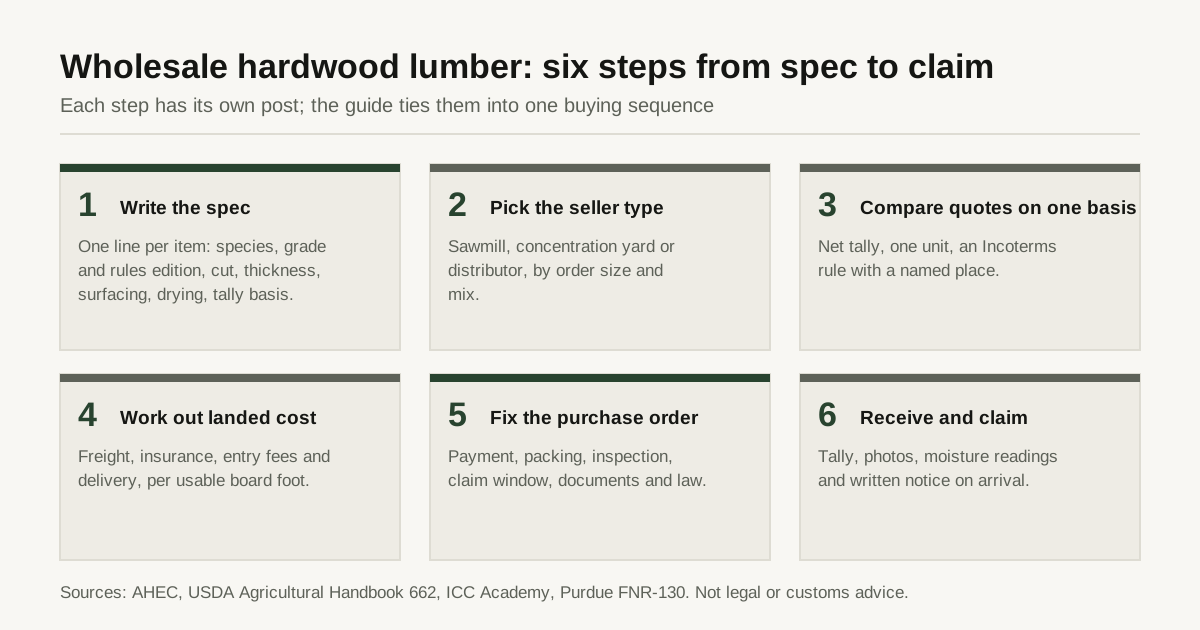
To buy wholesale hardwood lumber, write a one-line spec for each item, choose the seller type that fits your order size, and ask two or three suppliers to quote the same item on the same tally basis and delivery term. Convert each offer to landed cost per usable board foot, then fix payment, packing, inspection and the claim window in a purchase order and get a ready-to-load date in writing. This guide is for plant buyers, importers and millwork purchasers who must compare offers and place an order, and it ends with a checklist you can paste into an RFQ.
Hardwood Vendor is a matching service, not a sawmill. We own no mills, kilns or stock, and we name no seller here. You send one spec, we pass it to up to 3 mills or yards that say they carry it, and they quote you directly. Grade, thickness and moisture numbers in this guide are typical values, the NHLA rulebook and your contract govern, and every price in a worked example is made up.
Last reviewed: October 2026. Figures carry the source and edition they came from; confirm tariffs, rules and payment terms with your broker, bank or counsel before you rely on them.
- Where to buy: sawmill, yard or distributor
- Start from a written spec
- Board feet and price units
- Tally basis: net or gross
- Quote basis: FCA, FOB and CIF
- Landed cost per usable board foot
- Price series and what moves price
- Payment terms
- Containers, packing and delivery
- Lead time
- The purchase order
- Receiving the load and making a claim
- What plant buyers ask of a vendor
- Buyer checklist and how to send the RFQ
Where to buy: sawmill, yard or distributor
Order size usually decides the seller type. The Purdue market-structure slides by wood products professor Daniel Cassens (around 2010) list large and small sawmills, wholesalers, concentration yards, distribution yards and retail outlets as the types of supplier, and place wholesale quantities of hardwood grade lumber with end manufacturers, larger mills and concentration yards as buyers. A 1989 Forest Products Journal abstract says sawmills, depending on their size, sell lumber directly to end users, to concentration or distribution yards or to wholesalers. I could read only that abstract.
| If you buy | Typical fit | Ask first |
|---|---|---|
| Full lifts or truckloads of one species and grade | Sawmill or concentration yard | Minimum order and what the mill saws |
| Volume across several species | Concentration yard | Where the stock comes from and who dried it |
| Mixed or smaller lots, surfaced or ripped stock | Distribution yard | Stock list and its date |
| A container for export | A seller that ships containers | Net or gross tally and loading photos |
Caption: the type names come from the Cassens slides and the 1989 abstract; the “typical fit” and “ask first” columns are our working advice, not survey data. I found no public survey that defines the types or compares their minimums or prices. Trade usage varies, so ask each seller what it means by “yard”.
Read more: Sawmill, Lumber Yard or Distributor: Where to Buy Hardwood, for the full comparison, and How to Choose a Hardwood Lumber Supplier: 9 Checks, for the checks that come before the quote.
Start from a written spec
Two mills quote two prices for two different boards unless the spec is complete. One line per item should name the species and sorts, the grade with the rule book and edition, the cut, the thickness in quarters, the surfacing, the widths and lengths, the drying target and the tally basis. The Purdue summary notes that the NHLA rules date from 1898 and were written so that lumber could be sold at the producer’s location without examination by the buyer, and that the NHLA sales code binds buyer and seller only when the contract says it governs. A rule book therefore works only if the order names it.
The thickness notation counts quarters of an inch, so 4/4 is 1 inch rough. AHEC gives the allowed scant sizes for rough kiln dried lumber, so a board tallied as 4/4 may measure slightly under 1 inch after drying. State whether the order means nominal or measured thickness.
Read more: Hardwood Lumber Specifications: How to Write the Order, for each line of the spec in depth.
Board feet and price units
A board foot is a piece 1 foot long, 1 foot wide and 1 inch thick. AHEC gives the formula as width in inches times length in feet times thickness in inches, divided by 12, and surface measure as the same without the thickness, so a 4/4 board has one board foot for each unit of surface measure. In the United States lumber is bought and sold by the thousand board feet (MBF), and the USDA export handbook notes that foreign trade commonly uses cubic meters, square meters and metric tons. AHEC gives 1 cubic meter as 424 board feet and 1,000 board feet as 2.36 cubic meters, and states widths and lengths are rounded in a set way for a bundle tally: widths to the nearest whole inch with half inches alternating, lengths down to the whole foot.
State the unit next to every price and use one conversion for the whole shipment. A quote in dollars per cubic meter and a quote in dollars per MBF are comparable only after you convert them, and the conversion itself can differ by a small amount depending on which of AHEC’s rounded figures is used.
Read more: Board Feet and Quarter Thickness: How Hardwood Is Priced.
Tally basis: net or gross
The same lot has two footages. AHEC defines net tally as the board feet measured after kiln drying and gross or green tally as the board feet measured before it, and says a buyer on a gross tally can expect about 7% fewer board feet. Divide, do not add, to compare: a made-up gross price of $1,500 per MBF at 7% shrinkage is $1,500 divided by 0.93, or $1,612.90 per net MBF. Mills use different shrinkage rates, so write the rate into any gross quote.
| Gross (green) tally | Net tally | |
|---|---|---|
| Counted | Before the kiln | After kiln drying |
| Footage for the same boards | Higher, about 7% more (AHEC) | What you receive |
| Price per MBF for the same value | Lower | Higher |
| Ask | Which shrinkage rate? | Measured or calculated from gross? |
Caption: AHEC measurement page. The 7% is AHEC’s figure; the rate a mill uses is a term of your order.
Ask the seller to send the tally by bundle before the lumber ships. Our guide to the tally sheet covers the fields and rounding rules. Read more: Hardwood Lumber Tally: Net vs Gross and Green vs Dry and Lumber Tally Sheet: Fields, Rounding and Net vs Gross, for the sheet a mill sends.
Quote basis: FCA, FOB and CIF
A usable quote names the product exactly, the unit, the tally basis, a delivery term with a named place, the volume per shipment, the currency, how long the price holds and the payment terms. The USDA export handbook says quotes should include shipping arrangements and dates, payment terms and total weights or volume, and that a quote closer to the cost of goods delivered to the importer’s yard has a much better chance of being accepted than one that stops at the port of export. It was written in 2002 under older rules, so use it for the idea.
| Rule | Seller’s job ends | Notes from ICC Academy |
|---|---|---|
| FCA, named place | Goods handed to the buyer’s carrier at the named place | The appropriate rule when goods move in containers or on pallets |
| FOB, named port | Goods on board the vessel at the port | Only for sea and inland waterway transport |
| CIF, named port of destination | Goods on board at the port of shipment, seller pays freight and insurance to destination | Risk passes at loading; insurance may be minimum cover, Institute Cargo Clauses (C) or similar |
Caption: ICC Academy articles on FCA or FOB and on CFR or CIF under Incoterms 2020. Always write the rule with a place, such as FCA followed by the mill yard.
Read more: Hardwood Export Price Quote: FOB, CIF and Board Foot Math.
Landed cost per usable board foot
The price on the first line of a quote is one part of what you pay. Landed cost adds trucking, export handling, ocean freight, insurance, duty and entry fees, port and broker charges and delivery to the plant, then divides by the board feet you can use. Two corrections matter most. The first is the tally basis. The second is yield: Purdue’s summary of the 1998 NHLA rules gives the minimum clear face cuttings as 83 1/3% of the board for FAS, and its worked examples give 8/12, or 66 2/3%, for No.1 Common and 6/12, or 50%, for No.2A Common. Those are per-board minimums, and your cut list sets the real yield.
Container fill also moves freight per board foot. The 2002 USDA handbook says a freight container holds roughly 10,000 to 14,000 board feet of lumber depending on product and moisture content, and that carriers limit cargo weight. Our container loading guide lists about 17,000 to 20,000 board feet for a 40 foot container as typical. The two differ, I found no current public survey and I do not pick one; your forwarder confirms the figure for your item. Duty depends on the tariff heading. For the United States, our Section 232 guide found, as of October 2026, that sawn hardwood lumber was not on CBP’s list of covered lines, and it found no published decision on hardwood duties. Confirm with a customs broker.
Read more: Hardwood Lumber Landed Cost: Freight, Duty, Shrink, Yield, which runs a worked example in which the cheaper quote flips once both are put on a net, landed basis.
Price series and what moves price
I found no public price for a lot of your exact spec, and I give none here. A reference series exists. The Hardwood Market Report is sold by subscription, and a Nebraska Forest Service bulletin that reprinted its tables in 2019 states the basis: dollars per MBF, average market prices FOB mill, truckload and greater quantities, for 4/4 rough green lumber in random widths and lengths graded to NHLA rules. The kiln dried table is a separate basis, an estimate of predominant prices for 4/4 lumber measured after kiln drying. A published series is therefore a mill-gate reference for large lots, and a quote for a small kiln dried lot is a different product.
The 2011 study by Espinoza and colleagues, based on a fall 2009 survey of mills, names a weak housing market, imported products, higher transportation costs and expensive stumpage among the forces that changed how hardwood lumber is made and sold, and reports that red oak lost market share. It is a dated survey of producers. Guides on what moves hardwood lumber prices and on domestic versus imported hardwood are planned for this site.
Payment terms
The USDA export handbook ranks four methods by the seller’s risk, from the most secure to the least: cash in advance, documentary letter of credit, documentary collection and open account. Your risk as a buyer runs the other way.
| Method | Who carries the risk | What protects you |
|---|---|---|
| Cash in advance | You: the seller holds your money before shipping | The seller’s record and a clause for refund |
| Documentary letter of credit | Shared: the bank pays against compliant documents | The documents you require, such as an independent inspection certificate |
| Documentary collection | Mostly the seller | You pay or accept a draft to receive the documents |
| Open account | The seller | Your leverage and the contract |
Caption: USDA Agricultural Handbook 662 (2002). It adds that costs of a letter of credit add to the price and can tie up the buyer’s working capital or credit line.
The handbook says mixed methods are common and gives 50% by wire in advance and 50% by sight draft as an example, not a norm. I found no public survey of deposit sizes in hardwood trade. A credit pays on documents, not on boards, so name any inspection certificate you need in the credit. Copy the species, grade and unit wording from the order into the credit and the invoice exactly.
Read more: Lumber Import Payment Terms: LC, CAD and Deposits Compared.
Containers, packing and delivery
The USDA handbook names containers for higher valued shipments such as kiln dried dimension stock and lumber clears, with break bulk the most common method for lumber and plywood, and says bundles must be securely strapped, protected from rough handling, moisture and weathering and clearly marked. A 40 foot container can only be loaded with about 46,000 pounds of forest products when traveling over US highways, so weight can limit a load. A booking contract is mandatory to reserve space on a vessel, and the carrier can charge for space that is not used.
Ask for the tally by bundle, photos of the empty container, the half loaded container and the full container before the doors close and the seal number. Photos make a later claim easier to settle. Name the documents the seller issues with the shipment, such as the invoice, tally, bill of lading and any plant health or legality papers your route needs. The USDA handbook’s list of shipping documents includes the packing list, the bill of lading, the insurance certificate and the phytosanitary certificate. This is general information, not legal advice; check your import documents with your broker.
Read more: Hardwood Container Loading: Bundles, Tally and Weight.
Lead time
Lead time is the time from order to ready-to-load, and it depends first on whether the item is in stock. For lumber sawn to order, the drying steps set most of the time. The USDA Forest Products Laboratory’s Air Drying of Lumber (1999) estimates 50 to 120 days to reach 20% moisture for 1 inch upland red oak in the South, Mid-South and Central regions, with up to 165 days in the Mid-North and 190 to 360 days for 2 inch stock. The Dry Kiln Operator’s Manual (revised 1991) gives kiln examples for red oak from green to 7%: 18 days for 4/4, 32 days for 6/4 and 55 days for 8/4.
| Step | Public figure | Source |
|---|---|---|
| Air drying 1 in upland red oak to 20% | 50 to 120 days (South, Mid-South, Central) | FPL-GTR-117 |
| Kiln drying 4/4 red oak, green to 7% | 18 days (example) | Dry Kiln Operator’s Manual |
| Sawing queue, grading, packing | I found no public figure | Ask the supplier |
| Ocean transit | I found no public figure that fits every route | Forwarder |
Caption: both government documents are old, and real mills differ. Ask for a ready-to-load date counted from a named event.
Read more: Hardwood Lumber Lead Time: Stock, Sawn to Order, Kiln Wait.
The purchase order
A purchase order turns a quote into a contract, and it should fix the spec, the quantity and tally basis, the price and delivery term, the payment, the shipment window, packing and marking, inspection, the claim window, the remedy and the documents and governing law. The UN sales convention asks the seller to deliver goods of the quantity, quality and description the contract requires (Article 35), so your wording is the standard the lumber is judged against.
The convention applies to sales between businesses in different Contracting States unless the parties exclude it (Article 6). Ask counsel which law governs and write the choice into the order. Your claim window belongs in the order too, because the default is only a reasonable time.
Read more: Hardwood Lumber Purchase Order: Clauses to Fix Before Buying.
Receiving the load and making a claim
Check the lumber on the day it arrives, while it is still as shipped. Photograph the bundles before opening them, count bundles against the tally, take dated moisture readings and keep the lumber intact. UCC 2-607 says that after acceptance the buyer must notify the seller of a breach within a reasonable time after discovery, or be barred from any remedy, and that the burden of proving the breach is on the buyer. CISG Article 38 asks the buyer to examine the goods within as short a period as is practicable, and Article 39 requires notice within a reasonable time and in any event within two years of handover, unless a guarantee period says otherwise.
The Purdue summary of the NHLA sales code (1998 rules) gives 14 days from receipt to file a claim, with the lumber left unaltered, and says the code binds only if the contract names it. I found no current NHLA text I could open, so write your own window into the order. Our lumber quality claim guide differs: it found no public hardwood deadline and quotes a 5% loser-pays figure from a forum answer, while the Purdue summary gives 14 days and 4%, both from the 1998 rules.
Read more: Lumber Quality Claim: Photos, Tallies and Deadlines.
What plant buyers ask of a vendor
The 2011 abstract by Espinoza and colleagues says buyers asked mills for faster delivery, more customized products and smaller purchase volumes, that customers placed smaller, more frequent orders and that intermediaries such as hardwood distributors gained a larger share of business. That is a survey of mills from 2009, and I found no newer survey I could open. A 2014 paper by the same authors exists; I could not open it.
What this means for the buyer is practical. Offer what helps a vendor quote well: a stable spec, a tally basis you accept, a realistic ready date and prompt written notice of any problem. A guide on what cabinet shops expect from a lumber vendor is planned for this site.
Buyer checklist and how to send the RFQ
Use this list as the body of the RFQ, one line per item. Items you leave open are the ones a supplier fills with its own habit.
- Species and sorts, grade, rule book and edition.
- Cut, thickness in quarters, surfacing, widths and lengths.
- Drying target, the way it is checked and what happens outside the range.
- Quantity, unit, tally basis (net or gross) and tolerance.
- Delivery term with a named place, and the packing and marking you need.
- Payment method you can use and the documents that trigger payment.
- Ready-to-load date, counted from a named event.
- Paperwork: legality, plant health and origin records for your route.
- Inspection: where, when, by whom and at whose cost.
- Claim window, hold-intact duty and remedy.
- Photos or a sample reference for color or appearance.
- Your landed cost assumptions, so you can compare offers per usable board foot.
When the list is complete, send your lumber RFQ. We pass it to up to 3 mills or yards that say they carry it, they quote you directly and we reply within 24 business hours.
Sources
- American Hardwood Export Council, measurement: board feet, tally and kiln dried
- USDA Foreign Agricultural Service, A Guide to Exporting Solid Wood Products, Agricultural Handbook 662 (revised January 2002)
- ICC Academy, FCA or FOB under Incoterms 2020
- ICC Academy, CFR or CIF under Incoterms 2020
- Purdue Extension, FNR-130 Hardwood lumber grades (summary of the 1998 NHLA rules and sales code)
- Nebraska Forest Service, Timber Talk, June 2019 (Hardwood Market Report price notes)
- Espinoza and others, 2011, Assessing changes in the U.S. hardwood sawmill industry with a focus on markets and distribution, BioResources 6(3) (abstract via University of Minnesota)
- Purdue University, Cassens, Traditional Hardwood Market Structure: Opportunities for Small Producers (slides, around 2010)
- USDA Forest Products Laboratory, Air Drying of Lumber, FPL-GTR-117 (1999)
- USDA Forest Service, Dry Kiln Operator’s Manual, Agriculture Handbook 188 (revised August 1991)
- UNCITRAL, United Nations Convention on Contracts for the International Sale of Goods (CISG), text
- Cornell LII, UCC 2-607 Effect of acceptance; notice of breach
Frequently asked questions
How do I buy hardwood lumber wholesale?
Write a one-line spec, choose a seller type that fits your order size, ask two or three suppliers to quote the same item on the same tally basis and delivery term, convert each offer to landed cost per usable board foot, then fix payment, inspection and the claim window in a purchase order. Get a ready-to-load date in writing.
What is the minimum order for wholesale hardwood lumber?
I found no public minimum that applies across suppliers, so ask each one for the figure in writing, for a single item and for a mixed load. Sawmills often sell full lifts or truckloads, and yards sell smaller mixed lots. A 2011 survey of mills reported buyers placing smaller, more frequent orders.
Is a net or gross tally better when I buy hardwood lumber?
A net tally counts the footage after kiln drying, so it matches what you receive. A gross or green tally counts it before drying, and AHEC says the buyer can expect about 7% fewer board feet. Prefer net and write it into the order, or convert the gross price by dividing by 0.93 before you compare.
What payment terms are normal for wholesale lumber imports?
The USDA export handbook ranks four methods by seller risk: cash in advance, documentary letter of credit, documentary collection and open account. Your risk runs the other way. Mixed terms are common, and the handbook's example is 50% by wire in advance and 50% by sight draft. I found no public survey of norms in hardwood trade.
How long does a wholesale hardwood lumber order take?
Stock lumber can be ready to load in days. Lumber sawn to order must be sawn, dried, graded and packed first. The USDA gives 50 to 120 days to air dry 1 inch upland red oak to 20% moisture in the South, Mid-South and Central regions and 18 days as a kiln example for 4/4 red oak. I found no public end-to-end figure.
What should be in a hardwood lumber purchase order?
The spec with the grading rules and edition, quantity with the tally basis and tolerance, price and Incoterms rule with a named place, payment terms, shipment window, packing and marking, inspection, the claim window and remedy, the documents the seller issues and the governing law.
Know what you need? Send the spec.
Tell us the species, grade, thickness and board feet. We pass it to up to 3 mills or yards that carry it and reply within 24 business hours.
Send my lumber RFQ