Guides / Cost and Ordering
Payment Terms for Hardwood Lumber Imports: Letter of Credit, CAD and Deposits Compared
February 9, 2027
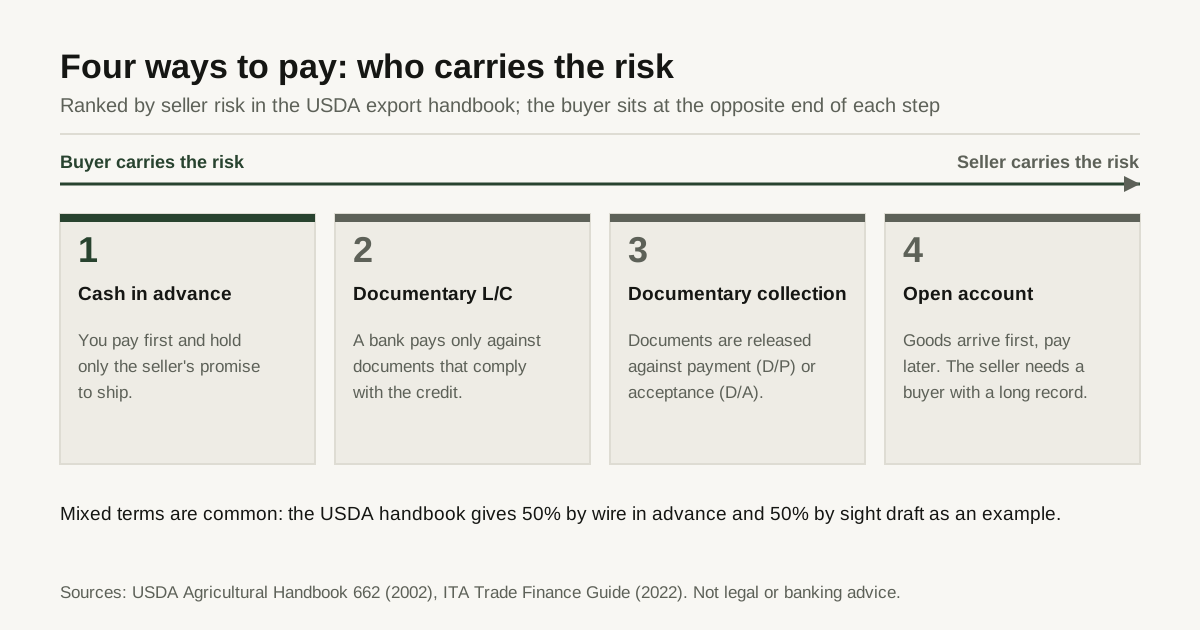
For a buyer, payment terms decide who carries the risk between the day money moves and the day lumber arrives. The USDA export handbook ranks the four common methods by seller risk, from safest for the seller to least safe: cash in advance, documentary letter of credit, documentary collection and open account. Your risk runs the other way. This guide compares them from the importer’s side, shows where cash against documents (CAD) and deposits fit and lists the clauses to write so the terms in the quote match the terms in the contract.
This is general information as of October 2026, not legal or banking advice. The USDA handbook I used was revised in January 2002 and refers to an older edition of the ICC credit rules, so I checked the credit timing against the ICC library and the 2022 Trade Finance Guide from the US International Trade Administration. Confirm every term with your bank and your freight forwarder.
The four methods from the buyer’s side
| Method | Who carries the risk | What protects you | Cost and friction |
|---|---|---|---|
| Cash in advance | You carry all of it, you hold only the seller’s promise to ship | Nothing but the seller’s record | Wire fees, no credit line tied up |
| Documentary letter of credit | Shared. The bank pays only if documents comply | The documents you require in the credit | Bank fees and tied up credit, labor intensive |
| Documentary collection (D/P or D/A) | Mostly the seller. Banks do not verify documents or guarantee payment | You pay, or accept a draft, to receive the documents | Cheaper and simpler than a credit |
| Open account | The seller. You receive goods first | Your own leverage and the contract | Seller needs a buyer with a long payment record |
The Trade Finance Guide states the tension plainly: for exporters any sale is a gift until payment is received, and for importers any payment is a donation until the goods are received.
Cash in advance and deposits
The USDA handbook says full cash in advance is the safest method for the seller because the buyer carries all the risk. It adds that few sellers can demand it, typically those with products in high demand or made to the buyer’s order, though some can obtain a down payment. A wire transfer is the usual form, most complete in 2 to 3 days and the fees are normally deducted from the proceeds. The handbook points out the buyer’s side: the seller holds your money, has not shipped and you are at risk that the seller will be unable to ship as contracted. The Trade Finance Guide calls cash in advance the least attractive option for the importer because it tends to create cash flow problems.
Mixed terms are common. The handbook’s example is 50% by wire in advance and 50% by documentary collection on a sight draft. That is an example, not a market norm: I found no public survey of deposit sizes in hardwood export trade. What you can control is the structure of the deposit:
- Pay a deposit against a proforma invoice that states species, grade, thickness, volume, tally basis and price. See the tally guide.
- Tie the balance to documents you can check, not to a promise to ship.
- Say what happens to the deposit if the seller cannot ship by the agreed date.
- Pay only to an account in the seller’s company name as in the contract, and confirm changes of bank details by phone to a number you already hold.
Letter of credit
A documentary letter of credit is a bank commitment to pay the seller a stated amount if the conditions in the credit are met. The Trade Finance Guide says it is always irrevocable unless it states otherwise, that the bank’s obligation depends only on compliant documents and that banks deal in documents, not goods. The handbook says a credit spreads risk more evenly and is common when the relationship is new: you are assured the specified conditions are documented and shipment has been made.
That is the lever for lumber. A bank checks paper, not boards. If you want grade or moisture checked by someone independent, the credit has to call for that agency’s certificate. If it asks only for the seller’s invoice and packing list, the bank will pay on the seller’s own description of the wood. Typical documents to consider are the commercial invoice, the packing list or tally by bundle, the bill of lading and any phytosanitary or legality papers your route needs. See bundles, tally and weight.
The costs and traps:
- Cost. The handbook says credit costs add to the product price and can tie up the buyer’s working capital or credit line. The Trade Finance Guide calls it a relatively expensive and labor intensive method.
- Discrepancies. If documents differ from the credit and the seller cannot fix them, you may approve and pay, usually at a discount, or reject the shipment. The handbook’s list of common causes includes late shipment, late presentation, an expired credit, inconsistent documents and a mismatch between invoice and credit descriptions.
- Timing. Under the ICC’s UCP 600, a presentation with original transport documents must be made within 21 calendar days after shipment and never after the credit expires. Read the dates in the credit itself and set shipment and expiry dates that allow time for production, loading and presenting documents.
- Seller pushback. The handbook’s checklist for sellers warns against unacceptable conditions, such as an inspection certificate that the buyer must supply. Name an independent agency and say when the certificate must be issued, so the condition is something the seller can meet.
CAD, documentary collection and open account
With a documentary collection the seller’s bank sends the documents to your bank. With documents against payment (D/P) you pay and receive them. With documents against acceptance (D/A) you sign a time draft, receive the documents and the goods and pay at maturity. The Trade Finance Guide says collections are generally cheaper than credits but riskier for the seller, because banks neither verify documents nor guarantee payment. The handbook says collections suit ocean freight because the ocean bill of lading is negotiable and acts as title: the carrier will not release the cargo without the original, which you cannot get until you pay.
Cash against documents is the trade name most often used for D/P, but the term is loose. Ask which one the supplier means:
- A bank collection, where you pay your bank to receive the originals. You get the title before the cargo moves.
- Payment by wire against scanned copies of documents. You are paying without holding the originals, so you pay before you hold title.
Open account means you receive the goods first and pay on a later date. The handbook calls it a high risk method for the seller, who needs a buyer that is well established with a long and favorable payment record. A new buyer should not expect it on a first order.
Matching terms to the order
My suggestions, not a rule:
| Situation | Structure to ask for |
|---|---|
| First order from a new supplier, full container | Letter of credit with an independent inspection certificate, or a deposit plus balance by collection against original documents |
| Small trial lot | Wire against a proforma invoice, with photos of the lot before shipment |
| Custom sizes or thick stock cut to your order | A deposit is normal, so protect it with dates and a refund clause |
| Repeat orders after clean shipments | A collection on D/P, then balance after arrival or open account as the record builds |
Compare any choice with price. A lower unit price with weaker terms may cost more once you count a lost deposit or a disputed lot, as described in what moves hardwood lumber prices and how to choose a hardwood lumber supplier.
Clauses to write
- The method, in full: letter of credit at sight or term, or collection D/P or D/A, with who pays each bank fee. The handbook advises defining payment terms precisely, including late payments, partial payments and remedies for nonpayment.
- Currency of payment. The handbook notes that quoting in US dollars puts the exchange risk on the buyer.
- The documents that trigger payment, and the issuer of any inspection certificate.
- The tally basis and the quantity tolerance, so the invoice and the delivery can be compared.
- Shipment date, the last date for presenting documents and the credit expiry.
- What happens to the money if the seller cannot ship, or the lot fails the agreed grade.
Payment is one step of a longer sequence; see wholesale hardwood lumber.
The RFQ checklist covers the product lines. To get quotes that state their payment terms up front, send your lumber RFQ with the grade, volume, destination port and the terms you want. We pass it to up to 3 mills or yards that say they can supply it, and they reply to you directly.
Sources
- USDA Foreign Agricultural Service, A Guide to Exporting Solid Wood Products, Agricultural Handbook 662 (revised January 2002)
- International Trade Administration, Trade Finance Guide (2022 edition)
- ICC Digital Library, UCP 600 article 14(c), presentation period
Frequently asked questions
Is a letter of credit safer than a wire transfer for a lumber buyer?
For the buyer, usually yes on a first order. A bank pays only against documents that comply with the credit, so you can require an invoice, tally, bill of lading and an independent inspection certificate. A wire in advance gives you only the seller's promise. A letter of credit costs more and ties up your credit line.
What does CAD mean in lumber trade?
CAD usually means cash against documents: you pay when the shipping documents are presented, not before shipment. The term is used loosely. Ask whether it is a bank documentary collection, where you pay to receive the original bill of lading, or a wire against emailed copies, which leaves you paying before you hold title.
How big a deposit should I pay on a hardwood order?
I found no public survey of deposit sizes in hardwood trade, so there is no standard to quote. The USDA export handbook gives 50% in advance and 50% by sight draft as an example, not a norm. Negotiate by supplier record, product type and what protects the deposit if the shipment fails.
What is a confirmed letter of credit?
A confirmed credit has a second bank, the seller's, add its own promise to pay to that of the issuing bank. The seller then carries less credit and country risk, and the USDA handbook says a seller should prefer a credit confirmed by its own bank. Who pays for the confirmation is negotiable, so settle it in the contract.
Know what you need? Send the spec.
Tell us the species, grade, thickness and board feet. We pass it to up to 3 mills or yards that carry it and reply within 24 business hours.
Send my lumber RFQ