Guides / Cost and Ordering
Hardwood Lumber Landed Cost: Freight, Duty, Shrink and Yield, With a Worked Example
March 4, 2027
Landed cost is what you pay to have usable hardwood lumber at your plant, divided by the board feet you can actually cut into parts. It takes the lumber invoice, adds freight, insurance, duty and entry fees, port and delivery charges, then corrects for shrink and yield. This post is part of our guide to wholesale hardwood lumber and shows each line with its source, then runs a worked example with made-up prices so you can copy the arithmetic.
Hardwood Vendor is a matching service, not a sawmill. We own no mills, kilns or stock and we name no seller. This is general information as of October 2026, not customs, tax or shipping advice. Confirm every line with your forwarder and broker.
The drivers at a glance
Eight lines move landed cost. The table gives the direction, the size of the effect where I could source one and who controls it.
| Driver | Direction | Magnitude | Who controls it |
|---|---|---|---|
| Price per board foot | Moves with the market | I found no public price for a lot of your spec; see the note on price series below | Market and seller |
| Tally basis, net or gross | A gross tally bills footage you will not receive | About 7% fewer board feet after drying (AHEC) | You, in the order |
| Grade yield | A lower grade leaves less clear wood | Minimum clear face cuttings: FAS 83 1/3%, No.1 Common 66 2/3%, No.2A Common 50% (Purdue) | Your cut list and grade choice |
| Container fill | Fewer board feet per box raises freight per board foot | 10,000 to 14,000 board feet per container, USDA 2002; carriers limit cargo weight | Species, thickness, packing and forwarder |
| Ocean freight | Changes with route and season | I found no public figure that fits every route | Forwarder quote on the day |
| Insurance | CIF includes minimum cover only | Institute Cargo Clauses (C) or similar (ICC) | You and the insurer |
| Duty and entry fees | Adds a share of value | US merchandise processing fee 0.3464% with an annual floor and cap (19 CFR 24.23); duty depends on the tariff heading | Broker and the tariff schedule |
| Port, broker and inland delivery | Fixed cost per container | I found no public figure | Broker and trucker |
Caption: AHEC measurement page, Purdue FNR-130 (summary of the 1998 NHLA rules), USDA Agricultural Handbook 662 (2002), ICC Academy and Cornell LII for 19 CFR 24.23. The Hardwood Market Report is a subscription series; a Nebraska Forest Service bulletin that reprinted it in 2019 states its basis as dollars per MBF, FOB mill, truckload and greater quantities, for 4/4 rough green lumber.
Shrink: net and gross
Wood shrinks as it dries, so a lot counted green holds more board feet than the same lot counted after the kiln. The American Hardwood Export Council defines net tally as the footage measured after kiln drying and gross or green tally as the footage measured before it, and says a buyer on a gross tally can expect about 7% fewer board feet. Divide, do not add, to move from gross to net: a made-up price of $1,230 per gross MBF divided by 0.93 is $1,322.58 per net MBF. Our guide to the hardwood lumber tally shows the rounding rules and the check you can run on arrival.
Mills use different shrinkage rates, so a gross quote needs the rate written in.
Yield: from board feet to usable board feet
You pay for board feet and cut parts from clear wood. Grade sets only a minimum of clear wood. Purdue’s summary of the 1998 NHLA rules says FAS needs at least 83 1/3% of the board in clear face cuttings, and its worked examples give the factors for No.1 Common (8/12, or 66 2/3%) and No.2A Common (6/12, or 50%). Those are minimums per board, graded from the poorer face for most grades. Your real yield depends on your cut list, the board sizes and your saw kerf and trim.
Our board feet and pricing guide says rough mill yields often land between 50 and 80% and suggests a 15 to 30% allowance. That guide gives no source for the figures and I found no public survey behind them, so treat them as a starting point and run a test lot. A grade with a lower price per board foot but a lower yield can cost more per part. The worked example below uses an assumed 70% yield only to show the arithmetic; the NHLA minimum for No.1 Common is lower, and your own test lot sets the real figure.
Freight and container fill
Freight is charged per container, so the number of board feet in the box sets freight per board foot. The 2002 USDA export handbook says a freight container holds roughly 10,000 to 14,000 board feet of lumber depending on product and moisture content, and that carriers limit cargo weight, with about 46,000 pounds for a 40 foot container on US highways.
Our own container loading guide lists about 17,000 to 20,000 board feet for a 40 foot container as a typical load. The two figures differ, the USDA one is old and I found no current public survey, so this post does not pick one. Ask your forwarder for the loadable figure for your thickness, length and species. The worked example uses 11,000 net board feet per container to match our hardwood export price quote guide, which covers the Incoterms rules and the board foot to cubic meter math.
Ocean freight itself moves with route, season and carrier. I found no public rate that fits every route, so the example uses a made-up round figure. Get a written quote from a forwarder for your route on the day you compare offers.
Insurance, duty and entry fees
Under the ICC’s CIF rule the seller pays freight and arranges insurance to the destination port, but risk passes to the buyer once the goods are on board at the port of shipment, and the seller may buy only limited cover under Institute Cargo Clauses (C) or similar. Under FCA and FOB the buyer carries the risk from the point of delivery, so insuring the cargo is your decision. Decide whether minimum cover is enough for the lot you ship.
For duty, look up the tariff heading for sawn hardwood (heading 4407 in the Harmonized System) in your own country’s schedule. For the United States, our guide to the Section 232 lumber tariff found, as of October 2026, that sawn hardwood lumber was not on CBP’s list of covered lines and that it found no published decision on hardwood duties. Entry fees apply whether or not there is duty. Under 19 CFR 24.23 the US merchandise processing fee is 0.3464% ad valorem on formal entries, with a floor and a cap that are adjusted each fiscal year. The example below applies the percentage to the FOB value as a simplification and ignores the floor and cap; your broker calculates the real figure.
Other import lines, such as customs broker fees, terminal charges and inland delivery, depend on the port and the carrier. I found no public figure that applies to all ports, so ask for them in writing.
A worked example with made-up prices
Every price here is invented to show the steps, not a market price or a supplier quote.
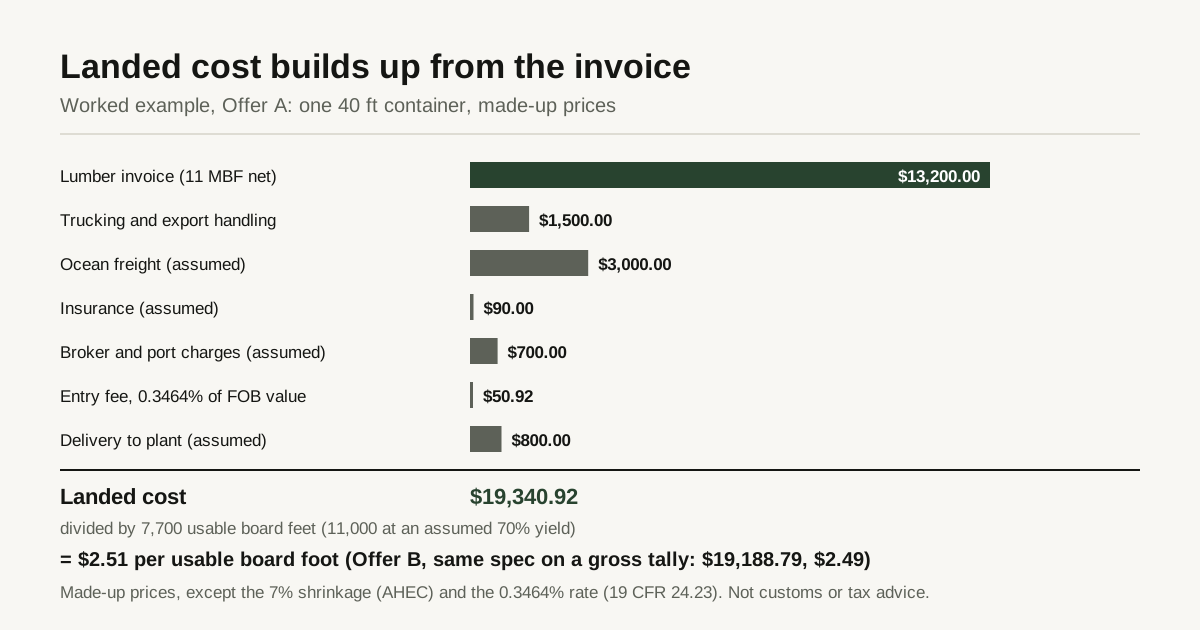
The order. One 40 foot container of 4/4 red oak, kiln dried, No.1 Common and better, 11,000 net board feet (11 MBF). Two offers for the same spec:
- Offer A: FCA mill yard, net tally, $1,200 per net MBF. You pay trucking to the port ($900) and export handling and clearance ($600).
- Offer B: quoted FOB port, gross tally at 7% shrinkage, $1,230 per gross MBF. Trucking and export handling are included.
Exporters often still quote FOB for containers, although the ICC Academy article says FCA suits containers; the arithmetic is the same under FCA at the port. Offer B needs 11,000 / 0.93 = 11,827.96 gross board feet billed to deliver 11,000 net. Its net-basis price is $1,230 / 0.93 = $1,322.58 per MBF. From the port onward both offers share the same assumed lines.
| Line | Offer A | Offer B |
|---|---|---|
| Quoted price | $1,200 per net MBF | $1,230 per gross MBF |
| Lumber invoice | $13,200.00 | $14,548.39 |
| Trucking and export handling | $1,500.00 | Included |
| Value at the port (FOB) | $14,700.00 | $14,548.39 |
| Ocean freight (assumed) | $3,000.00 | $3,000.00 |
| Insurance (assumed) | $90.00 | $90.00 |
| Broker and port charges at destination (assumed) | $700.00 | $700.00 |
| Entry fee, 0.3464% of FOB value | $50.92 | $50.40 |
| Duty (assumed zero) | $0.00 | $0.00 |
| Delivery to the plant (assumed) | $800.00 | $800.00 |
| Landed cost | $19,340.92 | $19,188.79 |
| Per net MBF | $1,758.27 | $1,744.44 |
| Per usable board foot at an assumed 70% yield | $2.51 | $2.49 |
Caption: all figures are made up except the 7% shrinkage (AHEC) and the 0.3464% rate (19 CFR 24.23). Per usable board foot is landed cost divided by 7,700 usable board feet, which is 11,000 times 0.70.
On the price line alone Offer A looks $30 per MBF cheaper. On a landed, net basis Offer B is $13.83 per net MBF cheaper. The order flipped because of the tally basis and because A leaves $1,500 of cost with you. With different freight or yield the answer can flip back, so run the sum for each offer.
Quote lines to ask for
Ask every supplier to put these in the quote so you can fill the table above:
- Price per unit, the unit named (MBF or cubic meter) and the tally basis, net or gross, with the shrinkage rate if gross.
- Incoterms rule with a named place, for example FCA followed by the mill yard.
- Board feet or cubic meters per container for this item, and the weight.
- Which of trucking, export handling, loading, bundling and tally sheet are in the price.
- Insurance cover and who buys it.
- Documents the seller will issue for your import route.
- How long the price holds and the payment terms; our guide to lumber import payment terms compares letters of credit, collections and deposits.
Where this leaves you
Compare offers by landed cost per usable board foot, on one tally basis, with every assumption written down and the supplier’s own lines added in. For the full buying sequence, from seller type to purchase order, read our guide to wholesale hardwood lumber. When you have a spec and a volume, send your lumber RFQ. We pass it to up to 3 mills or yards that say they carry it, they quote you directly and we reply within 24 business hours.
Sources
- American Hardwood Export Council, measurement: board feet, tally and kiln dried
- USDA Foreign Agricultural Service, A Guide to Exporting Solid Wood Products, Agricultural Handbook 662 (revised January 2002)
- Purdue Extension, FNR-130 Hardwood lumber grades (summary of the 1998 NHLA rules)
- ICC Academy, FCA or FOB under Incoterms 2020
- ICC Academy, CFR or CIF under Incoterms 2020
- Cornell LII, 19 CFR 24.23 Fees for processing merchandise
- Nebraska Forest Service, Timber Talk, June 2019 (Hardwood Market Report price notes)
Frequently asked questions
What is landed cost for hardwood lumber?
It is everything you pay to have usable lumber at your plant: the lumber invoice, inland and ocean freight, insurance, duty and entry fees, port and broker charges and delivery, then divided by the board feet you can actually use. The price on the first line of a quote is only one part of it.
How do I compare a gross tally price with a net tally price?
Divide the gross price by 0.93 to get a net price, because AHEC says a buyer on a gross tally can expect about 7% fewer board feet after kiln drying. A made-up $1,230 per gross MBF becomes $1,322.58 per net MBF. Agree the shrinkage rate in writing, since mills differ.
Why does container fill change the cost per board foot?
Freight is charged per container, so every board foot that does not fit raises freight per board foot. A 2002 USDA handbook says a container holds roughly 10,000 to 14,000 board feet of lumber and that carriers limit cargo weight. Ask your forwarder for the loadable figure for your thickness and species.
Does hardwood lumber carry a tariff when imported to the United States?
Rules change, so check with a customs broker. As of October 2026 our Section 232 guide found sawn hardwood lumber was not on CBP's list of covered lines, and it found no published decision on hardwood duties. Entry fees apply regardless of duty, for example the 0.3464% merchandise processing fee in 19 CFR 24.23.
Know what you need? Send the spec.
Tell us the species, grade, thickness and board feet. We pass it to up to 3 mills or yards that carry it and reply within 24 business hours.
Send my lumber RFQ