Guides / Cost and Ordering
Section 232 Lumber Tariffs: What Hardwood Buyers Should Check Before They Order
January 6, 2027
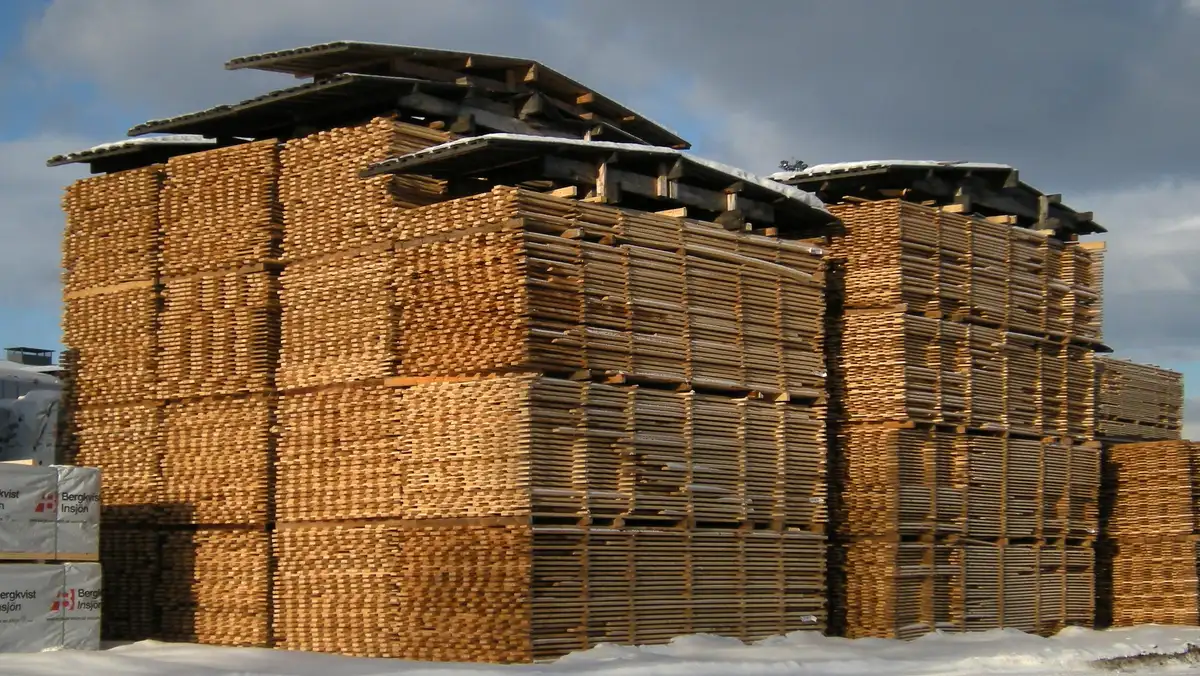
The Section 232 duties on wood that took effect on 14 October 2025 do not, on the CBP guidance I read, include sawn hardwood lumber. They do charge 10% on softwood lumber, 25% on upholstered wooden seating and 25% on kitchen cabinets and vanities, with steps to 30% and 50% scheduled for 1 January 2027 on the last two, so check whether they already apply when you read this. The proclamation also told Commerce to report by 1 October 2026 on whether a duty on hardwood timber and lumber is warranted, and I could not find a published decision. This guide sets out what is covered, where hardwood lumber sits in the tariff schedule and what to put in an order so a change in the rules does not become a dispute.
This is general information as of October 2026, not customs advice. Tariff orders on wood have changed since 2025, so confirm the current rate and classification for each shipment with a licensed customs broker. This guide covers only the Section 232 action on timber, lumber and derivative products. Other duties, such as country-level tariffs or antidumping duties on softwood, are separate and are not covered.
What the proclamation covers
The action is Proclamation 10976, issued in September 2025 and applied to goods entered for consumption, or withdrawn from a warehouse for consumption, on or after 12:01 a.m. EDT on 14 October 2025. Customs and Border Protection (CBP) gave its implementing guidance in CSMS message 66492057.
| Product | Rate from 14 Oct 2025 | Scheduled step | Notes |
|---|---|---|---|
| Softwood timber and lumber (headings 4403, 4406 and 4407, listed subheadings) | 10% | None in the amendment | Chapter 99 heading 9903.76.01, all countries |
| Upholstered wooden seating (9401.61) | 25% | 30% on 1 Jan 2027 | EU and Japan capped at 15% in total, UK at 10% |
| Completed kitchen cabinets and vanities (9403.40.9060, 9403.60.8093, 9403.91.0080) | 25% | 50% on 1 Jan 2027 | Same country caps |
The 30% and 50% steps were first due on 1 January 2026. A proclamation dated 31 December 2025 moved them to 1 January 2027. The steps do not apply to countries that reach an agreement with the United States that addresses the national security concern in the proclamation.
Drawback is available. Goods placed in a foreign trade zone after the effective date must enter as privileged foreign status unless they qualify for domestic status. The proclamation also tells the Secretary of Commerce to set up a process for adding derivative wood products, which can include requests from domestic producers, and a process to detect undervaluation. If it finds a risk, the Secretary may impose specific or compound duties by Federal Register notice.
Where hardwood lumber sits
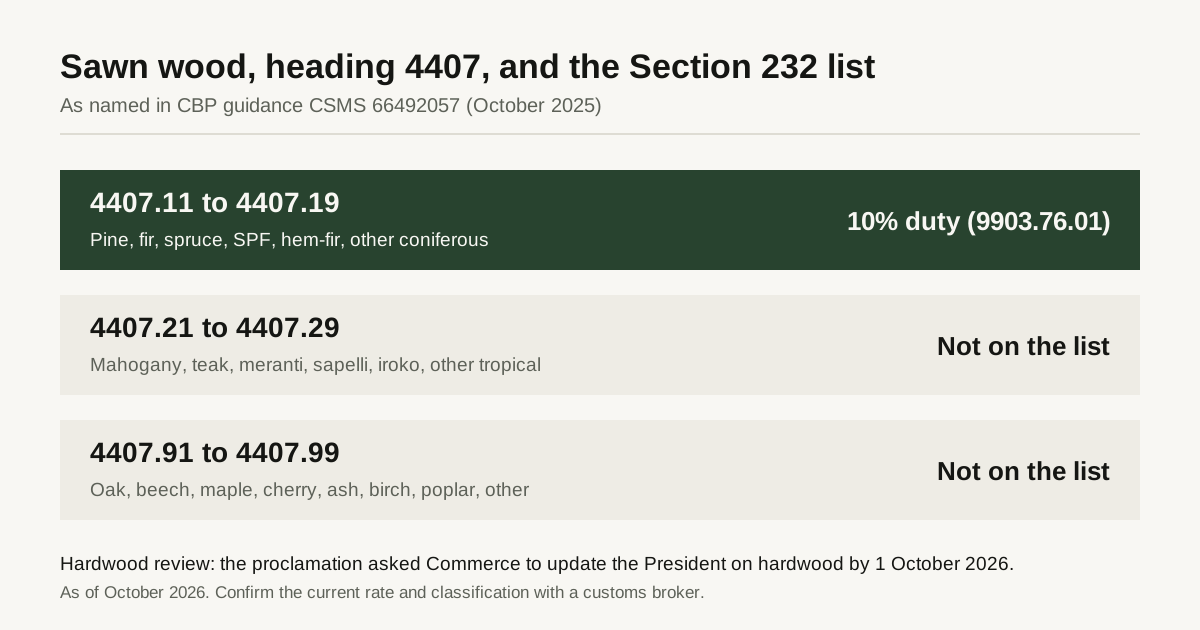
Sawn wood is heading 4407, and its subheadings separate the species groups:
| Subheadings | Wood | On the CBP Section 232 list |
|---|---|---|
| 4407.11 to 4407.19 | Pine, fir and spruce, spruce-pine-fir, hem-fir, other coniferous | Yes, 10% |
| 4407.21 to 4407.29 | Mahogany, virola, imbuia, balsa, teak, meranti, lauan, sapelli, iroko, other tropical | Not listed |
| 4407.91 to 4407.99 | Oak, beech, maple, cherry, ash, birch, poplar and aspen, other non-coniferous | Not listed |
CBP’s list for the 10% duty names 4407.11, 4407.12, 4407.13, 4407.14 and 4407.19 and no other 4407 line. That is the basis for saying hardwood lumber is not charged under this action today. It says nothing on whether a hardwood duty will follow.
The hardwood clause
Clause 9 of the proclamation directs the Secretary of Commerce to give the President, by 1 October 2026, an update on imports of hardwood timber and lumber, their markets and the domestic industry. The purpose is to let the President decide whether to impose an additional duty on hardwood timber or lumber, such as the phased duty recommended in the 1 July 2025 report, and on derivatives of those products.
That date has passed. I found no published presidential decision in the official sources I could open, but a decision can appear in the Federal Register or in a CBP message at any time. Treat hardwood lumber as an open risk, not a settled zero. If you import hardwood lumber, set a calendar check each month and ask your broker to alert you.
What hardwood buyers should check
- Classify each line. Take the HTS subheading of every lumber line and compare it to the CBP list. A hardwood line outside 4407.11 to 4407.19 is not charged today.
- Look at derivative products. If you buy or sell kitchen cabinets, vanities or upholstered wooden seating, the duty applies to the finished product whatever hardwood goes into it. A cabinet shop that imports finished doors and boxes should check which tariff line the broker uses.
- Check origin and entry date. The duty attaches at entry. A shipment ordered before a change but entered after it pays the new rate.
- Know the country caps. EU and Japan are capped at 15% in total on the derivative products. The UK is capped at 10%. Other countries pay the full rate.
- Ask who is importer of record. That party pays at entry and normally files any drawback claim.
- Check the scheduled steps. The amendment set 1 January 2027 for the steps on seating and cabinets unless an agreement lifts them. Confirm whether they now apply to your lines.
Contract clauses that carry the risk
- Tariff change clause. State who bears a new or higher duty that takes effect between order and entry, and whether the price is reopened.
- Incoterms. Under FOB or CIF the buyer is normally the importer of record. Under DDP the seller carries the duty, and a seller facing a new tariff may ask to renegotiate. Say what happens.
- HTS line on the invoice. Ask the supplier to show the species, the subheading and the origin on each invoice, so that the broker does not have to guess.
- Cancellation right. For a long order, add a right to cancel or re-price the unshipped part if a duty on your line is added.
- Stock position. If you expect a hardwood duty, compare the carrying cost of earlier orders with the risk. Our guide to board feet and hardwood pricing helps you compare quotes on one basis, and the container loading guide shows what else lands on the invoice.
Our guide on how to choose a hardwood lumber supplier lists the questions to ask about origin and documents. For species background see the hardwood species hub. To get quotes that state origin and terms up front, send your lumber RFQ with the species, grade, board feet and the destination. We pass it to up to 3 mills or yards that say they can supply it, and they reply to you directly.
See also: importing lumber into the US, which covers APHIS, Lacey Act and CITES checks next to the tariff.
Sources
- White House, Adjusting Imports of Timber, Lumber, and their Derivative Products (September 2025)
- White House, Amendments to the proclamation (December 2025)
- CBP CSMS 66492057, guidance on Section 232 duties on timber, lumber and derivative products
- USITC Harmonized Tariff Schedule search, heading 4407
Frequently asked questions
Does the Section 232 lumber tariff apply to hardwood lumber?
Not on the lines in the CBP guidance I read. The 10% duty is listed for softwood lumber under heading 4407 subheadings 4407.11 to 4407.19, and hardwood subheadings such as oak, maple and cherry are not on it. The proclamation asked Commerce to update the President on hardwood by 1 October 2026, so confirm the current status.
What are the Section 232 rates on wood products?
As proclaimed in September 2025, softwood timber and lumber carry 10%, upholstered wooden seating 25% and kitchen cabinets and vanities 25%, from 14 October 2025. A December 2025 amendment moved the steps to 30% and 50% for the last two to 1 January 2027. EU and Japan are capped at 15% in total and the UK at 10%.
Do these tariffs hit an importer or the supplier?
The importer of record pays duty at entry. Who bears the cost in the end is a contract question. Under FOB or CIF terms the buyer is normally the importer. Under DDP the seller carries it. Write a clause that says who pays if the duty changes between order and entry.
Could a hardwood lumber tariff still be added?
It could. The proclamation told the Secretary of Commerce to report by 1 October 2026 on whether to add a duty on hardwood timber and lumber, such as the phased duty recommended in a July 2025 report. It also set a process to add derivative products. I found no published decision, so treat it as an open risk.
Know what you need? Send the spec.
Tell us the species, grade, thickness and board feet. We pass it to up to 3 mills or yards that carry it and reply within 24 business hours.
Send my lumber RFQ