Home / Lumber import rules / Importing Hardwood Lumber Into the United States: Lacey Act, APHIS, Tariffs and CITES
Importing Hardwood Lumber Into the United States: Lacey Act, APHIS, Tariffs and CITES
Reference page · Last reviewed 15 April 2027
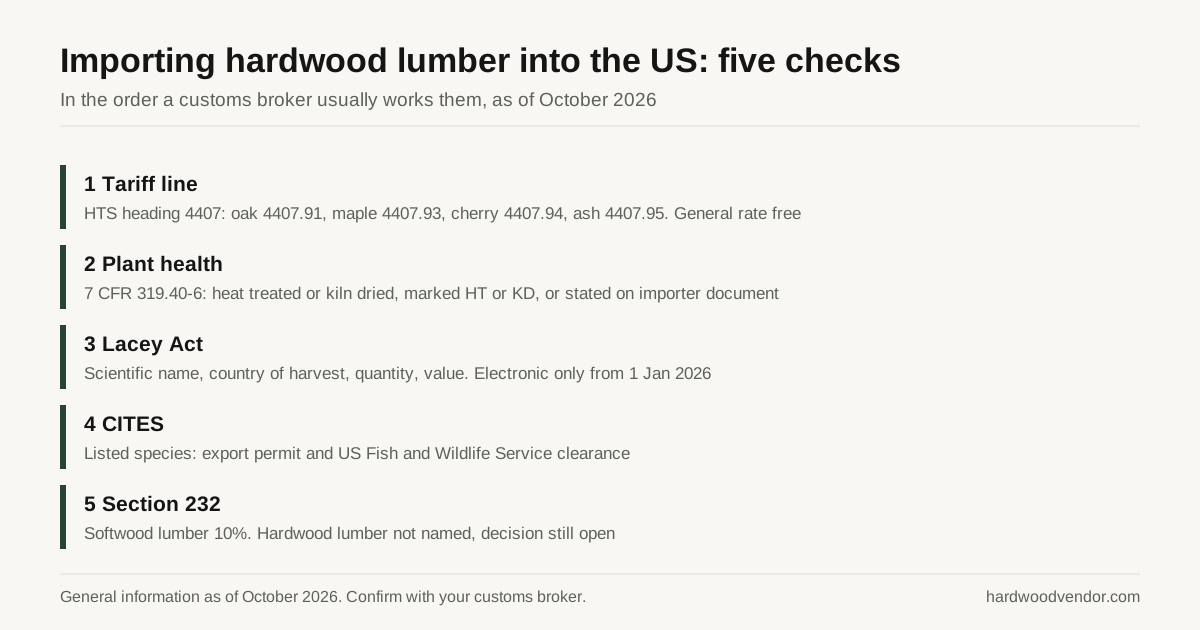
Importing hardwood lumber into the United States takes five checks: the tariff line under heading 4407, the APHIS plant health rule (heat treated or kiln dried, stated or marked), the Lacey Act declaration with species and country of harvest, CITES papers for listed species and the current status of trade actions such as Section 232. As of October 2026 the general duty on temperate hardwood lumber lines is free and the Section 232 lumber duty names softwood only. This page is general information, not legal advice. Confirm every point for your shipment with a licensed customs broker.
| Check | Rule (as of October 2026) | Who supplies what |
|---|---|---|
| Tariff line | Heading 4407, wood sawn lengthwise over 6 mm thick. Oak 4407.91, maple 4407.93, cherry 4407.94, ash 4407.95, poplar 4407.97, other hardwoods 4407.99 | Broker classifies, mill confirms species |
| General duty | Free on the temperate hardwood lines above (HTS column 1) | Broker confirms the full rate |
| Plant health | 7 CFR 319.40-6(b): heat treated or kiln dried before import, stated on the importer document or marked HT or KD | Mill dries and marks, importer documents |
| Lacey Act | Declaration with scientific name, country of harvest, quantity and value, filed electronically. Paper PPQ 505 ended 1 January 2026 | Mill gives the data, importer files |
| CITES | Listed species need the exporting country’s CITES document and US Fish and Wildlife Service clearance | Exporter obtains, importer declares |
| Section 232 | 10% on softwood timber and lumber. Hardwood lumber not named, decision on hardwood still open | Broker watches for changes |
Tariff lines and duty
Hardwood lumber sits in heading 4407 of the Harmonized Tariff Schedule. The temperate hardwood subheadings each name a genus, and several have statistical suffixes for the trade name:
| Subheading | Wood | Statistical lines include | General rate (column 1) |
|---|---|---|---|
| 4407.91 | Oak (Quercus) | Red oak, other oak | Free |
| 4407.92 | Beech (Fagus) | Free | |
| 4407.93 | Maple (Acer) | Hard maple, other | Free |
| 4407.94 | Cherry (Prunus) | Free | |
| 4407.95 | Ash (Fraxinus) | Free | |
| 4407.96 | Birch (Betula) | North American, European, other | Free |
| 4407.97 | Poplar and aspen (Populus) | Yellow poplar (Liriodendron), other | Free |
| 4407.99 | Other | Hickory and pecan, walnut, red alder, other | Free |
Source: HTS as published by the US International Trade Commission, read October 2026. Tropical hardwoods sit in 4407.21 to 4407.29. The column 2 rate applies only to a few countries. A free general rate does not rule out other duties added by separate trade actions on the country of origin, so the full rate for an entry is a question for your broker. Accurate species names on the invoice make the classification easy.
Plant health: heat treated or kiln dried
APHIS regulates imported lumber under 7 CFR part 319, subpart L. The general route for hardwood lumber is the universal option in 7 CFR 319.40-6(b):
- Treated before import. Lumber heat treated, or heat treated with moisture reduction (kiln dried), under part 305 before it ships may be imported.
- Proof. The fact must be stated on the importer document, or each piece or bundle carries a permanent mark: “HT” or “Heat Treated”, or “KD” or “Kiln Dried”.
- Raw lumber. Untreated lumber can enter only if it goes to a facility with a compliance agreement that heat treats it within 30 days of release from the port of first arrival.
Section 319.40-5 adds conditions for particular articles. Debarked tropical hardwood logs and lumber may enter subject to inspection. Ash (Fraxinus) wood from Canada has its own rules tied to emerald ash borer, with certificates or importer documents depending on the province and county of origin. Wood packaging, such as pallets and dunnage in the container, must meet the ISPM 15 treatment and mark rules separately.
For what the exporting mill and its plant protection office provide, see the page on the phytosanitary certificate for lumber exporters and the guide to hardwood phytosanitary and fumigation rules.
The Lacey Act declaration
The Lacey Act makes it unlawful to import wood taken, harvested or traded in violation of the laws of the country of harvest, and it requires an import declaration for plant products. Sawn lumber under heading 4407 has been covered since the second phase of enforcement in April 2009.
| Field | What the mill provides |
|---|---|
| Scientific name | Genus and species of each wood in the load, for example Quercus alba |
| Country of harvest | Where the trees were cut, not where the lumber was sawn or shipped |
| Quantity | With the unit, such as cubic meters or board feet |
| Value | Declared value of the lumber |
APHIS states that paper PPQ 505 and 505B forms are no longer accepted from 1 January 2026. The declaration goes through the broker’s electronic filing. The law also expects due care: an importer who could have known the wood was illegal is exposed. Our page on the Lacey Act PPQ 505 declaration takes the fields one by one, and the lumber import documents checklist lists the full paper set.
CITES species
Most temperate hardwoods are not listed under CITES. Several tropical timbers are, for example genuine mahogany (Swietenia), several rosewoods and some African species. Lumber of a listed species needs the CITES export permit or re-export certificate from the country of export, and it must be declared to and cleared by the US Fish and Wildlife Service at the port. The US Fish and Wildlife Service bulletin on the 2025 conference amendments, effective 5 March 2026, lists the current changes. Check every species on the order against the current appendices. See CITES timber species and the CITES permit process for timber.
Section 232 and other trade actions
Under the Section 232 proclamation of September 2025, softwood timber and lumber carry a 10% duty from 14 October 2025, and kitchen cabinets, vanities and upholstered wooden seating carry their own rates, with steps on 1 January 2027 set by a December 2025 amendment. Hardwood lumber is not named. The proclamation told the Secretary of Commerce to update the President on hardwood timber and lumber by 1 October 2026. As of October 2026 we found no published decision.
What a buyer can do now:
- Classify each line at the subheading level and keep species names exact on the invoice.
- Put a clause in the contract on who carries a new duty that applies after the order date.
- Ask your broker to alert you to Federal Register notices and CBP messages on timber and lumber.
Our guide to the Section 232 lumber tariff sets out the lines and rates in detail.
Buyer practice in the US market
| Topic | Typical US practice |
|---|---|
| Grades | NHLA rules, edition named in the contract |
| Measure | Board feet on a nominal rough thickness, tally per bundle |
| Moisture | Kiln dried 6 to 8% for interior use |
| Sizes | Thickness in quarters (4/4, 5/4, 8/4), random widths and lengths |
| Disputes | NHLA reinspection when the contract names NHLA rules |
Imported lumber graded under other rules, such as EN 975-1 for European oak or the ATIBT rules for African species, should be priced on its own rule. Do not assume an imported “FAS” equals NHLA FAS. Our guide to hardwood grading rules compared shows the differences.
What to write on the RFQ
Add the import lines to the lumber spec: species with scientific name, country of harvest, HT or KD mark, Lacey Act data, CITES documents if listed, Incoterm and port. Then send your lumber RFQ and we pass it to up to 3 mills or exporters that ship to the United States. Other destinations are on the lumber import rules hub.
RFQ line: European oak (Quercus robur/petraea), country of harvest stated, EN 975-1 grade named, 52 mm, KD 8-10%, KD marked, Lacey Act data (scientific name, country of harvest, m3, value), FOB port named.
Frequently asked questions
Is there a US import duty on hardwood lumber?
The general (column 1) rate in the Harmonized Tariff Schedule is free for the temperate hardwood lines under heading 4407, such as oak, maple, cherry, ash, poplar and walnut, as of October 2026. Other duties can be added by separate actions, so confirm the full rate for your entry with a licensed customs broker.
Does the Section 232 lumber tariff apply to hardwood?
As of October 2026 the Section 232 duty on lumber names softwood lumber at 10%, not hardwood lumber. The proclamation asked Commerce to update the President on hardwood timber and lumber by 1 October 2026, and we found no published decision. Treat it as an open risk.
Does kiln dried lumber need a phytosanitary certificate to enter the US?
APHIS lets lumber enter under 7 CFR 319.40-6 when it was heat treated, or heat treated with moisture reduction (kiln dried), before import, with that fact on the importer document or the lumber marked HT or KD. Some species and origins have their own conditions. Check the current rule for your origin with your broker or APHIS.
Who files the Lacey Act declaration?
The importer, usually through the customs broker, files it electronically with the entry. APHIS stopped accepting paper PPQ 505 forms on 1 January 2026. The mill supplies the data: scientific name, country of harvest, quantity and value.
Sources
- APHIS: Lacey Act (plant and plant product declarations)
- APHIS: File a Lacey Act declaration (electronic filing, end of paper PPQ 505)
- 16 U.S.C. 3372, Lacey Act prohibited acts and import declaration
- 7 CFR 319.40-6, universal importation options (lumber: heat treatment, KD marking, importer document)
- 7 CFR 319.40-5, conditions for specific articles (tropical hardwood, ash from Canada)
- US International Trade Commission: Harmonized Tariff Schedule, heading 4407
- White House: Proclamation adjusting imports of timber, lumber and their derivative products (September 2025)
- White House: Amendments to the timber and lumber proclamation (December 2025)
- US Fish and Wildlife Service: CITES CoP20 amendments to Appendices I and II, public bulletin (January 2026)
Standards and rules are cited as references, not as claims about Hardwood Vendor or any mill. Editions and status change: confirm with the issuing body, your customs broker or the regulator.
Know what you need? Send the spec.
Tell us the species, grade, thickness and board feet. We pass it to up to 3 mills or yards that carry it and reply within 24 business hours.
Send my lumber RFQ