Guides / Species
CITES-Listed Timber Species: Which Hardwood Lumber Needs Export Permits
December 30, 2026

Common North American hardwoods are not in the notices behind this guide, but a list of tropical groups is, and that list has grown in recent years. If a species is in the Appendices, the shipment needs a permit or certificate from the exporting country, and the annotation on the listing decides whether your product form, whether sawn boards, veneer or flooring strips, is covered. This guide names the groups that matter to lumber buyers, shows what each listing covers and gives you the lines to put on an RFQ.
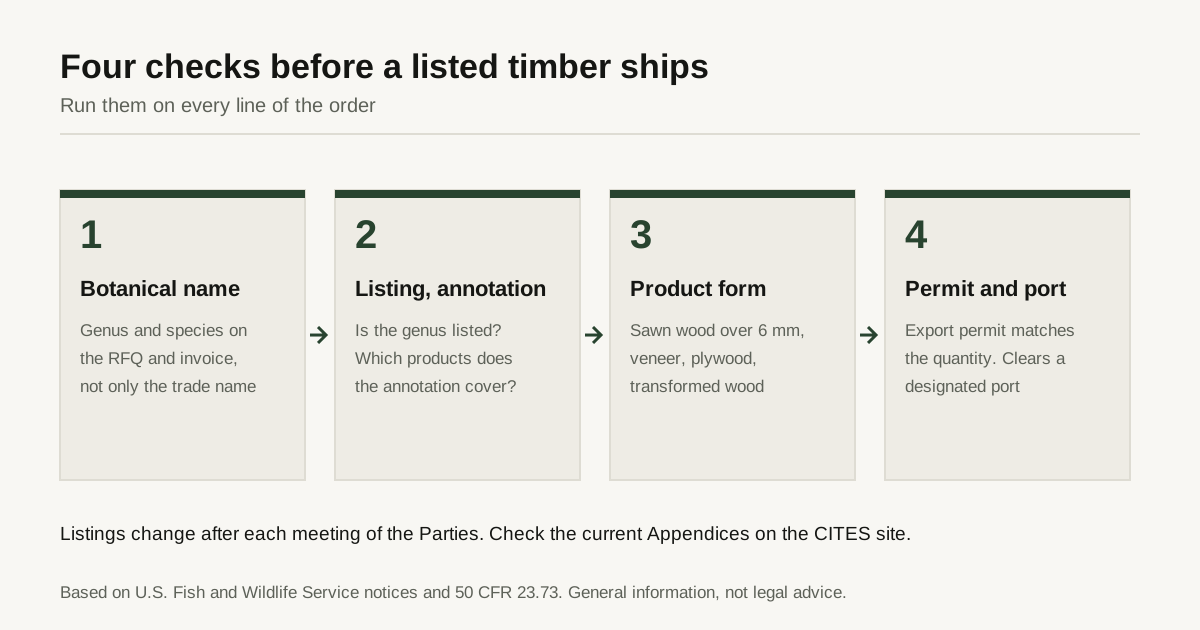
This is general information, not legal advice. It rests on notices from the U.S. Fish and Wildlife Service for the 2019 and 2022 meetings of the Parties. The Parties met again in late 2025, so check the current Appendices on the CITES site, and ask your broker about the rules of your own destination.
How CITES treats timber
CITES lists species in Appendices. Species in Appendix II may be traded with an export permit or re-export certificate from the exporting country. Many timber listings carry an annotation that limits the listing to certain product forms. A listing without an annotation covers every part and derivative.
Amendments adopted at a meeting of the Parties normally take effect 90 days after the meeting, unless the Parties set a delay. The 2022 meeting set 24-month delays for two groups, so those listings took effect on 25 November 2024.
Three annotation types appear below. They use terms with a fixed CITES meaning:
- Annotation #6: logs, sawn wood, veneer sheets and plywood.
- Annotation #17: logs, sawn wood, veneer sheets, plywood and transformed wood.
- Annotation #15: all parts and derivatives, with listed exceptions.
Under the U.S. rules in 50 CFR 23.73, sawn wood is wood simply sawn lengthwise or produced by profile-chipping, normally more than 6 mm thick, and veneer sheets are layers usually 6 mm or less. Transformed wood, as defined in the CITES interpretation notes quoted by the Fish and Wildlife Service, reaches continuously shaped pieces, such as tongued, grooved or beaded profiles and parquet strips. So flooring strips and moulding in a listed species can need papers even when they are not logs.
Timber groups that need CITES papers
| Group and common names | Botanical names | Listing and annotation | Effective |
|---|---|---|---|
| Rosewoods, palisanders and bubinga | Dalbergia spp.; Guibourtia demeusei, G. pellegriniana, G. tessmannii | Appendix II, #15: all parts and derivatives, with exceptions | #15 revised 26 Nov 2019 |
| African padauk, kosso | Pterocarpus spp., African populations (incl. P. erinaceus, P. tinctorius) | Appendix II, #17 | 23 Feb 2023 |
| Afrormosia | Pericopsis elata | Appendix II, #17 (new scope) | 26 Nov 2019 |
| African mahogany, afzelia, pod mahogany, African oak | Afzelia spp., African populations | Appendix II, #17 | 23 Feb 2023 |
| Cumaru, shihuahuaco, tonka | Dipteryx spp. | Appendix II, #17 | 25 Nov 2024 |
| Trumpet trees (ipe, lapacho, tabebuia) | Handroanthus, Roseodendron, Tabebuia spp. | Appendix II, #17 | 25 Nov 2024 |
| Spanish cedar and other neotropical cedars | Cedrela spp., neotropical populations | Appendix II, #6 | 28 Aug 2020 |
| Brazil wood, pernambuco | Paubrasilia echinata | Appendix II, #10: all parts, derivatives and finished products | Revised 23 Feb 2023 |
Bigleaf mahogany, Swietenia macrophylla, is also in Appendix II for its neotropical populations, so mahogany lumber from that range needs papers too. Red sanders, Pterocarpus santalinus, stays under its own annotation #7 for logs, woodchips, powder and extracts.
Notes on the table:
- African populations only. The padauk and afzelia listings cover only trees of African origin. The wood must come with a document if it originates from the African continent.
- Rosewood exceptions. Annotation #15 excludes leaves, flowers, pollen, fruits and seeds, finished products up to 10 kg of listed wood per shipment, and finished musical instruments, parts and accessories. The 10 kg limit is judged per item in the shipment, not against the total. A blank that still needs shaping does not fit the definition of a finished instrument part quoted in the notice, so ask the authority before you rely on the exception. Our guide to tonewood lumber for instrument makers covers the buyer side.
- Delayed listings. Cumaru and the trumpet trees were listed in 2022 but took effect in 2024. Check the date of entry into force, not the date of the meeting.
What a CITES shipment needs
Papers come from the exporting side. The Fish and Wildlife Service states that imports of covered specimens into the United States must be accompanied by a CITES permit or certificate issued by the country of export or re-export. This applies even if the lumber was shipped before the listing took effect but arrives after. Other points from the same notices:
- Designated ports. Shipments of CITES-listed plant specimens, timber included, must clear through a port designated by the U.S. Department of Agriculture for CITES plants. Customs and Border Protection inspects non-living specimens on import.
- Pre-Convention wood. If the wood comes from trees harvested before the species was first listed, the shipment still needs a document, which can be a pre-Convention certificate if the requirements are met.
- Validity and redirects. Under 50 CFR 23.73, an export permit normally lasts six months, and the importing authority may update the importer’s name after a redirect if the quantity and bill of lading match.
- Re-export. Lumber re-exported from the United States needs a U.S. re-export certificate.
- Stockpiles. The Fish and Wildlife Service does not require registration of stockpiles, but it asks for proof of legal acquisition if you re-export, such as import documents, receipts or inventory logs.
If your destination is not the United States, the same CITES system applies, but the national authority, forms and ports differ. Ask your broker for the import conditions in writing.
How buyers get caught
- Trade names. Afzelia is sold as African mahogany and African oak. Padauk is sold as African rosewood. Cumaru goes by shihuahuaco and tonka. Ipe is one of several trumpet trees. A quote that lists only the trade name hides the botanical genus, and the genus decides whether CITES applies.
- Product form. A listing under #6 may leave a finished product outside the scope, while one under #17 reaches profiled strips. The same species can need papers in one product form and not in another.
- Mixed loads. One container may carry listed and unlisted species. The paperwork has to match the line items by quantity.
- Old stock. A supplier who says the lumber is old stock still has to show a document or a pre-Convention basis when the wood crosses a border.
RFQ lines that prevent trouble
- Botanical name for every line item, with the trade name in brackets.
- The statement that the supplier will arrange the CITES export permit where the species is listed, and send a copy before shipment.
- The permit number and quantity to match the packing list.
- The port of entry and who clears it.
- A clause that lets you cancel if the permit does not match the load.
Pair these with the papers in our guide to phytosanitary certificates and fumigation and the checks in how to choose a hardwood lumber supplier. For a species list by use, see our hardwood species hub. If you need a listed species, send your lumber RFQ with the botanical name and the form you need, and we pass it to up to 3 mills or yards that say they can supply it with the papers. They reply to you directly.
See also: CITES permits for timber for the permit steps in order, validity and the CoP20 changes.
Sources
- U.S. Fish and Wildlife Service, CoP19 timber outcomes letter to importers, 31 January 2023
- U.S. Fish and Wildlife Service, changes to CITES species listings, 9 September 2019
- 50 CFR 23.73, how can I trade internationally in timber
- Swietenia macrophylla, Wikipedia (CITES status)
Frequently asked questions
Which hardwood species need a CITES permit?
The main groups for lumber buyers are rosewoods and palisanders (Dalbergia), bubinga (three Guibourtia species), African padauk (Pterocarpus), afrormosia (Pericopsis elata), African mahogany or afzelia, cumaru, the trumpet trees such as ipe, and Spanish cedar from the neotropics. Each listing names the products it covers, so check the annotation.
Does CITES cover sawn lumber or only logs?
It depends on the annotation. Annotation #6 covers logs, sawn wood, veneer sheets and plywood. Annotation #17 adds transformed wood. Annotation #15 for rosewoods and bubinga covers all parts and derivatives with exceptions. Sawn wood is normally wood over 6 mm thick, so lumber is covered under all three.
Do oak, maple, walnut and cherry need CITES papers?
They do not appear in the CITES timber notices used for this article. Still, write the botanical name on every RFQ and invoice, because listings change after each Conference of the Parties. Confirm the current Appendices on the CITES site before you buy a species you have not traded before.
Who issues the CITES document for an import?
The Management Authority of the exporting or re-exporting country issues the permit or certificate. For the United States, the U.S. Fish and Wildlife Service notices say the document must travel with the shipment. The shipment must also clear a port designated for CITES-listed plants. Your broker confirms the rules for other destinations.
Know what you need? Send the spec.
Tell us the species, grade, thickness and board feet. We pass it to up to 3 mills or yards that carry it and reply within 24 business hours.
Send my lumber RFQ