Home / Lumber papers and certificates / CITES Permits for Timber: Export, Import and Re-export Steps
CITES Permits for Timber: Export, Import and Re-export Steps
Reference page · Last reviewed 23 February 2027
A CITES permit is the document that lets a listed timber species cross a border. For species in Appendix II, which covers most commercial timber listings, the exporting country issues an export permit, and many importing countries add their own import step on top. The buyer does not obtain the export permit, but it needs to know what the mill must obtain, which steps the destination adds and how long the paper is valid.
| Item | Typical rule (as of October 2026) |
|---|---|
| Appendix I | Highest protection. Trade needs an import permit and an export permit |
| Appendix II | Most listed timber. Export permit or re-export certificate from the exporting country |
| Appendix III | A country asks for help controlling trade in its own species. Export permit from the listing country, certificate of origin from others |
| Issuer | The Management Authority of the exporting or re-exporting country |
| Validity | Export permit and re-export certificate: six months at most. EU import permit: up to 12 months |
| EU extra step | Import permit from the Member State for species in Annexes A and B of Regulation 338/97, which includes CITES Appendix II species |
| Applies to | The product forms named in the listing annotation. Check logs, sawn wood, veneer, transformed wood |
This page is general information, not legal advice. Listings and procedures change. Confirm with your customs broker, the issuing authority or the regulator.
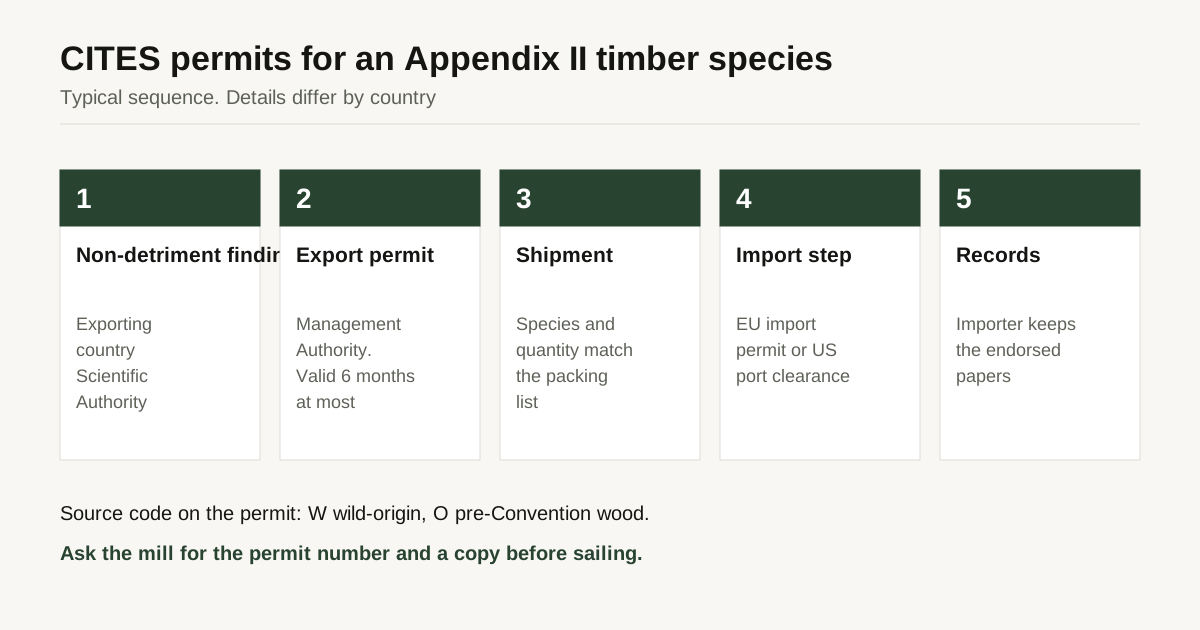
The sequence for an Appendix II species
- Non-detriment finding. The Scientific Authority of the exporting country assesses whether trade would harm the species. The finding must exist before a permit is issued. Many countries turn the result into an export quota for wild-origin material for the calendar year.
- Export permit. The Management Authority issues it only if the wood was legally obtained and the finding is in place. The mill or exporter applies. The buyer asks for the permit number and a copy before shipping.
- Shipment. The permit travels with the goods. Quantity and species on the permit must match the packing list and the invoice.
- Import step. The destination country checks the export permit. The EU requires an import permit as well. The United States requires the CITES document and clearance at an authorized port.
- Clearance and records. Customs endorse the papers. The importer keeps them. In the EU the yellow copy of the import permit, endorsed by customs, is the importer’s proof of a legal import and stays with the importer, not the forwarder.
If the wood is later re-exported, the re-exporting country issues a re-export certificate, and it does so only if the wood was imported in line with the Convention.
Source codes and pre-Convention wood
The permit carries a source code. W means wild-origin. O means pre-Convention wood. Pre-Convention timber is wood from trees felled before the species was listed. A shipment of pre-Convention wood still needs a document: it can be a CITES permit with the O code or a pre-Convention certificate, issued on proof of the felling date. The date that matters is the date the listing took effect, not the date of the Conference. See CITES timber species for the groups and the effective dates.
EU, US and other destinations
European Union. Species listed in Appendix II fall in Annex B of the EU wildlife trade regulation. For Annex A and B species the importer needs an EU import permit issued before shipment on the basis of a copy of the foreign export permit. In addition, the Member State’s Management Authority makes a legal acquisition finding and its Scientific Authority makes a non-detriment finding for timber. The EU has said the criteria for timber are under review by its Scientific Review Group. Plan time for the import permit: at CoP20, operators reported EU import permit delays of up to 18 months for some Central African timber, while export permits last six months.
United States. The US Fish and Wildlife Service states that shipments into and out of the United States of listed species, including parts and products, must be accompanied by the right CITES document and presented for clearance at a designated port or one authorized by a Designated Port Exception Permit. The detail for timber is in 50 CFR 23.73, which defines sawn wood (normally thicker than 6 mm) and veneer sheets (normally 6 mm or less) and sets the rules for permit validity and for a change of importer after a redirect. Which agency clears your shipment and at which port is something to confirm with your broker.
Other markets. Each country is free to impose its own import permit. Ask the broker for the requirement in writing.
CoP20 and what changed
The Conference of the Parties met in Samarkand, Uzbekistan, from 24 November to 5 December 2025. Amendments took effect on 5 March 2026, 90 days after the meeting, except those with a delayed date. The US notice of the amended Appendices lists these points for timber and other plants:
- No new hardwood timber species were added. Plant changes in the notice concern other plants, such as Chilean palm in Appendix I.
- The annotation for Paubrasilia echinata (pernambuco, Brazilwood) was amended, with a zero quota for wild-harvested specimens traded for commercial purposes.
- Trade bodies report that proposals by the Republic of Congo and Gabon to remove African populations of Afzelia bipindensis (doussie) and Pterocarpus soyauxii (padouk) from Appendix II won about 47 percent of the vote and failed to reach the two-thirds majority.
- Parties adopted a compromise on permit delays: importing countries must give written reasons for refusing a permit, and must notify the exporting country and the Secretariat. A proposed 30-day maximum for processing was not adopted.
- Trade bodies expect the Entandrophragma group (sapelli, sipo, tiama, kosipo) and okoume to be discussed at a later Conference, but no proposal to list them was put to CoP20.
These are the outcomes found in the sources listed below. Check the current Appendices on the CITES website for the full list before you buy a species you have not traded before.
What the buyer should ask for
| Ask | Why |
|---|---|
| Botanical name for each RFQ line | The listing is by species or genus, never by trade name |
| The species list and annotation the mill relies on | Shows whether the product form is covered |
| Copy of the export permit before sailing, then the original with the goods | Quantity and species must match |
| Source code on the permit | W or O changes the import path |
| The EU import permit number for EU entry | Applied for before shipment |
| Name of the exporting Management Authority | Lets you or the broker verify the permit |
Our guide to CITES timber species lists the groups and annotations. For the declaration that goes with a US entry see the Lacey Act declaration, and for the whole file of papers see the import documents checklist.
What to write on the RFQ
- Botanical name for every item, with the trade name in brackets.
- The supplier obtains the export permit and sends a copy before shipment.
- Permit number and quantity to match the packing list.
- Destination port and who clears the shipment.
- A clause that lets you cancel if the permit does not match the load.
Send your lumber RFQ with the botanical names and the destination and we pass it to up to 3 mills or yards that say they can supply the species with the papers.
RFQ line: Ipe (Handroanthus spp.), 5/4 rough, KD, CITES export permit copy before sailing, botanical name and permit number on invoice and packing list.
Frequently asked questions
Does every hardwood need a CITES permit?
No. Only species listed in the CITES Appendices do, and the annotation on the listing decides which product forms are covered. Common North American species such as oak, maple, walnut and cherry do not appear in the timber listings covered on this page, but check the botanical name on every RFQ, because listings change after each Conference of the Parties.
Who issues the export permit?
The Management Authority of the exporting or re-exporting country. It issues the permit only if the wood was obtained legally and the Scientific Authority has found that the export is not detrimental to the survival of the species.
How long is an export permit valid?
Export permits and re-export certificates are valid for a maximum of six months. The export and the import into the destination country must both take place inside that time. Under US rules the importing authority can extend a permit once, for up to six months, in the narrow case where the shipment reached its final port and is held in bond.
What changed at CoP20?
The 20th Conference of the Parties met in Samarkand from 24 November to 5 December 2025. The US notice of amended listings, in force from 5 March 2026, lists no new hardwood timber species. Proposals to remove African populations of Afzelia bipindensis and Pterocarpus soyauxii from Appendix II did not reach the two-thirds majority. The annotation for Paubrasilia echinata was amended.
Sources
- ATIBT CITES FAQ (version 23 February 2023): Appendix II permits, EU Annex B import permit, validity, source codes, non-detriment findings
- U.S. Fish and Wildlife Service public bulletin PB 26-001: CITES CoP20 amendments to Appendices I and II (in force 5 March 2026)
- 50 CFR 23.73: how can I trade internationally in timber
- ATIBT: CITES CoP20 in Samarkand, Central Africa at the heart of debates on tropical timber trade
- CITES notification E-Notif-2024-138 (EU Annex B import checks for timber, legal acquisition and non-detriment findings)
- Earth Negotiations Bulletin: CITES CoP20 summary
Standards and rules are cited as references, not as claims about Hardwood Vendor or any mill. Editions and status change: confirm with the issuing body, your customs broker or the regulator.
Know what you need? Send the spec.
Tell us the species, grade, thickness and board feet. We pass it to up to 3 mills or yards that carry it and reply within 24 business hours.
Send my lumber RFQMore in lumber papers and certificates
- Lacey Act Declaration (PPQ 505) for Hardwood Lumber, Field by Field
- FSC Certified Hardwood Lumber: Certificate Codes, Claims and Scope
- Testing Lumber Moisture: Oven-Dry, Resistance and Capacitance Methods
- NHLA Inspection Reports for Hardwood Lumber: What a Graded-Lot Report Should Show
- Kiln Drying Quality: Moisture Spread, Gradient and Case Hardening Checks
- Hardwood Lumber Import Documents: The Set an Importer Should Receive