Home / Lumber papers and certificates / Hardwood Lumber Import Documents: The Set an Importer Should Receive
Hardwood Lumber Import Documents: The Set an Importer Should Receive
Reference page · Last reviewed 27 February 2027
An importer of hardwood lumber should receive one set of papers per shipment, with the same species, quantity and lot numbers on every page. Three papers are the core: the commercial invoice, the packing list or tally and the transport document. The rest depend on the species, where the trees grew, how the lumber was treated and where it is going. This checklist names each paper, who issues it and what it can and cannot prove.
| Document | Issued by | What it shows | What it does not show |
|---|---|---|---|
| Commercial invoice | Seller | Parties, goods, quantity, value, terms | Grade, moisture or legality |
| Packing list and tally | Seller | Bundles, pieces, board feet or cubic meters | Whether the grade is right |
| Bill of lading or waybill | Carrier | The goods were shipped, container and seal numbers | Contents of the container |
| Grade report | Mill grader or independent inspector | Grade result for the lot against a named rule | Legal origin |
| Moisture or kiln record | Mill | Drying run and readings | A guarantee of moisture on arrival |
| Phytosanitary certificate | Plant protection authority of the exporting country | Plant health status at export | Quality, grade or legality |
| Fumigation or heat treatment record | Treatment provider | Treatment applied | Plant health clearance on its own |
| Certificate of origin | Chamber or authority named by the destination | Where the goods were made | Where the trees were harvested |
| Lacey Act data | Mill gives, importer files | Species, harvest country, value, quantity | Legality |
| CITES permit | Authority of the exporting country | Permission to export a listed species | Other legal origin papers |
| FSC or other chain-of-custody claim | Seller, backed by a certificate | A claim on the invoice with a certificate code | Compliance with import law |
| EUDR data and reference number | Importer or operator | Due diligence statement reference for EU entry | Compliance of the wood by itself |
This page is general information as of October 2026, not legal advice. Which papers a shipment needs depends on species, origin and destination. Confirm with your customs broker.
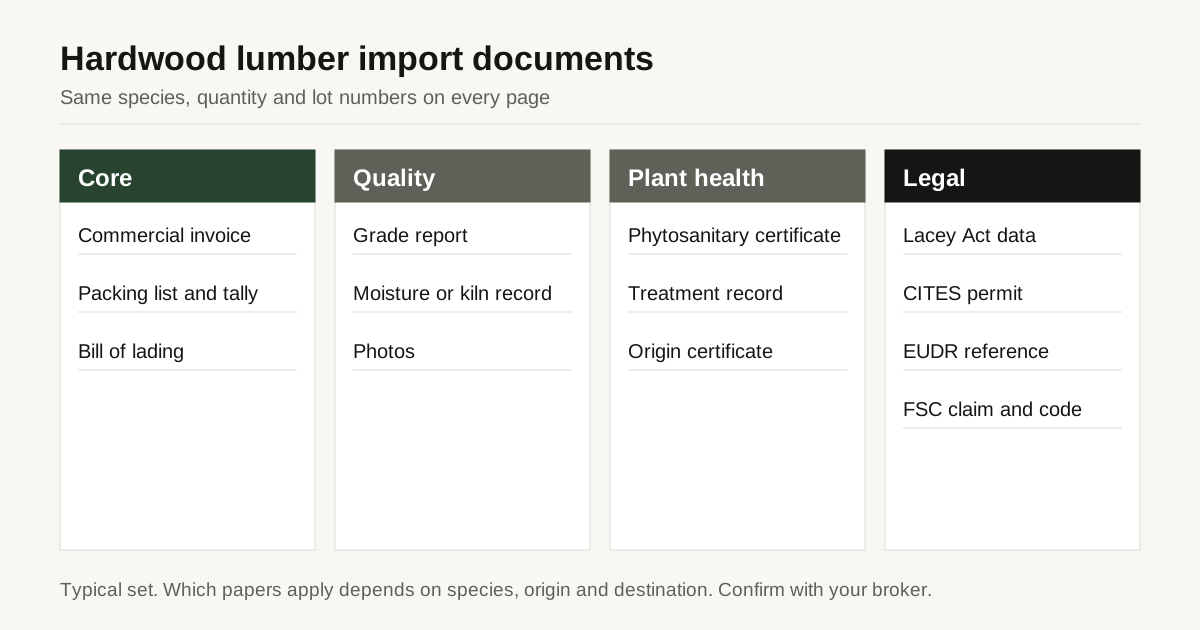
The core three
Commercial invoice. Seller, buyer, description, quantity, unit price, total, Incoterm and payment terms. Use the botanical name in the description, with the trade name in brackets. Customs reads the invoice for the entry value, so the species and the value on it must match the other papers. For payment terms see lumber import payment terms.
Packing list and tally. By bundle: piece count, widths and lengths or a summary, grade, thickness, and board feet or cubic meters. State whether the tally is gross or net and the rule it follows. See NHLA measurement rules and the guide to container loading, bundles and tally.
Transport document. The bill of lading (sea) or waybill (air and some other modes) names the carrier, the container and seal numbers and the ports. The goods description must match the invoice.
The quality papers
- Grade report. A graded-lot report from the mill grader or an independent inspector, naming the rule and edition. See NHLA inspection reports.
- Moisture or kiln record. The kiln charge number, the drying run and the moisture readings at loading, with the method. See moisture test methods and kiln drying schedules.
- Photos. Bundle ends, labels and container loading photos give a visual record. See lumber photos for buyers.
The plant health papers
A phytosanitary certificate is issued by the exporting country’s plant protection authority when the destination requires it. It states that the shipment meets plant health rules. It is not a statement of grade. Where a treatment such as fumigation or heat treatment is part of the requirement, the treatment record is a separate paper. Read hardwood fumigation and heat treatment rules for the details by destination. Whether plant health papers are needed at all depends on the species, the form of the wood, the origin and the destination, so ask your broker before you order.
Papers by destination
| Destination | Extra papers to expect (typical, confirm) |
|---|---|
| United States | Lacey Act declaration data for the electronic filing. Paper PPQ 505 has not been accepted since 1 January 2026. CITES document for listed species. Plant health papers where required |
| European Union | EUDR due diligence statement reference. The regulation applies from 30 December 2026 to large and medium operators and from 30 June 2027 to other micro and small operators, after the December 2025 amendment. CITES export permit and, for Annex B species, an EU import permit. Plant health papers where required |
| Other markets | National legal timber rules, import permits and certificates of origin named by the destination. Ask the broker for the list in writing |
For the US declaration see Lacey Act declaration and, for the mill side, Lacey Act supplier records. For panels, mouldings and blanks in the same load see solid lumber and TSCA Title VI. For EU data see the EUDR guide for hardwood lumber and EUDR sawmill due diligence. For listed species see CITES permits for timber. Tariffs are a separate question: see Section 232 and lumber.
The May 2026 EUDR guidance, as summarized by a law firm, says downstream traders meet the duty to collect and keep information by retaining what they received through standard commercial documents such as invoices. Operators have heavier duties. Check which role your company has.
How to run the check
- Before the order: send the checklist to the mill and agree which papers it will provide and by when.
- Before sailing: compare the draft set. Species, quantity, lot numbers and values must match on every page.
- At arrival: file the entry with the final set and keep the file.
- After clearance: store the file. Authorities can ask for records after the goods are released.
Common mismatches
| Mismatch | Why it matters |
|---|---|
| Species written as a trade name on one paper and a botanical name on another | Lacey and CITES checks depend on the botanical name |
| Quantity in board feet on the invoice and cubic meters on the tally | Unit conversion errors change the declared value |
| Container or seal number differs from the bill of lading | Delays at the port |
| Certificate code on the invoice not found in the database | The claim cannot be relied on |
| Phytosanitary certificate issued for a different lot | Border authority may refuse it |
What to write on the RFQ
List the papers you expect as separate lines, with a date for each. Send your lumber RFQ and we pass it to up to 3 mills or yards that can supply the set.
RFQ line: Ash (Fraxinus americana), No.1 Common, 4/4, KD 6-8%, documents before sailing: invoice, tally, grade report, kiln record, Lacey Act data, plant health papers as required for the destination.
Frequently asked questions
Which documents does every lumber shipment need?
A commercial invoice, a packing list or tally and a transport document (bill of lading or waybill). Almost every other paper depends on the species, the origin, the treatment and the destination. Your customs broker confirms the rest before the order is placed.
Is a phytosanitary certificate a quality certificate?
No. It states that the shipment meets plant health requirements of the importing country. It is not a certificate of grade, moisture or quality.
Do I need all of these papers for a US import?
The core set is the invoice, tally and transport document, plus the Lacey Act declaration data that your broker files electronically, plus a CITES document for a listed species. Plant health, origin and certification papers depend on the shipment. Ask your broker.
Who keeps the documents?
The importer keeps the file. Customs and enforcement agencies can ask for records after the goods are cleared. Keep the set in one folder per shipment with the species, harvest country and lot numbers visible.
Sources
- APHIS: File a Lacey Act declaration (paper PPQ 505 ended 1 January 2026)
- 16 U.S.C. 3372, import declaration for plants
- Arendt: EUDR simplification review published (application dates and downstream operator duties, 18 May 2026)
- CITES notification E-Notif-2024-138 (EU Annex B import checks for timber)
- 50 CFR 23.73: international trade in CITES timber
Standards and rules are cited as references, not as claims about Hardwood Vendor or any mill. Editions and status change: confirm with the issuing body, your customs broker or the regulator.
Know what you need? Send the spec.
Tell us the species, grade, thickness and board feet. We pass it to up to 3 mills or yards that carry it and reply within 24 business hours.
Send my lumber RFQMore in lumber papers and certificates
- Lacey Act Declaration (PPQ 505) for Hardwood Lumber, Field by Field
- FSC Certified Hardwood Lumber: Certificate Codes, Claims and Scope
- Testing Lumber Moisture: Oven-Dry, Resistance and Capacitance Methods
- NHLA Inspection Reports for Hardwood Lumber: What a Graded-Lot Report Should Show
- Kiln Drying Quality: Moisture Spread, Gradient and Case Hardening Checks
- CITES Permits for Timber: Export, Import and Re-export Steps