Guides / Grades and Specs
Kiln Drying Hardwood: Schedules, Case Hardening and Checks Explained
November 12, 2026
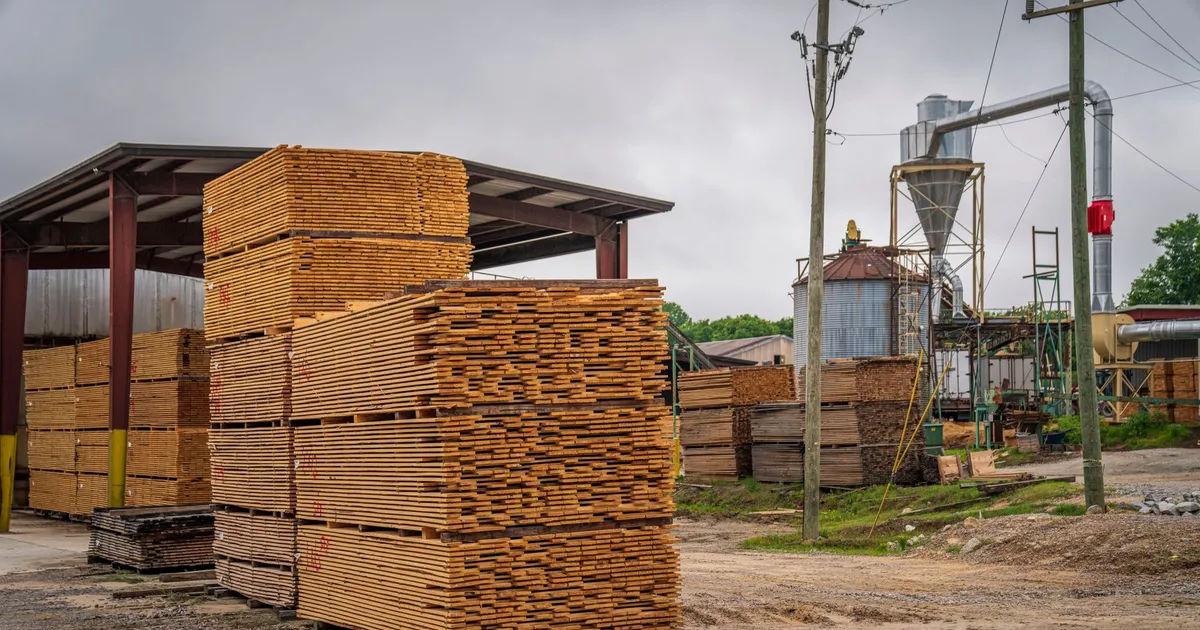
A kiln does not just take water out of lumber. It controls how fast the water leaves, and that speed decides whether you receive flat, stable boards or a stack that cups, checks and moves after the first rip. If you buy kiln dried hardwood, the schedule behind it matters as much as the moisture number printed on the tally.
This guide explains how kiln schedules work, what goes wrong when they are rushed, and which questions let a buyer judge a supplier’s drying without visiting the kiln. Numbers here are typical. Each kiln, species and load behaves differently, so use them to ask better questions, not to set a contract.
What a kiln schedule actually is
A kiln schedule is a step-by-step plan for air temperature and humidity during a drying run. Most schedules are written in terms of two readings:
- Dry bulb temperature. The ordinary air temperature in the kiln.
- Wet bulb temperature. The reading of a thermometer wrapped in a wet wick. The gap between wet and dry bulb tells you how humid the air is, and so how hard the air pulls on the wood.
As the lumber dries, the operator raises the temperature and widens the gap between the two readings. Early in the run the air is warm and damp, so surface water leaves slowly and evenly. Later the air gets hotter and drier because the wood can now take it.
The United States Forest Products Laboratory publishes reference schedules by species and thickness. Many mills start from those and adjust for their own kiln. Hard, dense species such as white oak and hickory get gentler schedules than poplar or soft maple. Thick stock gets gentler schedules than thin stock, because water takes much longer to travel out of a 2 in board than a 1 in board.
How long drying takes
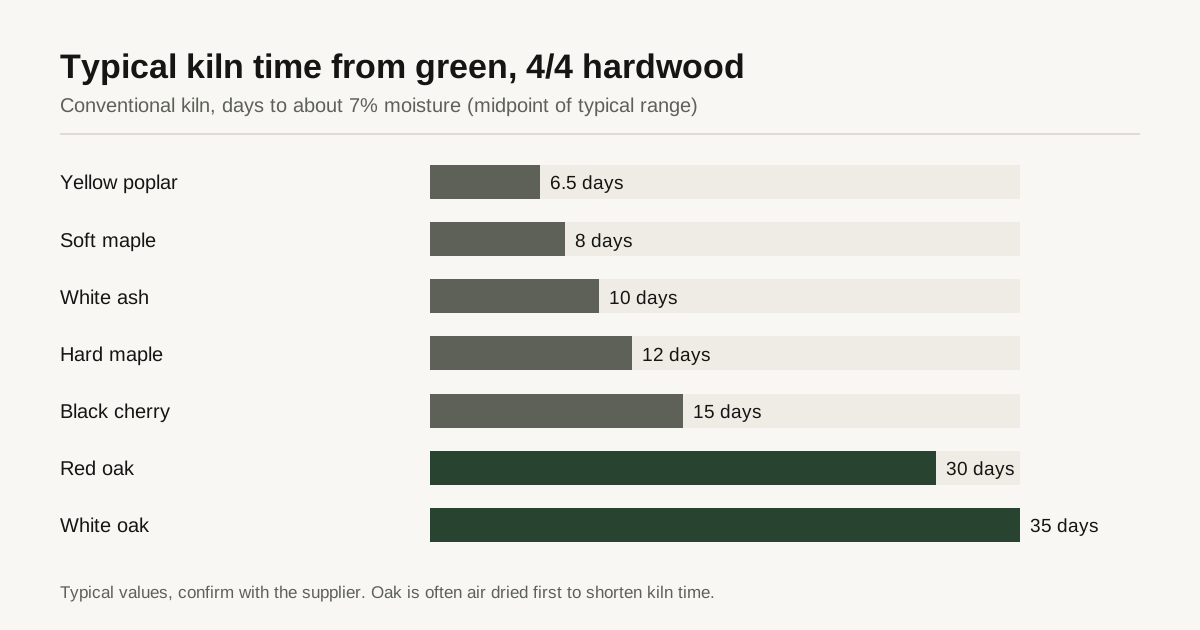
Drying time depends on species, thickness, starting moisture and whether the lumber was air dried first. These typical ranges are for a conventional kiln drying from green to about 7 percent:
| Species and thickness | Typical kiln time from green | Notes |
|---|---|---|
| Yellow poplar, 4/4 | 5 to 8 days | Fast, but wet pockets in the heartwood can stay behind |
| Soft maple, 4/4 | 6 to 10 days | Keep temperature moderate to limit stain |
| White ash, 4/4 | 8 to 12 days | Dries easily with little degrade |
| Hard maple, 4/4 | 10 to 14 days | Moderate temperature protects the white color |
| Black cherry, 4/4 | 12 to 18 days | Prone to gum pockets and some checking |
| Red oak, 4/4 | 25 to 35 days | Slow and gentle to avoid surface and end checks |
| White oak, 4/4 | 30 to 40 days | Prone to checking and collapse, often air dried first |
| Red oak, 8/4 | 45 to 70 days | Thickness lengthens drying sharply |
Many mills air dry oak for a few months to bring it to about 20 to 25 percent moisture, then finish in the kiln. This saves energy and lowers the risk of checks. If a supplier says “kiln dried” you can ask whether the lumber was air dried first. Neither route is wrong, but the answer tells you how the mill works.
Where the water moves: why speed causes damage
Wood dries from the outside in. Water at the surface leaves first, and water inside moves outward to replace it. If the surface dries faster than the inside can feed it, the surface shrinks while the core is still swollen. This mismatch is the root of most drying defects.
Surface checks. Small cracks along the grain on the face of the board, caused by the surface drying and shrinking too early. They often close up later in the run but leave weak lines. Checks are most common in oak and in thick boards.
End checks. Cracks at the ends of boards, where water leaves fastest along the grain. Mills seal the ends of valuable stock with wax or paint to slow this down. A few inches of end check is normally trimmed off, but long checks that run deep waste wood.
Honeycomb. Cracks inside the board that you cannot see from the surface. They form when the core is put under too much tension late in the run. You find them when you rip or plane the board. Honeycomb is a serious defect because the board looks fine on the outside.
Collapse. Cells that flatten as water leaves, leaving a washboard surface. It is typical of white oak and some other slow-drying species when they are dried too hot while still wet. Collapse is often only partly recoverable.
Warp. Cup, bow, crook and twist. These come from uneven drying and from poor stacking, such as uneven or widely spaced stickers.
Case hardening: the hidden stress
Case hardening is the defect buyers meet most often without knowing it. When the surface dries and sets in a stretched state while the core is still wet, the core later shrinks and pulls the case into compression. The result is a board with a compressed outer layer and a core under tension.
You usually cannot see it. You find out when you rip the board and the two halves bow toward or away from each other, pinching the saw blade or springing off the fence. A board that was flat before the rip turns into two curved pieces after it.
Case hardening is especially a problem for:
- Straight line ripping and gang ripping, where boards are cut into narrower strips
- Resawing thick stock into thinner boards
- Parts with uneven machining, such as a profile cut on one face only
- Long, narrow parts, which show small amounts of movement clearly
The prong test
The standard way to check is the prong test, sometimes called the fork test:
- Cut a slice about 1 inch wide across the width of a board, at least 12 inches from the end.
- Cut the slice into a fork with two or three prongs, joined at one end, using saw cuts that run along the grain.
- Leave the prongs for a short time and watch them.
Prongs that bend inward mean case hardening. Prongs that bend outward mean the lumber was over-conditioned. Straight prongs mean the stress is relieved. Mills that care about quality test several boards from each charge, and you can run the same test on a delivery.
Conditioning and equalizing
At the end of a drying run, good operators equalize and condition. Equalizing brings the wettest and driest boards in the load to the same moisture content. Conditioning, also called stress relief, raises the humidity in the kiln near the end, which re-wets the surface just enough for it to relax without adding much overall moisture. This step can add a day or two to a run, which is why a mill that is rushing sometimes skips it.
If your plant rips lumber for edge-glued panels, stair parts or straight line ripped blanks, conditioning is worth asking about in writing. Our guide on straight line rip and gang rip edge options shows why stress matters most at the ripsaw.
What final moisture to specify
For interior work in most of North America and Europe, the usual target is 6 to 8 percent moisture content. Flooring plants often ask for slightly tighter ranges, and some exporters ship at 8 to 10 percent for destinations with humid climates.
Put three things on the RFQ:
- The target range, for example 6 to 8 percent average.
- The upper limit for any single board, for example no reading above 9 percent.
- The method, such as the supplier checking a set number of boards per lift with a calibrated meter.
A single average without a spread hides wet boards. A lift averaging 7 percent can still contain a few boards at 12 percent, and those are the boards that move after machining. Our guide to moisture meters, pin and pinless covers how to check a delivery yourself.
Storage after drying
A kiln dried board does not stay dry on its own. Lumber stored outside or in a damp shed picks moisture up again within weeks. Ask whether dried lumber is kept in a closed building and how long it waits before shipping. Check that the lifts are wrapped or covered during trucking and container loading, because a well dried load can arrive damp after a long wet journey.
Questions to ask a supplier
You do not have to understand every detail of a schedule to judge a supplier’s drying. These questions are enough to separate a careful mill from a careless one:
- Was the lumber air dried first, or dried from green in the kiln?
- Do you run an equalizing and conditioning step?
- Do you check stress with prong tests, and on how many boards per charge?
- What moisture range do you ship to, and how do you check it?
- How is dried lumber stored and wrapped before shipping?
- Can you send photos of the prong test and the meter readings for this lot?
Answers that come quickly and with numbers usually point to a mill that dries on purpose. Vague answers such as “it is dry” or “we dry it properly” tell you very little.
A short checklist for your RFQ
- Species, grade and thickness in quarters
- Target moisture and the upper limit for any one board
- Conditioning or stress relief required, yes or no
- Surfacing and any ripping you plan to do, since stress matters most there
- How you will check moisture on arrival
- Paperwork, and a request for the supplier’s drying and storage details
The NHLA grading rules do not cover drying quality, so this is something you have to ask for. If you would like help finding mills and yards that dry the way you need, send your lumber RFQ. We read the spec and pass it to up to 3 suppliers that carry your species, grade and thickness, and they reply to you directly.
Frequently asked questions
How do I know if lumber is case hardened?
Cut a slice about 1 inch wide across a board, at least 12 inches from the end, and cut it into prongs with a saw. If the prongs bend inward, the board is case hardened. If they bend outward, it was over-conditioned. Straight prongs mean the stress is relieved. Ask the supplier if they run this test on every charge.
Is a slower kiln schedule always better?
No. A schedule that is too fast causes checks, collapse and stress. A schedule that is too slow costs the mill money and can stain light species such as maple. The right schedule depends on species, thickness and starting moisture, and good kiln operators adjust it as the load dries.
What moisture content should I order for interior work?
Most cabinet, furniture and millwork buyers specify 6 to 8 percent. The number to put on the RFQ is the target plus the allowed spread, for example 6 to 8 percent average with no board above 9 percent.
Know what you need? Send the spec.
Tell us the species, grade, thickness and board feet. We pass it to up to 3 mills or yards that carry it and reply within 24 business hours.
Send my lumber RFQ