Guides / Grades and Specs
Lumber Moisture Meters: Pin vs Pinless, Accuracy and How to Check a Load
November 20, 2026
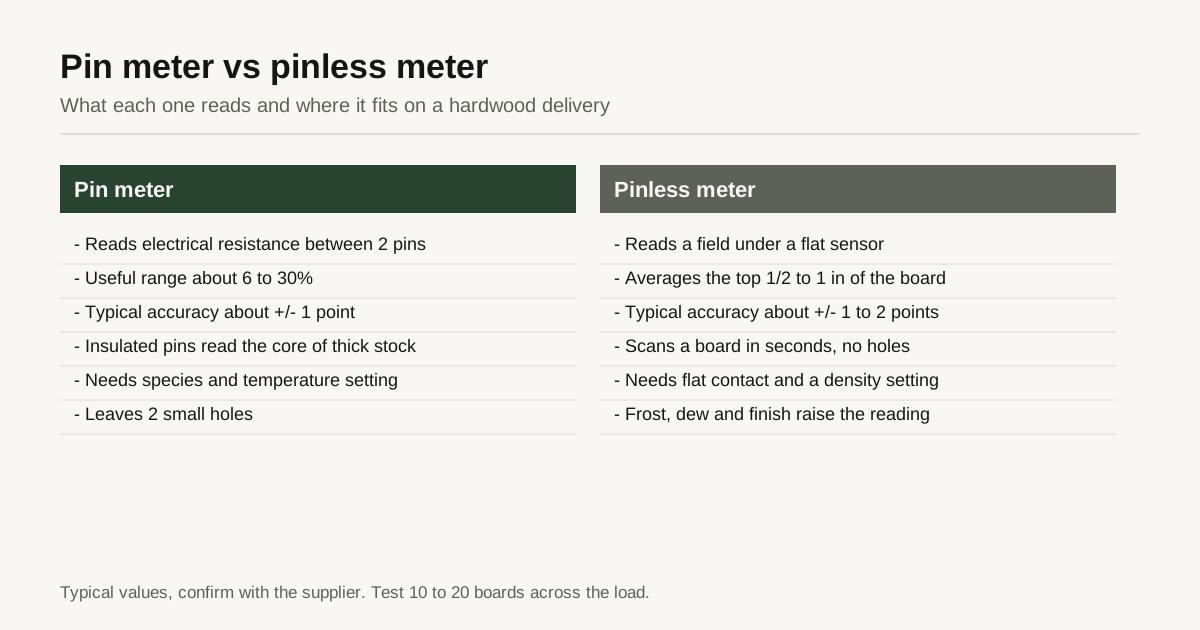
A lumber moisture meter is the cheapest insurance a buyer can own. Hardwood that arrives at the wrong moisture content will cup, shrink or open up joints after machining, and by that point the lumber is cut and the claim is hard to prove. A few minutes with a meter at the dock gives you a number you can send to the supplier the same day.
This guide covers the two main types of meter, what each can and cannot tell you, how accurate the readings really are, and a simple method for checking a delivery. The figures are typical. Always follow the instructions for your own meter and write your acceptance range into the order.
How a pin meter works
A pin meter pushes two pins into the wood and measures the electrical resistance between them. Dry wood resists current strongly. Wet wood conducts it much better. The meter converts the resistance into a moisture reading using a built-in table.
Points that matter in practice:
- Species correction. Resistance for a given moisture content differs by species. Meters are calibrated to a reference species, and you apply a correction for the species you are testing. If the setting is wrong the number is wrong, sometimes by several points.
- Temperature correction. Warm wood conducts better than cold wood, so an uncorrected reading runs high in warm wood and low in cold wood. Many meters adjust for temperature automatically or give a correction chart. A load that spent the night outside in winter needs the correction.
- Pin depth. The reading comes from the path of least resistance, which is the wettest zone between the pins. In a board with a dry shell and wet core, short pins read the shell and miss the wet center.
- Insulated pins. These have coated shafts so that only the tips conduct. You can drive them deep and read the moisture at the tip, which lets you measure the core of thick boards and find a gradient from shell to core.
- Pin damage. The pins leave two small holes. On finished faces or high-value parts, pinless meters or edge testing avoid the marks.
Pin meters work best in the range of roughly 6 to 30 percent. Below about 6 percent the wood resists current so strongly that readings become unreliable. Above the fiber saturation point, which is around 25 to 30 percent for most species, the reading no longer follows the moisture content in a simple way.
How a pinless meter works
A pinless meter sits flat on the surface and sends a field into the board. The meter reads how that field changes with the wood’s dielectric properties, which depend on moisture content and density. It reads an area under the sensor to a depth that depends on the model, commonly between about one half and one inch.
Strengths:
- It leaves no holes.
- It scans quickly. You can slide it along a board and watch the reading change.
- It finds wet spots and checks the whole width of a board in seconds.
Limits:
- Density. Denser species read differently from lighter ones, so you need the right species or density setting.
- Flat contact. The sensor needs full flat contact. Rough, warped or deeply checked faces give poor readings, so a pinless meter works best on surfaced stock.
- Depth. It averages moisture within the field depth. In 8/4 or thicker stock, it can miss a wet core.
- Surface water. Frost, dew, rain, glue or finish on the surface can raise the reading.
Side by side
| Feature | Pin meter | Pinless meter |
|---|---|---|
| What it measures | Electrical resistance between two pins | Dielectric field under a flat sensor |
| Typical useful range | About 6 to 30% | About 5 to 30%, depends on the model |
| Typical accuracy in range | About plus or minus 1 point | About plus or minus 1 to 2 points |
| Damage to the board | Two small holes | None |
| Reads core of thick stock | Yes, with insulated pins | Limited by field depth |
| Best on | Rough or surfaced lumber, thick stock | Surfaced lumber, fast scanning |
| Main source of error | Wrong species or temperature setting, short pins | Rough surface, density, surface water |
Neither type is “better” in every case. Pin meters are more reliable in rough lumber and thick stock. Pinless meters are faster and cleaner on surfaced boards. Many mills and plants own both and use the second as a cross check.
What accuracy really means
A meter specification such as “plus or minus 1 percent” applies under good conditions: the right species setting, the right temperature, good contact and a reading in the stated range. Outside those conditions, the actual error is larger.
Three points help set realistic expectations:
- A reading is a snapshot of one spot. Lumber from one lift can vary by several points between boards, and between the ends and the middle of one board.
- A meter does not measure the whole board. A reading of 7 percent can hide a wet core in thick stock.
- Calibration drifts. Check the meter against the reference block that came with it before each session, and send it to be checked at the interval the maker recommends.
The reference method for moisture content is the oven-dry method, which most standards, including ASTM D4442, describe. You cut a sample, weigh it, dry it in an oven until the weight stops changing and weigh it again. The moisture content is the weight lost divided by the dry weight. This takes hours and destroys the sample, so it is used to settle disputes and to calibrate meters, not for daily checks.
A simple method to check a delivery
- Let the load settle. If lumber is cold, wait until the surface has dried and the wood has warmed to room temperature, or correct for temperature.
- Set the meter. Select the species and confirm the temperature setting. Check the reference block.
- Pick boards across the load. Choose at least 10 to 20 boards from the top, middle and bottom of several lifts. Include boards from the center of the stack, where drying is slowest and moisture is most likely to be high.
- Read in several places. Take readings about 18 in from each end and near the middle. Avoid the last foot of the board, which dries fastest and reads low. Avoid knots and spots with pitch.
- Use the right depth. With pin meters, drive the pins to about one fifth to one quarter of the thickness for an estimate of the average, the same range as in the Wood Handbook and in university extension guides (about 1/4 in for 4/4 lumber, 1/2 in for 8/4). Some meter makers advise deeper insertion, so follow your meter’s manual too. Use insulated pins at the center to read the core of thick stock.
- Record the numbers. Write down the lift number, board position and reading. Take a clear photo of the meter on the board.
- Compare to the order. Check the average and the highest readings against the range you put on the RFQ.
The kiln drying guide explains why wet boards survive in a dry load. A lift averaging 7 percent can still hold a few boards at 12 or more, and those boards are the ones that move.
What to put in the contract
Meters become useful only when the order says what the numbers must be. Put these on the RFQ and the purchase order:
- Target range, for example 6 to 8 percent average.
- Upper limit, for example no board above 9 percent.
- Test method, for example resistance meter with species correction, at least 10 boards per lift, readings 18 in from the end.
- Time limit for reporting a problem, for example within 7 days of receipt, with photos and readings.
- Remedy, such as a credit, a replacement or an agreed re-drying step.
A supplier who agrees to the method in writing is far more likely to ship lumber that passes it.
Common mistakes
- Reading only the top board of the top lift, which may have been dried and stored differently from the rest
- Leaving the species set to a default, or to the last species used
- Testing right after unloading from a cold truck
- Reading on the last few inches of the board, where the ends are drier than the middle
- Using a pinless meter on a rough face with a gap under the sensor
- Judging by the average alone without checking the highest readings
Your own checking tools
For a shop that receives hardwood regularly, a modest kit is enough: one pin meter with insulated pins and a species table, one pinless meter, a reference block, a notebook or a phone for photos, and a sealed bag or a scale and oven for the occasional oven-dry check. Spend more where the cost of a wrong reading is high, such as flooring stock or thick, long-grain parts.
Closing checklist
- Choose a meter that fits your stock: pin for rough and thick boards, pinless for surfaced lumber
- Set species and temperature, and check the reference block
- Test 10 to 20 boards across the load in several positions
- Compare the average and the highest readings with the order
- Write the target range, upper limit and test method on the RFQ
If you want the moisture range written into the supplier match, send your lumber RFQ with the target and the upper limit. We pass it to up to 3 mills or yards that can ship to that range, and they reply to you directly.
See also: lumber moisture test methods for the oven-dry reference method and the standards behind meter checks.
Frequently asked questions
Which is better for checking a hardwood delivery, pin or pinless?
Many receiving crews carry both. A pinless meter scans many boards quickly and shows if a lift is uniform. A pin meter confirms suspect boards and can read at depth with insulated pins. If you buy only one, a pin meter with species correction is the better tool for thick stock.
How accurate is a lumber moisture meter?
Typical meters read within about 1 percentage point in the 6 to 20 percent range when the species setting, temperature and contact are right. Accuracy falls above about 25 to 30 percent and below about 6 percent, and a wrong species setting alone can cause an error of several points.
How many boards should I test in a load?
A common practice is to test at least 10 to 20 boards spread across the load, taking boards from the top, the middle and the bottom of several lifts and reading each in two or more places. For a high value order, test more or send samples for oven-dry testing.
Know what you need? Send the spec.
Tell us the species, grade, thickness and board feet. We pass it to up to 3 mills or yards that carry it and reply within 24 business hours.
Send my lumber RFQ