Guides / Grades and Specs
Straight Line Rip and Gang Rip: Hardwood Edge Options Explained
December 9, 2026
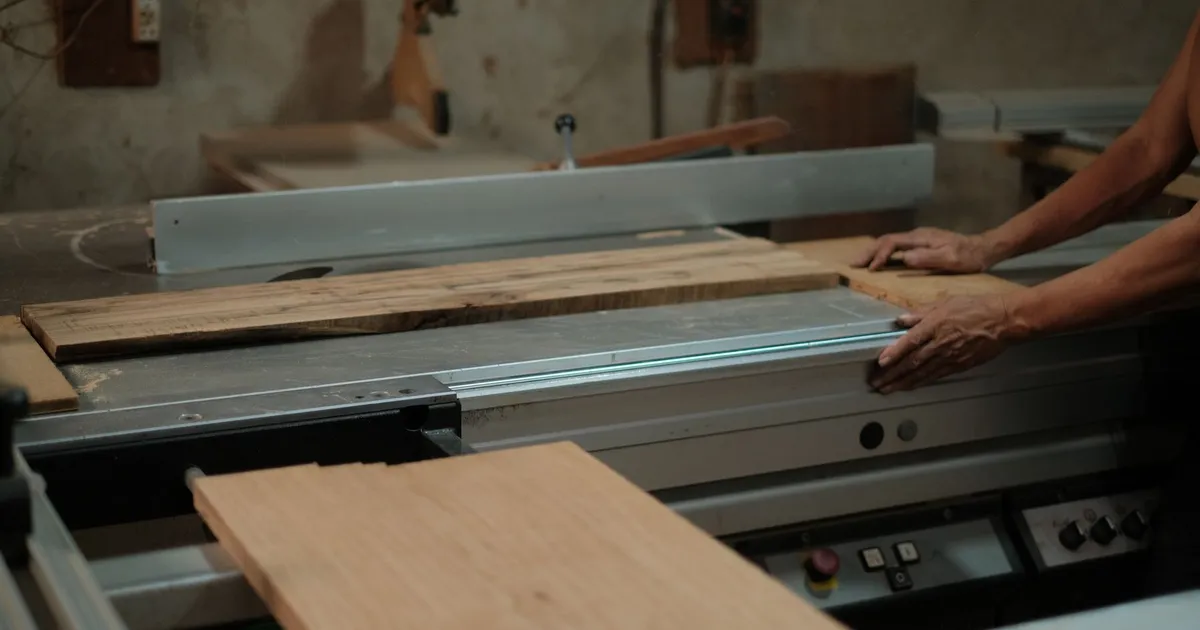
A rough hardwood board has uneven edges and sometimes bark or wane. Before it can become a cabinet part, a floor board or a glued-up panel, someone has to give it two straight, parallel edges. That step is called ripping, and the way it is done decides how much usable wood you get, how much your own plant has to do and how stable the parts are.
This guide explains the edge options you can order, how straight line ripping and gang ripping work, and what to write on an RFQ so the supplier prices the right thing.
The edge options at a glance
Hardwood lumber can be sold with several kinds of edges:
- Rough edge, also called waney edge. The edge is left as the saw cut it, with bark, wane or taper allowed within the rules of the grade. Widths vary from board to board.
- Edged. An edger trims both edges to remove bark and wane, leaving parallel or nearly parallel edges. The boards are random width. Most “edged and trimmed” rough lumber falls here.
- Straight line ripped one edge (SLR1E). One edge is cut straight on a straight line rip saw. The board is random width but has a true reference edge.
- Straight line ripped two edges. Both edges are cut straight and parallel, to random widths or to widths the buyer specifies.
- Gang ripped to width. The board is cut into several strips of set width in one pass, with the strips ready for the next step.
Abbreviations such as SLR1E, S2S1E or S2S&SL1E appear on tally sheets, and different mills use them slightly differently. The NHLA publishes standard surfacing terms, but write the meaning in words on the RFQ anyway so a supplier cannot read it two ways.
How a straight line rip saw works
The straight line rip saw has a fixed blade and a feed system that holds the board against a guide. An operator, or a scanning system with a laser line, shows where the cut will fall. The goal is to remove the minimum amount of wood to get a clean, straight edge that is parallel to the best line of the board.
Why it matters:
- A true reference edge. Rough boards are not straight. If a board with a curved edge goes straight to a table saw, the cut follows the curve. A straight line ripped edge gives the fence a flat line to run against.
- Better width yield. A well-set ripped edge gets the widest straight board out of a waney piece. A careless cut wastes wood.
- Cleaner work for downstream machines. Gang rip saws, moulders and planers feed better when one edge is true.
Quality of the ripped edge can be checked by laying a straightedge along it. Typical commercial straightness is within about 1/32 to 1/16 in over an 8 ft board, but agree a tolerance with the supplier instead of relying on a typical figure.
How a gang rip saw works
A gang rip saw carries several blades on one arbor. The boards are fed through under pressure rolls, and each pass cuts the board into several strips at once. Blade spacing sets the strip widths. Many plants use fixed-spacing arbors for repeat parts and movable blades for varied work.
Gang ripping is used to:
- Make blanks for edge-glued panels, tops and stair treads from boards that are wide and uneven
- Cut strips for flooring stock, moulding blanks and cabinet frame parts
- Produce dimension parts to a set width
A typical blade kerf is about 1/8 in, so each cut removes that much wood. A 6 in board cut into two strips loses about 1/8 in between them, plus whatever the trim cuts remove at the edges. On wide boards the kerf is small. On narrow strips such as 1 1/2 in blanks, kerf and trim add up to a real share of the board, so the supplier’s yield and price quote should account for it.
Rip first or crosscut first
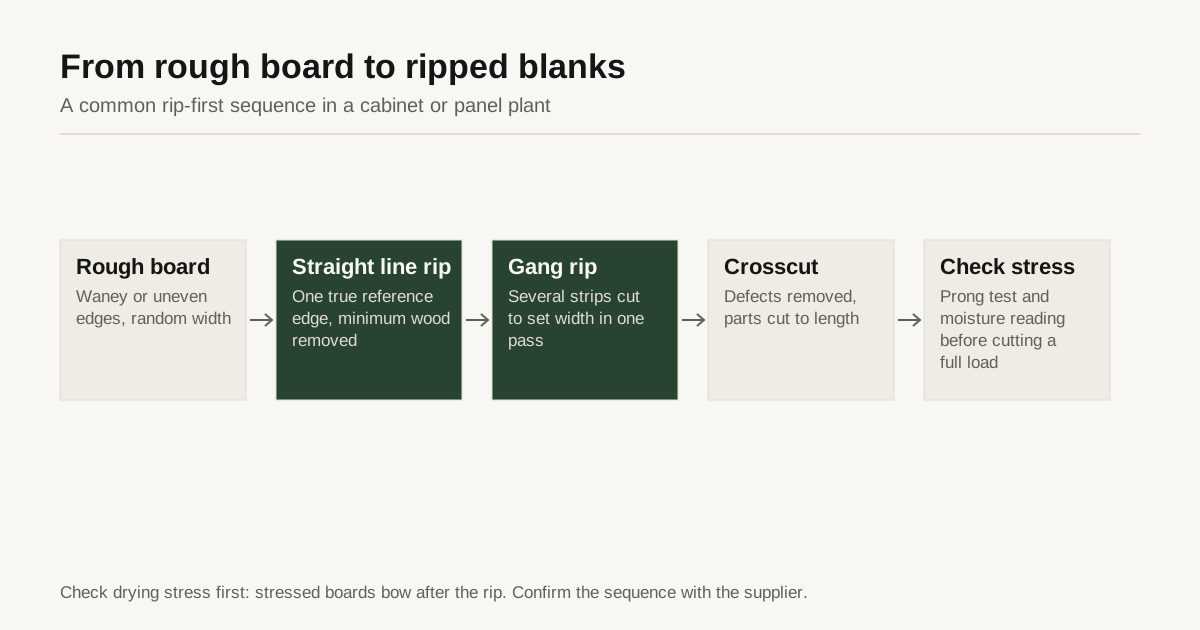
Many cabinet and furniture plants rip first, then crosscut. They straight line rip the boards, gang rip them to the part width, and then use optimizing crosscut saws to cut out defects and cut to length. The rip-first line suits long clear boards such as FAS and Select, where the grade gives long, wide cuttings. For short parts from lower grades, a plant may crosscut first to remove defects. The right order depends on part sizes and the grade.
Dimension parts and ripped stock from suppliers
Some mills and dimension plants sell lumber that has already been ripped to width or cut to length. This is sold as dimension stock, flooring stock or ripped blanks. The mill takes on the sawing and saves your plant the step. The tradeoff:
- Higher price per board foot, because the mill has added labor and machine time.
- Better yield for your plant. You pay only for the pieces you can use.
- Less flexibility. A set width is only useful if it matches your part list.
- Tighter spec needs. You have to specify width, thickness, length, tolerances and moisture.
Our guide to rough lumber, S4S and dimension parts compares these choices in more detail. The right edge option often depends on where in the chain you want to take on the work.
Ripping and stress
The biggest hidden problem with ripping is internal stress from drying. Lumber that was dried too fast or not conditioned after drying holds stress, called case hardening. The shell is compressed and the core is in tension. When a rip saw cuts the board, it releases that balance. The strips often bow, cup, or close up and pinch the blade.
Signs you may have stressed lumber:
- Blade pinching or burning during ripping
- Strips that spring away from the fence
- Two strips from one board that curve in opposite directions
- Boards that were flat before the rip and bowed after it
A prong test on a sample board shows stress before you commit. Our guide to kiln drying schedules explains the test and what conditioning does. If you rip a lot of stock, add “stress relieved, prong tested” to the RFQ.
Uneven moisture is the second cause. A board with a wet core and a dry shell moves as it dries after the rip. Check moisture on arrival as in our guide to lumber moisture meters.
Setting widths and tolerances
If you order ripped strips, the width needs more than one number. Decide these points before you ask for a quote:
- Finished width or rough width. A strip ripped to 2 1/2 in rough will plane to a smaller width. If your part must finish at 2 1/4 in, say which one you mean.
- Allowance for planing and glue-up. Plants that glue strips into panels usually want 1/16 to 1/8 in of extra width for jointing and planing.
- Width tolerance. Ripped to width normally allows a small plus and minus, for example 1/32 in. Tighter tolerances cost more and need better saw maintenance.
- Mixed widths. Some buyers accept two or three widths in one load, which lets the mill fit more strips from each board and lowers the price.
- Length handling. Strips can be random length, set length or random length with a minimum. Longer strips are worth more but are harder to ship straight.
A good supplier will ask about these points. If a quote arrives without them, the price is probably based on assumptions you did not make.
Common problems with ripped stock
- Edge burn. Dark marks on the edge, often from a dull blade or a slow feed. Light burn planes off, deep burn does not.
- Wavy edges. Caused by a worn feed system or a board that moved during the cut. Check with a straightedge.
- Mixed widths in a load marked as one width. Ask for a tally by width when the order is a set width.
- Strips that bow in the bundle. Often a sign of stress or of strips stored unevenly. Ask how ripped stock is stickered and wrapped.
- Missing tally. Ripped strips are sold by the board foot or the piece, so the tally must list the thickness, width and length counts for the load.
Yield and cost
Ripping changes the volume you pay for and the volume you can use. A rough guide to the effect:
| Edge option | Who does the work | Your yield | Price per board foot |
|---|---|---|---|
| Rough or waney edge | You | Lowest, you trim wane | Lowest |
| Edged, random width | Mill | Moderate | Slightly higher |
| SLR1E, random width | Mill | Good | Higher |
| SLR two edges, ripped to width | Mill | Very good if widths fit | Higher again |
| Gang ripped strips | Mill | Best if widths match your parts | Highest |
The pattern is the same everywhere: the more work the mill does, the higher the price per board foot and the less waste you carry. Whether that saves you money depends on your own plant’s scrap rate and labor cost. A plant with a modern rip line may prefer rough edge lumber at a lower price. A smaller shop without a rip saw usually benefits from SLR1E stock.
What to put on the RFQ
- Edge condition written out: for example “straight line ripped one edge, random width” instead of “SLR1E” alone
- Width rules: random, minimum width, or set widths with a tolerance
- Straightness tolerance of the ripped edge
- Grade, species, thickness and surfacing
- Moisture range and stress relief, if you rip yourself
- How the lumber is packaged, as ripped boards are often bundled by width
Closing checklist
- Decide where in the chain you want the ripping done: your plant or the mill
- Spell out the edge option in words, not only abbreviations
- Set width, tolerance and straightness
- Ask whether the lumber is stress relieved
- Compare price per usable board foot, not only price per board foot
Edge codes belong with thickness and grade on one line: see hardwood lumber specifications.
If you want edge options priced across several suppliers, send your lumber RFQ with the edge condition and width rules. We pass it to up to 3 mills or yards that carry the species, grade and thickness, and they reply to you directly.
Frequently asked questions
What does SLR1E mean on a lumber order?
It is shorthand for straight line ripped on one edge. The board goes through a straight line rip saw that cuts one edge straight and parallel to a reference line, so the next machine, such as a table saw or gang rip saw, gets a true edge to push against. Spell the term out on your RFQ because abbreviations vary between mills.
Is gang ripped lumber the same as ripped to width?
They overlap. Gang ripping cuts a board into several strips in one pass using multiple blades, and ripped to width means the strips are cut to the width you specify. The first is the method, the second is the result. Both need a straight reference edge first.
Why do ripped boards sometimes bow after cutting?
Usually because of drying stress, also called case hardening, or uneven moisture across the board. When the saw releases the locked-in stress, the strips spring toward or away from each other. Ask for stress relieved lumber if you rip your own stock.
Know what you need? Send the spec.
Tell us the species, grade, thickness and board feet. We pass it to up to 3 mills or yards that carry it and reply within 24 business hours.
Send my lumber RFQ