Guides / Grades and Specs
Hardwood Lumber Specifications: Grade, Cut, Surfacing and How to Write an Order a Mill Can Quote
February 20, 2027
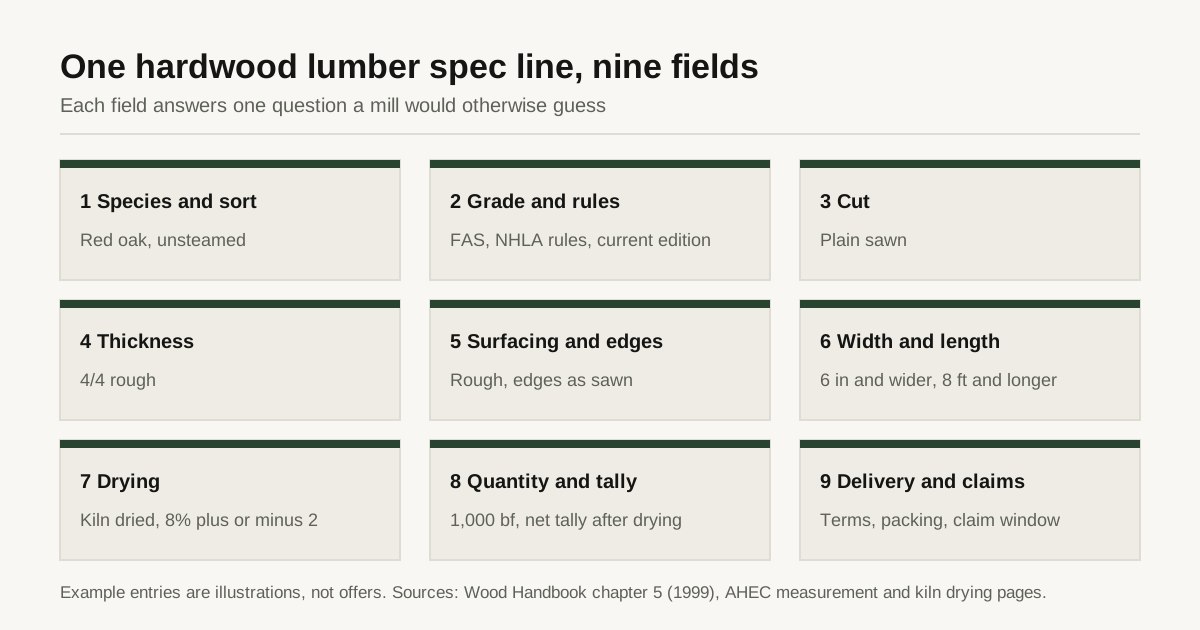
A hardwood lumber specification is one line per product that names the species, the grade and the grading rules, the cut, the thickness in quarters, the surfacing and edges, the widths and lengths, the drying target and the tally basis. If any of these is missing, two mills will quote two different boards at two prices. This guide is for plant buyers, importers and millwork purchasers who need to turn a cut list into an order a sawmill or yard can price, and it ends with a checklist you can paste into an RFQ.
Hardwood Vendor is a matching service, not a sawmill. We own no mills, kilns or stock, and we name no supplier here. You send one spec, we pass it to up to 3 mills or yards that say they carry it, and they quote you directly. Grade, thickness and moisture numbers in this guide are typical values, and the NHLA rulebook and your contract govern.
Last reviewed: October 2026. Figures carry the source and edition they came from; confirm grading rules and tolerances against the current rulebook before you rely on them.
- The spec stack on one page
- Species and sorts
- Grade under NHLA rules
- Grading rules outside NHLA
- Cut: plain, quarter and rift sawn
- Thickness in quarters
- Surfacing and edges
- Widths and lengths
- Drying and moisture
- Defects and what grades allow
- End uses: moulding, stairs, butcher block and flooring stock
- Quantity, tally and the quote line
- Checking the lumber against the spec
- Spec checklist and how to send it
The spec stack on one page
Think of the spec as a stack of lines, each answering one question a mill would otherwise guess. The table gives the stack in the order a buyer usually fills it in, with a typical entry and the section that covers it.
| Line | What to write | Example entry | Section |
|---|---|---|---|
| Species and sort | Species or group, color or heart rules | Red oak, unsteamed | Species and sorts |
| Grade and rules | Grade name plus the rule book | FAS, NHLA rules | Grade under NHLA rules |
| Cut | Plain, quarter or rift sawn | Plain sawn | Cut |
| Thickness | Quarters, rough or surfaced | 4/4 rough | Thickness in quarters |
| Surfacing and edges | Code written out in words | S2S, random width | Surfacing and edges |
| Width and length | Minimums, sorts, random or set | 6 in and wider, 8 ft and longer | Widths and lengths |
| Drying | State, target and check method | Kiln dried, 8% plus or minus 2 | Drying and moisture |
| Quantity and tally | Unit, basis, tolerance | 1,000 bf, net tally after drying | Quantity and tally |
| Delivery and claims | Terms, packing, claim window | Packs strapped, claim terms stated | Checking the lumber |
Caption: structure compiled by the author from the Wood Handbook purchase-specification list and the AHEC measurement page (see Sources). Example entries are illustrations, not prices or offers.
The Wood Handbook’s own list for buying lumber runs the same way: species, product, seasoning, surfacing, grading rules and a procedure for disputes. Its advice on the grading line is to give the agency, the name of the rules, the paragraph and the edition date. Order matters too: species comes first because some grading rules change by species.
Read more: Hardwood lumber terms: a buyer glossary from FAS to wane, for every abbreviation used on this page.
Species and sorts
Start with the species, named the way the trade and your paperwork name it. “Maple” is not enough when hard and soft maple price and look differently, and “oak” is two groups, red and white, that are graded the same way but are not interchangeable in finish or use. Add the botanical name when customs or legal papers will ask for it.
Species also changes the grading rule. Purdue’s extension note on NHLA grades says plain red and white oak are graded to the standard rule apart from a consideration for mineral stain, while walnut and butternut have their own rules: FAS admits boards 6 and 7 ft long against the standard 8 ft, and the minimum FAS width is 5 in against 6 in. In cherry, small knots up to 1/8 in are admitted in cuttings. A walnut FAS board therefore yields less clear area than an oak FAS board.
Sorts sit on top of the grade because standard grades do not judge color. Typical sorts are sapwood limits, heart face percentage, steamed or unsteamed walnut and white or red maple. Each sort narrows the list of mills that can quote, so use only the ones your product needs. Write them as separate lines so a supplier cannot read them as part of the grade.
Read more: Steamed vs unsteamed walnut and Hard maple vs soft maple.
Grade under NHLA rules
Most hardwood lumber in North America, and much traded abroad, is graded to the Rules for the Measurement and Inspection of Hardwood and Cypress published by the National Hardwood Lumber Association (NHLA). The Wood Handbook describes the logic: since 1932 the grade has been set by the share of a board that can be cut into clear pieces of a minimum size. The NHLA page says it reviews the rules every four years, with approved changes effective January 1 of the following year.
The NHLA rulebook text itself was not read for this guide; it is sold by the association. The table gives the main grades as the Wood Handbook and the Purdue note (a summary of the 1998 rules) present them.
| Grade | Minimum board | Minimum clear cutting | Clear face yield |
|---|---|---|---|
| FAS | 6 in wide, 8 to 16 ft | 4 in x 5 ft or 3 in x 7 ft | 83 1/3% (more where an extra cutting is taken) |
| FAS 1-Face (F1F) | 6 in wide | As FAS, on the better face | 83 1/3% on the better face |
| Selects | 4 in wide, 6 to 16 ft | As FAS, on the better face | 83 1/3% on the better face |
| No.1 Common | 3 in wide, 4 to 16 ft | 4 in x 2 ft or 3 in x 3 ft | 66 2/3% |
| No.2A Common | 3 in wide, 4 to 16 ft | 3 in x 2 ft | 50% |
Caption: Wood Handbook (FPL-GTR-113, 1999) Table 5-1 and Purdue FNR-130 (summary of the 1998 NHLA rules). Typical values; species exceptions apply and the current rulebook governs.
Three points matter in an order. The grade is read from the poorer face, except F1F and Selects, which need one face at FAS and the other at No.1 Common. The number of cuttings allowed grows with the surface measure of the board, so large boards can use more cuttings. And per the Wood Handbook, hardwood factory lumber is generally graded on its quality and size before kiln drying, so a grade does not promise what the board looks like after planing.
Read more: NHLA lumber grades explained: FAS, Select and Common.
Grading rules outside NHLA
The same grade name does not mean the same thing under every rule book. AHEC notes that European temperate hardwoods are typically graded by the visual judgment of a grader, while NHLA rules give measurable criteria. EN 975-1 (BSI edition of April 2009) covers oak and beech.
The ATIBT grading rules for African sawn timber show how far names can drift. The April 1999 edition has a grade called FAS, but defines it as not less than 40% clear of defects and sapwood, with a limit on the number of standard defects by piece area. NHLA FAS needs 83 1/3% clear face cuttings. The Malaysian Timber Council describes the Malaysian Grading Rules as two systems, a cutting system with grades Prime, Select, Standard, Sound, Serviceable and Utility, and a defect system for items such as sleepers and scantlings.
The text of EN 975-1, which national standards bodies sell, was not read either, so only the edition date and scope come from the BSI listing. For tropical or European stock, write the rule book, the edition and the grade code on the order, and ask for the mill’s written limits when it uses its own grades.
Read more: European oak lumber grades and Hardwood grading rules compared: NHLA, EN 975 and tropical rules.
Cut: plain, quarter and rift sawn
Cut describes how the saw met the growth rings, and it changes how the grain looks on the face. The AHEC glossary defines quarter and rift sawn as lumber cut on or near the radial axis of the log, giving edge, straight or vertical grain patterns. Plain sawn is everything else, the flat-sawn board with the cathedral pattern on its face.
| Cut | Face pattern | Use it when |
|---|---|---|
| Plain sawn | Arches and cathedrals on the face | Most cabinet, furniture and general parts |
| Quarter sawn | Straight lines on the face, sawn near the radial axis | The look needs straight grain and the spec says so |
| Rift sawn | Straight lines on the face, sawn at an angle between plain and quarter | Straight grain on every face is the requirement |
Caption: descriptive summary based on the AHEC glossary definition; no yield or price figures are given because we found no public ones.
The NHLA grade does not check grain angle. A board of FAS can be plain, quartered or rift, so a quartered or rift requirement is a separate line, often with its own minimum width. Ask the mill whether it sorts cut by lift or by board, and whether the sort applies to both faces. Expect fewer mills to quote it and a different price from plain sawn stock.
Read more: Plain sawn, quarter sawn and rift sawn hardwood: what to specify.
Thickness in quarters
Hardwood thickness is counted in quarters of an inch of rough lumber: 4/4 is 1 in, 5/4 is 1 1/4 in, 8/4 is 2 in. AHEC adds that most US production is sawn between 1 in and 2 in. The surfaced size is smaller, because planing removes wood. AHEC gives the rule: subtract 3/16 in from nominal for lumber 1 1/2 in and thinner, and 1/4 in for lumber 1 3/4 in and thicker. The Wood Handbook’s standard thickness table agrees.
| Quarters | Rough | Surfaced two sides (S2S) |
|---|---|---|
| 4/4 | 1 in | 13/16 in |
| 5/4 | 1 1/4 in | 1 1/16 in |
| 6/4 | 1 1/2 in | 1 5/16 in |
| 8/4 | 2 in | 1 3/4 in |
| 10/4 | 2 1/2 in | 2 1/4 in |
| 12/4 | 3 in | 2 3/4 in |
Caption: Wood Handbook (FPL-GTR-113, 1999) Table 5-4, standard thickness values for rough and S2S hardwood lumber.
Kiln dried rough stock may run a little thin. AHEC lists a scant allowance of 1/16 in for rough kiln dried lumber from 3/8 in to 1 3/4 in and 1/8 in for 2 in and thicker. State the minimum thickness you can plane from, not only the nominal quarter. If you buy surfaced lumber, say whether the size is the S2S table size or a dimension you need after your own planing.
Read more: Board feet and quarter thickness: how hardwood is priced.
Surfacing and edges
Surfacing describes what the mill does after sawing. The Wood Handbook lists the standard codes: S1S and S2S for one or two faces planed, S1E and S2E for one or two edges, S1S1E, S2S1E and S1S2E for combinations and S4S for all four sides. RGH means rough. The AHEC glossary adds that PAR, planed all round, is the same as S4S. Many stock lists also use SLR1E, straight line ripped one edge. It is not in the Wood Handbook list, so write it in words.
| Order as | What you receive | Who does the next step |
|---|---|---|
| Rough (RGH) | Saw-textured faces and edges, thicker than the S2S size | Your plant planes and rips |
| S2S | Two faces planed to a uniform thickness, edges as sawn | Your plant straightens edges |
| S2S, SLR1E | Faces planed, one edge ripped straight | Your plant rips the second edge |
| S4S | Faces and edges planed to size | Ready for cutting to length and use |
Caption: code meanings from the Wood Handbook abbreviation list and the AHEC glossary; the SLR1E description follows our guide to rip options.
When the width is set by the purchase agreement, the Wood Handbook says S1E and S2E lumber is 3/8 in scant of nominal in boards narrower than 8 in and 1/2 in scant at 8 in and wider. AHEC notes that defects that planing removes do not affect the grade, so a rough board graded FAS may lose width or face area when you surface it. Ask who grades, rough or surfaced, and when.
Read more: Straight line rip and gang rip lumber: edge options.
Widths and lengths
Hardwood lumber is normally sold in random widths. The grading rules set a minimum width by grade, not a standard width, and lengths run in 1 ft steps from 4 to 16 ft according to the Wood Handbook.
| Grade | Minimum width | Standard length range |
|---|---|---|
| FAS and F1F | 6 in | 8 to 16 ft |
| Selects | 4 in | 6 to 16 ft |
| No.1, 2A, 2B, 3A, 3B Common | 3 in | 4 to 16 ft |
Caption: Wood Handbook (FPL-GTR-113, 1999). The grades also admit a share of shorter boards; see the rulebook.
Sorts on top of that are common and are written on stock lists. A public sawmill stock list of April 2026, for example, shows lines such as “7’ only” and “11 in and wider” next to the grade, and states that prices are for a kiln dried net tally. Those are sorts the mill applies to the grade. If your parts need long boards, ask for a minimum average length or a share of boards over a stated length instead of accepting the grade minimum.
On the tally, AHEC says widths are rounded to the nearest whole inch and lengths are rounded down to the whole foot, so a 5 1/4 in by 8 1/2 ft board is counted as 5 in by 8 ft. Say in the order that the mill’s rounding follows the rulebook, or agree your own.
Drying and moisture
“KD” says only that the lumber was dried in a kiln. The Wood Handbook defines kiln dried as seasoned in a chamber to a predetermined moisture content and advises that when the requirement is critical, you should specify the level and how it will be achieved. AHEC says American hardwoods are typically kiln dried to about 7 to 9% moisture content, given as 8% plus or minus 2, and that European hardwoods run slightly wetter, around 10 to 12%. It also says all American hardwoods are exported kiln dried unless the order says otherwise.
So write the drying line in four parts: the state (kiln dried or air dried), the target range, how it is measured (meter or oven-dry sample) and what happens when a lot falls outside the range. Parts for a dry indoor use need a different target from parts for a humid warehouse, and a buyer who needs a tighter spread between boards, for example for glued panels, has to ask for it, because a range of plus or minus 2% around the central value is the normal tolerance AHEC describes.
Drying quality affects more than moisture. Fast or uneven drying leaves stress and stain, which show up when the board is ripped or planed. We found no public figure for how often lots miss the target, so treat the range in the order as the only promise that counts.
Read more: Kiln drying hardwood: schedules and checks, Lumber moisture meters: pin vs pinless and Sticker stain in hardwood lumber.
Defects and what grades allow
A grade is a limit on defects, so it helps to know which features the rules treat as defects and which they allow. AHEC lists characteristics that are not defects under NHLA rules, among them heartwood and sapwood, burls, gum streaks in cherry, mineral streaks, glassworm and sticker marks that planing removes. Its list of defects includes bird pecks, sound and unsound knots, sticker stain, worm holes, bark pockets, checks, decay, splits, shake, wane and grub holes. It adds that bird pecks, sound knots, sticker stain and worm holes count as sound and are allowed in the clear cuttings of 2B Common.
| Feature | Treatment in a typical grade |
|---|---|
| Sound knot | Not allowed in a clear cutting, allowed in a sound cutting (2B and lower) |
| Wane | Restricted by grade and by cutting; special wane limits apply to F1F and Selects |
| Check or split | Defect, unless planing removes it |
| Sticker stain | Defect in clear grades, sound in 2B Common |
| Mineral or gum streak | Characteristic, not a defect, though the rules have species notes |
Caption: AHEC pages on characteristics and defects and the Purdue FNR-130 note; summarized, species exceptions are in the rulebook.
Because the rules leave color and some streaks out of the grade, put your own limits next to it, for example “no heart center in face cuttings” or “sap stain not accepted”. Free of heart center (FOHC) is one of the abbreviations the Wood Handbook lists.
Read more: Hardwood lumber defects: wane, knots and grade limits.
End uses: moulding, stairs, butcher block and flooring stock
The Wood Handbook separates three kinds of product: factory lumber, which is cut into smaller pieces; dimension parts, which are specified by the size of the whole piece; and finished market products such as moulding, stair treads and flooring, which have their own rules. That is why the spec for an end use is a different spec, not just a different grade.
- Moulding and millwork. Plants choose the grade by blank width and length, and the RFQ states the blank, the face and back rule and the moisture range.
- Stair treads and risers. Treads need long clear faces and a clean nosing edge, so the spec adds rules for knots, wane, grain and color across a flight.
- Butcher block and countertops. Moisture is the critical line, because glue lines every inch or two turn any difference between strips into stress.
- Flooring stock. The Wood Handbook lists flooring with the finished market products that have their own grading, so the lumber grade alone does not describe it.
Read more: Hardwood for moulding and millwork plants, Hardwood for stair treads and risers and Hardwood lumber for butcher block and countertop plants.
For dimension parts and flooring stock, write the final size, the tolerance and the moisture, not only the lumber grade.
Quantity, tally and the quote line
Hardwood is sold by the board foot: width in inches times length in feet times thickness in inches, divided by 12. AHEC defines surface measure as width times length divided by 12, rounded to the nearest whole number, and board feet as surface measure times thickness. Its example is a 6 1/4 in by 8 ft by 2 in board, which has a surface measure of 4 and 8 board feet. Large orders use MBF, a thousand board feet, which AHEC converts at about 2.36 cubic meters.
The tally basis can move a price. A green or gross tally is measured before kiln drying and a net tally after, and AHEC says buyers can expect about 7% fewer board feet after drying. Two quotes at the same price per board foot are not equal when one is gross and one is net. Write the basis, the tolerance on quantity and where the measure is taken.
A quote line packs the whole spec into one row, for example species, quarters, grade, drying, surfacing and footage. The stock list guide walks through each token and what to ask when a token is missing.
Read more: Hardwood lumber tally: net vs gross and green vs dry and How to read a hardwood lumber stock list or quote line.
Checking the lumber against the spec
A spec is only as strong as the way you check it. The Wood Handbook’s purchasing list ends with reinspection: the procedure for settling a dispute, with time limits, liability and costs set in the grade rules of the agency under which the lumber was graded. The NHLA says its National Inspectors provide on-site guidance, rule interpretations and dispute resolution.
Purdue’s summary of the 1998 sales code gives the shape of a claim, and the numbers are from that older edition, so confirm them in the current rules. The sales code binds buyer and seller only when the contract states that it governs. The buyer had 14 days from receipt to file a claim, and the lumber had to stay intact, with no surfacing, trimming, ripping or drying, or the claim was forfeited. If a national inspection found more than 20% of the footage off the order, the buyer could reject the whole shipment. If at least 80% matched, the lumber was repriced at the inspection result, and a gap of 4% or less in money value meant the buyer lost the claim and paid for the inspection.
So the practical steps are to write the claim window and the rule book into the order, keep a sample of the lumber untouched and agree before shipping who inspects and when.
Read more: Pre-shipment lumber grading and Lumber quality claim: photos, tallies and deadlines.
Spec checklist and how to send it
Use this list as the body of the RFQ, one line per item. Items you leave open are the ones a supplier will fill with its own habit.
- Species, botanical name where needed and any color or heart rule.
- Grade, the rule book and its edition (for example NHLA, current edition).
- Cut: plain, quarter or rift sawn, and whether the sort applies to both faces.
- Thickness in quarters, rough or surfaced and the minimum thickness you can plane from.
- Surfacing and edges written out in words, not only as a code.
- Width and length rules: minimums, random or set, share of long boards.
- Drying: state, target range, check method and what happens outside the range.
- Defect limits you add on top of the grade, such as no heart center or no sap stain.
- Quantity, unit, tally basis (net or gross, green or dry) and tolerance.
- Packing: pack size, strapping, wrapping and tally per pack.
- Delivery terms, paperwork and the claim window.
- Photos or a sample board of what you call acceptable.
When the spec is written, send your lumber RFQ with these lines. We pass it to up to 3 mills or yards that say they carry it, they quote you directly and we reply within 24 business hours.
Read more: How to choose a hardwood lumber supplier, for the checks that come before the spec.
Sources
- Purdue Extension, FNR-130 Quality control in lumber purchasing: hardwood lumber grades (Cassens, summary of the 1998 NHLA rules)
- USDA Forest Products Laboratory, Wood Handbook chapter 5, Commercial Lumber (FPL-GTR-113, 1999)
- American Hardwood Export Council, Technical Matters 6: hardwood lumber grading
- American Hardwood Export Council, grading sawn lumber: characteristics and defects
- American Hardwood Export Council, grading sawn lumber: measurement
- American Hardwood Export Council, Technical Matters 3: kiln drying
- American Hardwood Export Council, glossary of terms
- National Hardwood Lumber Association, grading rules page
- ATIBT, Grading of African sawn timber, April 1999 edition (PDF)
- Malaysian Timber Council, Malaysian Grading Rules
- BSI, BS EN 975-1:2009 Appearance grading of hardwoods, oak and beech
- A sawmill’s public kiln dried stock list, April 2026 (format reference only, no prices used)
Frequently asked questions
What must a hardwood lumber specification include?
Species and any color sort, grade and the grading rules, cut (plain, quarter or rift), thickness in quarters, surfacing and edges, width and length rules, drying target, quantity with the tally basis and delivery terms. Leave one out and each mill fills the gap with its own habit, so quotes cannot be compared.
Does the NHLA grade tell me the color or the grain?
No. NHLA grades measure the clear wood a board can yield, judged on the poorer face for most grades. Color, sapwood, heart face and grain angle are separate lines. If your parts depend on them, write them as sorts next to the grade.
What does 4/4 mean and what thickness do I get after planing?
4/4 is a rough thickness of 1 in, counted in quarters of an inch. Surfaced on two sides (S2S) it is normally 13/16 in under the standard thickness table. Planing takes 3/16 in off lumber up to 1 1/2 in and 1/4 in off thicker stock.
What moisture content should I specify for kiln dried hardwood?
AHEC says American hardwoods are typically kiln dried to 7 to 9% moisture, given as 8% plus or minus 2. The right number depends on where the parts will be used, so write your own target and the way it is checked instead of relying on the letters KD.
Which grading rules apply to imported hardwood?
North American species are normally graded to NHLA rules. European oak and beech follow EN 975-1 and tropical timber may follow African or Malaysian rules, or a mill's own. Name the rule book on the order, because the same grade name can mean different things.
How long do I have to claim if the lumber is below spec?
It depends on the contract. The NHLA sales code is binding only when the contract says it governs, and Purdue's summary of the 1998 rules gives 14 days from receipt with the lumber left unaltered. Check the current rulebook and write your own claim window into the order.
Know what you need? Send the spec.
Tell us the species, grade, thickness and board feet. We pass it to up to 3 mills or yards that carry it and reply within 24 business hours.
Send my lumber RFQ