Guides / Grades and Specs
Hardwood Lumber for Stair Treads and Risers: Species, Grade and Sizes
October 30, 2026
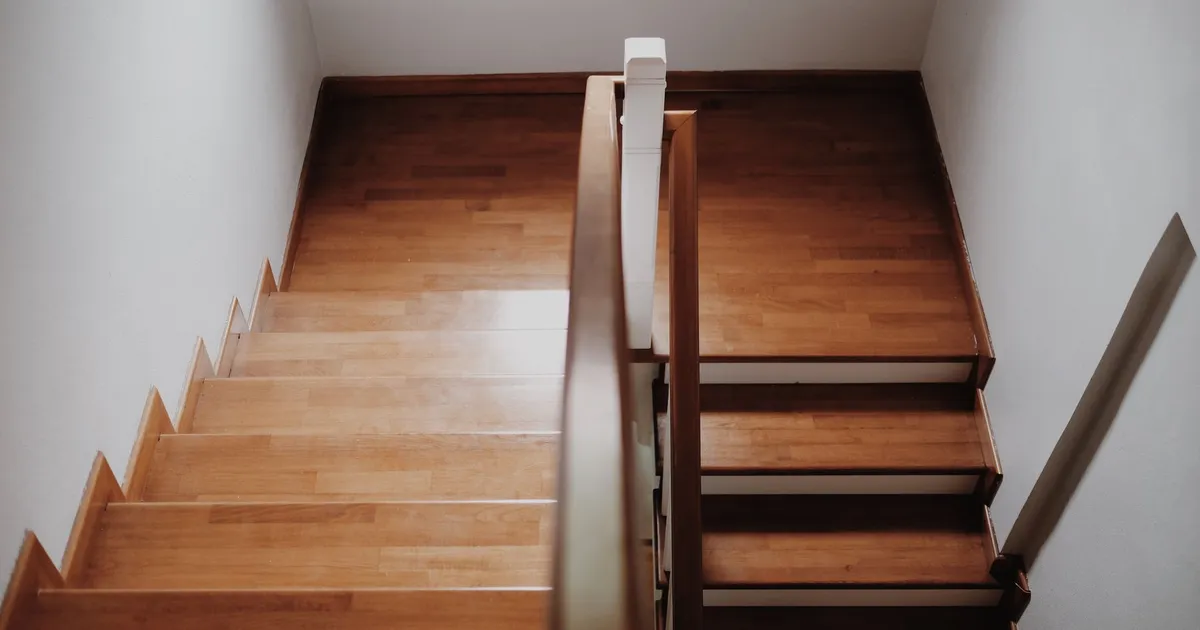
A stair tread is one of the hardest-working parts of a house. It takes foot traffic every day, and the front edge, called the nosing, takes the most wear. The riser, the vertical part beneath, takes much less abuse but is highly visible. Buyers who choose the wrong species or grade end up with dented treads, cracked nosings or ugly joints that show every time someone climbs the stairs.
This guide explains the common species, the grades and sizes that suit treads and risers, the option of glued-up stock and what to put on an RFQ so the supplier quotes the right lumber.
What treads and risers need
A tread needs:
- Hardness and wear resistance, especially at the nosing
- Clear faces and edges. A knot in the middle of a tread is a weak spot, and a knot in the nosing can break out.
- Stable boards. Movement opens joints at the stringers and makes squeaks.
- Straight grain along the nosing, so the profile cuts cleanly and holds
- Even color between treads in a flight, since they are seen together
A riser needs:
- A clean, even face, since it is seen from the front
- Stability, so it does not cup and pull away from the stringers
- A color and grain that match the treads, or a good surface for paint
Treads tolerate fewer defects than risers, and that difference affects which grade to buy.
Typical sizes
Typical dimensions in North American residential stairs, as a starting point. Always confirm with the stair drawings and local building rules:
| Part | Typical finished thickness | Typical width | Typical length |
|---|---|---|---|
| Tread | about 1 1/16 in, from 5/4 rough | about 10 1/2 to 11 1/2 in, including the nosing | 36, 42 or 48 in, or cut to length |
| Riser | 3/4 in or thinner, from 4/4 rough | about 7 to 8 in | Same as the tread length |
| Heavy duty tread | 1 1/2 in or more, from 6/4 or 8/4 | As above | As needed |
Building codes in the United States commonly limit the maximum riser height to 7 3/4 in and set a minimum tread depth, so the exact width depends on the stair design. Check the code and the drawings. This is general information, not a code interpretation.
A tread that is 11 1/2 in wide is wider than most boards are sold, so it often comes from an edge-glued panel, or from a wide board cut from larger logs. That choice affects price and availability.
Species for stair treads
| Species | Janka hardness (typical) | Color and grain | Typical role |
|---|---|---|---|
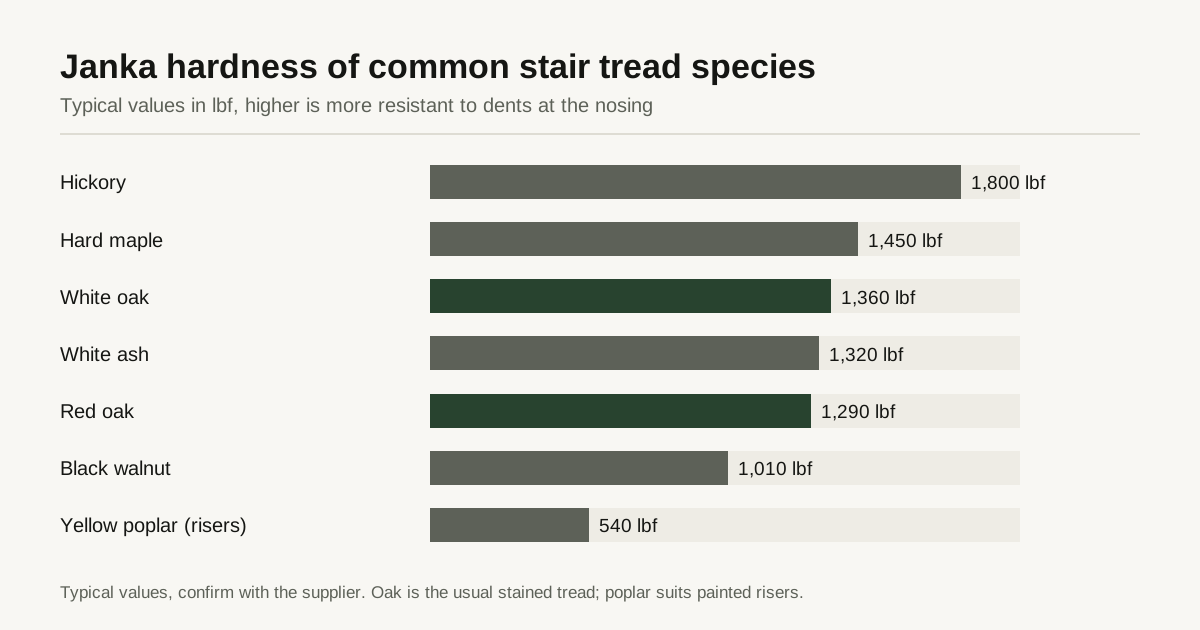
| Red oak | about 1,290 lbf | Pinkish brown, open grain | The most common stair tread species |
| White oak | about 1,360 lbf | Light to medium brown, open grain | Common for stained and natural looks |
| Hard maple | about 1,450 lbf | Pale cream, fine grain | Harder, modern look, stains blotchy |
| Hickory | about 1,800 lbf | High contrast, rustic | Very hard, strong character |
| White ash | about 1,320 lbf | Light brown, open grain | Strong, supply is changing |
| Black walnut | about 1,010 lbf | Dark brown | Premium look, softer than oak |
| Yellow poplar | about 540 lbf | Pale with green streaks | Painted risers, not treads in heavy traffic |
Figures are typical values and vary by lot. Our guides to hard maple vs soft maple, hickory and pecan and white ash supply cover three of these species in more detail.
Matching the species to the job
- Stained stairs in a house: red or white oak is the standard, with a wide range of stains and a good price.
- Natural clear finish with a light look: hard maple, or white oak with a light finish.
- High traffic or commercial use: hard maple or hickory for wear resistance.
- Painted stairs: poplar for risers, and a harder species such as maple or oak for treads. Painted poplar treads in heavy traffic dent and show wear.
- Dark, luxury look: walnut, with the awareness that it is softer than oak.
Grades for stair parts
NHLA grades apply to treads and risers as to other lumber. A tread needs a long, wide, clear piece, so it often comes from higher grades.
- FAS and Select: long clear boards, used for treads and long risers. The cost is higher, and the yield of clear 42 in treads is the best.
- No.1 Common: shorter clear pieces. Risers and short treads can come from this grade, and so can parts cut around a defect. For treads 36 in long, No.1 Common often gives good yields at a lower price than FAS.
- No.2A Common: hidden parts, wedges and blocking only.
Our guide to NHLA grades explains the yields. For treads, add rules on top of the grade:
- No knots, pin knots or mineral streaks on the face unless the design wants them
- No wane or bark on the nosing edge
- Straight grain along the length
- Color range for the whole flight, with a limit on sapwood or color sort
Many stair makers buy FAS 1-Face or Select, because only the top face and the nosing edge show.
Stability and moisture
Tread and riser defects often show up months after installation, as a crack in the nosing, a gap at the stringer or a squeak. Most come from moisture. Interior stair parts are usually made at 6 to 8 percent moisture, with a limit on any single board. If the lumber is wetter than the house will be, it shrinks after installation. Quarter sawn and rift sawn lumber moves less than plain sawn, see our guide to plain, quarter and rift sawn hardwood for the options.
Check moisture on arrival with a meter, as in our moisture meter guide, and let the lumber acclimate in the shop before machining. Drying stress shows when you rip and profile, so ask for stress-relieved stock if you cut nosings from wide boards. See the kiln drying guide.
Solid, glued-up or ripped blanks
- Solid wide boards. Treads cut from a single board have a continuous face and no glue lines. Wide clear boards are scarce and priced at a premium.
- Edge-glued treads. Two or three narrower boards are glued edge to edge into a tread. Matching color and grain makes the joints hard to see. Done well, this is stable, and it uses shorter boards from lower grades.
- Ripped blanks. Some suppliers cut and sell blanks ready to glue. Our guide to straight line rip and gang rip explains the options and the stress issue.
- Finished treads. Some plants sell treads machined to size with the nosing profile. This is faster but gives less flexibility.
Estimating board feet for a flight
A worked example shows why waste matters. Take a straight flight with 13 treads and 14 risers, each 42 in long.
- Each tread is cut from 5/4 stock, 12 in wide as a rough allowance. Board feet per tread: 1.25 x 12 x 42 / 144, about 4.4. Thirteen treads is about 57 board feet.
- Each riser is cut from 4/4 stock, 8 in wide. Board feet per riser: 1 x 8 x 42 / 144, about 2.3. Fourteen risers is about 33 board feet.
- The net requirement is about 90 board feet.
No flight is cut with zero waste. Boards have defects, ends are trimmed, and widths rarely match. A typical allowance for treads from FAS or Select is 25 to 35 percent, and more for lower grades or tight color rules. With a 35 percent allowance the order becomes about 120 board feet. Our guide to board feet and pricing explains the tally method, which should be the same in every quote you compare.
Finishing and safety
Finish and wear matter as much as species. Clear coats on stairs wear faster at the nosing, so many makers specify a harder coating on treads than on risers. Slip resistance is a safety point: a very glossy finish on a smooth hard maple tread can be slippery, so test the finish for the use and follow local safety rules. Stain on maple needs care because of blotching, as described in our maple guide.
Finish before installation when possible, and seal the underside and ends to even out moisture movement. Leave expansion room at the stringers according to the stair maker’s instructions.
Common mistakes
- Buying FAS for treads and risers that are 36 in long or less
- Ignoring grain direction at the nosing, and finding cracks along the edge later
- Using lumber that is wetter than the house, then watching joints open
- Mixing boards of different color in one flight, and seeing the difference at each step
- Painting poplar treads in a busy hallway
- Forgetting to ask whether glued-up treads use glue rated for the use
What to put on the RFQ
- Species, and the color sort or sapwood rule
- Grade: for example FAS and Select for treads, No.1 Common for risers
- Thickness, width and length for treads and risers, and whether rough or surfaced
- Defect rules for the face and the nosing edge
- Moisture range and stress relief if you cut from wide boards
- Form: solid boards, glued-up panels, ripped blanks, or finished treads
- Quantity in board feet or in pieces, and the delivery
Closing checklist
- Choose the species by finish, traffic and budget
- Choose the grade by the length you need, not by habit
- Set nosing and face rules on top of the grade
- Specify moisture and acclimation
- Decide whether to buy solid, glued-up or ripped stock
Treads need more than a grade; the guide to hardwood lumber specifications lists every line to fill in.
If you want stair stock quoted by several suppliers, send your lumber RFQ with the species, sizes and quantity. We pass it to up to 3 mills or yards that carry the item, and they reply to you directly.
Frequently asked questions
What thickness should stair tread lumber be?
Treads are commonly cut from 5/4 rough lumber and finished at about 1 1/16 in thick, and many makers also use 6/4 or 8/4 for heavy duty or open stairs. Risers are normally 3/4 in or less, cut from 4/4. Confirm the finished size you need and the allowance for planing.
Which hardwood is best for stair treads?
Red oak and white oak are the usual choices for stained stairs, with hard maple and hickory where more wear resistance is wanted. Poplar is common for painted risers. The best species depends on the finish, the wear and the budget, so compare hardness, color and price for your project.
Are glued-up treads as good as solid treads?
Properly made edge-glued treads are normal in the stair trade and are often more stable than a single wide board. Check that the grain direction is matched, the glue is rated for the use and the moisture is in range at glue-up.
Know what you need? Send the spec.
Tell us the species, grade, thickness and board feet. We pass it to up to 3 mills or yards that carry it and reply within 24 business hours.
Send my lumber RFQ