Guides / Species
White Ash Lumber After Emerald Ash Borer: Supply, Quality and Price
December 23, 2026
White ash has been a staple of North American hardwood for more than a century. It is strong and shock resistant, takes steam bending, finishes well and has an open grain that buyers like in furniture, cabinets, stair parts, flooring and tool handles. Since the early 2000s an insect, the emerald ash borer, has been killing ash trees across the eastern half of the continent, and the ash lumber market has gone through a flood, a squeeze and a slow shift.
This guide explains what happened to ash supply, what to look for in lumber from dead or dying trees, and how to write an RFQ that gets you sound boards on clear terms. Market conditions change and this guide does not give prices.
What emerald ash borer does
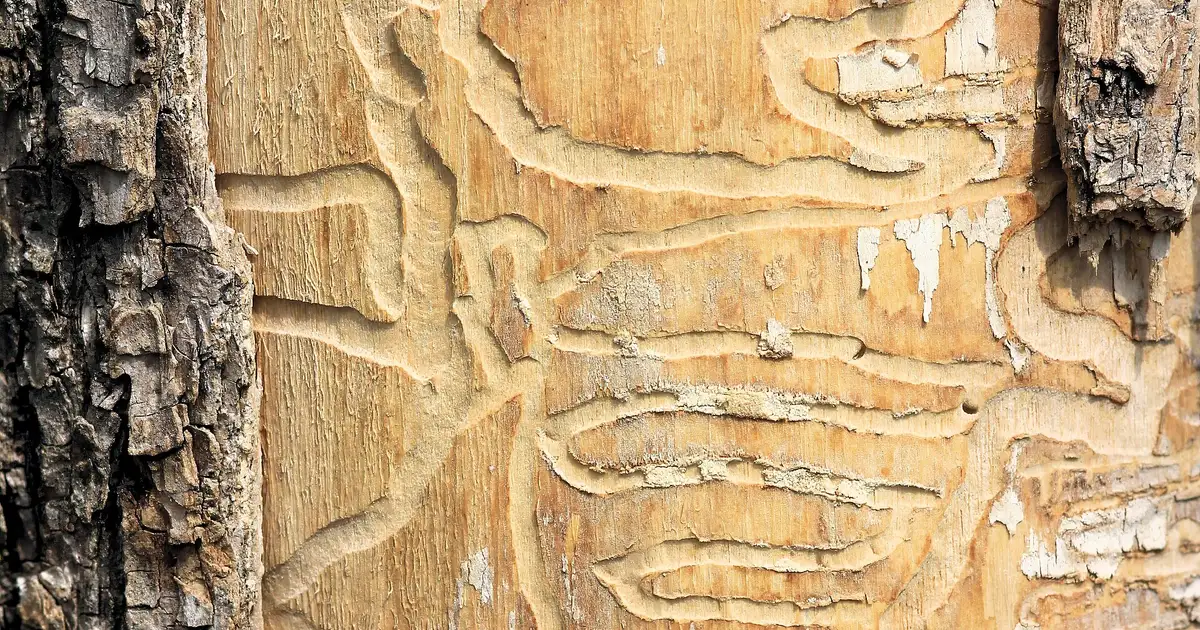
Emerald ash borer, Agrilus planipennis, is a beetle from Asia. The adults feed on ash leaves, and the larvae feed under the bark, cutting the channels that carry water and sugars up and down the tree. An infested ash tree usually dies within a few years, and in untreated forest stands the share of ash that dies is very high. The beetle was first found in North America near Detroit in 2002, and it is now present across a large part of the eastern United States and Canada.
The beetle affects the tree, not the sawn board. Lumber from an ash tree that died of borer attack has the same fiber and strength as lumber from a healthy tree, as long as the log is processed soon enough. That timing is the center of every buying decision for ash.
How supply has changed
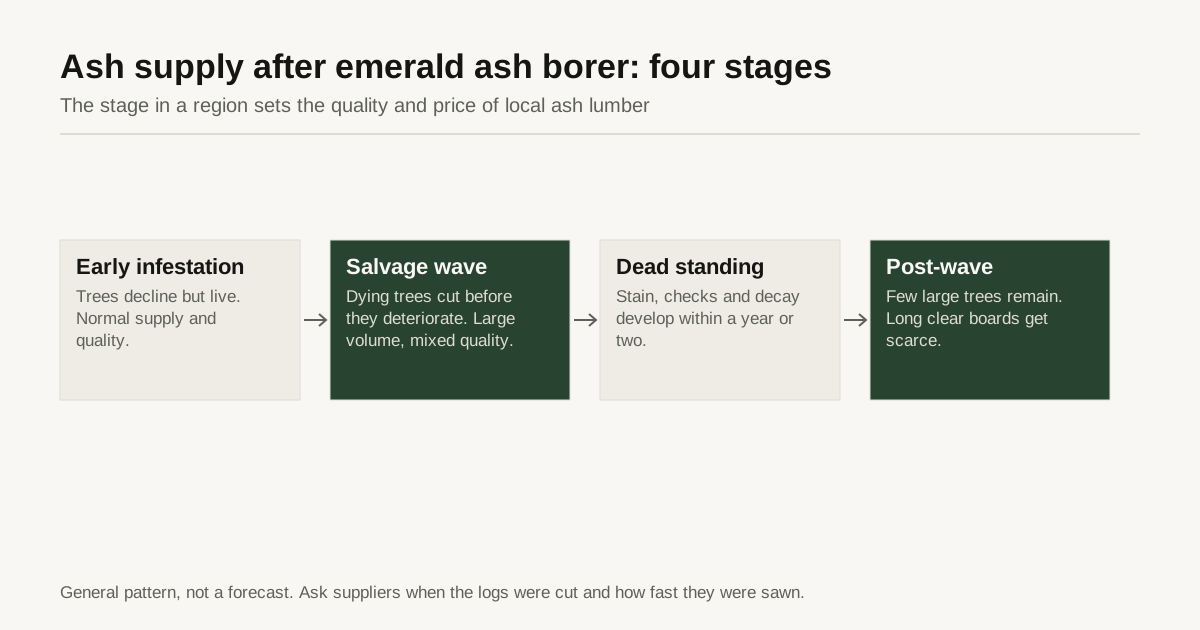
Supply has moved through stages, and the stage in a region sets the market there:
| Stage | What happens | Effect on lumber |
|---|---|---|
| Early infestation | Trees decline but are still alive | Normal supply and quality |
| Salvage wave | Landowners and mills cut dying trees before they deteriorate | Large volumes, more mixed quality, short-term price pressure |
| Dead standing | Trees left standing lose quality quickly | Stain, checks, decay and insect damage appear in boards |
| Post-wave | Few large ash trees remain | Tighter supply of long, wide, clear boards, more price swings |
In states hit early, the salvage wave has passed and large high-grade ash is harder to find. In regions the borer reached later, mills are still cutting salvage ash. Because ash is sold across the continent and abroad, a buyer feels both stages at once.
Another effect is on size. The trees that die first are often those along edges and in open stands, and the supply of large old trees for FAS boards shrinks sooner than the supply of smaller trees for No.1 Common and No.2A Common. Buyers needing long, wide, clear boards feel the squeeze first.
What is in the “white ash” you buy
Trade sells “white ash” as a group. It is mostly white ash (Fraxinus americana), often together with green ash (Fraxinus pennsylvanica) and sometimes other species such as blue ash. The woods are very similar in appearance and use. Black ash (Fraxinus nigra) is a separate, softer, lighter wood that is not sold as white ash. Ask the supplier which species the lot contains if it matters for your use.
Typical properties:
| Property | White ash, typical |
|---|---|
| Janka hardness | about 1,320 lbf |
| Density at 12% moisture | about 670 kg/m3 |
| Heartwood color | Light to medium brown |
| Sapwood color | Cream to near white |
| Grain | Straight, open pores, strong ring pattern |
| Strength | High, good shock resistance and bending |
These are typical values for the group, and they vary by tree and lot.
Why ash is hard to replace
Ash earns its place because it combines three things that few woods offer together. It is strong for its weight, so it makes light, tough parts. It bends well with steam, which is why it appears in chair parts, sports equipment and curved furniture. And it has a clear, open grain that finishes in many colors. Tool handles, stair treads, flooring and furniture frames all use these features.
Substitutes match some of these points and give up others. Oak bends less easily, maple is harder to stain evenly and hickory is heavier and harder to machine. Each switch means testing and sometimes a change in the finishing schedule, so plants that wait until supply is tight have less time to qualify a replacement.
Ash also faces a separate problem in Europe, where a fungal disease called ash dieback has damaged the native European ash. Buyers who source ash from several regions should not assume that supply in one place can fill the gap in another.
Quality problems in lumber from dead or dying ash
When ash is cut quickly, the quality is normal. When it has stood dead, these problems appear:
- Stain. Gray, blue-gray or brown color in the sapwood from fungi and from insects that carry them. It can be light or deep, and it does not wash out.
- Checks and shakes. Dead standing trees dry unevenly and crack. Cracks run into the boards and cut yields.
- Decay. After one to several years, depending on the climate, the sapwood softens and rots. Soft, punky wood has no place in structural or visible parts.
- Insect holes. Holes from other borers and ambrosia beetles may add dark stain around each hole.
- Weight and moisture changes. Dry standing trees start to dry before the mill gets them, which can cause drying defects in the kiln because the wood has uneven moisture.
Ask the supplier when the logs were cut and how fast they were sawn and dried. A mill that deals with salvage ash knows how to answer.
Rules for moving ash
Emerald ash borer is a quarantined pest in many places. Rules often cover ash logs, firewood and lumber with bark. Debarked lumber and lumber that has been heat treated or kiln dried are normally treated differently, but the details depend on the state, province or importing country. For exports, some destinations ask for debarked ash, a phytosanitary certificate or a certified treatment. Our guide to phytosanitary and fumigation rules explains the documents. Check the current text of the rules with your broker or authority, since they change.
Buying ash well today
Choose grade by part size
If your parts are short, No.1 Common ash gives clear cuttings at a lower price than FAS. Our guide to NHLA grades explains the yields. With tight supply of FAS, a buyer who can use shorter parts has more suppliers and lower prices to choose from.
Set stain and defect limits
Say what you accept. For clear-finish furniture, most buyers exclude stain and decay. For painted work or hidden parts, light stain may be fine, and accepting it lowers the price. Ask for photos of the lot, with a tape measure, including some boards from the middle of the lifts.
Specify drying and moisture
Ash dries without great difficulty, but it moves with humidity changes. The usual target for interior work is 6 to 8 percent, with a limit on any single board. Our kiln drying guide lists the questions to ask, and the moisture meter guide explains how to check the load.
Plan for substitutes
Dependence on one species is a risk. Plants that use ash for stairs, handles and furniture often qualify a second species, such as white oak, hard maple or hickory, so a supply problem does not stop production. See our guide to hickory and pecan and guide to hard maple vs soft maple for two alternatives.
Substitutes compared
| Species | Strength and hardness | Look | Comment |
|---|---|---|---|
| White ash | High | Light brown, open grain | The reference |
| White oak | Slightly lower hardness, high strength | Light to medium brown, open grain | Closest in grain and use, a bit different in color |
| Hard maple | Harder | Pale, fine grain | Stains blotchy, tight grain |
| Hickory | Harder | High contrast, rustic | Machines harder |
| Red oak | Slightly lower | Pinkish brown, open grain | Lower price, different color |
Questions for the supplier
- When were the logs cut, and how long did they wait before sawing?
- Does the lot include any wood from standing dead trees, and how is stain controlled?
- Which ash species are in the lot?
- How is the lumber graded, and what stain and defects does the grade allow?
- What are the moisture range and the drying method?
- Which debarking, treatment and documents are available for shipping?
What to put on the RFQ
- Species: white ash, and whether green ash may be mixed in
- Grade: FAS, Select, No.1 Common and better, or No.2A Common
- Sapwood and color rules: white sap or unselected
- Allowed stain and defects: limits on stain, checks and insect holes
- Thickness, surfacing, widths and lengths
- Moisture range, with a limit for any one board
- Origin and sawing date, if freshness matters
- Paperwork: debarked, phytosanitary certificate, treatment records
Closing checklist
- Ask how fresh the logs were when sawn
- Set clear limits on stain, checks and decay
- Buy shorter grades when your parts allow it
- Confirm moving and export rules for ash before shipment
- Qualify a second species
If you want ash quoted by several mills and yards, send your lumber RFQ with the grade, stain limits and moisture range. We pass it to up to 3 suppliers that carry ash, and they reply to you directly.
See also: white ash lumber, our reference page on ash properties, grades and uses.
Frequently asked questions
Is lumber from emerald ash borer trees safe to use?
Yes, if the trees were sawn soon after dying and the lumber was dried properly. The insect attacks the living tree, and the wood itself is not changed by the beetle once it is sawn and dried. The risk is time. Trees left standing dead for a year or two develop stain, checks and decay.
Will ash disappear from the market?
Supply of large, high quality ash sawlogs is shrinking in areas where the borer has spread and the trees have died. Ash will remain available for some years from salvage, from regions not yet affected and from trees that are treated or survive, but buyers should plan for tighter supply and for substitute species.
What species can replace white ash?
White oak, hard maple and hickory are the usual choices for strength, and red oak for a similar open grain at lower cost. Each differs in color, hardness and finish, so test a sample before you switch a product line.
Know what you need? Send the spec.
Tell us the species, grade, thickness and board feet. We pass it to up to 3 mills or yards that carry it and reply within 24 business hours.
Send my lumber RFQ