Home / Hardwood species / White Ash Lumber: Properties, Grades and Uses
White Ash Lumber: Properties, Grades and Uses
Reference page · Last reviewed 16 April 2027
White ash lumber is the sawn wood of the white ash group, mainly Fraxinus americana with green and blue ash sold alongside it. It is heavy, hard, strong and stiff, with high shock resistance and good bending properties, a white to yellow sapwood and a light to dark brown heartwood. It is graded under the standard NHLA rules, sold mostly in 4/4 to 8/4, and used for furniture, flooring, millwork, handles and sports goods.
| Item | Typical for white ash lumber |
|---|---|
| Species | White ash (Fraxinus americana), green ash (F. pennsylvanica), blue ash (F. quadrangulata) in the east, Oregon ash (F. latifolia) in the west |
| Sapwood | White to yellow, often wide |
| Heartwood | Light to dark brown, sometimes with lighter streaks |
| Grain | Ring porous, straight, distinct figure |
| Side hardness (Janka) | about 1,320 lbf at 12% moisture |
| Specific gravity | 0.55 green, 0.60 at 12% moisture |
| Modulus of rupture at 12% | about 15,000 psi |
| Shrinkage, green to oven dry | radial 4.9%, tangential 7.8%, volume 13.3% |
| Heartwood decay resistance | Slightly or not resistant (ashes group) |
| Common thicknesses | 4/4, 5/4, 6/4, 8/4 |
| Average dried weight | about 3.5 lb per board foot (NHLA guide) |
| US tariff line | 4407.95 (ash) |
Figures are typical for the species from the USDA Wood Handbook and the NHLA species guide, not guarantees for a lot. The NHLA rulebook governs grades.
What is sold as white ash
The Wood Handbook names American white ash, green ash and blue ash as the main eastern species of the white ash group, and Oregon ash on the Pacific coast. The trade sells them together as white ash. Black ash (Fraxinus nigra) belongs to a separate group and is lighter and weaker. If the strength of the wood matters, as it does for handles and sports goods, say “white ash (F. americana)” and ask how the mill separates species.
The NHLA species guide gives US ash growing stock as 657 million cubic meters, about 4.5% of all US hardwood growing stock, and says ash is readily available as lumber and veneer in a wide range of grades and sizes.
Strength, hardness and bending
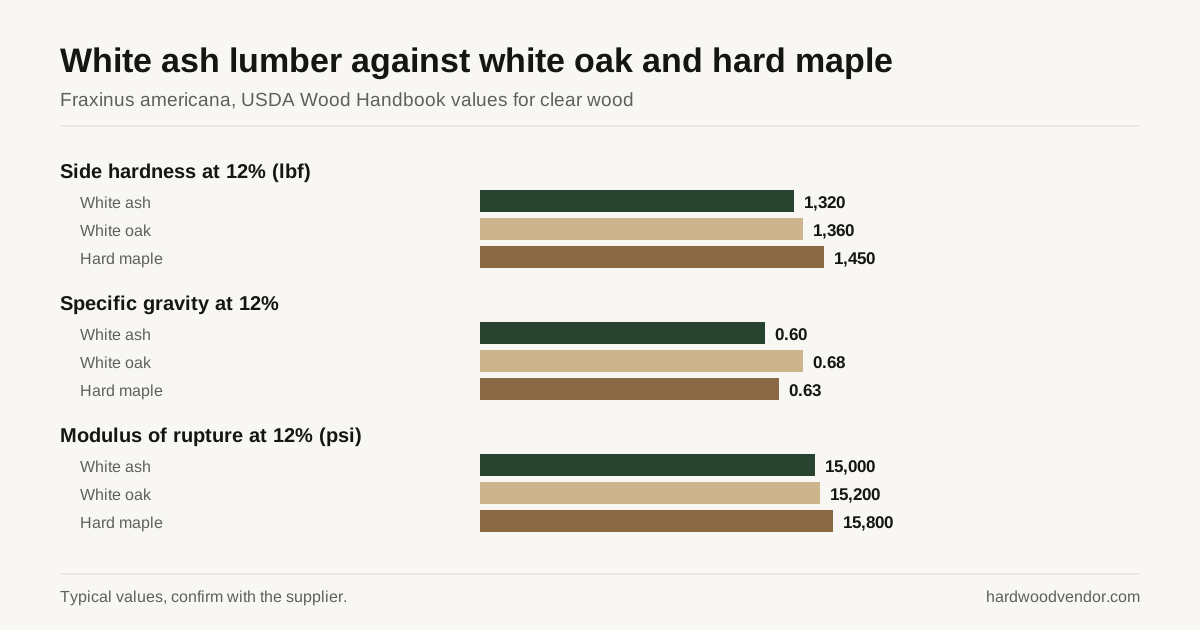
| Property at 12% moisture | White ash | White oak | Hard maple (sugar) |
|---|---|---|---|
| Side hardness | about 1,320 lbf | about 1,360 lbf | about 1,450 lbf |
| Specific gravity | 0.60 | 0.68 | 0.63 |
| Modulus of rupture | about 15,000 psi | about 15,200 psi | about 15,800 psi |
| Modulus of elasticity | about 1.74 million psi | about 1.78 million psi | about 1.83 million psi |
| Tangential shrinkage (green to oven dry) | 7.8% | 10.5% | 9.9% |
Values from the Wood Handbook tables for clear wood. White ash matches oak and maple for strength while being lighter than white oak, and it shrinks less across the face. The Handbook notes that second-growth trees are especially sought for their weight, strength, hardness, stiffness and shock resistance. The NHLA guide calls ash ideal for bending and turning.
That combination explains the classic ash uses: tool handles, baseball bats, oars, bent furniture parts and frames that take impact. For these uses, buyers often specify straight grain, a minimum growth ring count or density and freedom from cross grain, beyond the NHLA grade.
Grades and color
White ash follows the standard NHLA grades.
| Grade | Minimum board | Clear face yield | Typical ash use |
|---|---|---|---|
| FAS | 6 in wide, 8 to 16 ft | 83 1/3% | Furniture, millwork, bent parts |
| F1F and Selects | One FAS face, back No.1 Common | 83 1/3% on the better face | Doors, mouldings |
| No.1 Common | 3 in wide, 4 to 16 ft | 66 2/3% | Cabinets, furniture parts, handles |
| No.2A Common | 3 in wide, 4 to 16 ft | 50% | Flooring, short parts |
See the FAS grade page and the lumber grades hub for how cuttings are counted.
The NHLA guide notes that ash may be sold by color. Mills commonly offer white ash with a sapwood face for pale finishes, and brown heart ash for darker, warmer tones, as sorts. As with maple, define the sort in measurable words and ask how it is checked.
Emerald ash borer and supply
Emerald ash borer (EAB), an invasive beetle, kills ash trees across large parts of North America. The NHLA species guide links it to rising ash mortality and removals, expected to exceed growth in some states, and names Michigan and Ohio as central to the infestation. For a lumber buyer this means:
- Supply by region. Salvage harvests can raise short-term supply in some areas while standing ash declines over time. Long programs in ash need a supplier view on volume.
- Wood quality. Lumber sawn from trees dead for some time can show more stain, checks and insect marks. Ask whether logs were cut from live or recently killed trees if appearance matters.
- Import and export rules. Ash wood moves under specific plant health rules. Into the United States, ash wood from Canada needs certificates or importer documents depending on whether the area of origin is regulated for EAB (7 CFR 319.40-5(n)). The EU sets special requirements for ash wood from countries where EAB occurs. Check the destination rule before you quote.
Our guide to white ash lumber supply after emerald ash borer follows the supply side in more detail, and the EU import rules page covers the EU side.
Substitutes and alternatives
| If you need | Consider | Trade-off |
|---|---|---|
| Similar look, open grain | White oak, red oak | Heavier (white oak), different color |
| Shock resistance for handles | Hickory | Harder and heavier, more color variation |
| Pale, hard surface | Hard maple | Closed grain, different look |
| Exterior use with ash look | Thermally modified ash | Lower strength, better durability. See thermally modified hardwood |
Drying and weight
White ash dries fairly easily. For interior use in North America the usual target is 6 to 8%. The NHLA guide gives an average dried weight of about 3.5 lb per board foot, which is a fair starting point for freight. See kiln drying schedules for how ash is usually dried.
What to write on the RFQ
Name the species (white ash, F. americana if it matters), grade and rulebook, color sort, any straight grain or density requirement for handles, thickness, surfacing, drying, width and length limits, board feet and the destination’s ash paperwork. Our hardwood lumber specifications guide explains every field.
RFQ line: White ash (Fraxinus americana), FAS, NHLA rules (edition named), white one face, 8/4 rough, KD 6-8%, straight grain, 4 in and wider, 8-12 ft, 3,000 BF, ash plant health papers for destination.
Send it through our lumber RFQ form and we pass it to up to 3 mills or yards that carry white ash in that grade. More species are on the hardwood species hub.
Frequently asked questions
Is white ash a hard wood?
Yes. The Wood Handbook gives white ash a side hardness of about 1,320 lbf at 12% moisture, close to white oak at about 1,360 lbf and below hard maple at about 1,450 lbf. It is also strong, stiff and resistant to shock, which is why it is used for tool handles and sports goods.
Can white ash be used outdoors?
Not untreated. The Wood Handbook puts the ashes in the slightly or not decay resistant group. White ash is an interior wood unless it is treated or thermally modified.
Is white ash lumber still available after emerald ash borer?
Yes, for now. The NHLA species guide says ash is readily available in a wide range of grades and sizes, but it links emerald ash borer to rising ash mortality and removals, which are expected to exceed growth in some states. Supply and price can shift by region, so ask suppliers about volume over the length of your program.
What is the difference between white ash and green ash lumber?
Both belong to the white ash group and are usually sold together as white ash. Green ash (Fraxinus pennsylvanica) is a little lighter and less strong than white ash (Fraxinus americana) on Wood Handbook figures. Black ash is a different group with lower density.
Sources
- USDA Forest Products Laboratory: Wood Handbook, FPL-GTR-190 (2010), white ash group, Tables 4-3, 5-3b and 14-1
- NHLA species guide: ash (availability, thicknesses, color, weight, growing stock, emerald ash borer)
- American Hardwood Export Council: NHLA grades
- 7 CFR 319.40-5(n), US import conditions for Fraxinus wood from Canada
- US International Trade Commission: Harmonized Tariff Schedule, 4407.95 (ash)
Standards and rules are cited as references, not as claims about Hardwood Vendor or any mill. Editions and status change: confirm with the issuing body, your customs broker or the regulator.
Know what you need? Send the spec.
Tell us the species, grade, thickness and board feet. We pass it to up to 3 mills or yards that carry it and reply within 24 business hours.
Send my lumber RFQ