Guides / Species
Thermally Modified Hardwood: Ash, Poplar and Oak for Buyers
December 14, 2026
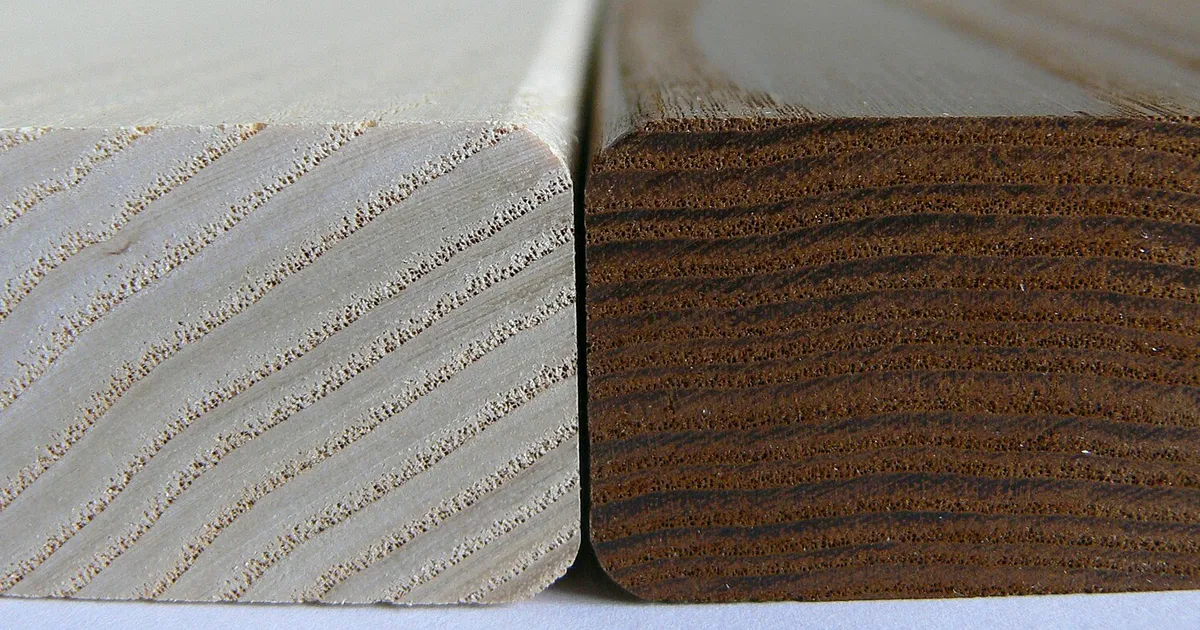
Heat changes wood. At temperatures well above those of a normal kiln, the chemistry of the cell walls shifts, and the result is a darker, more stable and more decay resistant material. This process is called thermal modification, and the product is sold as thermally modified wood, TMT, or under brand names. It has been used for softwood cladding and decking for years, and thermally modified hardwoods such as ash, poplar and oak are now common in the lumber market.
This guide explains what the process does, how the main hardwoods compare, where thermally modified lumber fits and where it does not, and what to put on an RFQ.
What thermal modification is
Thermal modification heats dried wood to a high temperature, typically in a range of about 160 to 230 degrees C, in an atmosphere with little oxygen, such as steam. The wood is held at peak temperature for a number of hours, then cooled and conditioned back to a moisture content suitable for use. The European specification CEN/TS 15679 defines thermally modified timber, and the Finnish ThermoWood system is a well-known industry standard for the process.
The wood is dried first. Thermal modification needs low starting moisture, so it is a second process after kiln drying, with its own chamber and its own cost.
The change comes from what the heat does to the hemicelluloses, which are the parts of the wood that attract water and that fungi feed on. Break them down, and the wood takes up less water and offers less food to decay organisms. Lignin and cellulose largely remain, which is why the wood keeps its shape and much of its strength.
What changes
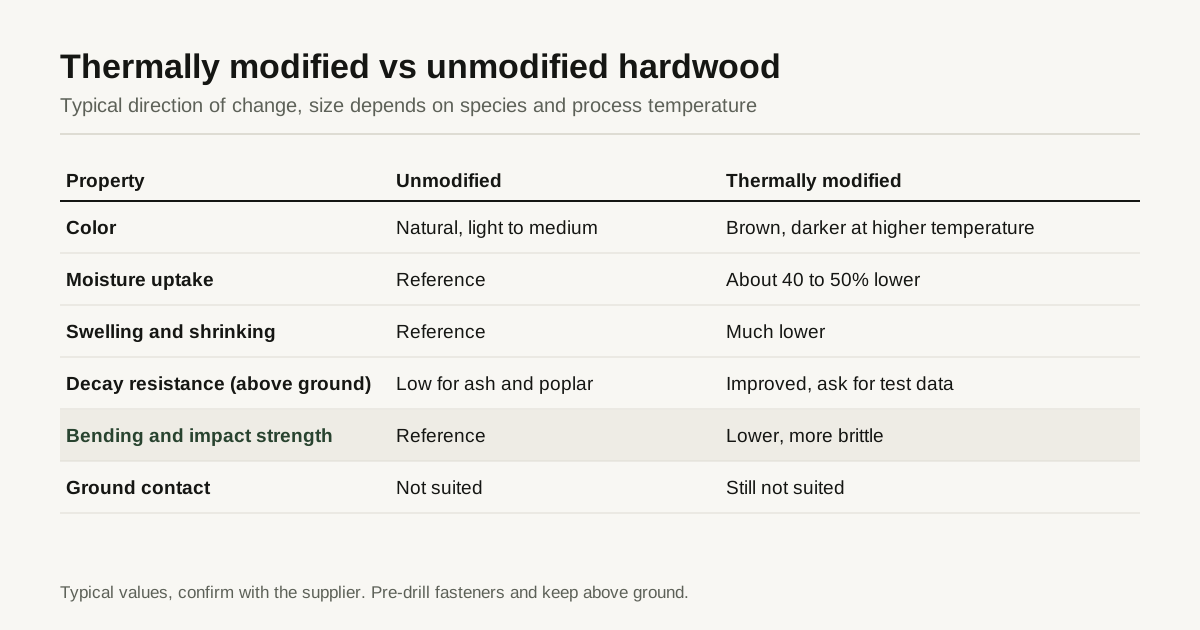
| Property | Unmodified hardwood | Thermally modified hardwood (typical) |
|---|---|---|
| Color | Natural, light to medium | Medium to dark brown, deeper at higher temperatures |
| Equilibrium moisture content | Typically about 12% in room conditions | Typically about 40 to 50% lower than unmodified wood |
| Dimensional stability | Moves with humidity | Shrinks and swells much less |
| Decay resistance | Low for ash and poplar, moderate for oak heartwood | Improved, depends on species and process temperature |
| Bending and impact strength | Reference | Lower, with more brittle fracture |
| Surface hardness | Reference | Similar or slightly changed |
| Weight | Reference | Somewhat lighter |
| Smell | Natural | Smoky or toasted, fades over time |
These are typical effects. Actual figures depend on species, thickness, temperature and the producer. Always ask for test data.
Color
Color is the most visible effect. Light species such as ash and poplar turn warm brown. The darker the color, the higher the process temperature, and the more the other properties change. The color extends through much of the board, though the core can be a little lighter than the surface in thick stock. Outdoors, thermally modified wood turns silver-gray as sunlight breaks down the surface unless it is protected with a UV oil or finish.
Stability
Because the wood absorbs less moisture, it swells and shrinks much less. That is the main selling point for decking, cladding, flooring and window parts, where movement causes gaps, cupping and finish failure. It does not make wood completely stable, and thickness, sawing pattern and installation still matter.
Durability
Thermal modification improves resistance to decay fungi. That moves low-durability woods such as ash and poplar into a more durable class for above-ground outdoor use. It does not make wood safe for ground contact, burial or constant wetting. Look at the durability test data from the producer, such as laboratory tests to EN 113, and the classification under EN 350, and ask what class applies to the species and temperature you are buying.
Strength
The cost of the process is strength. Bending strength falls, and impact resistance falls more. The wood becomes more brittle. Screws and nails may split the wood, so pre-drilling is the practice. Deck boards need correct spans, and structural beams and load-bearing parts should use unmodified wood or species and grades certified for that use.
The three species
Ash
White ash is a common base because it is strong, has a clear grain and is available in good volume, with salvage supply from trees killed by the emerald ash borer. Thermally modified ash takes a deep brown color and holds its grain pattern. It is used for decking, cladding, flooring and furniture. Ask whether the ash was sawn from sound logs. Our guide to white ash supply explains why stain and decay in the raw lumber matter.
Poplar
Yellow poplar is cheap, stable and abundant, and it is a growing choice for thermally modified cladding and interior paneling. The process gives a uniform brown color, hiding the green and purple streaks of natural poplar. It is soft, so it dents more than ash or oak, and it suits wall and ceiling applications more than decking in high-traffic areas. See our poplar guide for the base wood.
Oak
Oak is a naturally durable wood, especially white oak, and thermal modification makes it more stable and darker. It is used for flooring and furniture where stability across a wide face matters, and for interior and exterior joinery. Oak contains tannins that can react with metal fasteners, so use stainless steel for outdoor installations.
Where it fits
- Cladding and siding. Stable boards that hold their shape and take coatings well.
- Decking. Above-ground use only, with correct spans and fasteners.
- Interior paneling and saunas. Low moisture uptake and low heat conductivity at the surface.
- Flooring. Stable boards that suit underfloor heating and humidity swings.
- Window and door parts. Dimensional stability reduces sticking.
- Furniture and joinery. For indoor and covered outdoor pieces.
Where it does not fit
- Ground contact, posts in soil, or marine use
- Structural beams and load-bearing parts
- Parts that take impact, such as tool handles, ladders or stair nosings
- Glue-ups that need very high bond strength without testing the glue first
- Any job where the supplier cannot show test data for the product
Drying, moisture and handling
Thermally modified lumber arrives at a low moisture content, often 4 to 8 percent, and it picks up moisture in the shop or on site, so it should be installed after acclimation to the local conditions. Moisture meters calibrated for unmodified wood read differently. Ask the supplier for the target range and the method. Our moisture meter guide explains meter limits, and the same checks apply with a correction.
Practical handling points:
- Pre-drill for screws and nails.
- Use sharp tools, since the wood chips and splinters more than unmodified wood.
- Use stainless or coated fasteners outdoors.
- Seal the cut ends and edges when installing outdoors.
- Check adhesive compatibility with a bond test.
Who modifies the wood
Thermal modification needs a dedicated chamber with accurate temperature and steam control, so it is done by specialist plants, and by some mills that have added the equipment. The plants differ in process, temperature classes, species list and quality control. Some produce for a brand and sell finished profiles, and some sell modified rough lumber to be machined elsewhere. When you compare suppliers, ask:
- Which process and which temperature class does the plant run, for this species?
- Is the lumber dried before the process, and to what moisture content?
- Does the plant keep process records for each batch?
- Are test reports available for durability, strength and stability?
- How is the lumber sorted for color after the process?
A plant that controls the process batch by batch can show you a record, and the answers are usually clear. A supplier who is only reselling may not know the process at all, which is a reason to ask for the producer’s data.
Price
Thermally modified lumber costs more than the same species unmodified, because of the extra process, energy and yield loss. It can also replace more expensive materials such as tropical decking or chemically treated wood, so the comparison depends on the application and the service life you expect. Compare price per installed meter or square foot of the finished product, not just price per board foot.
What to put on the RFQ
- Species, such as ash, poplar or oak, and the grade
- Process and class: for example the temperature class, or the producer’s product name and test data
- Thickness, width, length and profile, and whether it is rough, planed or profiled
- Moisture target after modification
- Use: decking, cladding, interior, to match the class and durability
- Test data requested: durability, strength, dimensional stability
- Packaging and delivery
Closing checklist
- Decide whether you need the stability, the durability or the color
- Choose the species by the part and the traffic
- Ask for process class and test data
- Keep it above ground and design for the lower strength
- Plan fasteners, pre-drilling and acclimation
If you want thermally modified hardwood quoted by several suppliers, send your lumber RFQ with the species, grade and intended use. We pass it to up to 3 mills or yards that can supply it, and they reply to you directly.
Frequently asked questions
Is thermally modified wood treated with chemicals?
No. The process uses heat and steam, or heat in a low-oxygen atmosphere, with no added preservative. The change is in the wood itself. That is why buyers use it where they want to avoid chemicals, though the wood is still not suited to ground contact.
Is thermally modified wood weaker?
Yes, to some degree. Bending strength and especially impact strength fall as the process temperature rises, and the wood becomes more brittle. It suits cladding, decking with correct spans, paneling and flooring, but not load-bearing structure or parts that take shock.
Can I use a normal moisture meter on thermally modified wood?
Standard meter scales assume unmodified wood, and readings can be off because the wood holds less moisture at the same humidity. Ask the supplier for the target moisture range and the method they use, and use an oven-dry test for disputes.
Know what you need? Send the spec.
Tell us the species, grade, thickness and board feet. We pass it to up to 3 mills or yards that carry it and reply within 24 business hours.
Send my lumber RFQ