Guides / Species
Yellow Poplar for Paint Grade Millwork and Cabinets: Grade and Sorting
December 26, 2026
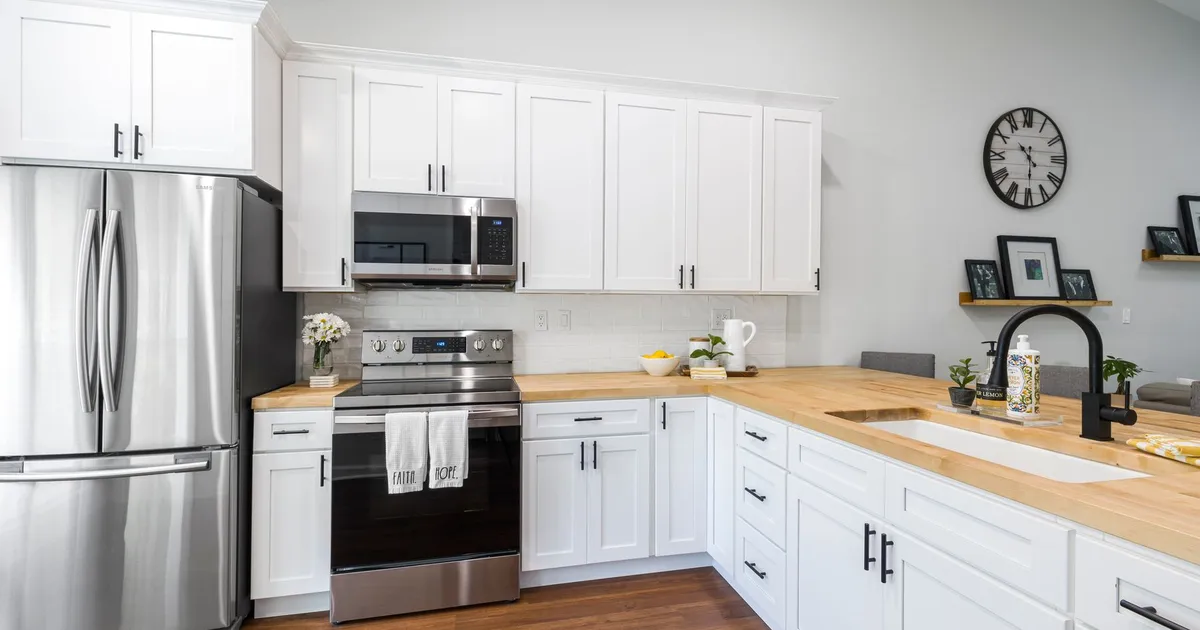
Yellow poplar is the working wood of paint grade joinery. It is soft enough to machine cleanly, stable once dried, available in wide boards and lower in price than the other hardwoods used in cabinets. It is also unattractive on its own, with green, purple and gray streaks, so it is almost always painted. That makes it a species where grade, color and price work in your favor if you order the right way.
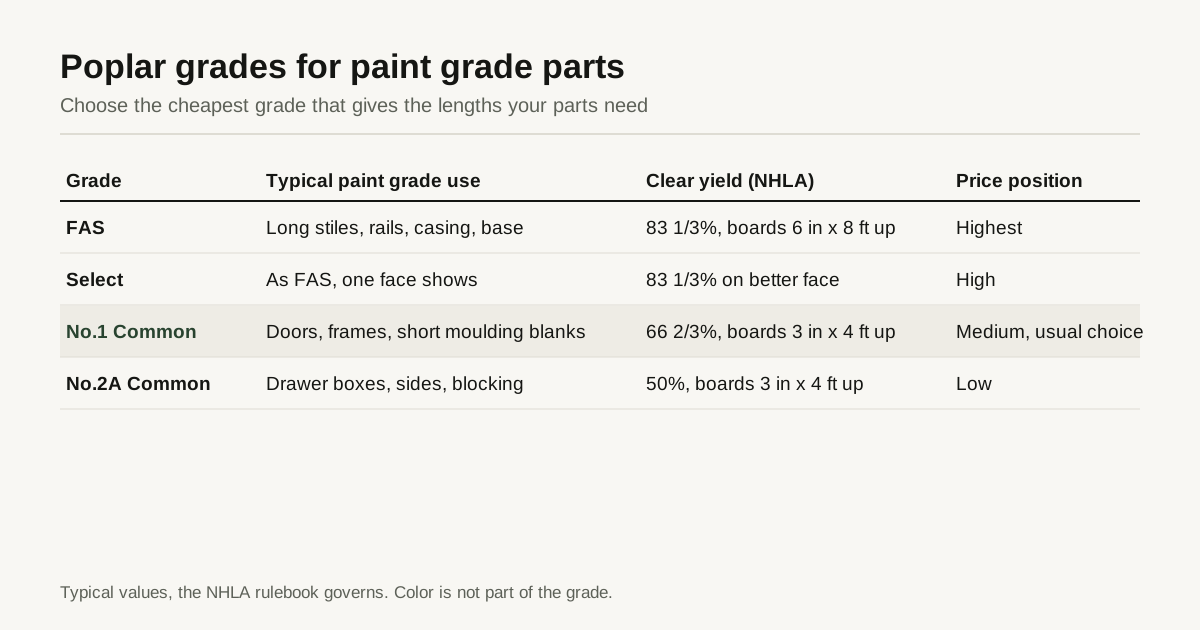
This guide explains why poplar suits paint grade work, which grades to buy, what defects matter under paint and what to write on an RFQ.
What yellow poplar is
Yellow poplar, also called tulip poplar or tulip tree, is Liriodendron tulipifera. It is not a true poplar. The sapwood is white, the heartwood is yellow-tan to olive, and mineral streaks add green, purple, brown and almost black lines. The grain is straight and fine, and the wood is lightweight and easy to work.
Typical properties:
| Property | Typical value |
|---|---|
| Janka hardness | about 540 lbf |
| Density at 12% moisture | about 450 to 480 kg/m3 |
| Typical board widths | 6 to 12 in, wider boards are common |
| Common thicknesses | 4/4, 5/4, 6/4, 8/4 |
| Common lengths | 8 to 16 ft |
| Machining | Cuts, sands and glues easily, can fuzz if knives are dull |
| Stability | Good once properly dried |
Poplar grows in large volume across the eastern United States, so supply is steady and boards are long and wide. These are typical values, so check a quote for the actual figures.
Why it suits paint grade work
- Takes paint well. Poplar has a closed, fairly even surface. After a sanding and a primer coat it holds paint smoothly, with less grain raising than many open-pored woods.
- Machines cleanly. Profiles, mouldings and raised panels cut well, and the soft wood dulls tools less than hard maple or oak.
- Wide boards. Face frames, casings and door stiles come from wide, clear lengths with less glue-up.
- Stable. Properly dried poplar moves less than many species, which matters for paint, because joints that move crack the paint line.
- Price. Poplar costs less per board foot than maple, cherry or oak in comparable grades, and a large share of paint grade parts can use lower grades.
Which grades to buy
The NHLA grades work for poplar the same way as for other species and are based on clear cuttings. Standard grades:
| Grade | Typical use in paint grade work | Comments |
|---|---|---|
| FAS | Long, wide stiles, rails, casing and base | Highest yield of long clear parts, highest price |
| Select | As FAS where one face is fine | A slight saving when only one face shows |
| No.1 Common | Doors, frames, shorter casing and moulding blanks | The usual paint grade choice for visible parts |
| No.2A Common | Drawer boxes, cabinet sides, blocking, small parts | Lower price, more cutting around defects |
Color is not part of the grade, which is good news for paint grade buyers, because the green and purple streaks do not matter. Our guide to NHLA grades explains the yields behind each grade. The key point is that you pay a premium for FAS length and width, and paint grade parts often do not need either.
Instead of FAS, many buyers order No.1 Common and better and rip and crosscut around the knots. Short parts from lower grades can cost less per finished part than long clear boards, even when the lower grade needs more cutting. Work out the cut list before choosing.
What matters under paint
Color streaks are not a problem under paint. These defects are:
- Large knots and knot holes. Poplar has fewer knots than many species, but they bleed through or fall out. Ask for a limit on knot size and place.
- Wane and bark pockets. These affect the face and edge of rough boards. Ask how they are counted for surfaced stock.
- Wet streaks and wet pockets. Poplar can keep pockets of high moisture in the heartwood after drying. They show up as dark, sometimes sunken areas after planing and can move after painting. Moisture readings across the load are the check. Our moisture meter guide explains how.
- Tension wood and fuzzy grain. Some boards have raised, woolly grain that sands badly. A sharp planer knife and a sample check help.
- Dark mineral streaks. They rarely show under opaque paint, but very dark lines can show through thin white coats. Use a good primer and test.
- Sapwood and heartwood boundaries. A sharp line of color is no problem under paint, but different moisture and density can give a ridge in the planed surface.
Dimensions, surfacing and moisture
Millwork plants often buy S4S stock, or rough lumber that they plane themselves. Check the options in the guide to rough lumber, S4S and dimension parts before choosing. Good practice is to buy slightly thicker than the finished thickness and plane after acclimatizing in the shop, so stock that moved in transit is removed.
For interior painted work the usual moisture target is 6 to 8 percent, with a limit on any single board. Paint locks in moisture, and a wet board that dries after painting shrinks and cracks the paint line at joints.
Preparing poplar for paint
A good paint finish starts in the lumber and finishes in the shop. A typical sequence for painted cabinet parts:
- Plane and sand to a uniform surface, ending with a fine grit such as 180 to 220.
- Remove dust and fill any pin knots, small checks and nail holes with a filler suited to paint.
- Apply a good primer, and sand lightly once it dries to remove raised fibers.
- Apply one or two coats of finish paint, sanding lightly between coats.
Poplar edges and end grain soak up more primer than faces. Many shops seal the end grain twice. Boards with fuzzy grain take more sanding than clean boards, and a sample run through the shop’s own machines shows whether the lot is a problem.
Poplar compared with other paint grade choices
| Option | Hardness and wear | Typical price position | Comment |
|---|---|---|---|
| Yellow poplar | About 540 lbf, dents easily | Low | Stable, wide boards, the usual choice |
| Soft maple | About 950 lbf | Low to medium | Harder and denser, finer grain, color streaks do not matter under paint |
| Hard maple | About 1,450 lbf | Higher | Very hard, a premium wood for paint, used when wear matters |
| MDF or veneer panels | Depends on the product | Low | Flat and smooth for large panels, not covered by this guide |
Poplar wins on price and machining. Soft maple is a step up in hardness and is often chosen for painted doors where dents are a concern. Hard maple is used when a painted surface must resist wear, such as painted stair treads and heavy-use furniture. See our guide to hard maple vs soft maple for the details.
Common mistakes
- Paying for FAS color and length when the parts are painted and short
- Skipping a limit on wet pockets, then finding sunken dark patches after planing
- Painting boards that are above the target moisture
- Comparing quotes without checking the tally method or the grade rules
- Ordering poplar for a surface that takes heavy wear, then repainting after a year
Common uses
- Painted face frames and doors on kitchen and bath cabinets
- Casing, base and crown mouldings
- Stair parts that will be painted, such as risers and stringers
- Drawer boxes and cabinet interiors
- Furniture frames and secondary parts
- Shelving and built-ins
For flat panels that must be very smooth and stable, plants sometimes pick MDF or veneer panels, and poplar for the frames. If your target surface is a work top or a wearing surface, look at harder species.
How to write the RFQ
- Species: yellow poplar
- Grade: for example No.1 Common and better, or FAS and Select for long parts
- Thickness and surfacing: 4/4 rough, or S2S to a given thickness
- Widths and lengths: minimum widths, length mix and any lengths needed for casing
- Color rule: any color acceptable, or sapwood limited, if you want a lighter look under thin paint
- Defect limits: knots, wane, wet streaks, mineral streak depth
- Moisture: 6 to 8 percent target with an upper limit for any board
- Packaging: bundle size, wrapping, and the tally method
Closing checklist
- List parts by size and choose the cheapest grade that gives the lengths you need
- Treat color as irrelevant, but set limits on knots, wane and wet pockets
- Specify moisture range and check boards on arrival
- Test paint and primer on a sample board
- Plan to plane after the lumber acclimates
If you want poplar priced from several mills, send your lumber RFQ with the grade, thickness and paint grade limits. We pass it to up to 3 mills or yards that carry poplar, and they reply to you directly.
Frequently asked questions
Is paint grade poplar an NHLA grade?
No. Paint grade is a sort or a buying practice, not a grade in the NHLA rules. Buyers usually order No.1 Common or Select, ignore color, and ask for a limit on knots, wane and mineral streaks that could show through paint. Write the limits on the RFQ.
Do the green and purple streaks in poplar show through paint?
Usually not, if the surface is properly primed and the paint is a normal opaque coat. Dark mineral streaks can show through very light, thin coats, so use a good primer and test a sample board. Color does not affect strength.
Is poplar strong enough for cabinet doors?
Yes, for painted frames and drawer parts it is widely used. Poplar is softer than maple or oak, with Janka hardness around 540 lbf, so it dents more easily. For high-wear surfaces such as work tops or stair treads, buyers often choose a harder species.
Know what you need? Send the spec.
Tell us the species, grade, thickness and board feet. We pass it to up to 3 mills or yards that carry it and reply within 24 business hours.
Send my lumber RFQ