Guides / Species
Hard Maple vs Soft Maple Lumber: Grade, Color and Where Each Fits
October 12, 2026
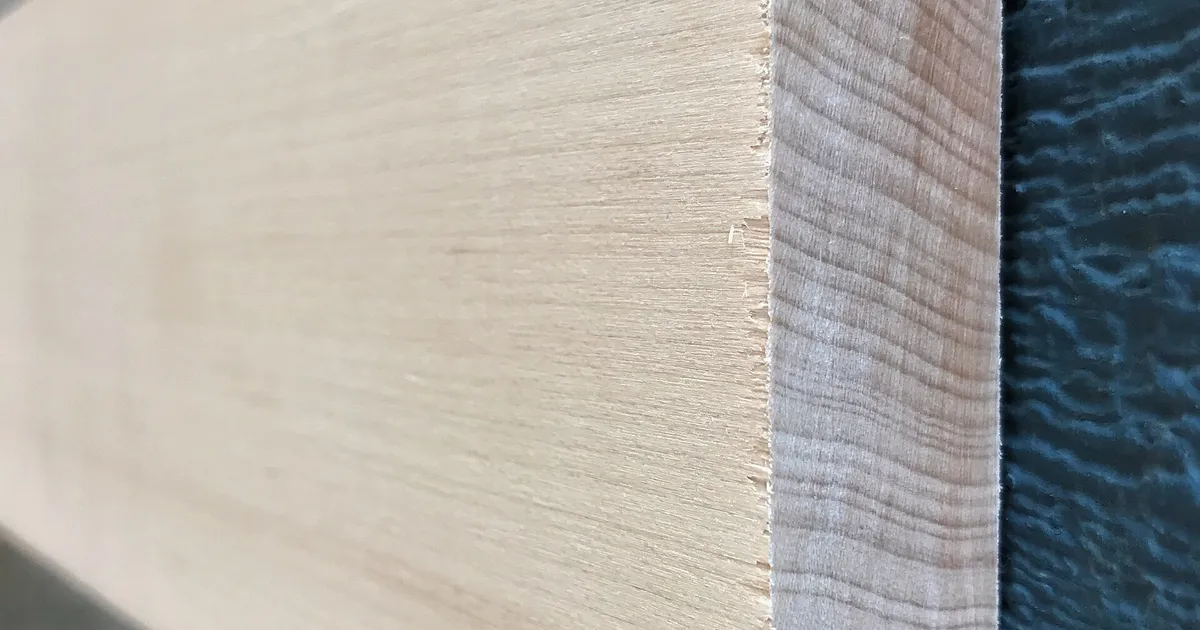
Maple is one of the most traded hardwoods in the world, and the word covers two very different groups of lumber. Hard maple, from the sugar maple tree, is dense, pale and tough. Soft maple, from red, silver and several related species, is lighter, softer and often cheaper. Plants that mix them up end up paying too much for hidden parts or choosing a wood that wears too fast on a floor.
This guide explains how the two compare, how maple is graded and sorted by color, what to watch in drying and finishing, and how to write the order so the supplier ships the right wood.
Which trees are behind the names
Hard maple is mainly sugar maple, Acer saccharum, with some black maple, Acer nigrum, mixed in. Trade grading usually treats them together. The main supply region is the northeastern and Great Lakes forests of the United States and neighboring parts of Canada.
Soft maple is mainly red maple, Acer rubrum, and silver maple, Acer saccharinum, with other species mixed in. It grows across a much wider range, and the supply is broader.
Both groups are sold as maple, so the RFQ must say hard or soft. A quote for “maple” without the word leaves the supplier free to ship whichever is easier.
Hardness, density and strength
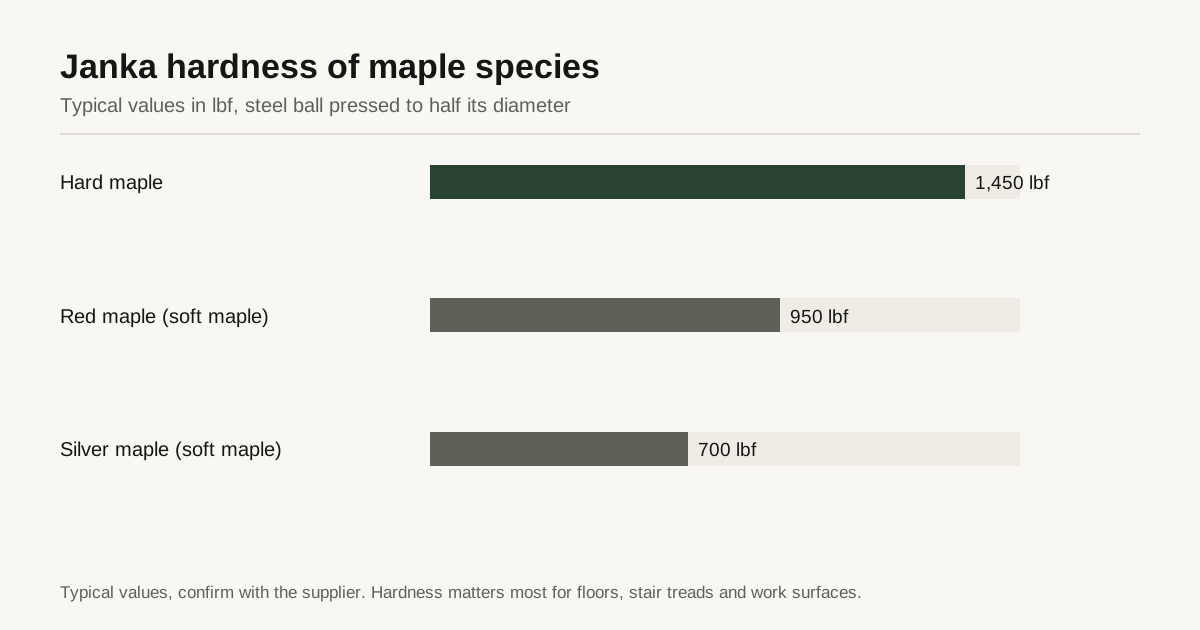
The Janka hardness test measures the force needed to push a steel ball into the wood. Typical values:
| Property | Hard maple | Soft maple (red maple) |
|---|---|---|
| Janka hardness | about 1,450 lbf | about 950 lbf |
| Density at 12% moisture | about 705 kg/m3 | about 610 kg/m3 |
| Typical sapwood color | Cream to near white | Cream to light gray or tan |
| Typical heartwood color | Light to dark reddish brown | Pale brown to red brown, often streaked |
| Color uniformity | Higher in white sorts | Lower, more variable |
| Relative price | Higher | Lower |
Silver maple is softer than red maple, at about 700 lbf, so the average for soft maple depends on the mix. Figures here are typical values for the species, not guarantees for a lot. Hardness matters most for floors, work surfaces, stair treads and parts that take impact. For doors, drawer fronts and most furniture, soft maple is hard enough.
Color sorts and grades
Standard NHLA grades judge clear cuttings, not color. Maple is one of the species where color matters most, so color sorts are added on top:
- White maple. Mostly sapwood, with creamy white faces. Hard maple sells as 1 white face or both faces white, and the sorts command a premium.
- Unselected. Any color, including brown heartwood. This is cheaper and is used for painted, hidden or dark-stained parts.
- Brown or heart. Sorted for heartwood. Some buyers want it for a darker, warmer look, and some mills sell it at a discount.
Terms differ between mills. Ask whether “white” is a percent of face surface, how much heartwood is allowed and whether the rule applies to one face or both. Our guide to NHLA grades explains why the grade and the color sort are two separate requests.
Soft maple also gets sorted, but its natural color variation is wider. Soft maple often has gray, green or pink tones in the sapwood and heartwood. Plants that want a uniform look usually choose hard maple white, or they stain or paint soft maple.
Grain and figure
Both groups can show special figure: bird’s eye, curly, quilted and fiddleback. These are cut and sold as separate items at much higher prices, and the supply is thin and sorted by hand. If figure is part of your spec, say so and ask for photos of the exact boards.
Plain maple has a fine, tight grain with little visible pores. That gives a smooth surface for paint and a clean, quiet look for modern cabinets. It also causes the blotch problem when staining.
Drying and stain
Maple dries without much trouble if it is handled well, and mishandled maple shows it immediately. The main drying issues:
- Sticker stain. Brown or gray stripes where stickers touched the board while it was drying slowly. Fast, warm, well-ventilated stacking avoids it.
- Chemical brown stain. Brown or tan areas inside the board, caused by chemical reactions in the wood when it dries slowly at high moisture. It can show up after planing.
- Mineral streaks. Dark lines that come from the tree and not from drying.
- Over-drying. Maple that is dried too hot can darken. Moderate temperatures protect the white color of hard maple.
White hard maple is often dried green or very fresh to keep the color. If white color matters, ask how long the logs and lumber waited before drying. Our kiln drying guide explains the schedule questions for this.
Machining and glue-up
Hard maple is dense and can burn on a table saw or router if the feed is slow or the blade is dull. Use sharp carbide tooling and a steady feed, and expect more tool wear than with soft maple. Soft maple cuts and sands more easily, but its softer, uneven density can tear out or fuzz on planers and moulders if the knives are dull.
Both glue well. For edge-glued panels, match boards by color before gluing, since a white board next to a brown one is the most common reason a maple panel is rejected. If you buy ripped strips or panels, put the color rule in the spec and ask for a sample layout.
Supply, thickness and lead time
Hard maple supply is concentrated in a smaller region than soft maple, and white sorts are a share of the cut. Common thicknesses are 4/4, 5/4, 6/4 and 8/4, with 4/4 the easiest to find and thicker stock available in smaller volume. Soft maple is easier to find in volume, particularly in unselected grades, and mills often carry it in more thicknesses.
Lead time depends on the sort. Unselected soft maple in 4/4 is usually the quickest to ship. Both faces white hard maple in 8/4, kiln dried and surfaced, may need extra time while the mill collects enough boards. Say early if the order is a repeat item, because mills that know the volume can sort and hold stock for you.
Finishing
Maple stains unevenly. Tight grain and alternating dense and less dense zones absorb stain at different rates and produce a blotchy surface, especially with oil stains. Typical fixes:
- A pre-stain conditioner or a washcoat
- Gel stain, which sits on the surface
- Dye with a toner coat
- Clear finish or paint instead of stain
If the finished color matters, test a sample from the lot. Soft maple with a high share of heartwood and gray streaks can look very different from a sample of white hard maple.
Where each one fits
Choose hard maple for:
- Flooring and stair treads where wear matters
- Butcher block, work surfaces and cutting boards
- Light, clean cabinet doors and frames
- Parts with tight tolerances and sharp edges that must resist dents
- Furniture where durability and a pale color are a selling point
Choose soft maple for:
- Painted cabinets and millwork, where grain and color do not show
- Stained furniture in darker colors
- Drawer boxes, case parts and hidden components
- Moulding and trim that needs easy machining
- Projects where price per board foot is the main concern
Many plants use both: hard maple for the visible face frames and doors, soft maple for the sides and drawer parts. This splits the premium across the project.
How price compares
Hard maple is usually priced above soft maple in the same grade and color sort, and white sorts carry a further premium. The gap changes with market conditions and with the grade, so price both options on your actual mix. Compare price per usable board foot instead of price on the tally. White maple sorts yield less per log, and the color rules can make a large difference to the price of otherwise similar boards. Our guide to board feet and pricing shows how to compare quotes on the same basis.
What to put on the RFQ
- Hard maple or soft maple, written out
- Grade, such as FAS, Select or No.1 Common
- Color sort: white one face, white both faces, unselected, or brown
- Thickness, surfacing, widths and lengths
- Drying and moisture range
- Figure, if any
- Photos of typical boards from the lot, with a tape measure in the frame
Common mistakes
- Ordering “maple” without saying hard or soft
- Asking for white maple without saying one face or both faces
- Judging color from the first board on top of the lift
- Staining without a test and finding blotches on the finished parts
- Using unselected soft maple for a clear finish and finding gray streaks
- Paying the white premium for parts that will be painted
Closing checklist
- Decide which parts need hard maple and which can use soft maple
- Choose the color sort for each use
- Ask how the supplier handles sticker stain and chemical stain
- Plan a finishing test before ordering a full load
- Compare price per usable board foot
If you want hard and soft maple quoted side by side, send your lumber RFQ with the color sort and grade for each. We pass it to up to 3 mills or yards that carry maple, and they reply to you directly.
See also: hard maple lumber, our reference page on hard maple sorts, grades and hardness.
Frequently asked questions
Is soft maple really soft?
It is softer than hard maple, but it is still a hardwood. Typical Janka hardness is about 950 lbf for red maple and about 700 lbf for silver maple, compared with about 1,450 lbf for hard maple. For many furniture and cabinet parts the difference does not matter, and soft maple machines and nails more easily.
What does white maple mean on a quote?
White maple is a color sort, normally hard maple sapwood, with the creamy white face wanted for light cabinets and floors. Standard grades do not set color, so the sort is added on top of the grade. Ask whether the white rule applies to one face or both.
Why does maple stain unevenly?
Maple has fine, tight grain and uneven density, so stain absorbs unevenly and looks blotchy. Finishers use conditioners, gel stains or dye toners. This is true of both hard and soft maple, so test a sample before you commit.
Know what you need? Send the spec.
Tell us the species, grade, thickness and board feet. We pass it to up to 3 mills or yards that carry it and reply within 24 business hours.
Send my lumber RFQ