Guides / Species
Ipe, Cumaru and Garapa Decking Lumber: Density, Moisture, Permits and Supply
February 10, 2027
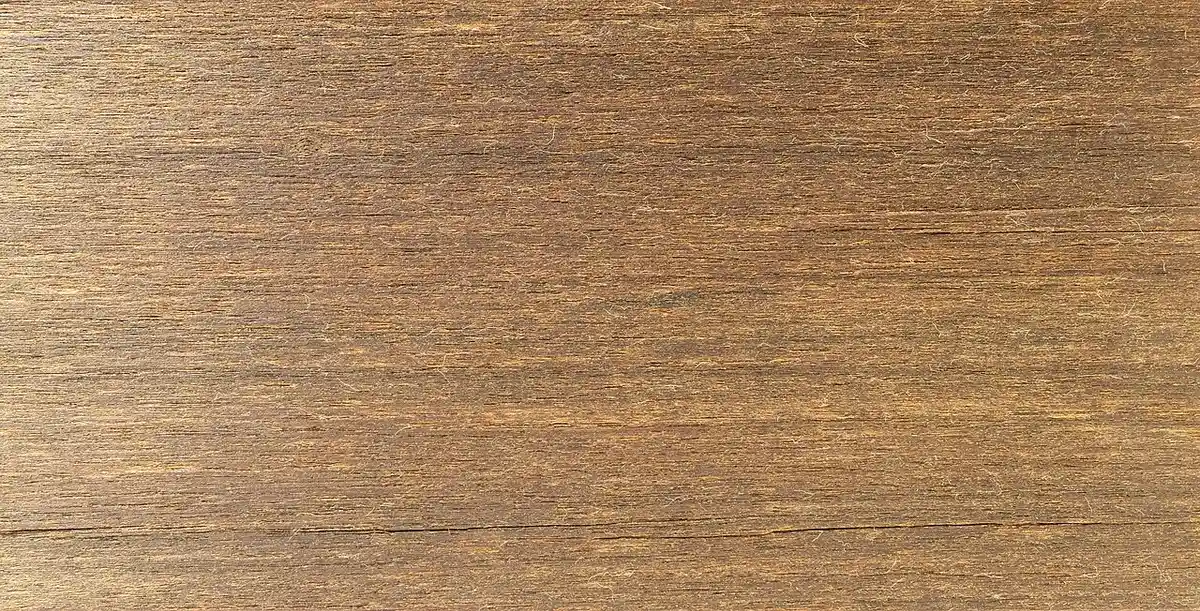
Ipe is the densest and usually the most expensive of the three common South American decking woods. Cumaru is almost as hard and typically cheaper. Garapa is much lighter and softer, and it is the only one of the three outside the CITES appendices. Since 25 November 2024 ipe and cumaru both need CITES papers to cross a border, which changes lead times and what you must ask a supplier for. This guide compares the three on published numbers, then covers the paperwork, drying, sizes and the lines to put on an RFQ.
This is general information as of October 2026, not legal advice. The physical figures come from the Wood Database. Vendor statements are labeled as such. I found no public standard grade for ipe decking, so grade terms below are for you to define with each supplier.
The three species side by side
| Ipe | Cumaru | Garapa | |
|---|---|---|---|
| Botanical name | Handroanthus serratifolius and related Handroanthus species | Dipteryx odorata | Apuleia leiocarpa |
| Other trade names | Lapacho, Brazilian walnut | Brazilian teak, tonka, shihuahuaco (Dipteryx spp.) | Grapia |
| Janka hardness | 3,490 lbf | 3,330 lbf | 1,650 lbf |
| Average dried weight | 65.5 lb/ft³ (1,050 kg/m³) | 68 lb/ft³ (1,085 kg/m³) | 51 lb/ft³ (820 kg/m³) |
| Shrinkage, radial / tangential | 5.5% / 7.1% | 5.3% / 7.7% | 4.2% / 7.5% |
| Decay resistance | Very durable, excellent insect resistance | Very durable, good termite resistance | Durable, vulnerable to termites and other insects |
| Working | Difficult, blunts cutters, can tear out in interlocked grain | Difficult, dulls tools moderately, oils make gluing difficult, needs pre-boring | Fairly easy, glues and finishes well |
| CITES | Appendix II since 25 Nov 2024 | Appendix II since 25 Nov 2024 | Not listed |
| Price tier (Wood Database) | Medium range for an imported tropical | Inexpensive for an import | Moderate for an imported hardwood |
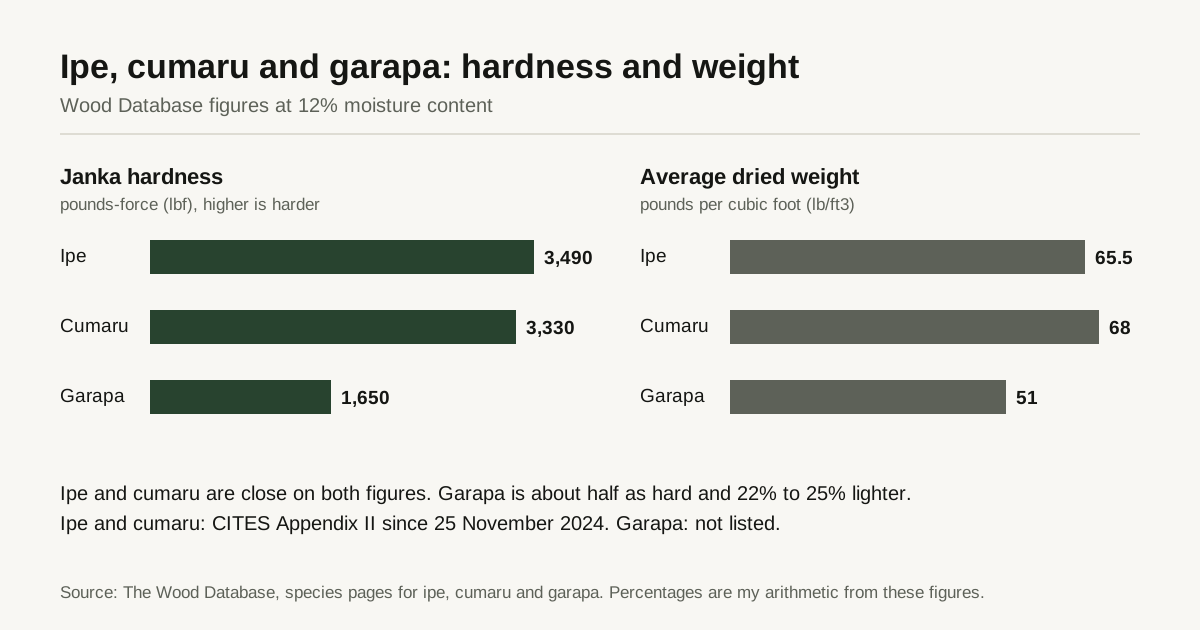
Two points to take from the table. First, ipe and cumaru are close on every physical figure, so the choice between them is mostly price, color and supply, not performance. Second, the weight is real money in freight. At the average dried weights above, 1,000 board feet (a cubic foot holds 12 board feet) weighs about 5,460 lb in ipe, 5,670 lb in cumaru and 4,250 lb in garapa. That is my arithmetic from the Wood Database figures, so check the actual weight on the packing list.
Color also differs. The Wood Database describes ipe heartwood as varying from reddish brown to yellowish olive brown to darker blackish brown, sometimes with darker stripes. “Brazilian walnut” is a halo name that flooring dealers use for ipe, and the wood is not related to walnut. Because trade names overlap, write the botanical name on the order.
Permits and legality
Ipe and cumaru both entered CITES Appendix II with annotation #17 (logs, sawn wood, veneer sheets, plywood and transformed wood). The CoP19 meeting in November 2022 adopted the listings and gave them a delayed start of 24 months, which put the effective date at 25 November 2024. The US Fish and Wildlife Service letter to importers states that the trumpet trees (Handroanthus, Roseodendron and Tabebuia) and cumaru (Dipteryx) are covered, and that on the effective date imports into the United States of specimens covered by the annotation must be accompanied by CITES permits or certificates issued by the country of export or re-export. Our guide to CITES timber species lists the other woods in the same position.
For Brazilian exports, the timber trade association ATIBT reported in October 2024 that Brazil would issue pre-Convention certificates for wood harvested before 25 November 2024 and CITES export permits for wood harvested after that date. The Wood Database says Brazil accounts for over 90% of ipe exports by volume. I could not open the CITES notification itself, so confirm current conditions with the exporter’s CITES authority and your broker.
Two other facts bear on risk. A 2022 Forest Trends report, as summarized by Mongabay, says about 96% of ipe trees are in Brazil, that at least 525 million kg of ipe wood was exported from the region from 2017 to 2021, and that the authors judged the US Lacey Act and the EU Timber Regulation insufficient to protect the species. The Wood Database notes that H. serratifolius is on the IUCN Red List as endangered. For a buyer this means more document checks, not fewer. Our guide to phytosanitary and fumigation rules covers the neighboring plant-health paperwork, and for EU buyers see EUDR for hardwood lumber, which applies to large and medium operators from 30 December 2026.
Garapa is described by the Wood Database as not listed in the CITES appendices or on the IUCN Red List. That makes the paperwork lighter, but the legality checks that apply to any tropical timber still apply.
Supply: what to expect
The Wood Database expects ipe availability to diminish steadily and prices to rise after the 2024 listing, and calls cumaru inexpensive for an import. I found no public price series for decking lumber, so I give no price figures. Quotes vary by grade definition, length, moisture and permit cost, and two quotes are comparable only when those four are written the same way.
Practical consequences for a buyer:
- Lead time. Allow for the exporter’s permit step. Ask for the permit status in the quote, not after the order.
- Mixed species risk. A supplier who offers “ipe” at a price far below others may be quoting cumaru or a lookalike. Ask for the botanical name and photos of end grain.
- Substitution. If you can accept a lighter, softer wood for a project, garapa avoids the CITES step. Check that it suits the span and the fastening you plan, because its hardness is less than half of ipe’s.
Drying and moisture
Decking is not dried like furniture stock. J. Gibson McIlvain, a US ipe seller, wrote in 2012 that ipe decking is air dried to around 18% moisture content or kiln dried to 10 to 18%, and that its interior-grade kiln dried lumber is dried to 6 to 8%. The same post says decking reaches equilibrium with its surroundings and suggests letting it acclimate on site, with a reader reply mentioning a week or two. This is a vendor statement, and it shows a wide range, so treat it as directional.
Write these lines instead of trusting a label:
- Target moisture content at shipment and the tolerance, in percent.
- The measuring method and meter type, with readings from several boards in a lot.
- Whether the lumber was air dried or kiln dried, and the date or lot.
- A line that stock dried for interior use (6 to 8% in the vendor post above) is not shipped as decking, and that decking stock is not used indoors without drying it further.
Our guide to moisture meters explains why readings on very dense, oily woods need care.
Sizes, profiles and grade
The same seller lists decking sizes with nominal and actual dimensions that differ. A 5/4 x 6 board is about 1 in x 5-1/2 in, and a 5/4 x 4 about 1 in x 3-1/2 in. Its own page gives 5/4 as nominal 1 inch in one place and 1-1/4 inch in another, so write actual thickness and width on the order. The seller also lists grooved profiles for hidden fasteners and tongue and groove for covered porches, and notes that long lengths reduce butt joints.
Grade is the weak point. I found no standard grade for ipe decking, and retailers use their own names. Define it yourself:
- A reference photo or sample board for the best and worst boards allowed.
- The features allowed and not allowed, such as pinholes, mineral streaks, end checks, sapwood, knots, bow and crook.
- Minimum lengths and the share of short pieces permitted.
- Edge treatment, such as eased edges, and the radius.
- End sealing, whether it is applied, with what product and by whom. Ask the supplier why or why not.
Working properties for the installer
The Wood Database says ipe is hard to work because of its density, blunts cutting edges, can tear out in interlocked grain and is difficult to glue. It adds that natural lapachol deposits can interfere with finishing. For cumaru it notes silica that dulls tools moderately, oils that make gluing difficult and a need for pre-boring for screws and nails. Plan for carbide tooling and pre-drilled fastening, and tell your installer the species before the first board is cut.
What to put on the RFQ
- Botanical name and trade name.
- Product: decking, 5/4 x 6 or other, actual thickness and width, profile and edges.
- Lengths and tolerance, volume in board feet or linear feet.
- Moisture target and method, drying type.
- Grade definition with reference photos.
- Documents: the CITES permit or pre-Convention certificate for ipe or cumaru, the Lacey Act information and any chain-of-custody certificate you require. Do not accept a verbal promise for permits.
- Packaging and end sealing.
- Tally basis and rounding. See our guide to lumber tally.
Send your lumber RFQ with the species, size, moisture and paperwork you need. We pass it to up to 3 mills or yards that say they can supply it with the papers, and they reply to you directly.
Sources
- The Wood Database, Ipe (Handroanthus spp.)
- The Wood Database, Cumaru (Dipteryx odorata)
- The Wood Database, Garapa (Apuleia leiocarpa)
- U.S. Fish and Wildlife Service, CoP19 timber outcomes letter to importers, 31 January 2023
- ATIBT, CITES implementation for cumaru and ipe in Brazil, October 2024
- Mongabay, report on ipe trade and extinction risk (Forest Trends), March 2022
- J. Gibson McIlvain, kiln dried ipe decking (vendor, 2012)
- J. Gibson McIlvain, ipe decking sizes (vendor)
Frequently asked questions
Is ipe decking lumber CITES listed?
Yes. Ipe and the other trumpet trees (Handroanthus, Roseodendron and Tabebuia) are in CITES Appendix II with annotation #17, covering logs, sawn wood, veneer sheets, plywood and transformed wood. The listing took effect on 25 November 2024. Shipments from Brazil need a CITES export permit or a pre-Convention certificate.
What is the difference between ipe and cumaru?
Both are very hard and dense. The Wood Database gives ipe a Janka hardness of 3,490 lbf and about 65.5 lb per cubic foot dried, and cumaru 3,330 lbf and about 68 lb. Cumaru is also CITES listed since November 2024. The same source expects cumaru to be inexpensive for an import.
Is garapa a good alternative to ipe for decking?
Garapa is softer, at 1,650 lbf Janka and about 51 lb per cubic foot, and the Wood Database says it works fairly easily and glues and finishes well. It is rated durable but vulnerable to termites and other insects. It is not listed in the CITES appendices, which makes the paperwork lighter.
What moisture content should ipe decking have?
One US importer says ipe decking is air dried or kiln dried to about 10 to 18% and that interior stock at 6 to 8% is a different product. This is a vendor statement, so ask each supplier for a target moisture content and a measuring method in writing, and plan for boards to settle at site conditions.
Know what you need? Send the spec.
Tell us the species, grade, thickness and board feet. We pass it to up to 3 mills or yards that carry it and reply within 24 business hours.
Send my lumber RFQ