Guides / Species
Red Alder Lumber for Cabinet Doors: Grades, Color and What to Order
January 26, 2027
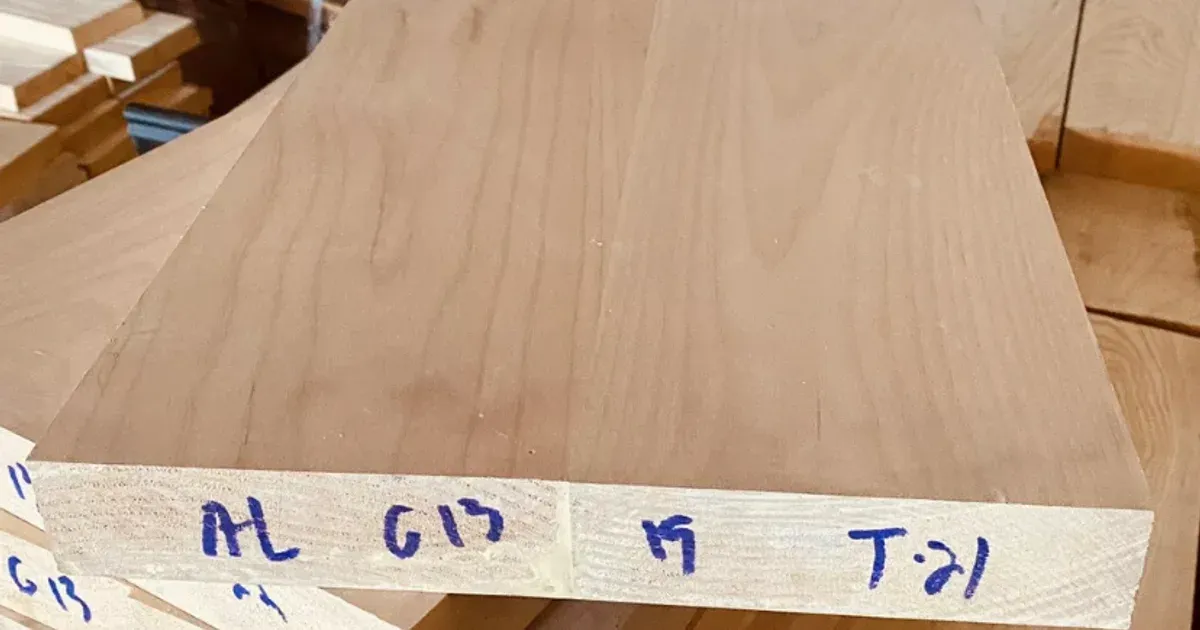
Red alder (Alnus rubra) is graded under its own Pacific Coast rule, in which boards are judged from the better face and pin knots count as character, not defects. That is the first thing to know before ordering it for cabinet doors, because it changes what a No. 1 Common board can show on its back. The primary grades are Superior, Cabinet and Frame. This guide covers how they map to the usual NHLA names, what color to expect, where alder is weak and how to write the order.
This is general information as of October 2026. The NHLA rule book governs grading, and I could not open the full Pacific Coast rule text, so the grade descriptions below come from AHEC and the Wood Database.
What red alder is
The Wood Database describes red alder as a coastal western North American species with light tan to reddish brown wood that darkens and reddens with age. The grain is generally straight, the texture moderately fine and uniform, and sapwood and heartwood look alike. Published properties:
| Property | Value |
|---|---|
| Average dried weight | 450 kg/m³ (28.0 lbs/ft³) |
| Janka hardness | 590 lbf (2,620 N) |
| Modulus of rupture | 9,800 lbf/in² (67.6 MPa) |
| Shrinkage, radial / tangential / volumetric | 4.4% / 7.3% / 12.6% |
| Decay resistance | Non-durable to perishable |
Source: Wood Database. AHEC lists nearly the same density and hardness for its American alder page.
Read this for door work. Alder is easy to machine, sand, glue and finish, and the page calls its stability good once fully dried. It is also soft: at 590 lbf it is less than half the 1,350 lbf the Wood Database gives for white oak, so doors, drawer fronts and rails dent more easily than oak or maple. The rating of non-durable to perishable means alder logs should be converted and dried quickly. If lumber was held green or air dried too long, expect stain or decay risk, so ask how fast the mill dries it. Our kiln drying guide lists the questions.
The grades
AHEC lists the primary grades under the NHLA Pacific Coast Red Alder Rules:
| Alder grade | Standard NHLA equivalent |
|---|---|
| Superior | Select and Better |
| Cabinet | No. 1 Common |
| Frame | No. 2 Common |
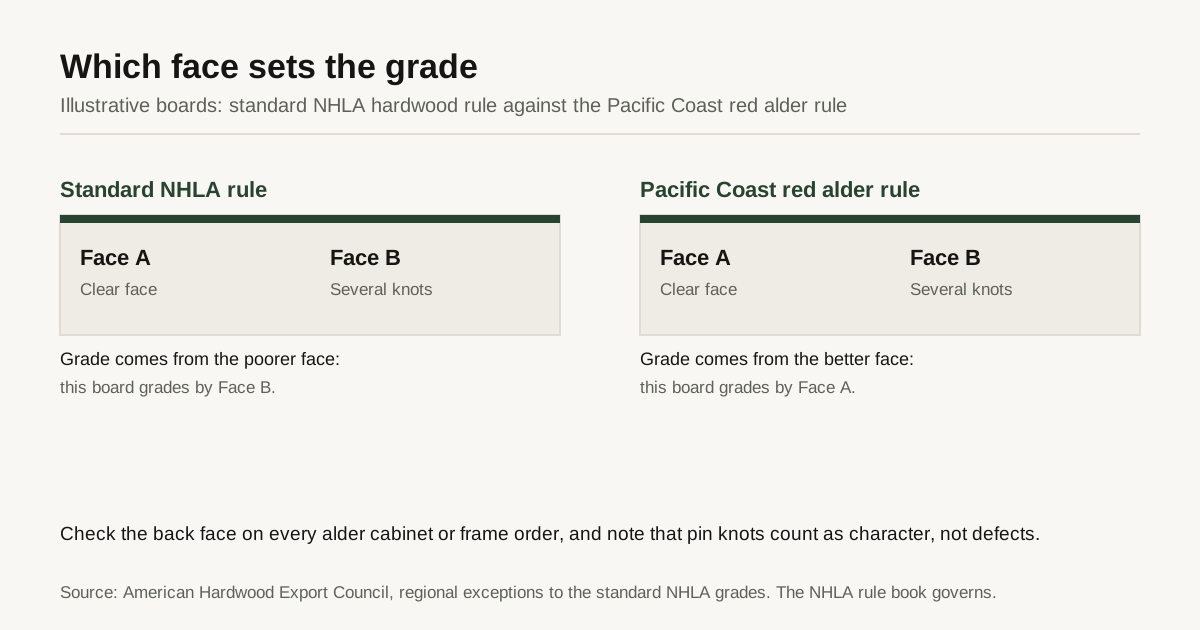
The rule differs from the standard NHLA practice in two ways, per AHEC’s page on regional exceptions. Boards are graded from the better face, not the poor side, and pin knots are treated as natural character, not defects. AHEC adds that exceptional cabinet wood is typically sold surfaced and often cut to specific lengths and widths.
Why it matters. Under the standard rule a board’s grade comes from its poorer face, so what you see on the back is at least as good as the grade. Under the alder rule the back can be worse than the grade suggests. For a cabinet door where only one face shows, that suits you. For rails, stiles with both faces visible, open shelving or exposed panels, say so and ask for both faces to meet the standard you need.
AHEC also says alder is often sold under grading rules outside the NHLA set, and tells buyers to consult suppliers. I could not open a source that lists those house grades, so I will not name them. The practical rule is to ask which system the quote follows, then get the face rule, the knot rule and the board sizes in writing. For the standard grades, our NHLA grades guide explains the cutting-unit logic.
Clear against knotty
The Wood Database notes that knotty alder is inexpensive, on par with other domestic utility woods, and that clear alder costs more, closer to domestic cabinet hardwoods. I found no standard that defines “knotty alder” or “rustic alder” as a grade, and the term describes a look. If your product is a knotty door, state the allowed knot size, count and whether knots must be sound and tight. If it is a clear door, state the clear face yield you expect.
Color: plan for change
AHEC says alder is almost white when freshly cut and turns light brown with a yellow or reddish tinge after exposure to air, and the Wood Database says it darkens and reddens with age. So a pale board from the sticker stack will not match a finished, aged door in the same job.
- Machine and finish parts that must match from one lot, and keep lots separate.
- Test a stain or clear coat on a sample from the actual lift.
- Ask whether the lumber is sold kiln dried and how fresh it is, since the color moves after sawing.
- Do not mix alder with other species in one door without a finish test. AHEC mentions alder as a possible cherry substitute, but the match depends on the stain.
Questions to ask the mill
Mills describe alder in different words, so a short call or email saves a rejected load:
- How soon after sawing is the lumber kiln dried, and to what moisture range?
- Is the quote on the Pacific Coast rule or on a house grade, and can you see the written limits?
- Does the back face have its own minimum, and how is it checked?
- Are boards sorted for color, or is the lift mixed?
- Can you send photos of boards from the actual lift with a tape measure in the frame, front and back?
A mill that grades by the Pacific Coast rule every day will answer these in a few lines. If the answers are vague, ask for a small trial lift before you commit a full truck or container.
Alder against other choices
Poplar is a common comparison for painted doors, covered in our guide to yellow poplar for paint grade millwork. Maple is harder and needs a different finish approach, see hard maple against soft maple. For a species overview by use, open the hardwood species hub. What cabinet shops ask of a vendor is covered in what cabinet shops expect from a lumber vendor.
What to write on the RFQ
- Species: red alder (Alnus rubra), from the Pacific Northwest or other stated origin.
- Grading rule and grade: NHLA Pacific Coast rule and Superior, Cabinet or Frame, or the mill’s named grade with its written limits.
- Face rule: which face is graded, and whether the back must meet a minimum.
- Knots: pin knots allowed or not, and limits for larger knots, as a count and a size.
- Thickness in quarters, surfacing (rough or S2S) and whether cut to length and width. See rough, S4S and dimension parts.
- Drying: kiln dried, with a moisture target, for example 6 to 8%, and how it is checked.
- Board feet, tally rule and delivery term. See board feet and pricing.
For delivery checks, use inspecting a hardwood delivery. To get quotes from mills and yards that carry alder and state their grade rule, send your lumber RFQ with the grade, face rule, thickness and volume. We pass it to up to 3 mills or yards that say they can supply it, and they reply to you directly.
Sources
- Wood Database, red alder (Alnus rubra)
- AHEC, American alder species page
- AHEC, regional exceptions to the standard NHLA grades
- Wood Database, white oak (Quercus alba), hardness comparison
- American Hardwood Export Council, hardwood lumber grading
Frequently asked questions
What are the grades of red alder lumber?
Under the NHLA Pacific Coast Red Alder Rules the primary grades are Superior (Select and Better), Cabinet (No. 1 Common) and Frame (No. 2 Common). Boards are graded from the better face and pin knots count as character. Many mills also sell on their own grade lists, so ask which rule the quote uses.
Is alder a hardwood good for cabinet doors?
It is a common choice. The Wood Database lists alder as straight grained, fine textured and very easy to work, with good stability once dried, and AHEC suggests it as a cherry substitute. It is soft at 590 lbf Janka, so it dents more easily than oak or maple.
Why does alder change color?
Alder is almost white when freshly cut and turns light brown with a yellow or reddish tinge after exposure, per AHEC. The Wood Database says it darkens and reddens with age. Finish parts from one lot together and test a sample under your finish.
What is knotty alder?
Knotty alder is a trade look, not a defined NHLA grade that I could find. The Wood Database notes alder sells in knotty and clear grades, with knotty inexpensive and clear priced closer to domestic cabinet hardwoods. Write the knot rule on the RFQ, with photos.
Know what you need? Send the spec.
Tell us the species, grade, thickness and board feet. We pass it to up to 3 mills or yards that carry it and reply within 24 business hours.
Send my lumber RFQ