Guides / Species
European Beech Lumber: Steamed or Unsteamed, Grades and What to Write on the Order
January 30, 2027
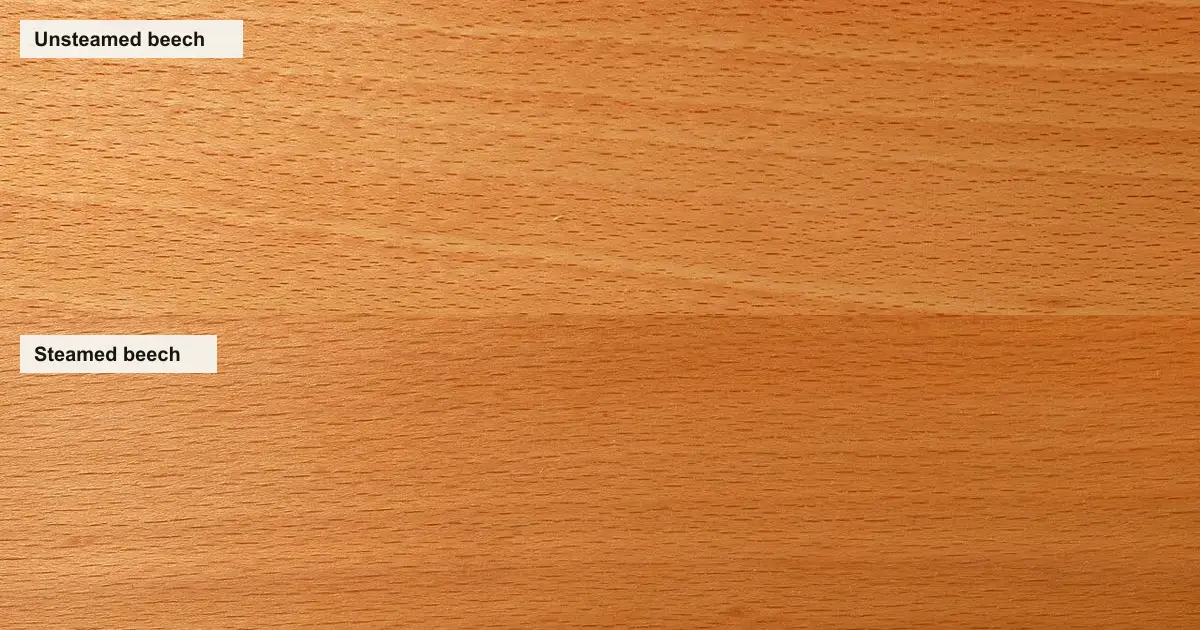
European beech (Fagus sylvatica) is sold steamed or unsteamed, and that choice changes color more than anything else on the quote. Unsteamed beech is white to pale cream and shows red heart where the tree has it. Steamed beech turns pale pink to pinkish brown and looks more even from board to board. Neither state is a grade, and I found no standard that defines how much steaming counts as light or full. Grade words such as CND are merchant terms. This guide covers what steaming does, how beech is graded, what moisture and size ranges merchants publish and what to write on the order.
This is general information as of October 2026. I could not open the beech limits of the European standard EN 975-1, which is sold by national standards bodies, so the grade terms below come from merchant pages and should be confirmed in writing with the supplier.
What European beech is
The Wood Database describes European beech as a pale straw wood, sometimes with a pink or brown hue, that machines, glues, finishes and turns well and takes steam bending superbly. Published properties:
| Property | Value |
|---|---|
| Average dried weight | 710 kg/m³ (44.3 lbs/ft³) |
| Janka hardness | 1,450 lbf (6,460 N) |
| Modulus of rupture | 15,970 lbf/in² (110.1 MPa) |
| Shrinkage, radial / tangential / volumetric | 5.8% / 11.7% / 17.9% |
| Tangential to radial ratio | 2.0 |
| Decay resistance | Non-durable or perishable |
Source: Wood Database, single published values for one species.
Two lines matter for a buyer. The first is movement. The Wood Database says beech has a large amount of movement in service, and a tangential to radial ratio of 2.0 means a flat sawn board changes width roughly twice as much as a quartered one for the same moisture change. See plain sawn against quarter sawn lumber if your parts are wide. The second is the health note: the Wood Database lists beech as a sensitizer that can irritate the eyes, skin and airways, so dust extraction matters in the plant.
What steaming does
Merchants give two reasons for steaming beech: stress and color. Duffield Timber says steaming is used to relieve drying stresses and that the wood turns pale pinkish as a result. A Dutch merchant, Total Timber, says steaming in special chambers reduces the internal tension that makes beech prone to warping, warms the color slightly and cuts the color contrast between wide planks. Both are merchant statements, and I found no test data that measures the warp benefit.
The color effect has a research basis. A 2009 paper in the journal Drewno by Tolvaj and co-authors steamed beech at 80 to 120°C and found that every temperature reduced the color difference between white wood and red heartwood. Most of the change came in the first 12 hours, and the best homogenizing time was 0.5 to 2 days depending on temperature. Starting moisture made no difference above the fiber saturation point, wood that started dry changed less, and the authors advised against steaming dry timber below 100°C. I read only the abstract, as the full text is restricted. The practical question for the supplier is when in the process the steaming happens.
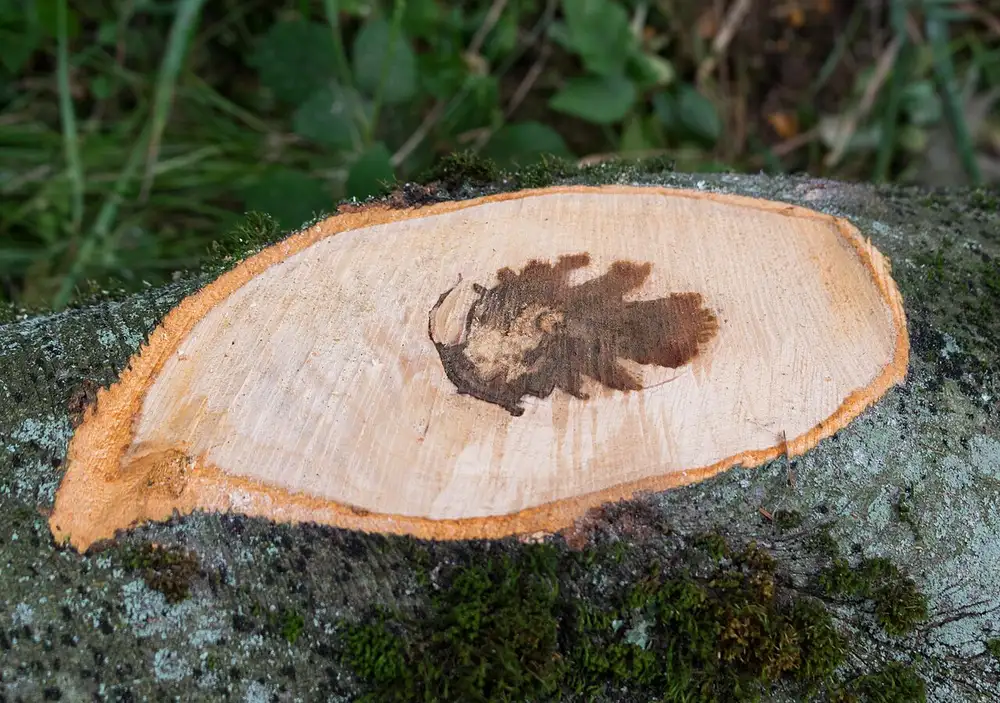
Red heart is the reason
Some beech trees have a reddish core. A European research project on red heartwood, INNOVATION FOR BEECH, notes that most buyers link beech with its white color, so discolored timber loses market value mainly for looks. It developed steaming, drying and ultraviolet treatments to make color more uniform. It also found that color variation is the main barrier to selling red heartwood furniture. Steaming narrows the gap, it does not erase it, so if you need pale white beech, ask for unsteamed boards and write the red heart rule.
| Unsteamed | Steamed | |
|---|---|---|
| Color as merchants describe it | White to pale cream | Pale pinkish, sometimes a pale pinkish brown |
| Red heart | Stands out as a darker patch | Contrast reduced |
| Stress and warp | No steaming claim | Merchants say tension is reduced |
| What to ask | How red heart is sorted | Degree of steaming and when it was done |
How beech is graded
The European standard EN 975-1 covers beech. The BSI listing says it applies to un-edged boards, including selected pieces and boules, to square edged timber and strips and to prepared, dried timber, with characteristics assessed at the time of grading. I could not open the beech classes, so I will not state their limits or assume they follow the oak codes in our European oak grades guide.
In practice the quotes use merchant terms:
- CND, Colour No Defect. Total Timber describes it as a strict selection for wide sections free of knots or other visual imperfections, and says color variation is of secondary importance for solid finishes. So a CND board can still differ in color from its neighbor.
- A/CND. Duffield lists its steamed beech under this label.
- Superior. One merchant lists this as its grade reference with no definition on the page.
None of these pages gives numeric knot or split limits. Ask for the limits in writing: knot size and count, whether red heart is allowed and how much, the color band, splits and checks, wane on un-edged boards and the minimum width.
Sizes and moisture merchants publish
The ranges below are from three merchant pages and are directional. They show how far offers differ, not a market norm.
| Item | Total Timber | Anyone Wood | Duffield |
|---|---|---|---|
| Thickness | 27, 34, 41, 47, 52, 65 and 80 mm | Not stated | Not stated |
| Width | Falling or fixed widths | 100 to 250 mm | Not stated |
| Length | 900 to 5,000 mm | 1.8 to 4.2 m | 2.15 to 3.50 m |
| Kiln dried moisture | 8 to 12% in the text, 10 to 12% in the spec box | 12 to 18% | Not stated |
The moisture spread is the useful part. Offers run from 8% to 18%, and one page contradicts itself. That is a reason to name a number, the measuring method and a tolerance on the order, as in our kiln dried against air dried guide, and to check boards on arrival, see inspecting a hardwood delivery. Thicknesses are in millimeters, so convert them before you compare with a quarter-inch quote, using board feet and pricing.
Where beech fits
The Wood Database lists lumber, veneer, flooring, furniture, cabinetry, musical instruments, plywood and turned objects as common uses, and says beech is very economically priced within its natural range in Europe. I found no public price index for sawn beech, and the merchant pages I read say price on application, so compare written quotes on the same grade and moisture. Beech is non-durable, so it is an interior species unless it is treated. If you are choosing between pale species for furniture parts, the hard maple against soft maple guide covers the main alternative, and the hardwood species hub lists the rest.
Paperwork depends on where the wood goes. For the usual records, see Lacey Act, FSC and legal timber papers and the EUDR guide for hardwood lumber. This is not legal advice.
What to write on the RFQ
- Species: European beech, Fagus sylvatica, and the country of origin.
- Steaming: unsteamed, lightly steamed or fully steamed, as the supplier defines it, and whether the steaming was done before drying.
- Grade: the EN 975-1 class if the supplier uses it, or the merchant term with its written limits for knots, red heart, color, splits and wane.
- Product: un-edged or square edged, thickness in millimeters, width and length ranges, fixed or falling widths.
- Drying: kiln dried to a stated moisture range and how it is measured.
- Quantity in cubic meters or board feet, and which rule counts it. See tally rules.
- Photos of boards from the actual lot, front and back, with a tape measure in the frame.
The RFQ checklist covers the other order lines. To get quotes that state the steaming and grade rules up front, send your lumber RFQ with the thickness, moisture target and volume. We pass it to up to 3 mills or yards that say they can supply it, and they reply to you directly.
Sources
- Wood Database, European beech (Fagus sylvatica)
- BSI, BS EN 975-1:2009 Sawn timber. Appearance grading of hardwoods. Oak and beech
- Tolvaj and others, Colour homogenisation of beech wood by steam treatment, Drewno 52 (181), 2009 (abstract)
- CORDIS, INNOVATION FOR BEECH, project 508137
- Total Timber, slightly steamed beech CND quality (merchant page, directional)
- Duffield Timber, European steamed beech sawn timber (merchant page, directional)
- Anyone Wood, steamed beech specification (merchant page, directional)
Frequently asked questions
What is steamed beech lumber?
Steamed beech is European beech (Fagus sylvatica) that has been treated with steam in a chamber, usually before drying. Merchants say it reduces drying stress and evens out color, turning white to cream wood pale pink. The degree of steaming varies, and I found no standard that defines light or full steaming.
What does CND mean on beech lumber?
CND stands for Colour No Defect. One Dutch merchant describes it as a strict selection of wide sections free of knots and other visual imperfections, with color variation of secondary importance. It is a merchant term, not a standard grade, and the page gives no numeric limits, so ask for the written rule.
Is steamed beech more stable than unsteamed beech?
Suppliers say steaming reduces the internal tension that makes beech warp, but I found no test data. The Wood Database warns that beech moves a large amount in service whatever the treatment, with tangential shrinkage twice the radial. Design for movement and ask for a sample from the lot.
What moisture content should European beech lumber have?
Merchants publish anything from 8% to 18%, and one page gives two different ranges. There is no single figure to quote. Choose the target from the end use and humidity of the plant, write it on the order with the measuring method, and check a sample of boards on arrival.
Know what you need? Send the spec.
Tell us the species, grade, thickness and board feet. We pass it to up to 3 mills or yards that carry it and reply within 24 business hours.
Send my lumber RFQ