Guides / Grades and Specs
Plain Sawn, Quarter Sawn and Rift Sawn Hardwood: What to Specify
November 23, 2026
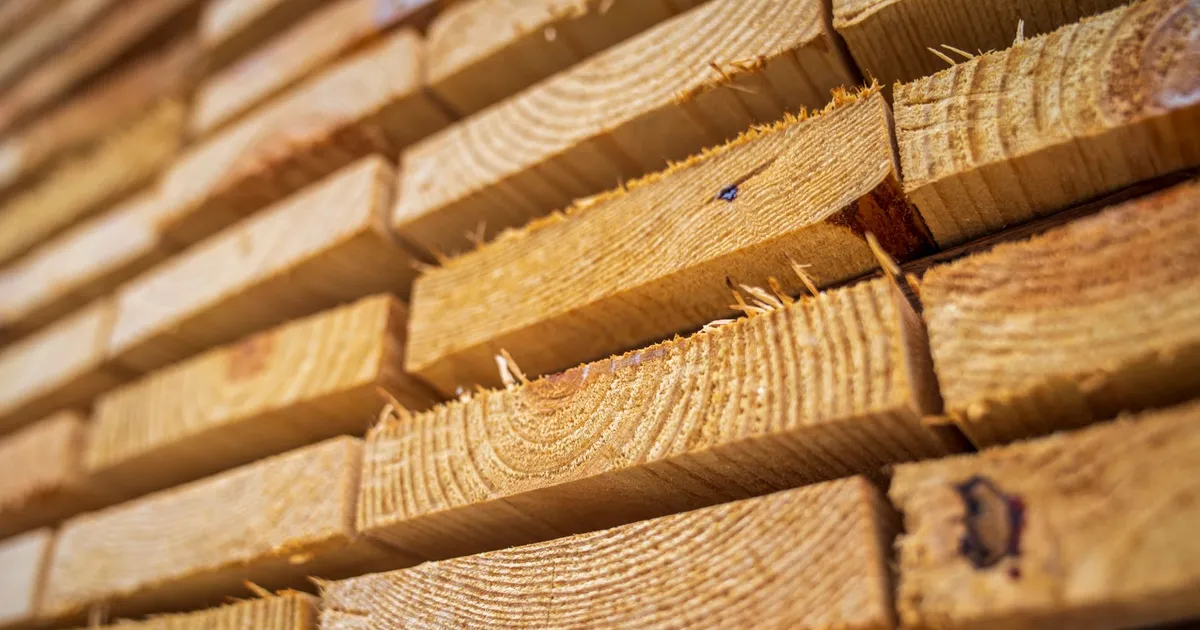
Two boards of white oak can have the same grade, the same thickness and the same moisture content, and still look and behave very differently. The reason is how the log was sawn. Plain sawn, quarter sawn and rift sawn lumber come from the same tree, but the angle between the growth rings and the face of the board changes the grain, the movement and the price.
Buyers who order only “white oak FAS” leave this choice to the supplier, and the supplier will ship plain sawn because it is the cheapest to produce. This guide explains the three patterns in plain terms and shows how to write the sawing pattern on an RFQ so the load matches your parts.
How the angle of the growth rings changes the board
Each year a tree adds a ring of wood. When a sawyer cuts a log into boards, the saw passes through those rings at different angles depending on where the cut falls. The angle at the end of the board, measured between the rings and the wide face, defines the pattern.
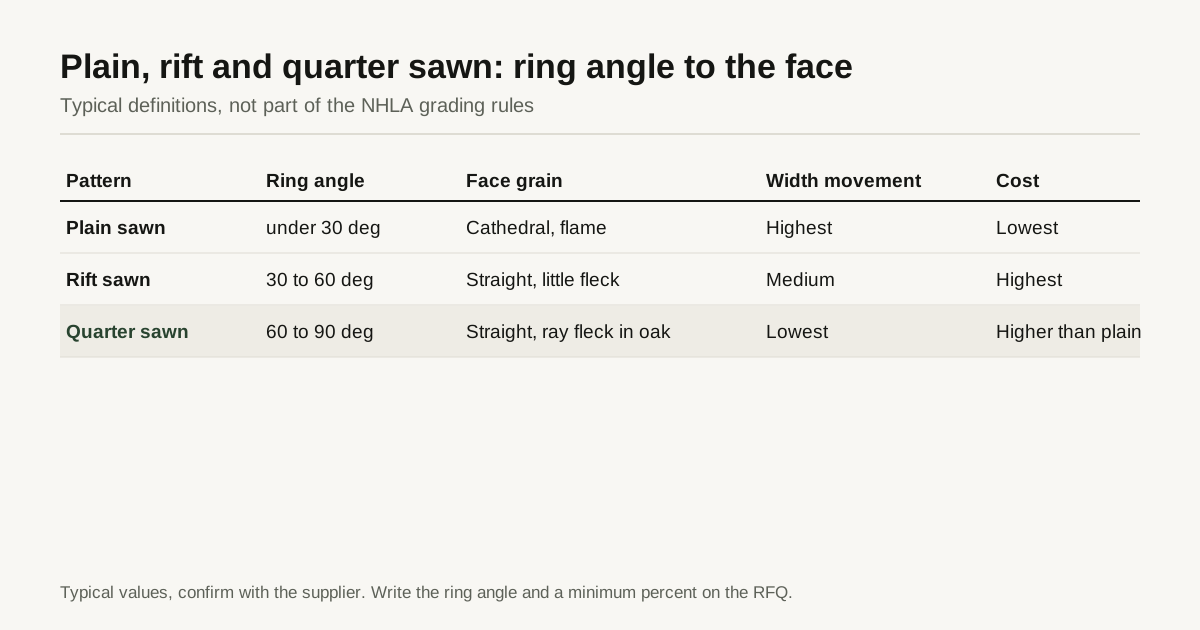
- Plain sawn (also called flat sawn): rings run at less than about 30 degrees to the face. Most boards from a log are cut this way.
- Rift sawn: rings run at roughly 30 to 60 degrees to the face.
- Quarter sawn: rings run at roughly 60 to 90 degrees to the face, so the ring lines look nearly vertical when you view the end of the board.
These angle ranges are common definitions. They are not part of the NHLA grading rules, so different mills draw the line in slightly different places. That is why it helps to write the angle on the RFQ instead of only the name.
What each pattern looks like
Plain sawn shows the cathedral or flame figure that most people picture in hardwood: long arches and ovals running along the face. The pattern is bold and varies a lot from board to board.
Quarter sawn shows straight, close lines on the face. In oak and a few other species the saw also cuts across the medullary rays, which show as bright flecks or ribbons. White oak has large ray fleck that is a design feature in Arts and Crafts furniture. Red oak has smaller rays. In maple and other species with fine rays, quarter sawn boards look plain and straight.
Rift sawn shows straight, even lines on both faces with little or no ray fleck. It is the pattern that looks calmest, which is why it is common in modern cabinet doors, stile and rail parts and some flooring.
Movement and stability
Wood shrinks and swells mostly across the grain, and it does so at different rates in different directions. Shrinkage along the growth rings (tangential) is roughly twice the shrinkage across them (radial) in most species. Typical green-to-dry figures from the USDA Wood Handbook are:
| Species | Radial shrinkage | Tangential shrinkage |
|---|---|---|
| Red oak | about 4.0% | about 8.6% |
| White oak | about 5.6% | about 10.5% |
| Hard maple | about 4.8% | about 9.9% |
Plain sawn boards have their wide face in the tangential direction, so they move the most in width as humidity changes and are more likely to cup. Quarter sawn boards have their wide face in the radial direction, so they move roughly half as much across the width, and they cup far less. Rift sawn boards fall in the middle, with the extra benefit of staying visually consistent as they move.
This is why quarter and rift sawn stock is used for flooring in rooms with changing humidity, for wide table tops, for door stiles and rails, and for parts that must stay flat after machining. Shrinkage figures here are typical values for whole species. The behavior of one board depends on its drying history and on its own grain.
Wear and finish
Quarter sawn faces wear evenly, because the growth rings do not flake off in layers the way a plain sawn face can. Quarter sawn boards also take stain evenly and are less prone to surface raising.
Yield and price
Producing quarter and rift sawn lumber takes more handling and creates more waste. The sawyer turns the log several times to expose the right angle, and the pieces that come off are narrower and shorter. Mills usually get fewer boards, and fewer wide boards, from the same log.
That is why the price differs. A typical pattern in oak is that quarter sawn costs noticeably more than plain sawn, often 30 percent or more, and rift sawn costs more again because it has the lowest yield and the narrowest boards. The gap changes with species, grade, thickness and the season, so quote it by item and do not assume a flat premium.
Another effect: width. Quartered and rift boards from most mills run narrower than plain sawn, because the log has to be larger to give wide boards at the right angle. If your parts need 7 in widths, ask what widths the mill actually has before you commit.
| Pattern | Ring angle (typical) | Look | Stability | Relative cost |
|---|---|---|---|---|
| Plain sawn | under about 30 degrees | Cathedral and flame figure | Moves most in width | Lowest |
| Rift sawn | about 30 to 60 degrees | Straight lines, little fleck | Good | Highest |
| Quarter sawn | about 60 to 90 degrees | Straight lines, ray fleck in oak | Best | Higher than plain |
How mills sell quartered and rift stock
Most boards from a log do not fall neatly into one pattern. A single board often has quartered grain on one side and rift or plain grain on the other, so mills sort and sell in several ways:
- Quartered and rift together. The most common combination, sold as “rift and quartered” or R&Q. It makes sense when your parts only need straight grain.
- Quarter sawn only. Sold in a tighter sort, often with a minimum percentage of boards that show fleck.
- Rift only. A rare sort in thin quantities and usually the most expensive. Suppliers often need time to collect enough.
- Mixed. Plain sawn with some quartered boards allowed. This is cheaper but gives you less control over appearance.
Some mills describe the sort by percentage, such as 80 percent of boards with rings at 45 degrees or more. Others describe it by the face. Ask which method the mill uses and whether the percentage applies to both faces or just the better one.
How to write it on the RFQ
A short, clear line saves most of the confusion. Include:
- The pattern name: quarter sawn, rift sawn, or rift and quartered
- The face rule: both faces, or better face only
- The minimum percent of boards that meet the rule, for example 80 percent
- The ring angle you consider acceptable, such as 45 degrees or greater
- Grade, thickness and widths, because quartered stock is limited in width
- Fleck rules, for example “no fleck required” for rift cabinet stock or “visible fleck on face” for furniture
You can also ask for photos of the ends of several lifts with a tape measure in the frame. The end of a board shows the ring angle at a glance, and a quick photo is the easiest way to check what a supplier means.
Choosing between them
Use plain sawn when you want the most economical lumber, bold figure is fine, and parts are narrow or glued up. It is the right choice for most painted work, hidden parts and general shop stock.
Use quarter sawn when parts must stay flat, when fleck is part of the look, or when wear matters, as in flooring, table tops and doors.
Use rift sawn when you want straight grain on both faces without fleck, for modern cabinet doors and stiles and for parts where a consistent look matters more than the lowest price.
Consider mixing patterns inside a project. Stiles and rails in rift or quarter sawn stock with plain sawn panels are common and save money, because most of the visible stability problems sit in the long narrow frame parts.
Closing checklist
- Decide for each part whether stability, look or price matters most
- Name the pattern and the ring-angle rule on the RFQ
- Set a minimum percent of boards that meet the rule
- Check available widths before ordering
- Ask for end photos with a tape measure, and check the load on arrival
Cut is one field in a spec; the guide to hardwood lumber specifications shows the others.
The grading rules in our guide to NHLA grades work together with the sawing pattern, because the grade tells you about clear cuttings and the pattern tells you about grain direction. For a first order, send your lumber RFQ with the pattern and percent rule written out. We pass it to up to 3 mills or yards that carry the item and they reply directly.
Frequently asked questions
Is quarter sawn lumber always more stable than plain sawn?
In general yes. Boards cut with the growth rings near vertical to the face shrink and swell much less across the width than boards cut with the rings near flat. The gain is real but it is not a guarantee against movement, so moisture content and storage still matter.
What is the difference between quartered and rift sawn?
Quarter sawn boards have growth rings at roughly 60 to 90 degrees to the face and show ray fleck in oak. Rift sawn boards have rings at roughly 30 to 60 degrees, giving straight lines on both faces with little or no fleck. Mills often sell the two together as rift and quartered.
Do NHLA grades say anything about sawing pattern?
No. The grade measures clear cuttings, not how the log was sawn. If you need quartered or rift stock you must say so on the RFQ, along with a minimum percentage of boards that meet your ring-angle rule.
Know what you need? Send the spec.
Tell us the species, grade, thickness and board feet. We pass it to up to 3 mills or yards that carry it and reply within 24 business hours.
Send my lumber RFQ