Home / Hardwood species / Hard Maple Lumber: White Sorts, Grades and Hardness
Hard Maple Lumber: White Sorts, Grades and Hardness
Reference page · Last reviewed 13 April 2027
Hard maple lumber is the sawn wood of sugar maple and black maple. It is the hardest of the common North American cabinet woods, with a fine, even texture and a white sapwood band that buyers often pay to select. It is graded under the standard NHLA rules, then sorted for color by most mills, and it is regularly sawn in 4/4 to 8/4.
| Item | Typical for hard maple lumber |
|---|---|
| Species | Sugar maple (Acer saccharum), black maple (Acer nigrum) |
| Sapwood | White with a slight reddish tinge, usually 3 to 5 in wide |
| Heartwood | Light reddish brown, sometimes much darker |
| Side hardness (Janka) | about 1,450 lbf at 12% moisture (sugar maple) |
| Specific gravity | 0.56 green, 0.63 at 12% moisture |
| Shrinkage, green to oven dry | radial 4.8%, tangential 9.9%, volume 14.7% |
| Heartwood decay resistance | Slightly or not resistant (maples group) |
| Common thicknesses | 4/4, 5/4, 6/4, 8/4. Thicker stock limited |
| Average board size | 5 to 8 in wide, 6 to 16 ft long |
| Grades | Standard NHLA grades, plus mill color sorts |
| US tariff line | 4407.93 (maple), statistical line for hard maple |
Figures are typical for the species from the USDA Wood Handbook and the NHLA species guide, not guarantees for a lot. The NHLA rulebook governs grades. Color sort names vary by mill.
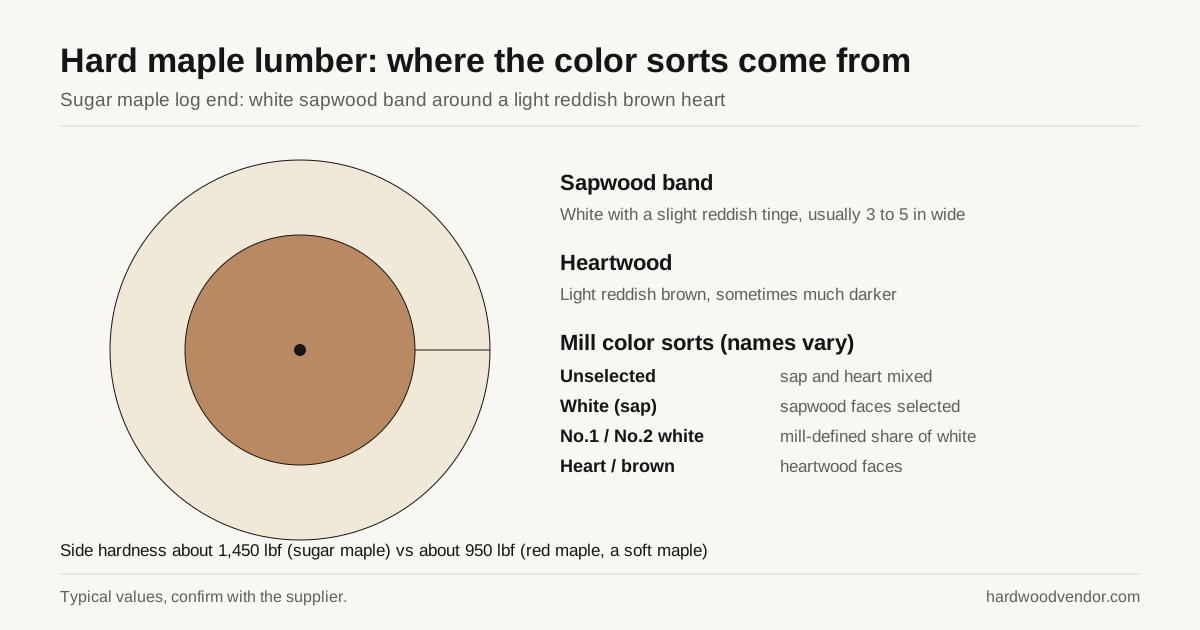
Hard maple and soft maple
The trade name “hard maple” covers sugar maple and black maple. Everything else sold as maple is soft maple: red maple, silver maple, boxelder and bigleaf maple. The two groups look alike as boards, but they behave differently.
| Property | Hard maple (sugar) | Soft maple (red) |
|---|---|---|
| Side hardness at 12% | about 1,450 lbf | about 950 lbf |
| Specific gravity at 12% | 0.63 | 0.54 |
| Modulus of rupture at 12% | about 15,800 psi | about 13,400 psi |
| Tangential shrinkage | 9.9% | 8.2% |
| US tariff statistical line | Hard maple | Other maple |
Values from the Wood Handbook tables for clear wood. Hard maple is the one for floors, work tops and parts that take impact. Soft maple machines, stains and nails more easily and is usually cheaper, so it suits painted cabinets and furniture frames. The full comparison is in our guide to hard maple vs soft maple.
The NHLA species guide gives US hard maple growing stock as 953.7 million cubic meters, about 6.6% of all US hardwood growing stock. The Wood Handbook notes that the Middle Atlantic and Great Lake States account for about two-thirds of maple lumber production.
Grades and color sorts
Hard maple is graded first, then sorted for color. The grade sets the clear yield. The color sort sets how much white sapwood or darker heartwood is on the face.
| Layer | Examples | Who defines it |
|---|---|---|
| NHLA grade | FAS, F1F, Selects, No.1 Common, No.2A Common | NHLA rulebook |
| Color sort | Unselected, white (sap), No.1 white, No.2 white, heart, brown | The mill, in its price list |
| Extra specs | Mineral limit, minimum width, length range, stain-free faces | The buyer, on the order |
The NHLA guide says white sapwood can be selected in hard maple lumber. Mill sort names are not standard. One mill’s “No.1 white” may mean one face fully white, another’s may mean both faces at least mostly white. Before you compare prices, ask each supplier how its sort is defined and how it is checked at grading.
For the grade rules themselves, see the FAS grade page and the lumber grades hub.
Mineral, stain and other features to specify
Hard maple faces are pale, so small marks show. Four features cause most disputes:
- Mineral streak. Dark gray to greenish streaks in the wood. Admitted in standard grades within limits. Write a mineral rule if your finish is natural.
- Sticker stain. Gray bands where the drying stickers touched the boards. It can lie under the surface and appear after planing. Our guide to sticker stain in lumber explains causes and checks.
- Enzymatic gray stain. Gray discoloration that can develop during slow air drying of white sapwood. Mills that sell white maple usually kiln dry quickly from green to avoid it.
- Figure. Curly, birdseye or fiddleback grain is selected and priced separately. It is not part of a standard grade.
Hardness and the uses it opens
Hardness and fine texture are why hard maple goes where it goes:
| Use | Grade and sort usually quoted | Why hard maple |
|---|---|---|
| Butcher block and work tops | FAS or No.1 Common, white or unselected, 5/4 to 8/4 | Hard, close grained, takes wear |
| Sports and dance floors, bowling lanes | Flooring grades from hard maple | Hardness and even wear |
| Cabinet doors and boxes | No.1 Common and F1F, white | Pale color under clear finish |
| Furniture | FAS and No.1 Common | Strength in thin parts |
| Cutting boards, handles, turnings | Thick stock, short lengths | Fine texture |
For edge-glued tops, see our guide to butcher block and countertop lumber, which covers strip widths, moisture and glue lines.
Drying and moisture
Hard maple has high shrinkage, 9.9% tangential from green to oven dry, so moisture content at delivery matters for flat panels and tight joints. For interior use in North America the usual target is 6 to 8%. Ask for a moisture reading at loading and let the stock reach shop conditions before machining. Our kiln drying schedules guide covers how maple is usually dried.
Weight from the Wood Handbook figures: hard maple at 12% moisture is near 44 lb per cubic foot, or a little under 4 lb per board foot. Use the supplier’s own weight for freight.
What to write on the RFQ
Name the species group, grade and rulebook, color sort with its definition, mineral rule, thickness, surfacing, drying, minimum width, length range, board feet and paperwork. Our hardwood lumber specifications guide explains every field.
RFQ line: Hard maple (Acer saccharum), No.1 Common and Better, NHLA rules (edition named), white one face (sap), light mineral allowed on back only, 6/4 rough, KD 6-8%, 4 in and wider, 8-12 ft, 2,500 BF.
Send it through our lumber RFQ form and we pass it to up to 3 mills or yards that sort hard maple the way you need. Other species are on the hardwood species hub.
Frequently asked questions
What does white hard maple mean?
It is a color sort, not an NHLA grade. White maple is lumber selected for sapwood color, with little or no heartwood on the face. Mills use names such as unselected, white, No.1 white and No.2 white, and the definitions differ by mill. Write the rule you need in measurable words, for example sap one face or the percentage of the face that must be white.
How hard is hard maple compared with soft maple?
The Wood Handbook gives sugar maple a side hardness of about 1,450 lbf at 12% moisture and red maple, the main soft maple, about 950 lbf. Hard maple is the choice for floors, work surfaces and butcher block. Soft maple is easier to machine and costs less.
Is mineral streak a defect in hard maple?
In most standard grades mineral streak is a natural characteristic that is admitted within limits, but it often matters to buyers who want clear white faces. If your product shows a natural or white finish, put a mineral rule on the order and check it on a sample.
What thicknesses of hard maple are available?
The NHLA species guide says hard maple is regularly produced in 4/4 through 8/4 and is limited as thicker stock. Thick blanks for butcher block or turning are a special order.
Sources
- NHLA species guide: hard maple (availability, white sapwood selection, thicknesses, sizes, growing stock)
- USDA Forest Products Laboratory: Wood Handbook, FPL-GTR-190 (2010), hard and soft maple groups, Tables 4-3, 5-3b and 14-1
- American Hardwood Export Council: NHLA grades
- US International Trade Commission: Harmonized Tariff Schedule, 4407.93 (maple, hard maple statistical line)
Standards and rules are cited as references, not as claims about Hardwood Vendor or any mill. Editions and status change: confirm with the issuing body, your customs broker or the regulator.
Know what you need? Send the spec.
Tell us the species, grade, thickness and board feet. We pass it to up to 3 mills or yards that carry it and reply within 24 business hours.
Send my lumber RFQ