Guides / Species
Hardwood Lumber for Butcher Block and Countertop Plants: Species, Grade and Moisture
October 8, 2026
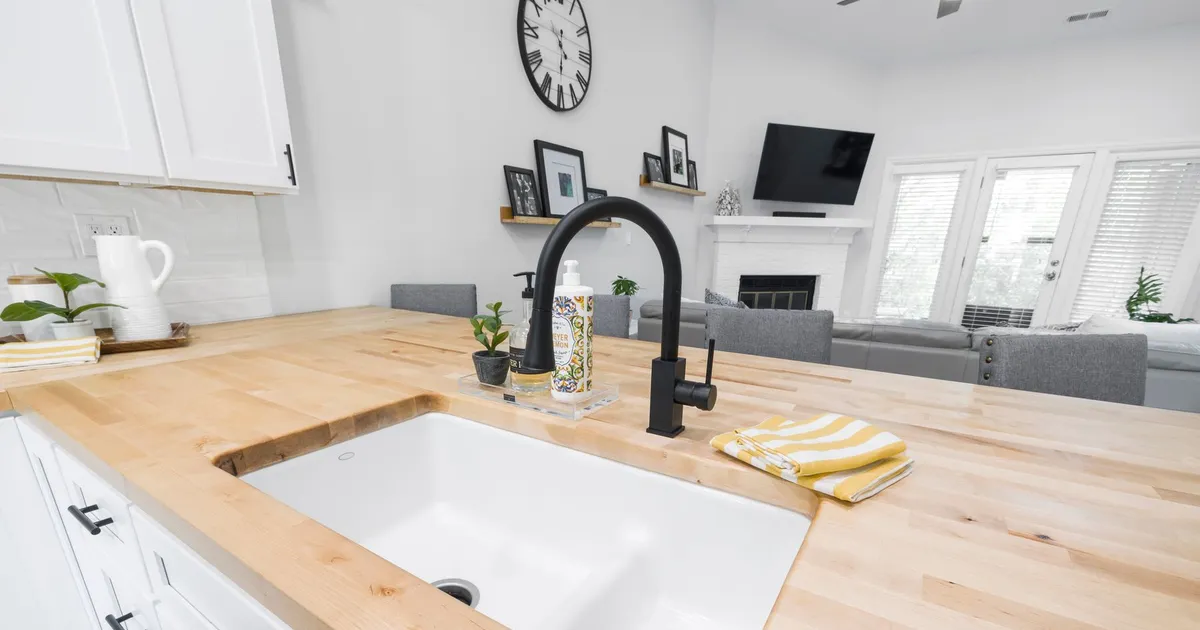
A butcher block or wood countertop plant turns lumber into thick, flat, glued panels. The product looks simple, but it is one of the most demanding uses of hardwood. Every strip must be dry to the same moisture content, straight to a tight tolerance and close in color to its neighbors. A weak spot in the lumber shows up as an open glue line, a warped top or a color mismatch after the customer has installed the counter.
This guide covers the species used in butcher block and countertops, the grade and strip specifications that work for plants, moisture and length needs, yield and what to write on an RFQ.
Construction types and what they need from lumber
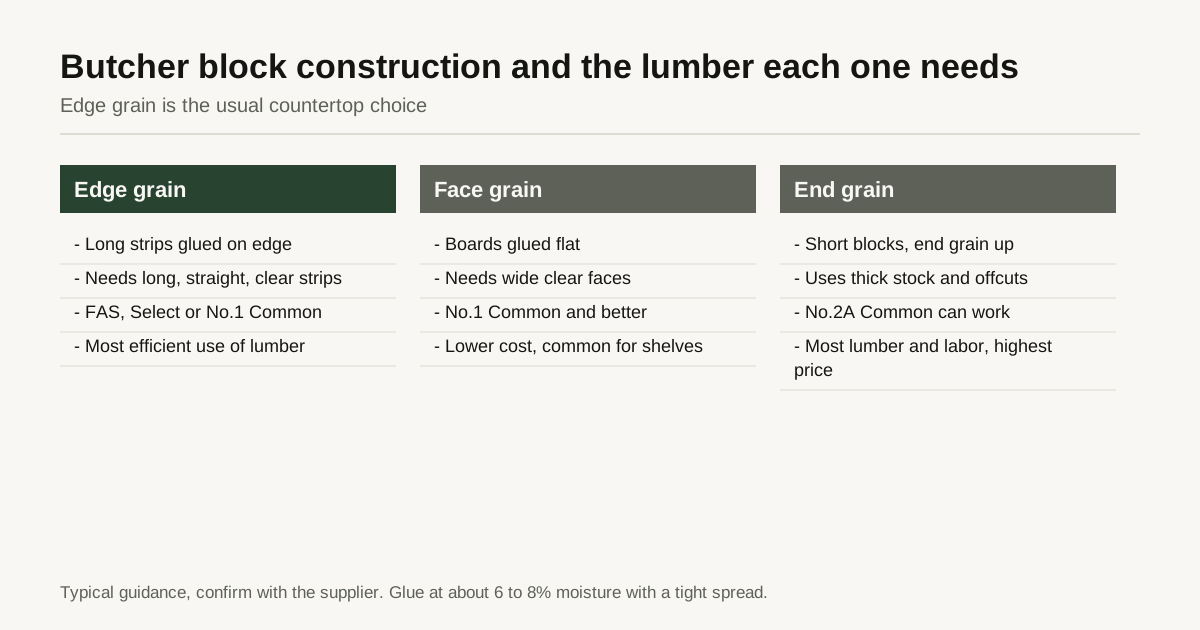
- Edge grain. Long strips are turned on edge and glued side by side, so the top shows the narrow edge of each strip. This is the standard for countertops. It uses long, straight, clear strips and is the most efficient in lumber.
- Face grain. Boards are glued flat, so the top shows the wide face. Cheaper and often used for panels and shelves.
- End grain. Short blocks are glued with the end grain up. It is strong and gentle on knives, but needs more lumber and more labor, and it is the highest priced.
- Finger-jointed or full length. Long tops can be made from full-length strips or from shorter pieces joined end to end with finger joints. Full-length strips cost more and are limited by log length.
Edge grain and face grain plants buy mostly lumber that has been ripped into strips. End grain plants buy more thick stock and use offcuts.
Species
| Species | Janka hardness (typical) | Color | Notes for countertops |
|---|---|---|---|
| Hard maple | about 1,450 lbf | Pale cream | The standard, tight grain, hard-wearing, stains blotchy if colored |
| White oak | about 1,360 lbf | Light to medium brown | Popular for a natural look, open pores, stable in rift sawn |
| Black walnut | about 1,010 lbf | Dark brown | Premium look, softer, steamed or unsteamed sorts matter |
| Cherry | about 950 lbf | Reddish brown, darkens with light | Soft, scratches, good color change over time |
| Birch | about 1,260 lbf | Pale yellow to light brown | A lower-cost alternative to maple |
| Beech | about 1,300 lbf | Pale pink-brown | Tight grain, common in European butcher block |
| Rubberwood | about 980 lbf | Pale cream | Low cost, treated with boron, see the guide to plantation woods |
Figures are typical values. Our guides to hard maple vs soft maple, steamed vs unsteamed walnut and rubberwood and acacia cover some of these species in more detail.
Choosing a species
- Maple is the first choice for a classic, light butcher block, and it sets the benchmark price in many markets.
- Oak suits kitchens with a warmer, more rustic look.
- Walnut suits premium islands and tops. Steamed walnut blends the sapwood, so more of each board is usable.
- Cherry gives a warm color, though it is soft.
- Birch and beech give a lower cost option with a light look.
- Mixed species can be glued in patterns, such as stripes of maple, walnut and cherry, but the strips must have the same moisture and similar movement.
What the strips need
Plants buy lumber in the form that suits their process. Typical requirements:
- Straight, clean strips. Warp and bow in the lumber cause gaps when strips are glued. Ripped strips need straight edges, and surfaced stock needs even thickness. See our guide to straight line rip and gang rip.
- Clear faces. No knots, no pin holes and no bark pockets on the surfaces that show. Small defects are cut out, and the yield suffers.
- Color consistency. Sort by color before gluing. With maple, many plants specify a white or select sort to avoid dark heartwood streaks.
- Matched grain pattern. Edge grain tops look best when the strips are similar in grain angle. Quarter sawn or rift sawn stock gives a more even edge, and plain sawn stock turned on edge gives a quartered-looking face.
- Consistent thickness and width. After ripping and planing, thickness and width tolerances of a few hundredths of an inch are typical. State the tolerance you need.
Grades
The NHLA grade determines the clear cutting yield, and countertop plants often want shorter clear pieces than furniture plants:
- FAS and Select. Long, clear boards that give a high yield of long strips. Used when full-length strips are needed.
- No.1 Common. Shorter clear pieces, often a good fit for finger-jointed tops and edge grain strips, at a lower cost per usable strip.
- No.2A Common. Very short clear pieces. Suited to end grain blocks or hidden parts, where more cutting is acceptable.
Our guide to NHLA grades explains the yield figures. The best grade depends on the strip length your product needs, so run a cut list through each grade before choosing.
A rough rule: edge grain tops with full-length strips use FAS and Select, finger-jointed tops use No.1 Common and better, and end grain blocks can use No.2A Common.
Moisture is the critical spec
Moisture content matters more here than in almost any other application. A countertop is a large flat panel with glue lines every inch or two, and any difference in moisture between strips becomes stress at the glue lines.
- Target range. Most plants glue at about 6 to 8 percent.
- Spread. Ask for a tight spread, often within 1 percentage point between strips, and a limit on any single strip.
- Equalizing. Lumber that has a wide moisture range should be equalized and conditioned in the plant before ripping.
- Stress. Ripping releases drying stress, and strips can bow. Ask for stress-relieved lumber. See the kiln drying guide.
- Storage. Dry lumber picks up moisture in a damp shop. Store strips in a controlled area before gluing.
Check moisture on arrival, using the method in our moisture meter guide, and record the readings by lot.
Lengths, thickness and yield
- Lengths. Countertops come in standard lengths, often 6, 8, 10 or 12 ft. Full-length strips need boards at least as long as the top plus trim, and long clear boards are in short supply and cost a premium. Many plants use finger joints to make long tops from shorter strips.
- Thickness. Finished countertop thickness is often 1 1/2 in, with 1 3/4 in and thicker used for heavy-duty or special designs. A 1 1/2 in finished strip normally comes from 6/4 or 8/4 rough stock, depending on the allowance for planing and truing.
- Yield. From rough lumber to finished strips, a plant often keeps about half of the volume, sometimes more with high grades, and less with strict color and clear rules. Use your own yield figure to compare quotes, because the cheapest board foot is not always the cheapest finished strip.
Glue and finishing
The plant chooses glue and finish, but the lumber has to suit them. Water-resistant, food-contact rated adhesives are common in the trade, and some oily woods need special surface preparation. Oily woods and very resinous species can resist glue, so test a bond before committing to a new species. Common finishes include mineral oil, hardwax oil and film finishes, depending on the customer’s use. Lumber with different surface preparation, for example sanded versus planed, may take the same finish differently.
Common problems and their causes
| Problem | Typical cause in the lumber |
|---|---|
| Open glue lines after a few weeks | Moisture spread between strips, or strips that were not conditioned |
| Top cups or bows | Plain sawn strips with uneven moisture, or stress released at the rip |
| Visible color stripes | Mixed heartwood and sapwood strips with no sort |
| Dark spots in the finish | Mineral streaks, pin holes or sticker stain in the boards |
| Strips that do not close tight | Bow and crook in the lumber, or poor ripped edges |
Most of these trace back to the specification, not to a defect the mill could not have avoided. A clear moisture range, a straightness rule and a color sort remove most of the risk.
Questions for the supplier
- What moisture range is the lumber dried to, and how tight is the spread inside a lift?
- Is the lumber conditioned or stress relieved after drying?
- What color sort can you offer, and can I see photos of boards from this lot?
- What strip widths and lengths can you cut and rip?
- How is the lumber stored and packaged before shipment?
- Which tally method does the quote use?
What to put on the RFQ
- Species, grade and color sort
- Form: rough, surfaced, ripped strips, or squares
- Thickness, width and length, with tolerances
- Edge condition: straight line ripped one edge or both, and strip widths
- Moisture: target range and allowed spread
- Stress relief: required or not
- Sawing pattern: plain, rift or quarter sawn
- Defect limits: knots, pin holes, mineral streaks, sapwood and heartwood
- Packaging and tally method
Closing checklist
- Choose the species by color, wear and price
- Choose the grade by the strip length you need
- Set a tight moisture spread and verify it on arrival
- Ask for straight, stress-relieved stock
- Compare quotes on usable yield, not price per board foot alone
For the general spec that this list sits inside, read hardwood lumber specifications.
If you want lumber for countertop and butcher block production quoted by several suppliers, send your lumber RFQ with the species, strip size and moisture requirement. We pass it to up to 3 mills or yards that carry the item, and they reply to you directly.
Frequently asked questions
Which hardwood is most used for butcher block?
Hard maple is the classic choice because it is hard, pale and has tight grain. White oak, walnut, cherry, birch and beech are also common, with the choice driven by color, price and the finish the customer wants. Ask the plant's customers what they expect before choosing.
What moisture content do countertop strips need?
Most plants glue at about 6 to 8 percent, with a very small spread between strips, often within 1 percentage point. A wide spread causes glue line stress and warping after the top is installed. Say the target and the allowed spread on the RFQ.
Is edge grain or end grain butcher block better?
Neither is better in every case. Edge grain uses long strips glued side by side and is the standard for countertops and the cheapest to make. End grain uses blocks with the end grain facing up, which is gentler on knives but uses much more lumber and costs more.
Know what you need? Send the spec.
Tell us the species, grade, thickness and board feet. We pass it to up to 3 mills or yards that carry it and reply within 24 business hours.
Send my lumber RFQ