Guides / Species
Rubberwood and Acacia Lumber: Plantation Hardwoods for Furniture Makers
November 27, 2026
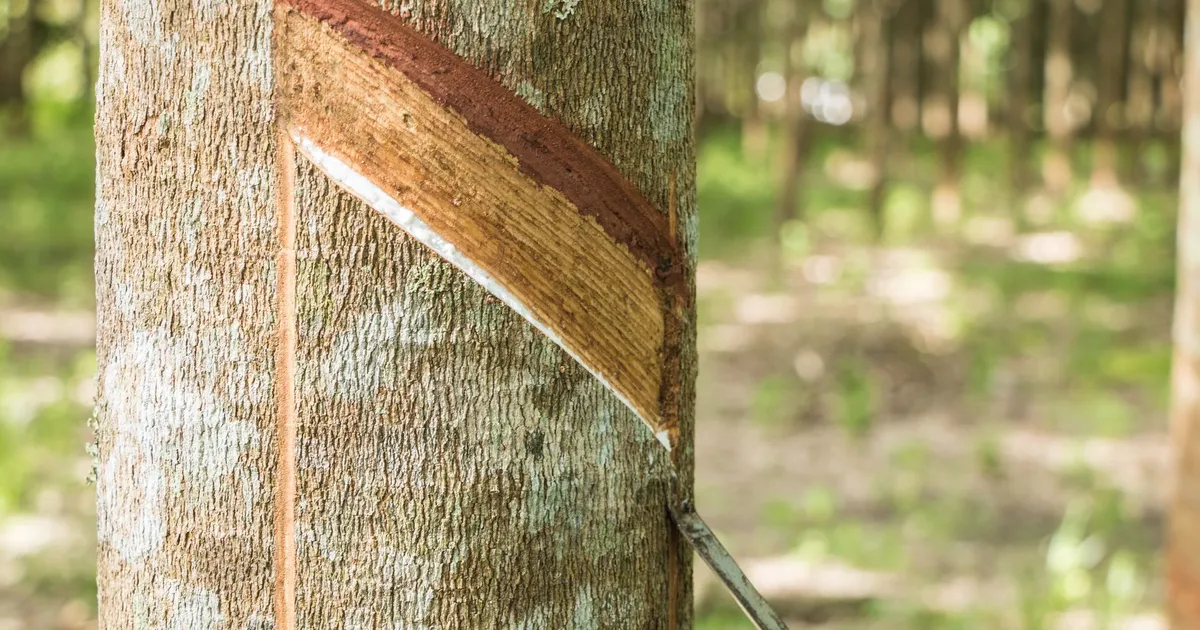
Rubberwood and acacia are two of the main plantation hardwoods in furniture manufacturing. Both come from trees grown on managed land, not from natural forest. Both are light in color, take stain and paint well and are priced below oak, maple and walnut. They also behave very differently from the temperate hardwoods that most buyers know, so a buyer who treats them like oak will get problems.
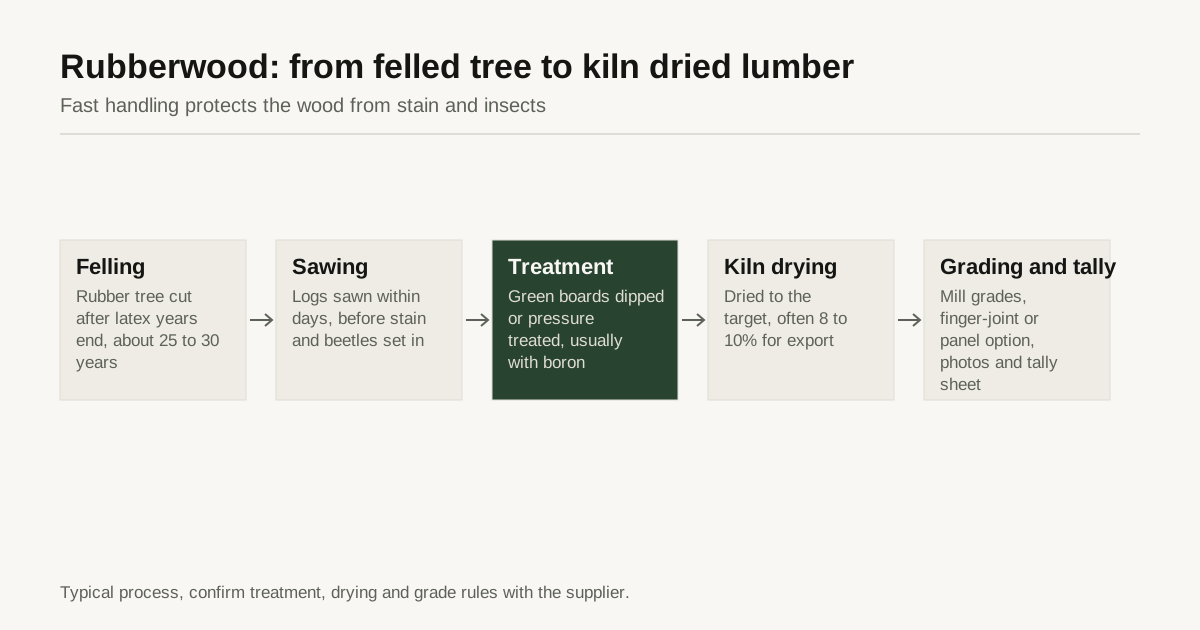
This guide explains what each wood is, how they are treated and dried, how the lumber is graded and sold, and what to write on an RFQ.
What each wood is
Rubberwood is the wood of Hevea brasiliensis, the tree grown for natural latex. After 25 to 30 years the tree gives less latex and is cut down, and the trunk is sawn into lumber. That is why rubberwood is called a by-product of rubber farming. The main growing regions are in Southeast Asia, with other plantations in South Asia, Africa and Latin America.
Acacia is a very large genus with many species. Furniture lumber sold as acacia usually comes from one of several plantation species, such as Acacia mangium, Acacia auriculiformis and hybrids, or from other acacias grown in Asia, Africa and Australia. The properties of the wood differ by species, which makes the botanical name important on any order.
Properties compared
| Property | Rubberwood | Acacia (plantation species) | Hard maple (reference) |
|---|---|---|---|
| Typical color | Pale cream to light tan, little difference between heart and sap | Golden to dark brown heartwood, paler sapwood, depends on species | Cream to reddish brown |
| Typical density at 12% moisture | about 560 to 650 kg/m3 | about 500 to 800 kg/m3 depending on species | about 705 kg/m3 |
| Hardness | Medium, comparable to some soft hardwoods | Varies widely by species | High |
| Grain | Fairly straight, even texture | Straight to wavy, may be figured | Fine, straight |
| Drying | Easy, but prone to stain and insects if untreated | Moderate, some species prone to checks and collapse | Moderate |
| Stability | Good when dried and treated well | Varies | Good |
| Price position | Low | Low to medium | Higher |
Figures are typical values and vary by species and lot, so ask for the specifics for the lumber you buy.
Why treatment matters for rubberwood
Rubberwood has a high content of starch and sugar. When a tree is cut, these attract wood-boring insects, mainly powderpost beetles, and staining fungi that turn the wood blue-gray. Left in the open for a few days, logs and green lumber can be ruined.
Mills handle this with quick processing and preservative treatment:
- Logs are sawn within a short time of felling, often within days.
- Green lumber is dipped or pressure treated with a boron compound, which is low in toxicity to people and protects against insects and fungi.
- Lumber is kiln dried soon after treatment.
Ask how soon after felling the wood was sawn, what treatment was used and whether the lumber is kiln dried and stored in a closed area. Unstained, insect-free rubberwood is routine from a good mill, and it is a matter of process. Our kiln drying guide explains the drying questions to ask.
Drying and moisture
Rubberwood dries well, because the wood is not dense and has few internal stresses. Typical kiln schedules are shorter than for oak. The main drying risks are stain, small checks and some warping from tension wood, which gives boards with a woolly surface. Final moisture for furniture to be used in cool, dry markets is typically 8 to 10 percent for export, sometimes lower for heated interiors. Plan to condition the wood to the shop before machining.
Acacia is more variable. Some species dry slowly and are prone to checks and, in a few cases, collapse. Because the property range is wide, ask for the schedule and a moisture reading with photos from the actual lot. Our moisture meter guide explains how to check the load on arrival.
Grades, sizes and forms
NHLA grades were written for North American hardwoods. Rubberwood and acacia are normally sold under the mill’s own grades or under local rules. Typical forms:
- Sawn lumber. Rough or planed boards, often in metric thicknesses such as 26, 32, 38 and 50 mm, and in random or set widths. Lengths are often shorter than for oak.
- Finger-jointed boards. Short pieces are joined end to end with glued finger joints to give long boards. Common for rubberwood.
- Edge-glued panels. Boards joined side by side to give a wide panel for tabletops, shelving and cabinet sides. Rubberwood is a common panel species.
- Dimension squares and blanks. Pieces cut to part size for turning, legs and frames.
Grade names vary, for example A, B and C or Select, Prime and Standard. Ask for the grade rules in writing and a picture of each grade. Note that “A” at one mill may be “B” at another. A sample or a set of clear photos is the only dependable way to compare.
Our guide to board feet and pricing explains the conversion from cubic meters to board feet. One cubic meter is about 424 board feet. Quotes may be in cubic meters, per piece or per panel, so agree the unit.
Color and finish
Rubberwood is pale and even, so it takes stain and paint with little streaking. Because the color between boards is close, panels look uniform. It is often stained to resemble darker woods, and some buyers use it unfinished for a light, clean look. Rubberwood can darken a little over time.
Acacia has more color contrast, from golden brown to chocolate, and some species have a striking grain. It is usually finished with clear oil or lacquer to show the pattern. Different boards can look quite different, so sorting for color before glue-up matters.
Always make a finish sample with your own system, because the wood absorbs coatings differently than oak or maple.
Where each one fits
Rubberwood:
- Dining and kids’ furniture, beds and cribs, in painted or stained finishes
- Kitchen cabinets and cabinet parts
- Edge-glued panels for shelving, tabletops and countertops
- Moulding, toys and household items
Acacia:
- Dining tables and chairs where grain is a design feature
- Cutting boards, bowls and accessories
- Flooring, in species that are hard and stable enough
- Outdoor furniture, in species with natural durability, with the exact species checked
Neither wood is a good choice where very high hardness or strength is required, such as stair treads in a heavy-traffic building, or where a certified durable species is called for.
Legality and sourcing
Plantation wood is not exempt from legality rules. Buyers in the United States need a Lacey Act declaration with the botanical name and the country of harvest. Buyers in the European Union need due diligence records for the origin. Plantation timber often has clear land title and records, and some lots carry FSC or PEFC certificates. The certification claim must be on the invoice and tied to a valid chain of custody certificate. This is general information, not legal advice.
Ask the supplier which documents they issue, whether the plantation is certified and whether the wood is treated with boron or other compounds. Our guide to phytosanitary and fumigation rules covers plant health rules that may also apply.
Questions for the supplier
- What is the botanical name, and are the logs from a plantation?
- How soon after felling is the wood sawn and treated?
- What preservative is used, and is the treatment recorded for each batch?
- What are the grade rules, and can you send photos of each grade from the current lot?
- Is the lumber kiln dried, to what moisture, and how is it checked?
- For finger-jointed boards and panels, which adhesive is used, and does it meet the emission rule of my market?
- What certificates and legality records can you issue?
Common mistakes
- Ordering acacia without the species and then receiving a lot that differs from the sample
- Assuming rubberwood grades match NHLA grades
- Skipping a moisture check, and watching panels warp in a dry climate
- Buying untreated or late-treated rubberwood that shows blue stain after a few weeks
- Comparing a quote per cubic meter with one per board foot without converting
- Using a pale rubberwood sample to judge the color of a darker acacia lot
What to put on the RFQ
- Botanical name and trade name: Hevea brasiliensis for rubberwood, and the acacia species
- Form: sawn lumber, finger-jointed boards, edge-glued panels, or squares
- Grade rules and photos of the grade
- Thickness, width, length, in metric or imperial, and surfacing
- Moisture range and drying method
- Treatment: type and timing, for rubberwood
- Color rules: for example uniform color, or sorted for acacia
- Documents: legality records, certification, treatment records
- Packaging, unit and tally method
Closing checklist
- Decide whether you need sawn lumber, finger-jointed boards or panels
- Put the botanical name on the RFQ
- Ask how and when the rubberwood was treated
- Request sample boards and a moisture check
- Confirm the legality documents for your market
If you want rubberwood or acacia quoted by several suppliers, send your lumber RFQ with the species, form and grade. We pass it to up to 3 mills or yards that carry the item, and they reply to you directly.
Frequently asked questions
Why is rubberwood treated with boron?
Rubberwood is rich in starch and sugars, which attract powderpost beetles and staining fungi soon after felling. Mills dip or pressure treat the wood, usually with a boron compound, before and during drying to protect it. Ask the supplier how soon after felling the logs were treated and what compound was used.
Is acacia a single species?
No. Acacia is a very large genus. Furniture lumber sold as acacia may be plantation species such as Acacia mangium or other species with very different density, color and drying behavior. Ask for the botanical name of the lot and request a sample.
Are rubberwood and acacia legal to import?
Both are normal trade woods, and plantation sourcing is common. Importers still need records of species and origin under rules such as the Lacey Act in the United States and the timber rules in the European Union. Ask the supplier which documents they can issue before ordering.
Know what you need? Send the spec.
Tell us the species, grade, thickness and board feet. We pass it to up to 3 mills or yards that carry it and reply within 24 business hours.
Send my lumber RFQ