Home / Hardwood species / Red Oak Lumber: Northern and Southern, Grades and Use
Red Oak Lumber: Northern and Southern, Grades and Use
Reference page · Last reviewed 14 April 2027
Red oak lumber is the sawn wood of the red oak group, the largest hardwood resource in the United States. It is heavy and hard, with open pores, pinkish to reddish brown heartwood and pronounced grain. It is sold as northern, southern or Appalachian red oak, graded under the standard NHLA rules and sawn in volume from 4/4 to 8/4. It is a cabinet, furniture and flooring wood, not an exterior one.
| Item | Typical for red oak lumber |
|---|---|
| Species | Northern red oak (Quercus rubra) and other red oaks sold together: black, scarlet, Shumard, pin, Nuttall, southern red, cherrybark, water, laurel, willow oak |
| Heartwood | Brown with a tinge of red, often pinkish to reddish brown |
| Sapwood | Nearly white to light brown, about 1 to 2 in wide |
| Pores | Open, generally without tyloses |
| Side hardness (Janka) | about 1,290 lbf northern red, about 1,060 lbf southern red, at 12% moisture |
| Specific gravity at 12% | 0.63 northern red, 0.59 southern red |
| Shrinkage, green to oven dry | Northern red: radial 4.0%, tangential 8.6%, volume 13.7% |
| Common thicknesses | 4/4, 5/4, 6/4, 8/4. 10/4 to 16/4 in smaller volumes |
| Grades | FAS, F1F, Selects, No.1 Common, No.2A Common and lower |
| US tariff line | 4407.91 (oak), statistical line for red oak |
Figures are typical for the species from the USDA Wood Handbook and the NHLA species guide, not guarantees for a lot. The NHLA rulebook governs grades.
Northern, southern and Appalachian
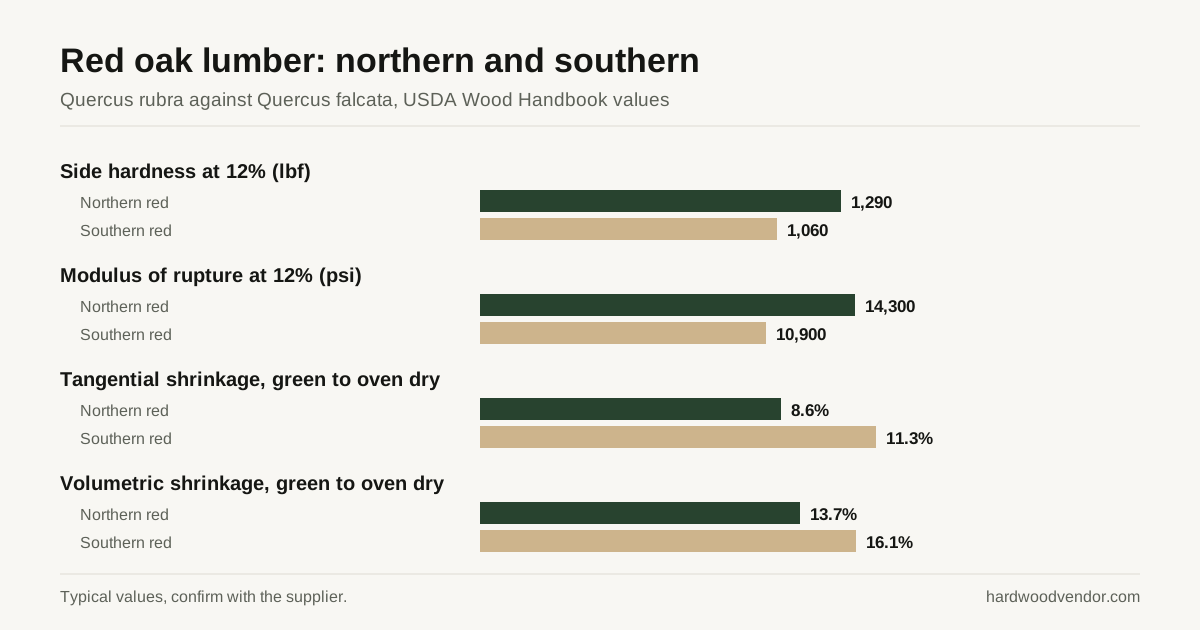
The Wood Handbook says sawn lumber of the red oak group cannot be separated by species from the wood alone. The trade separates it by region instead, because growth rate changes the wood.
| Property | Northern red oak | Southern red oak |
|---|---|---|
| Growth | Slower, shorter season | Faster |
| Grain and texture | Tighter | More open |
| Sapwood | Less, per the NHLA guide | More |
| Side hardness at 12% | about 1,290 lbf | about 1,060 lbf |
| Modulus of rupture at 12% | about 14,300 psi | about 10,900 psi |
| Tangential shrinkage | 8.6% | 11.3% |
| Volumetric shrinkage | 13.7% | 16.1% |
Values from the Wood Handbook tables for the two named species. Lumber sold as “southern red oak” may include other southern species such as cherrybark oak, which is stronger than southern red oak itself. “Appalachian” is a regional label used by many mills for lumber from the Appalachian hardwood region. If tight grain or consistent color matters, name the region on the order and ask the mill where the logs come from.
The NHLA species guide gives US red oak growing stock as 2.62 billion cubic meters, about 18% of all US hardwood growing stock, the largest single share.
Open pores: where red oak does not fit
The Handbook notes that red oak generally lacks tyloses, the growths that plug the pores of white oak. Two results follow:
- No tight cooperage. Liquids pass through the open pores, so red oak is unsuitable for tight barrels unless they are lined.
- No exterior or wet use without treatment. Water enters the wood easily and the heartwood is not in the decay resistant groups. Railroad ties and fence posts of red oak are treated with preservative.
Open pores also matter for finishing. Red oak takes stain readily and shows a strong grain, and it may need a grain filler for a smooth, glossy finish. For the closed-pore alternative, read the white oak lumber page.
Grades and color sorts
Red oak follows the standard NHLA grades.
| Grade | Minimum board | Clear face yield | Typical red oak use |
|---|---|---|---|
| FAS | 6 in wide, 8 to 16 ft | 83 1/3% | Furniture, millwork, stair parts |
| F1F and Selects | One FAS face, back No.1 Common | 83 1/3% on the better face | Doors, face frames, mouldings |
| No.1 Common | 3 in wide, 4 to 16 ft | 66 2/3% | Cabinets, furniture parts |
| No.2A Common | 3 in wide, 4 to 16 ft | 50% | Flooring, short parts, pallets |
See the FAS grade page and the lumber grades hub for how the cuttings are counted.
Color is a separate line. Red oak heartwood varies from light pinkish to darker reddish brown, and the NHLA guide notes that the heartwood is often, but not always, pinkish to reddish. Mills may offer color-sorted red oak, or sort for low sapwood. Define the sort in words you can check at the yard, for example “heart one face” or “no green or gray mineral on face”.
Cut and movement
Most red oak is plain sawn. Quartersawn red oak shows broad ray fleck, though less dramatic than white oak, and moves less across its width. Northern red oak’s radial shrinkage (4.0%) is less than half its tangential shrinkage (8.6%), so a quartersawn board is markedly more stable. Our guide to plain sawn vs quarter sawn vs rift sawn hardwood compares the cuts.
Uses
| Use | Grade usually quoted | Note |
|---|---|---|
| Flooring | No.1 and No.2A Common | Large volume, takes stain |
| Kitchen cabinets | No.1 Common and F1F | Doors, frames, boxes |
| Furniture | FAS and No.1 Common | Strong grain figure |
| Millwork and mouldings | FAS, F1F | Stain grade |
| Stair treads and risers | FAS 5/4 to 8/4 | Hardness, wide boards |
| Pallets and crating | Lower Common grades | Low cost per board foot |
Drying and weight
Red oak shrinks a lot from green to dry and needs careful kiln drying to avoid checks and honeycomb in thick stock. For interior use in North America the usual target is 6 to 8%. Ask for the kiln record or moisture readings at loading. See kiln drying schedules.
Weight from the Wood Handbook figures: northern red oak at 12% moisture is near 44 lb per cubic foot, or a little under 4 lb per board foot. Use the supplier’s own weight for freight.
What to write on the RFQ
Name the species group and region if it matters, grade and rulebook, color rule, thickness, surfacing, drying, width and length limits, board feet and paperwork. Our hardwood lumber specifications guide explains every field.
RFQ line: Red oak (Quercus rubra group), northern, No.1 Common, NHLA rules (edition named), 4/4 rough, KD 6-8%, random widths 3 in and up, 6-16 ft, 10,000 BF, Lacey Act data.
Send it through our lumber RFQ form and we pass it to up to 3 mills or yards that carry red oak in that grade. More species are on the hardwood species hub.
Frequently asked questions
What is the difference between northern and southern red oak lumber?
Both are sold as red oak. Northern red oak grows more slowly, with tighter grain and less sapwood. Southern red oak grows faster, with a more open grain. On Wood Handbook figures northern red oak is harder (about 1,290 lbf against 1,060 lbf) and shrinks less across the face (8.6% against 11.3% tangential).
Can red oak lumber be used outdoors?
Not without treatment. Red oak pores are open, so water moves through the wood, and its heartwood is not in the decay resistant groups of the Wood Handbook. For exterior or wet use, white oak heartwood or a durable species is the usual choice.
Why is red oak cheaper than white oak?
Red oak is the largest US hardwood resource. The NHLA species guide gives its growing stock as 2.62 billion cubic meters, 18% of all US hardwood growing stock, and it is sawn in large volumes in every grade. Price also moves with demand for flooring and cabinets, so check current quotes.
What thicknesses of red oak are easy to get?
4/4 to 8/4 are produced in volume. 10/4 and 12/4 can be sourced in smaller volumes from specialist suppliers, and the NHLA guide lists 16/4 among the thicknesses.
Sources
- NHLA species guide: red oak (northern and southern, thicknesses, growing stock)
- USDA Forest Products Laboratory: Wood Handbook, FPL-GTR-190 (2010), red oak group, Tables 4-3, 5-3b and 14-1
- American Hardwood Export Council: NHLA grades
- US International Trade Commission: Harmonized Tariff Schedule, 4407.91 (oak, red oak statistical line)
Standards and rules are cited as references, not as claims about Hardwood Vendor or any mill. Editions and status change: confirm with the issuing body, your customs broker or the regulator.
Know what you need? Send the spec.
Tell us the species, grade, thickness and board feet. We pass it to up to 3 mills or yards that carry it and reply within 24 business hours.
Send my lumber RFQ