Home / Hardwood species / White Oak Lumber: Grades, Thicknesses and Properties
White Oak Lumber: Grades, Thicknesses and Properties
Reference page · Last reviewed 17 April 2027
White oak lumber is the sawn wood of the white oak group, sold under one trade name and graded under the NHLA rules. It is heavy, hard and resistant to decay in the heartwood, its pores are plugged so it holds liquids, and it is cut plain sawn, rift or quartered. Most of it is sold kiln dried in 4/4 to 8/4, in FAS, F1F and Common grades.
| Item | Typical for white oak lumber |
|---|---|
| Trade name and species | White oak: Quercus alba plus other white oaks sold together (bur, chestnut, post, swamp white, overcup, chinkapin) |
| Side hardness (Janka) | about 1,360 lbf at 12% moisture |
| Specific gravity | 0.60 green, 0.68 at 12% moisture |
| Shrinkage, green to oven dry | radial 5.6%, tangential 10.5%, volume 16.3% |
| Decay resistance of heartwood | Resistant (Wood Handbook group) |
| Common thicknesses | 4/4, 5/4, 6/4, 8/4. 10/4 and 12/4 from fewer suppliers |
| Cuts offered | Plain sawn, rift, quartered or rift and quartered mixed |
| Grades | FAS, F1F, Selects, No.1 Common, No.2A Common and lower |
| Typical kiln dried moisture | 6 to 8% for interior use in North America |
| US tariff line | 4407.91 (oak), statistical suffix for white oak under “other” |
Figures are typical values for the species from the USDA Wood Handbook, not guarantees for a lot. The NHLA rulebook governs grades.
What is sold as white oak
The trade does not sort white oak by species. The Wood Handbook lists white oak (Quercus alba) with chestnut, post, overcup, swamp chestnut, bur, chinkapin and swamp white oak as the main species of the group, and they reach the market mixed. The sawn boards cannot be told apart reliably by species, only by group. For most buyers that is fine. It matters in two cases:
- Tight cooperage and wet use. White oak pores are usually plugged with tyloses, which makes the wood hard for liquids to pass through. The Handbook notes that many heartwood pores of chestnut oak lack tyloses. A stave buyer therefore cares about the source and the cut, not just the trade name.
- Color matching. Heartwood runs from grayish brown to mid brown and darker. Lumber from different regions and mills can differ in tone. Keep one lot for one product line.
The NHLA species guide gives US white oak growing stock as 2.26 billion cubic meters, about 15.5% of all US hardwood growing stock. It is readily available as sawn lumber and veneer in a wide range of grades and sizes.
Grades and what they yield
White oak follows the standard NHLA grades. A grade is set by the share of the board that can be cut into clear pieces of a minimum size, judged on the poorer face for most grades.
| Grade | Minimum board | Clear face yield | Typical white oak use |
|---|---|---|---|
| FAS | 6 in wide, 8 to 16 ft | 83 1/3% | Long rails, table tops, stair treads, millwork |
| F1F and Selects | One FAS face, back No.1 Common | 83 1/3% on the better face | Face frames, doors, drawer fronts |
| No.1 Common | 3 in wide, 4 to 16 ft | 66 2/3% | Cabinet doors, furniture parts, flooring |
| No.2A Common | 3 in wide, 4 to 16 ft | 50% | Flooring, short parts, rustic work |
Sizes and yields come from the NHLA grade summaries published by the American Hardwood Export Council and the Wood Handbook. Read the FAS grade page for how cuttings are counted and the lumber grades hub for every grade side by side.
Grade and appearance are separate. Sapwood and color are not grade defects in white oak. If you need heartwood only, color-matched stock or a narrow color range, write it as an extra line on the order.
Plain sawn, rift and quartered
White oak has broad rays. The cut decides how they show and how much the board moves.
| Cut | Ring angle to face (typical) | Look | Movement across the width |
|---|---|---|---|
| Plain sawn | 0 to about 30 degrees | Cathedral figure on the face | Highest, close to the tangential value |
| Rift sawn | about 30 to 60 degrees | Straight, tight grain, little fleck | Between the two |
| Quartersawn | about 60 to 90 degrees | Straight grain with ray fleck | Lowest, close to the radial value |
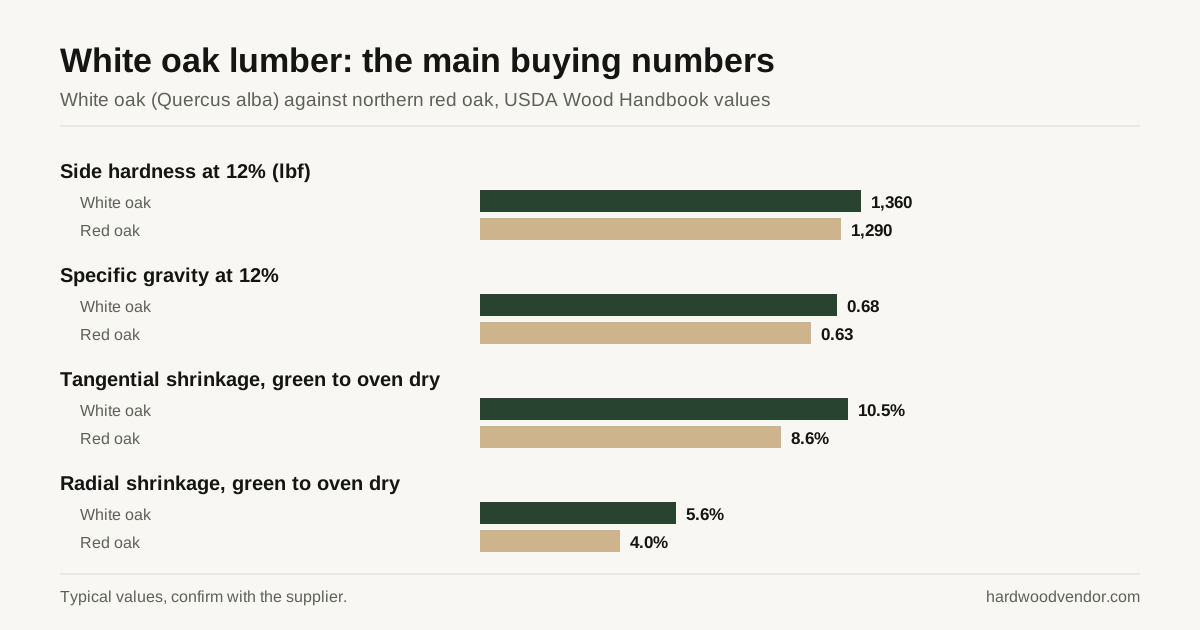
The Wood Handbook gives white oak a tangential shrinkage of 10.5% and a radial shrinkage of 5.6% from green to oven dry. A quartersawn board therefore moves about half as much across its width as a plain sawn board for the same change in moisture. That is the reason quartered and rift white oak is chosen for wide panels, flooring in heated rooms and furniture with tight joints.
Quartered and rift lumber cost more because the log yields less of it. Mills sell “rift and quartered” as a mix, rift only or quartered with a stated minimum fleck. Agree the sort and the angle tolerance in writing. Our guide to plain sawn vs quarter sawn vs rift sawn hardwood compares the three cuts across species.
Properties that matter to a buyer
| Property | White oak | Northern red oak | What it means |
|---|---|---|---|
| Side hardness at 12% | about 1,360 lbf | about 1,290 lbf | Both suit floors and treads |
| Specific gravity at 12% | 0.68 | 0.63 | White oak is heavier, more freight per board foot |
| Modulus of rupture at 12% | about 15,200 psi | about 14,300 psi | Similar strength |
| Tangential shrinkage | 10.5% | 8.6% | White oak moves more when plain sawn |
| Pores | Usually plugged with tyloses | Open | White oak for wet use and barrels |
| Heartwood decay resistance | Resistant | Not in the resistant groups | White oak for exterior and boat parts |
Values are from the Wood Handbook tables for clear wood. A lot of lumber varies around them. Weight from these figures: white oak at 12% moisture is near 47 lb per cubic foot, or roughly 4 lb per board foot. Use the supplier’s own weight for freight.
Red oak, the cheaper and more open-pored alternative, has its own page: red oak lumber. If you are weighing European oak against American white oak, see European oak vs American white oak.
Drying and thick stock
White oak dries slowly. Thick boards that are dried too fast can surface check and honeycomb, so mills air dry or pre-dry before the kiln and run conservative schedules. Two consequences for the order:
- Lead time. 8/4 and thicker can take months from the saw to kiln dried stock. Ask whether the mill has dry inventory or will saw to order. The NHLA guide notes that not all suppliers offer 10/4 and 12/4.
- Moisture spec. For interior use in North America the usual target is 6 to 8%. Ask for the kiln record or a moisture reading at loading. The kiln drying schedules guide explains what a good schedule looks like.
Where white oak is used
| Use | Grade and cut usually quoted | Note |
|---|---|---|
| Furniture and cabinets | FAS and No.1 Common, plain or rift | Rift for straight grain on doors |
| Flooring | No.1 and No.2A Common, plain or rift and quartered | Hardness and wear resistance |
| Stair treads | FAS 5/4 to 8/4 | Wide, clear boards |
| Millwork and mouldings | FAS, F1F | Stain grade, consistent color |
| Barrel staves | Quartered stave bolts from selected logs | Tight grain and tyloses |
| Exterior and marine parts | Heartwood, FAS | Decay resistance of heartwood |
What to write on the RFQ
A white oak quote is comparable only when these fields match: species name, cut, grade and rulebook, thickness in quarters, surfacing, drying, color or heartwood rule, width and length limits, board feet and paperwork. Our hardwood lumber specifications guide explains every field.
RFQ line: White oak (Quercus alba group), rift and quartered, FAS, NHLA rules (edition named), 5/4 rough, KD 6-8%, random widths 4 in and up, 8-16 ft, 3,000 BF, Lacey Act data.
Send it through our lumber RFQ form and we pass it to up to 3 mills or yards that carry white oak in that grade and thickness. More species are listed on the hardwood species hub.
Frequently asked questions
What thickness of white oak lumber is easiest to buy?
4/4 to 8/4. The NHLA species guide lists 4/4, 5/4, 6/4 and 8/4 as common and notes that not all suppliers offer 10/4 and 12/4, because thick white oak takes a long time to dry. Ask for thick stock early and expect a smaller choice of grades.
Is white oak lumber good for outdoor or wet use?
Better than most domestic hardwoods. The Wood Handbook groups white oak heartwood as resistant to decay, and its pores are usually plugged with tyloses, which is why it is used for tight barrels and boat parts. Sapwood has no such resistance, so ask for heartwood if the part will get wet.
How do I tell white oak lumber from red oak?
Look at the end grain. White oak pores are usually plugged with tyloses, red oak pores are open. A drop of water or a breath blown through a short piece of red oak end grain passes through, white oak resists it. The color difference is less reliable.
Is rift and quartered white oak a separate grade?
No. Rift and quartered describe how the board was cut from the log, not its NHLA grade. A board can be FAS quartered or No.1 Common rift. Name both the cut and the grade on the order.
Sources
- USDA Forest Products Laboratory: Wood Handbook, FPL-GTR-190 (2010), chapter 2 species, Table 4-3 shrinkage, Table 5-3b strength, Table 14-1 decay resistance
- NHLA species guide: white oak (availability, thicknesses, growing stock)
- American Hardwood Export Council: NHLA grades
- US International Trade Commission: Harmonized Tariff Schedule, heading 4407
Standards and rules are cited as references, not as claims about Hardwood Vendor or any mill. Editions and status change: confirm with the issuing body, your customs broker or the regulator.
Know what you need? Send the spec.
Tell us the species, grade, thickness and board feet. We pass it to up to 3 mills or yards that carry it and reply within 24 business hours.
Send my lumber RFQ