Home / Hardwood species / Black Walnut Lumber: Sapwood Rules, Steaming and Grades
Black Walnut Lumber: Sapwood Rules, Steaming and Grades
Reference page · Last reviewed 10 April 2027
Black walnut lumber is graded under NHLA rules that are modified for walnut: boards may be narrower and shorter, clear cuttings smaller and sapwood is admitted without limit. Most of it is sold unsteamed and unselected for color in 4/4 to 8/4, with steamed stock from specialist producers. A buyer who wants heartwood only, wide boards or long clear lengths has to say so on the order.
| Item | Typical for black walnut lumber |
|---|---|
| Species | Juglans nigra |
| Grading | NHLA rules with walnut modifications: smaller boards and cuttings, sapwood admitted without limit |
| Color | Heartwood light to dark brown, sapwood nearly white and up to about 3 in wide in open-grown trees |
| Steaming | Generally sold unsteamed. Steamed stock from specialist producers |
| Common thicknesses | 4/4, 5/4, 6/4, 8/4, 10/4 |
| Average board size | 4 to 8 in wide, 6 to 12 ft long |
| Side hardness (Janka) | about 1,010 lbf at 12% moisture |
| Specific gravity | 0.51 green, 0.55 at 12% moisture |
| Shrinkage, green to oven dry | radial 5.5%, tangential 7.8%, volume 12.8% |
| Heartwood decay resistance | Resistant (Wood Handbook group) |
| US tariff line | 4407.99, statistical line for walnut |
Values are typical for the species from the USDA Wood Handbook and the NHLA species guide. They are not guarantees for a lot. The NHLA rulebook governs grades.
Why walnut has its own rules
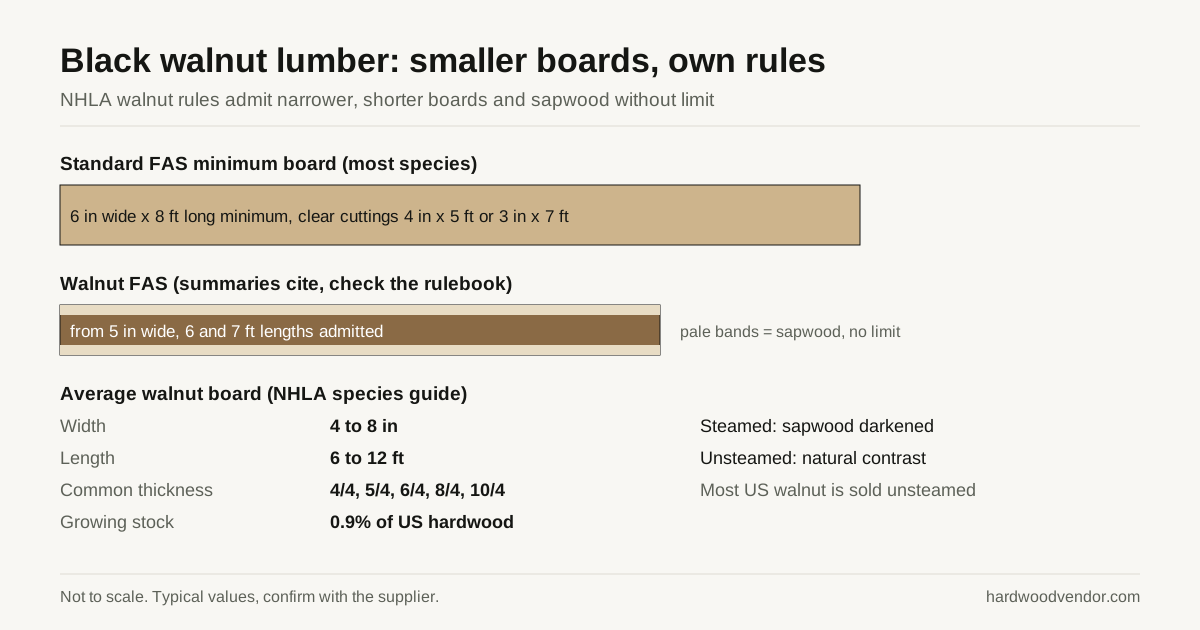
Walnut does not grow in stands like oak. It grows as scattered, often open-grown trees with short clear trunks and a wide band of sapwood. The NHLA species guide gives US walnut growing stock as 137.8 million cubic meters, about 0.9% of all US hardwood growing stock. If walnut were graded on the standard rule, little of it would make the top grades.
The NHLA rules are therefore modified for walnut. The species guide sums up the effect: smaller specifications, smaller clear cuttings and sapwood admitted without limit. Extension summaries of the rules note, for example, that walnut FAS admits boards from 5 in wide and boards 6 and 7 ft long, which the standard FAS rule (6 in and 8 ft minimum) does not. Read the walnut section of the current rulebook for the exact figures in your contract.
| Point | Standard NHLA rule | Walnut |
|---|---|---|
| FAS minimum board | 6 in wide, 8 ft long | Narrower and shorter boards admitted (summaries cite 5 in and 6 to 7 ft, check) |
| Clear cutting sizes | 4 in x 5 ft or 3 in x 7 ft for FAS | Smaller cuttings admitted |
| Sapwood | Not a defect in most species | Admitted without limit |
| What the buyer gets | Long, wide clear boards in FAS | Shorter, narrower boards, sapwood on edges |
Two practical consequences follow. First, a walnut FAS price cannot be compared directly with an oak or cherry FAS price, because the boards are not the same. Second, a cut list built for oak needs to be checked against walnut sizes. Our FAS grade page shows the standard rule and the lumber grades hub lists all grades.
Sapwood, color and steaming
Because sapwood is not a defect, a typical walnut board has pale edges on a brown heart. Buyers handle that in three ways:
| Option | What you order | Effect on price and supply |
|---|---|---|
| Accept sapwood | Standard grade, unsteamed | Widest choice, lowest walnut price |
| Steam the lumber | Steamed walnut, sapwood admitted | Sapwood darkens toward the heart color, heartwood tones even out |
| Limit sapwood | Grade plus a written sap limit, such as heartwood one face or a percentage | Smaller choice, higher price, more waste at the mill |
Steaming is done on green lumber in a closed chamber before kiln drying. The NHLA guide says specialist producers offer steamed walnut to darken the sapwood. It does not turn sapwood into heartwood, and very pale sapwood may still show under a clear finish. Unsteamed walnut keeps a lighter, more varied heartwood with purple and gray tones that many furniture makers prefer. Our guide to steamed vs unsteamed walnut compares the two in finish samples.
Write any color rule in measurable words. “Sap one face only”, “heart one face, sap on the back allowed” or “sapwood not over 10% of the face” can be checked at the yard. “Good color” cannot.
Yield, sizes and thickness
The NHLA guide lists average walnut boards at 4 to 8 in wide and 6 to 12 ft long. That shapes how walnut is used:
- Short parts first. Drawer fronts, frames, legs and short rails come out of walnut boards with little waste. Long table tops need FAS boards sorted for length, often at a premium.
- Wide boards are rare. Wide, clear walnut is sold as a sort with its own price. Glued panels from narrower boards are the usual answer.
- Thick stock exists. 8/4 and 10/4 are common enough for legs and solid tops, more so than in cherry.
Grade by part matters more in walnut than in other species, because the grade price steps are large. Many shops buy No.1 Common walnut for short, narrow parts and keep FAS for long rails and tops. Run a yield test on a small lot of two grades before a large order.
Properties that matter to a buyer
| Property | Black walnut | Black cherry | Hard maple (sugar) |
|---|---|---|---|
| Side hardness at 12% | about 1,010 lbf | about 950 lbf | about 1,450 lbf |
| Specific gravity at 12% | 0.55 | 0.50 | 0.63 |
| Modulus of rupture at 12% | about 14,600 psi | about 12,300 psi | about 15,800 psi |
| Tangential shrinkage | 7.8% | 7.1% | 9.9% |
| Heartwood decay resistance | Resistant | Moderately resistant | Slightly or not resistant |
Values are from the Wood Handbook tables for clear wood. The Handbook describes black walnut as normally straight grained, easy to work with tools, stable in use and well suited to natural finishes. Weight from these figures: walnut at 12% moisture is near 38 lb per cubic foot, or a little over 3 lb per board foot. Use the supplier’s weight for freight.
Where walnut is used
| Use | Grade usually quoted | Note |
|---|---|---|
| High-end furniture | FAS and No.1 Common, steamed or not | Grade by part, color agreed |
| Cabinets and doors | No.1 Common and F1F | Short and narrow parts |
| Architectural woodwork and paneling | FAS, color sorted | Consistent heartwood |
| Gunstocks and turnings | Thick stock, select figure | Special sorts |
| Flooring | Common grades | Character marks accepted |
What to write on the RFQ
A walnut quote needs more lines than an oak quote because the defaults are looser. State the species, grade and rulebook, steamed or unsteamed, sapwood rule, thickness, minimum width and length if your parts need them, drying, board feet and paperwork. Our hardwood lumber specifications guide explains every field.
RFQ line: Black walnut (Juglans nigra), FAS and No.1 Common, NHLA walnut rules (edition named), steamed, sapwood one face allowed, 8/4 rough, KD 6-8%, 5 in and wider, 6-12 ft, 1,500 BF, Lacey Act data.
Send it through our lumber RFQ form and we pass it to up to 3 mills or yards that stock walnut in that grade. For other species see the hardwood species hub.
Frequently asked questions
Why is walnut graded differently from other hardwoods?
The NHLA rules are modified for walnut because the species grows as smaller, scattered trees. The NHLA species guide says the modified rules allow smaller specifications and smaller clear cuttings, and that sapwood is admitted without limit. A walnut FAS board is therefore not the same board as an oak FAS board.
Is sapwood a defect in walnut lumber?
Not under the NHLA walnut rules, where sapwood is admitted without limit. If you need heartwood only or a limited amount of sapwood, you must write it as a separate requirement and expect a higher price and a smaller choice.
Should I buy steamed or unsteamed walnut?
Steaming darkens the pale sapwood so it blends with the heartwood, and it also softens the purple and gray tones of the heartwood. US walnut is generally sold unsteamed and unselected for color, and steamed stock comes from specialist producers. Choose steamed for even color with sapwood included, unsteamed for natural color and full contrast.
How thick and wide is walnut lumber usually?
The NHLA species guide lists 4/4, 5/4, 6/4, 8/4 and 10/4 as common, with average lengths of 6 to 12 ft and widths of 4 to 8 in. Wide, long, clear walnut is scarce and is priced as such.
Sources
- NHLA species guide: walnut (modified rules, sapwood, steaming, sizes, growing stock)
- USDA Forest Products Laboratory: Wood Handbook, FPL-GTR-190 (2010), black walnut description, Tables 4-3, 5-3b and 14-1
- American Hardwood Export Council: NHLA grades
- US International Trade Commission: Harmonized Tariff Schedule, 4407.99 (walnut statistical line)
Standards and rules are cited as references, not as claims about Hardwood Vendor or any mill. Editions and status change: confirm with the issuing body, your customs broker or the regulator.
Know what you need? Send the spec.
Tell us the species, grade, thickness and board feet. We pass it to up to 3 mills or yards that carry it and reply within 24 business hours.
Send my lumber RFQ