Home / Lumber grades and size rules / FAS Lumber: What the Firsts and Seconds Grade Allows
FAS Lumber: What the Firsts and Seconds Grade Allows
Reference page · Last reviewed 8 April 2027
FAS (Firsts and Seconds) is the top standard grade of the NHLA rules for hardwood lumber. A FAS board is at least 6 in wide and 8 ft long, and at least 83 1/3% of its surface must cut into clear face pieces of 4 in by 5 ft or 3 in by 7 ft, on the poorer face. The number of cuttings allowed grows with the board’s surface measure. Walnut and a few other species have their own modifications.
| Rule | FAS (standard species) |
|---|---|
| Lengths | 8 to 16 ft |
| Minimum width | 6 in |
| Surface measure | 4 sq ft and up |
| Face graded | Poorer face (both faces must meet FAS) |
| Minimum clear yield | 83 1/3% (10/12) of surface measure |
| Minimum cutting | 4 in x 5 ft or 3 in x 7 ft |
| Number of cuttings | 1 to 4, by surface measure (table below) |
| Extra cutting | One more cutting allowed on boards of 6 to 15 sq ft if the yield is 91 2/3% (11/12) |
| Grades that share the FAS face rule | F1F (one FAS face) and Selects (smaller boards, one FAS face) |
Figures are from the Wood Handbook summary of the NHLA rules (Table 6-1) and the American Hardwood Export Council grade summary. The NHLA rulebook, in the edition your contract names, governs. NHLA reviews its rules every four years.
How a board is graded FAS
The grader works on the poorer face and asks one question: can enough of this face be cut into clear pieces, few enough and large enough?
- Measure the board. Width in inches times length in feet, divided by 12, gives the surface measure (SM) in square feet. A board 8 in wide and 12 ft long has SM 8. The NHLA measurement rules page covers rounding.
- Find the yield needed. For FAS the clear cuttings must cover 10/12 of the surface. In cutting units (inches of width times feet of length), that is SM x 10. The SM 8 board needs 80 units of clear cuttings.
- Count the cuttings allowed. The table below sets the maximum number of cuttings for that surface measure.
- Check sizes. Each cutting must be at least 4 in by 5 ft or 3 in by 7 ft, clear on the graded face. The reverse of each cutting must be sound.
- Check the other face. For FAS both faces must make the grade, so the poorer face decides.
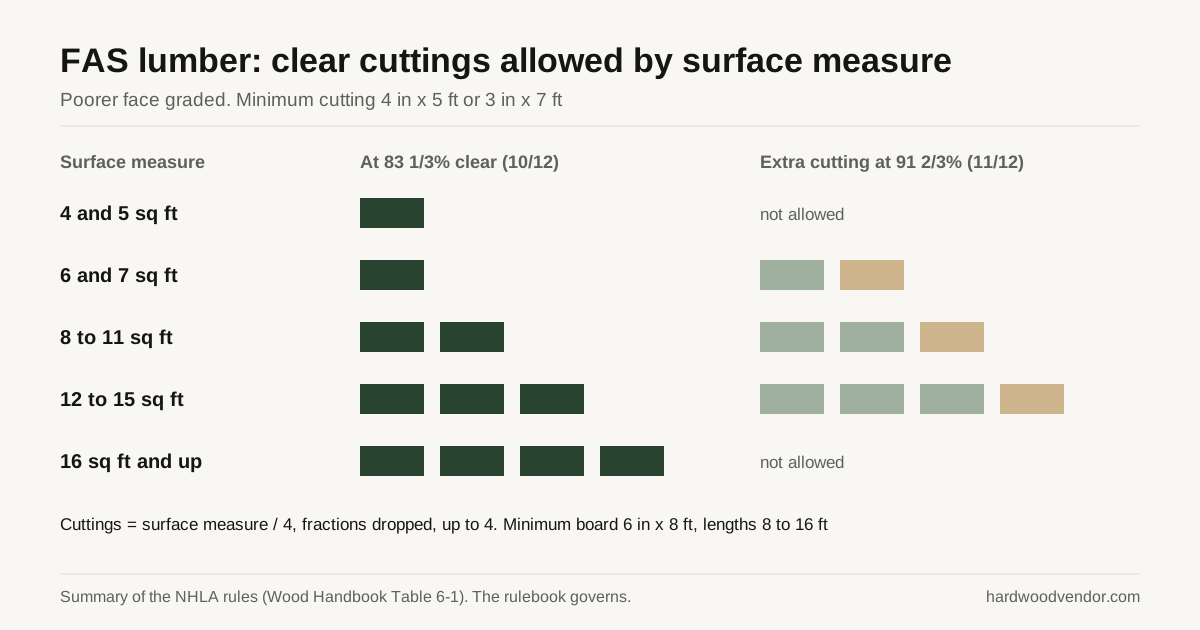
Cuttings by surface measure
| Surface measure (sq ft) | Cuttings allowed at 83 1/3% | With one extra cutting at 91 2/3% |
|---|---|---|
| 4 and 5 | 1 | Not allowed |
| 6 and 7 | 1 | 2 |
| 8 to 11 | 2 | 3 |
| 12 to 15 | 3 | 4 |
| 16 and up | 4 | Not allowed |
From the Wood Handbook Table 6-1 summary of the NHLA rules. The pattern in trade summaries is SM divided by 4, fractions dropped, up to 4 cuttings. The extra cutting is a concession: a board that needs one more piece can still grade FAS if the clear yield is higher, 11/12 instead of 10/12.
A worked example: a board 9 in wide and 12 ft long has SM 9. FAS needs 90 cutting units in at most 2 cuttings. A clear piece 9 in by 8 ft (72 units) plus 6 in by 3 ft (18 units) reaches 90 units, but the second piece is smaller than both minimum cuttings (4 in x 5 ft or 3 in x 7 ft), so it does not count. The board fails FAS on two cuttings. With the extra cutting it would need 99 units (SM x 11) in 3 cuttings. If it cannot reach that, it is graded lower, often F1F or No.1 Common.
FAS, F1F and Selects
| Grade | Better face | Poorer face | Minimum board |
|---|---|---|---|
| FAS | FAS | FAS | 6 in x 8 ft |
| F1F (FAS one face) | FAS | No.1 Common | 6 in x 8 ft |
| Selects | FAS | No.1 Common | 4 in x 6 ft |
Many mills sell “FAS and F1F” or “Selects and Better” as one item at one price. That is a mix, not a grade. Ask for the share of FAS in the mix if both faces of your parts show. Our page on Selects and F1F covers the one-face grades in detail.
Species exceptions
The standard rule is written for the common species. Some species are graded on modified rules:
- Walnut and butternut. The NHLA species guide says the walnut rules allow smaller specifications and smaller clear cuttings, and admit sapwood without limit. Summaries cite FAS boards from 5 in wide and 6 ft long.
- Cherry. Extension summaries of the rules note that small knots not over 1/8 in across can be admitted in cherry cuttings. The NHLA species guide lists gum pockets, pin knots and pith flecks as natural characteristics of cherry.
- Color. Sapwood is not a defect in most species. A FAS board can be half sapwood. Color sorts such as white maple or heartwood-only cherry are extra specifications.
Read the species section of the rulebook for the wood you buy. Our black walnut lumber page explains what the walnut rules mean for board sizes.
When to buy FAS
| Situation | FAS or a lower grade |
|---|---|
| Long rails, stiles over 5 ft, stair treads, table tops | FAS: the long clear pieces exist only here |
| Both faces show (open shelves, table aprons seen from both sides) | FAS, not F1F or Selects |
| Mostly short parts under 3 ft | No.1 Common often costs less per usable part |
| Painted parts with fillable marks | No.1 or No.2A Common |
| Wide panels glued from strips | No.1 Common usually works |
Price steps between FAS and No.1 Common vary by species and market. The only reliable test is your own cut list. Run a small lot of each grade through your rough mill and compare cost per usable part. Our guide to NHLA hardwood lumber grades explains the Common grades, and the lumber grades hub lists every grade side by side.
Checking an FAS delivery
- Pull boards from several bundles and measure width, length and surface measure.
- On boards that look borderline, mark the clear cuttings with chalk and add up the units.
- Check the poorer face. A board with one perfect face and a poor back is F1F, not FAS.
- Record results against the contract rule and edition. A grade dispute under NHLA rules can go to NHLA reinspection. See pre-shipment lumber grading for agreeing checks before the lumber ships.
What to write on the RFQ
RFQ line: White oak, FAS, NHLA rules (edition named), poorer face graded, 4/4 rough, KD 6-8%, 8-16 ft with not more than 25% under 10 ft, random widths 6 in and up, 4,000 BF.
The length clause in that example is a buyer specification, not part of the FAS rule. Send your lumber RFQ with the grade, rule and edition, and we pass it to up to 3 mills or yards that carry FAS in your species and thickness.
Frequently asked questions
What does FAS stand for?
Firsts and Seconds. The two top grades of the old rules were combined into one grade, FAS, which is now the top standard NHLA grade for hardwood lumber.
What percentage of an FAS board is clear?
At least 83 1/3% (10/12) of the board's surface measure must be in clear face cuttings, judged on the poorer face. Cuttings must be at least 4 in by 5 ft or 3 in by 7 ft. The rest of the board may hold knots, splits or other defects.
What is the minimum size of an FAS board?
6 in wide and 8 ft long for most species, with lengths from 8 to 16 ft. Walnut and butternut have modified rules that admit narrower and shorter boards. Check the species section of the rulebook edition in your contract.
Is FAS worth the price over No.1 Common?
When your parts are long and wide, or both faces show, usually yes. When the cut list is mostly short parts, No.1 Common often gives a lower cost per usable part. Run a yield test on a small lot of each grade with your own cut list.
Sources
- USDA Forest Products Laboratory: Wood Handbook, FPL-GTR-190 (2010), Table 6-1 standard hardwood lumber grades (summary of the NHLA rules)
- American Hardwood Export Council: NHLA grades (FAS, F1F, Selects, Common grades)
- NHLA: grading rules and the four-year review cycle
- NHLA species guide: walnut (modified rules)
Standards and rules are cited as references, not as claims about Hardwood Vendor or any mill. Editions and status change: confirm with the issuing body, your customs broker or the regulator.
Know what you need? Send the spec.
Tell us the species, grade, thickness and board feet. We pass it to up to 3 mills or yards that carry it and reply within 24 business hours.
Send my lumber RFQMore in lumber grades and size rules
- NHLA Measurement Rules: Surface Measure, Board Feet and Tally Rounding
- Selects and F1F Hardwood Lumber: When One Clear Face Is Enough
- EN 1313-2: Permitted Deviations and Preferred Sizes for Hardwood Sawn Timber
- EN 13556 Timber Names: How to Read Trade Names and Codes on a European Quote
- Hardwood Flooring Stock Grades: NWFA and NOFMA Names, Lengths and the EN 14342 Note
- Hardwood Dimension Stock: Cut Size Specs, Face Rules and Yield Math