Home / Lumber grades and size rules / EN 13556 Timber Names: How to Read Trade Names and Codes on a European Quote
EN 13556 Timber Names: How to Read Trade Names and Codes on a European Quote
Reference page · Last reviewed 11 March 2027
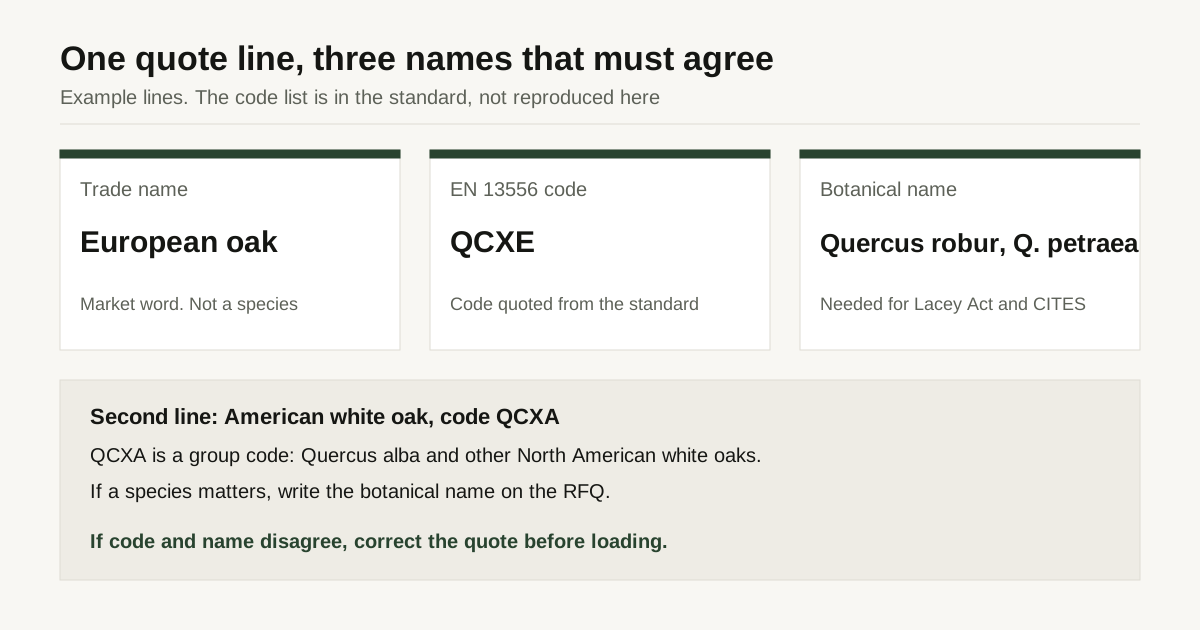
A European quote usually names the wood three ways: a trade name, a four-letter code and, if the seller is careful, a botanical name. EN 13556 is the standard behind the trade name and the code. The three have to describe the same wood. When they do not, the quote is ambiguous and the problem shows up later as a wrong species at the dock or a wrong name on an import declaration.
| Item on the quote | Example | Where it comes from | What to check |
|---|---|---|---|
| Trade name | European oak, American white oak | Market usage, listed in EN 13556 with a standard name | The name is not a species. Several species can share it |
| EN 13556 code | QCXE, QCXA | The standard’s four-letter code | The code stands for a species or a group of species |
| Botanical name | Quercus robur, Quercus alba | Botanical naming | Needed for Lacey Act and CITES paperwork |
| Customs heading | HS 4407 | The tariff, not EN 13556 | Describes the product form, not the species |
This page is general information as of October 2026. The standard is a paid document and the complete code list is not reproduced here. Where this page gives a code, it is one that a published data sheet quotes from the standard. Check any other code in the standard itself or with the seller.
What the standard is
EN 13556 is titled Round and sawn timber, Nomenclature of timbers used in Europe. National standards bodies list the 2003 edition, published in English, French and German in the DIN edition. The Irish standards catalogue assigns it to the CEN committee for round and sawn timber, CEN/TC 175. No announcement of a revision turned up in October 2026, so confirm the current edition with your national standards body before you cite it in a contract.
The standard gives each listed timber a standard commercial name and a four-letter code. The code is built from the botanical name. One secondary source gives TEGR for teak (Tectona grandis) as an example of that logic. A European sawmill, importer or timber merchant will often put the code on a price list or an order confirmation because it is short and unambiguous in any language.
Two codes that matter for oak buyers
Data sheets that quote DIN EN 13556 give the following for the two oak groups most often traded across the Atlantic:
| Code | Species named | Typical trade name |
|---|---|---|
| QCXE | Quercus petraea, Quercus robur | European oak |
| QCXA | Quercus alba and other North American white oaks | American white oak |
The pattern shows how the codes work. The first letters point to the genus (Quercus). The last letters separate the group. The code QCXA is a group code: it covers more than the one species in its name. That is also how the trade uses the words “white oak”. A buyer who needs Quercus alba specifically, for example for a water-contact use or a customer specification, has to write the botanical name on the RFQ and not rely on the code or on the trade name.
Our guides on European oak lumber grades and European oak versus American white oak cover the wood itself. This page covers the label.
Trade names versus botanical names
A trade name is a market word, and the same word can cover different genera. “Mahogany” is the standard example: the trade uses it for woods from different genera, and a plain “mahogany” line cannot tell a reader which one is on offer. Our guide to sapele, khaya and African mahogany shows how far the names drift. For hardwood buyers the rule is simple:
- Trade name in the language of the order.
- Botanical name next to it, at least to genus and preferably to species.
- EN 13556 code if the buyer is in Europe or the seller already uses it.
If the three do not agree, ask before you order. A mill that prints QCXE on a quote for “American oak” has made an error somewhere, and you want to know where before the container is loaded.
Why the botanical name has to stay on the paper
The code is shorthand for a name list. Import and permit systems work from scientific names. The US Lacey Act declaration asks for the scientific name, including genus and species, of each plant in the shipment, and APHIS says that common names such as “oak” do not give the filer anything usable. Our Lacey Act declaration page goes through the four fields. CITES permits name the species in the same way, and our guide to CITES-listed timber explains the steps. For EU-bound goods, our guide to the EU deforestation regulation for hardwood lumber covers the information an importer has to collect. Confirm the exact fields with your customs broker.
So the code helps the people who read the price list. It does not replace the botanical name for the people who read the declaration.
Reading a European quote
Look at each quote line from left to right and test the three names against each other.
| Quote line | Problem | What to ask |
|---|---|---|
| “Oak, QCXE, 52 mm” | No botanical name. The code points to a European oak group | Add Quercus robur or Quercus petraea, or both, and confirm the origin country |
| “American oak, FAS, 8/4” | Trade name only. White oak and red oak are different groups | Which group, which species mix, which grade rule |
| “White oak, QCXA” with an NHLA grade | Group code, grade in NHLA terms | Is the species mix Quercus alba only, or a group sort? |
| “Mahogany” | Trade name that covers different genera | Which genus, which species, and does it need a CITES permit |
| Code on quote differs from code on invoice | One of the two documents is wrong | Correct before shipping, not after |
For size rules on the same quote, see EN 1313-2 permitted deviations. A European quote usually combines a name, a grade (EN 975-1 or an NHLA grade) and a size standard. Each one needs to be named.
What a buyer should require
- The botanical name of every species on every quote line, invoice line and tally line.
- The trade name that the seller uses, so both sides use one word for one wood.
- The EN 13556 code, if the buyer or the end customer works with it. It is a convenience, not a legal document.
- A statement that the species mix of any group sort will be named before shipment.
- A rule for mismatches: the botanical name decides, and a conflicting line is corrected before loading.
What a mill can say about itself
Hardwood Vendor does not hold or issue any nomenclature standard and does not check species. Species identification is the supplier’s responsibility, and in a dispute it is a laboratory matter. Ask the mill how it identifies species at the sort and what it will state in writing.
What to write on the RFQ
Write the species the way a customs broker and a European buyer will both read it: trade name, botanical name and code in one line, then the grade and size rules. Send your lumber RFQ and we pass it to up to 3 mills or yards that carry the species and say they can name it on their documents.
RFQ line: White oak group (QCXA), Quercus alba and other North American white oaks as listed on the tally, FAS, 8/4 rough, KD 6-8%, botanical name on every invoice and tally line.
Frequently asked questions
What is EN 13556?
EN 13556 is the European standard titled Round and sawn timber, Nomenclature of timbers used in Europe. It lists commercial hardwood and softwood timbers with standard names and a four-letter code for each. The edition listed by national standards bodies is EN 13556:2003. It is a paid standard, so the full table is not reproduced here.
Is the EN 13556 code the same as a customs code?
No. The four-letter timber code identifies a species or species group by name. A customs code is a number from the tariff, such as an HS heading, and describes the product form. Both can appear on one invoice and they answer different questions.
Does a code replace the botanical name?
No. The code is shorthand. Lacey Act declarations and CITES permits work from the scientific name, so the botanical name should stay on the invoice and the tally even when a code is shown.
Why does the code QCXA matter to an American white oak buyer?
Data sheets that quote the standard list QCXA for Quercus alba and other North American white oaks. It is a group code. A quote that says QCXA is selling a white oak group, not a promise of Quercus alba alone, so ask for the species mix.
Sources
- BSI: EN 13556 Round and sawn timber, nomenclature of timbers used in Europe
- EVS: EN 13556:2003 (edition listing)
- Irish standards shop: EN 13556:2003, committee CEN/TC 175
- Teknos white oak data sheet, codes quoted from DIN EN 13556 (QCXE, QCXA)
- APHIS: Lacey Act declaration (scientific name of each plant)
Standards and rules are cited as references, not as claims about Hardwood Vendor or any mill. Editions and status change: confirm with the issuing body, your customs broker or the regulator.
Know what you need? Send the spec.
Tell us the species, grade, thickness and board feet. We pass it to up to 3 mills or yards that carry it and reply within 24 business hours.
Send my lumber RFQMore in lumber grades and size rules
- FAS Lumber: What the Firsts and Seconds Grade Allows
- NHLA Measurement Rules: Surface Measure, Board Feet and Tally Rounding
- Selects and F1F Hardwood Lumber: When One Clear Face Is Enough
- EN 1313-2: Permitted Deviations and Preferred Sizes for Hardwood Sawn Timber
- Hardwood Flooring Stock Grades: NWFA and NOFMA Names, Lengths and the EN 14342 Note
- Hardwood Dimension Stock: Cut Size Specs, Face Rules and Yield Math