Home / Lumber papers and certificates / Lacey Act Declaration (PPQ 505) for Hardwood Lumber, Field by Field
Lacey Act Declaration (PPQ 505) for Hardwood Lumber, Field by Field
Reference page · Last reviewed 26 February 2027
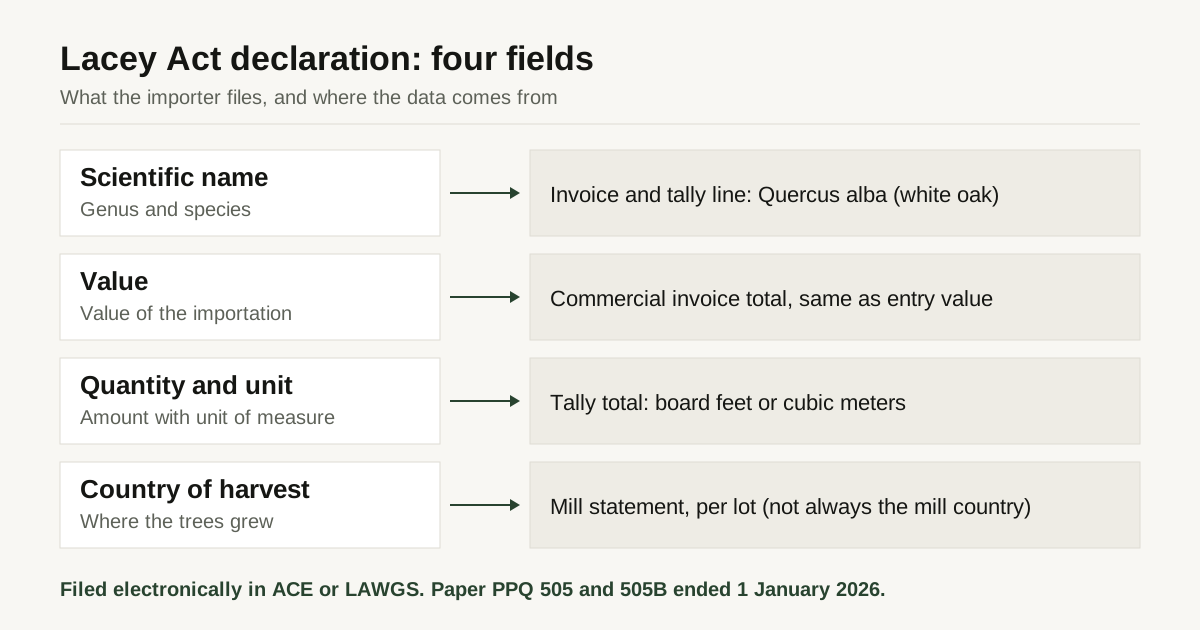
The Lacey Act declaration is the US customs filing that names the species, the country of harvest, the value and the quantity of the wood in an import. For sawn hardwood lumber the importer, usually through a customs broker, files it electronically with the entry. Paper form PPQ 505 has not been accepted since 1 January 2026. The mill’s job is to give the importer clean data for each of the four fields.
| Item | Typical rule for lumber (as of October 2026) |
|---|---|
| Law | Lacey Act, 16 U.S.C. 3372(f): import declaration for plants and plant products |
| Who files | The importer, in practice the customs broker acting for the importer |
| Where | CBP’s ACE (the main route) or APHIS’s LAWGS web system. Paper PPQ 505 and 505B ended 1 Jan 2026 |
| Four data fields | Scientific name, value, quantity with unit, country of harvest |
| Lumber tariff heading | 4407 (wood sawn or chipped lengthwise) sits in enforcement phase II, from 1 Apr 2009 |
| Other lumber-like headings | 4408 veneer sheets and 4409 continuously shaped wood, also phase II. 4412 plywood is phase III |
| Not a permit | The declaration does not approve the wood. It is a record that customs and APHIS can check |
This page is general information, not legal advice. Confirm the filing method, the covered tariff codes and your own duties with a customs broker or counsel.
What changed in 2026
For years importers filled in a paper PPQ 505 and a continuation sheet 505B, or filed the same data electronically. APHIS now states that it no longer accepts the paper forms, from 1 January 2026. A customs broker’s notice to its clients says the same and adds that paper is allowed only in rare emergencies with prior USDA approval. The data did not change. Only the way it is delivered did.
What this means for a lumber buyer:
- Ask your broker whether they file the declaration in ACE for you. Most do. If you file yourself, you need an APHIS LAWGS account and someone trained to use it.
- The old habit of sending a paper PPQ 505 with the documents to the port no longer works. The data has to reach the filer before the entry is lodged, so the mill documents must arrive early.
- Phase VII of the enforcement schedule, which a trade publication reports as starting on 1 December 2024, widened the list to many finished goods. It did not change the position of sawn lumber, which has been in scope since 2009.
The four fields, one by one
| Field | What the declaration needs | What to get from the mill |
|---|---|---|
| Scientific name | Genus and species of each plant in the shipment | Botanical name on every invoice line and tally line, trade name in brackets |
| Value | Value of the importation | Invoice value that matches the entry value, per line if species differ |
| Quantity and unit | Amount of plant material with its unit of measure | The tally total in the unit the entry uses, with the board foot to cubic meter conversion shown |
| Country of harvest | The country where the plant was harvested | Country where the trees stood, which is not always the country of the mill |
Scientific name
The statute asks for the scientific name, including genus and species, of each plant. Common names such as “red oak” cover more than one species, and “white oak” lists several. A line that reads “Quercus rubra” is something a filer can use. A line that reads “oak” is not.
If the exact species is not known, APHIS guidance published with the phase-in says the declaration should list the possible species. The abbreviation spp. after a genus is acceptable only when every species of that genus could be in the shipment. For a sawmill that sorts a species group mixed, ask for the botanical names the mill commonly sorts together and put them in the contract.
Value and quantity
Value and quantity come from the commercial invoice, so any difference between the invoice and the tally becomes a declaration error too. Check that the unit on the tally (board feet, cubic meters, pieces) is the unit the broker will enter. Our guides on board feet and how hardwood is priced and hardwood lumber tally show how the same load can be written in different units.
Country of harvest
This is the field that trips up exporters who buy logs or green lumber from several places. If the country of harvest is unknown or the wood may come from more than one country, APHIS guidance says the filer must name every country it could have come from. A mill that cannot say where the logs came from is a problem for the importer, not only a paperwork gap.
Recycled content
The recycled-content field in the statute is for paper and paperboard. For ordinary sawn lumber it does not apply. Reclaimed lumber and recycled wood have their own handling in APHIS tables, so ask the broker before you buy them.
Where lumber sits in the tariff schedule
APHIS phased the requirement in by tariff heading, starting with the least processed goods. For wood the 2009 schedule put the following headings in phase II, from 1 April 2009: fuel wood, wood in the rough, sleepers, wood sawn or chipped lengthwise (4407), veneer sheets (4408), continuously shaped wood (4409) and builders’ joinery (4418). Plywood and veneered panels (4412) followed in phase III from 1 October 2009. Articles of wood such as heading 4421 came in phase IV from 1 April 2010.
Packaging is treated differently. Plant material used only to support, protect or carry another item is not declared unless the packaging is the item imported. A pallet that carries lumber is not declared as part of the lumber shipment.
Due care and what the declaration is not
The Lacey Act makes it unlawful to trade in plants taken in violation of the laws of the country of origin. The declaration is how the importer states what is in the shipment, but filing it does not show that the wood was legal. The penalty section of the Act uses a “due care” standard: a person who should have known through due care that the wood was taken unlawfully can face civil penalties, and knowing violations carry criminal penalties and forfeiture of the goods. A false or incomplete declaration is itself a violation.
What helps an importer show due care is a file that stays consistent from the forest to the entry:
- Species and harvest country on every document, matching the declaration.
- Purchase records from the mill that show where the logs were bought.
- Harvest permits or export papers where the country of harvest requires them.
- A mill statement of what it knows about the origin of each lot, signed and dated.
The mill side of this file, with a sheet layout and a statement template, is on Lacey Act records a supplier gives its importer.
Certification such as FSC is useful evidence for part of this file, but it is a separate topic: see FSC certified hardwood lumber. For CITES-listed species, a CITES permit is required on top of the declaration: see CITES permits for timber. The European rules are different again: the EUDR guide for hardwood lumber covers them.
What to write on the RFQ
- Botanical name for every line, with the trade name in brackets.
- Country where the trees were harvested, per line.
- The mill will send species, harvest country, value and quantity in writing at least 5 business days before the vessel sails. This is an RFQ term you can set, not a legal limit.
- Invoice and tally in the same unit as the entry.
- A clause that lets you stop the shipment if the species on the documents does not match the lumber.
When you are ready, send your lumber RFQ with the botanical names and the destination port.
RFQ line: White oak (Quercus alba), FAS, 4/4, KD 6-8%, rough, harvest country stated per lot, Lacey Act data sent before sailing.
Frequently asked questions
Do I still file a paper PPQ 505?
No. APHIS states that it stopped accepting paper submissions of form PPQ 505 and its continuation sheet 505B on 1 January 2026. The declaration is filed electronically in CBP's ACE or in APHIS's LAWGS web system. Paper is allowed only in an emergency with prior approval from APHIS.
Is a Lacey Act declaration needed for sawn hardwood lumber?
Yes, for lumber that is imported into the United States. Wood sawn or chipped lengthwise (HTS heading 4407) was part of the second enforcement phase, which began on 1 April 2009. Confirm the current list of covered tariff codes and any exemption with your customs broker.
What if the mill ships a mix of species?
The declaration needs the scientific name of each plant in the shipment. If the species is unknown, APHIS guidance says to list every species that may be present, and to use the genus with spp. only when every species of that genus could be in the load. A mixed lot is better solved by a tally that separates species.
Does FSC certification replace the declaration?
No. The declaration is a customs filing about species, value, quantity and country of harvest. An FSC claim is a separate statement about chain of custody. Neither one proves that the wood was harvested legally.
Sources
- 16 U.S.C. 3372, prohibited acts (import declaration in subsection f)
- 16 U.S.C. 3373, penalties and sanctions (due care standard)
- APHIS: File a Lacey Act declaration (paper PPQ 505 and 505B ended 1 January 2026; ACE and LAWGS)
- APHIS: Lacey Act declaration frequently asked questions (unknown species and several countries of harvest)
- Federal Register, 2 September 2009: Lacey Act declaration phase-in schedule, HTS chapter 44 phases
- Federal Register, 31 March 2020: proposed phase VI, declaration contents and packaging exemption
- Customs broker notice: end of paper Lacey Act filings from 1 January 2026
- Trade guide on Lacey Act phase VII (start 1 December 2024), secondary source
Standards and rules are cited as references, not as claims about Hardwood Vendor or any mill. Editions and status change: confirm with the issuing body, your customs broker or the regulator.
Know what you need? Send the spec.
Tell us the species, grade, thickness and board feet. We pass it to up to 3 mills or yards that carry it and reply within 24 business hours.
Send my lumber RFQMore in lumber papers and certificates
- FSC Certified Hardwood Lumber: Certificate Codes, Claims and Scope
- Testing Lumber Moisture: Oven-Dry, Resistance and Capacitance Methods
- NHLA Inspection Reports for Hardwood Lumber: What a Graded-Lot Report Should Show
- Kiln Drying Quality: Moisture Spread, Gradient and Case Hardening Checks
- Hardwood Lumber Import Documents: The Set an Importer Should Receive
- CITES Permits for Timber: Export, Import and Re-export Steps