Home / Lumber papers and certificates / Lacey Act Records a Lumber Supplier Gives Its Importer
Lacey Act Records a Lumber Supplier Gives Its Importer
Reference page · Last reviewed 23 March 2027
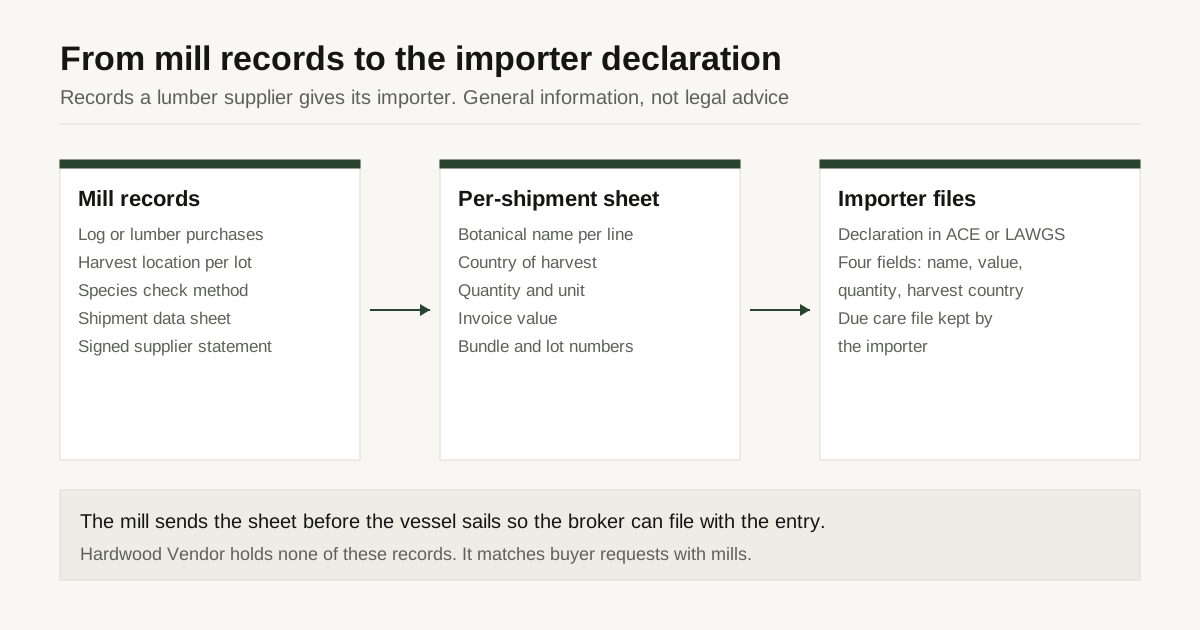
A US importer files the Lacey Act declaration, but it can only be as good as the papers the mill hands over. Those papers fall into three groups: a sheet of data for each shipment, records that show where the wood was bought and a short signed statement from the mill. This page lists what goes in each group, in the order an importer or customs broker will ask for it. It is the supplier-side pair of the PPQ 505 field-by-field page.
| Group | What the mill keeps | Why the importer wants it |
|---|---|---|
| Per-shipment sheet | Botanical name, harvest country, quantity with unit, invoice value, bundle and lot numbers | The four declaration fields come straight from it |
| Purchase records | Log or green lumber purchases with seller, date, volume and place | Shows where the wood came from and supports the harvest country |
| Species check | How the mill knows the species, and who sorts mixed lots | A line that says “oak” is not a species |
| Supplier statement | A signed, dated statement of what the mill knows about the lot | One document the importer can put in its due care file |
| Permits and export papers | Harvest, transport or export documents where the harvest country asks for them | Evidence for the legality of harvest, which the declaration does not prove |
This page is general information as of October 2026, not legal advice. Duties depend on the importer, the species and the harvest country. Confirm them with a customs broker or counsel.
What the law asks of the importer
The Lacey Act’s import declaration rule, 16 U.S.C. 3372(f), requires the importer to declare the scientific name (genus and species) of each plant, the value of the importation, the quantity with its unit of measure and the country where the plant was harvested. For plant products the statute adds two fallbacks while no other regulation is in force: if the species varies and is unknown, the declaration lists every species that may have been used, and if the product is commonly harvested in several countries and the real source is unknown, it lists each possible country.
The penalty section, 16 U.S.C. 3373, applies civil penalties to a person who knew, or in the exercise of due care should have known, that the plants were taken in violation of the underlying law. The statute does not define due care. APHIS guidance describes it as the care a reasonably prudent person would take in the same circumstances, and leaves importers to decide how to verify their supply chain. This is why a mill’s records matter: they are what the importer shows when asked how it checked.
The per-shipment sheet
One page per shipment, matched to the invoice and the tally, is enough. Send it before the vessel sails, not after.
| Field | What the mill writes | Common error |
|---|---|---|
| Line number | The invoice line and tally line it matches | Sheet and invoice have different line orders |
| Botanical name | Genus and species, with the trade name in brackets, for example Quercus rubra (red oak) | Trade name only, or “oak” for a mix of species |
| Harvest country | The country where the trees stood, one per line | The mill’s country written instead of the log’s country |
| Quantity | Total and unit (board feet or cubic meters), same unit as the invoice | Tally in board feet, entry in cubic meters, no conversion shown |
| Value | The invoice value for that line | Sheet total does not equal the invoice |
| Bundle and lot numbers | The bundles and kiln charges that make up the line | No link between the sheet and the physical bundles |
A mill that sorts several species together should list every botanical name it commonly mixes in that sort and say so on the sheet. If the load is mixed, a tally that separates species is better than a long list.
Purchase and origin records
The sheet states a harvest country. The purchase records back it up. Whether a mill buys logs, green lumber or kiln-dried stock, it should be able to show for each lot:
- Who sold it, with name and address.
- The date, the volume and the price.
- The place of harvest, as precisely as the seller will state it. For logs from private land that can be a county or a landowner. For public land it is the sale or permit.
- Scale tickets, delivery tickets or bills of lading that tie the purchase to the lot the mill sawed.
- Any permit the law of the harvest country asks for, such as a harvest permit, a transport permit or an export document.
A mill that buys from several suppliers should keep the same set for each one. Where a purchase has a gap, such as a trader who will not name the source, write the gap on the record rather than leave it out. The importer needs to know what is not known.
The species check
The mill needs a way to know the species it ships. Three routes are common. The sawyer or grader identifies the wood by eye. The supplier states it on the purchase paper. A laboratory identifies it from a sample. The right one depends on how easy the species is to confuse. White oak and red oak are different groups with several species each. Some imported hardwoods have look-alikes that are hard to tell apart on the board. A mill should write which route it used for each lot and keep the lab report if it ordered one. Our page on CITES permits for timber explains why a wrong species can also change the permit needed.
A supplier statement layout
A statement is a short document. It does not replace the records above. Here is a layout the mill can adapt:
| Part | Content |
|---|---|
| Header | Mill name and address, date, shipment or invoice number |
| Scope | The lots and bundles the statement covers |
| Species | Botanical names for the lots, and how the mill identified them |
| Harvest | Country of harvest per lot, and the purchase records that support it |
| Gaps | Anything the mill does not know, for example the exact place of harvest of one lot |
| Permits | Permits or export papers attached, or a statement that none are required in the harvest country |
| Declaration | “The above is correct to the best of our knowledge, and we will send the supporting records on request” |
| Signature | Name, role and date of a person who can sign for the mill |
Do not copy a legal form from the internet and sign it without reading it. If the importer sends its own form, fill that in and keep a copy.
How long to keep the records
The Lacey Act names no retention period for a supplier. The importer’s position is different. CBP’s general rule, 19 CFR 163.4, sets five years from the date of entry for records the importer must keep under the customs rules. Whether a particular supplier document falls under that rule is a question for the importer’s broker. A mill that keeps its shipment sheets, purchase records, permits and signed statements for at least five years from the shipment date is in a good position to answer a request. That is a practical choice, not a legal limit.
Keep the set together by shipment number and keep it in a form that can be found quickly: a folder per shipment, a scan per record, a single index sheet.
Weak spots an importer will question
- A harvest country that is the same for every shipment from a mill that buys from many places.
- A species line that never changes while the grade and thickness do.
- Purchase records that stop at a trader.
- A statement with no attached records.
- A value or quantity that differs between the sheet, the invoice and the tally.
- Documents that arrive after the vessel sails.
What certification adds
An FSC or SFI claim is evidence for part of the origin file and sometimes a good one, but it is a different document. See FSC certified hardwood lumber and SFI and PEFC certified lumber. A certificate does not replace the sheet, and it is not a Lacey Act declaration. For shipments to the EU the rules differ: see EUDR due diligence for sawmills.
What a mill can say about itself
Hardwood Vendor does not file declarations, keep a mill’s records or give legal advice. It matches buyer requests with mills and yards that say they can meet them. A mill that says it has origin records should show a sample sheet with the customer details removed.
What to write on the RFQ
- Botanical name and harvest country per line, on the quotation and the invoice.
- A shipment sheet sent at least 5 business days before sailing. This is an RFQ term you can set, not a legal limit.
- Purchase records or a signed supplier statement available on request.
- Records kept for at least five years from the shipment date.
- A clause that stops the shipment if the species or country on the sheet does not match the lumber.
Mills and yards that keep these records can register as a supplier. Buyers can send a lumber RFQ with the botanical names and the destination port, and we pass it to up to 3 mills or yards that say they can meet it.
RFQ line: White oak (Quercus alba), FAS, 4/4, KD 6-8%, rough, shipment sheet with botanical name and harvest country per line sent before sailing, supplier records kept five years.
Frequently asked questions
Does the mill file the Lacey Act declaration?
No. The statute puts the declaration on the importer, and in practice a customs broker files it electronically. The mill supplies the data: botanical name, country of harvest, quantity and value for each line of the shipment.
Is a mill legally required to keep Lacey Act records for a set number of years?
The statute names no retention period for a supplier. CBP's general rule for the importer's own records is five years from the date of entry. A mill that keeps its shipment sheets and purchase records for at least that long can answer a question when the importer is asked for them. Confirm the rule that applies to you with counsel or a customs broker.
Is a supplier statement enough to show due care?
No. Practitioner guides and the legislative history treat a supplier's word alone as weak. A statement helps when it comes with records the importer can check, such as purchase documents, permits and a consistent chain of paper from the forest to the shipment.
What should a mill do when it does not know the exact species or harvest location?
Say so in writing and list what it does know. The statute tells the importer to list every species that may be in the product and every country it may have come from. A mill that sorts species together can agree a list of botanical names with the buyer before the lot ships.
Sources
- 16 U.S.C. 3372, prohibited acts (import declaration in subsection f)
- 16 U.S.C. 3373, penalties and sanctions (civil penalties where a person should have known in the exercise of due care)
- 19 CFR 163.4, record retention period (five years from the date of entry)
- APHIS: Lacey Act declaration frequently asked questions (unknown species, several countries, due care)
- APHIS: File a Lacey Act declaration (paper PPQ 505 and 505B ended 1 January 2026)
- Congressional Research Service R42119: The Lacey Act, compliance issues related to importing plants and plant products (secondary source)
Standards and rules are cited as references, not as claims about Hardwood Vendor or any mill. Editions and status change: confirm with the issuing body, your customs broker or the regulator.
Know what you need? Send the spec.
Tell us the species, grade, thickness and board feet. We pass it to up to 3 mills or yards that carry it and reply within 24 business hours.
Send my lumber RFQMore in lumber papers and certificates
- Lacey Act Declaration (PPQ 505) for Hardwood Lumber, Field by Field
- FSC Certified Hardwood Lumber: Certificate Codes, Claims and Scope
- Testing Lumber Moisture: Oven-Dry, Resistance and Capacitance Methods
- NHLA Inspection Reports for Hardwood Lumber: What a Graded-Lot Report Should Show
- Kiln Drying Quality: Moisture Spread, Gradient and Case Hardening Checks
- Hardwood Lumber Import Documents: The Set an Importer Should Receive