Home / Lumber papers and certificates / Kiln Drying Quality: Moisture Spread, Gradient and Case Hardening Checks
Kiln Drying Quality: Moisture Spread, Gradient and Case Hardening Checks
Reference page · Last reviewed 14 March 2027
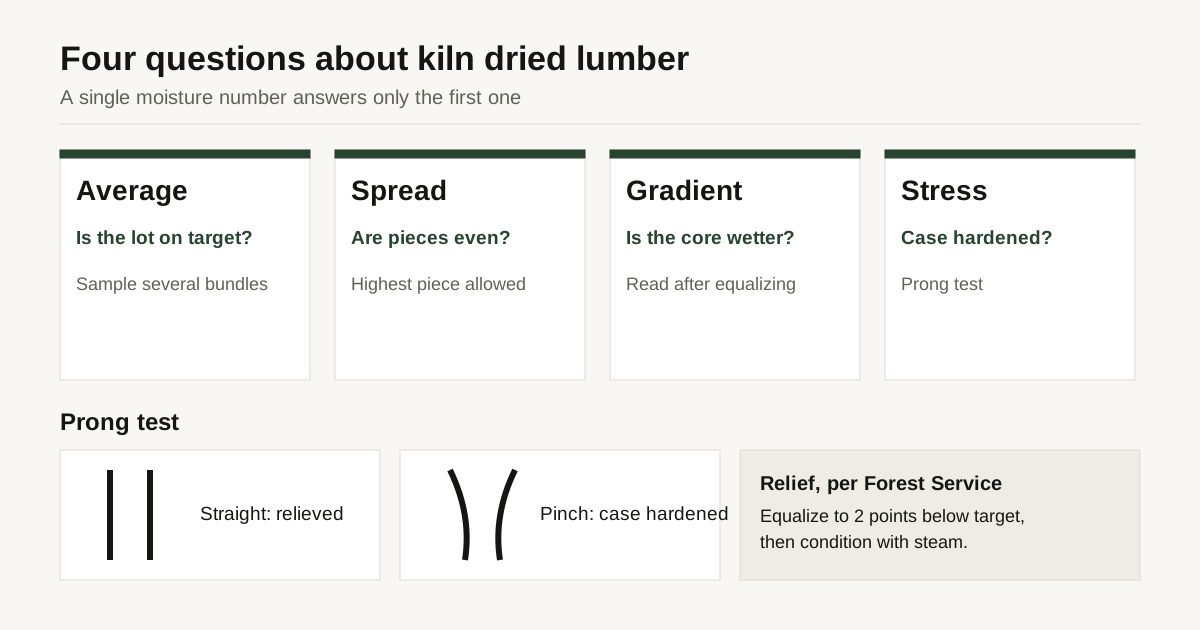
Kiln dried hardwood has to meet three tests, and a single moisture number covers only one of them. The lot should average the target, the pieces should sit close together around that average, and the boards should not carry drying stress that shows up when you rip them. This page sets out each check, the standard behind it and the fields a kiln record should show.
| Check | What it tells you | Method or reference | Where it is recorded |
|---|---|---|---|
| Lot average moisture | Whether the lot is on target | Sample from several bundles, oven-dry reference (EN 13183-1) or calibrated meter | KD record and receiving record |
| Spread between pieces | Whether the lot is even | EN 14298 expresses variation between pieces as limits | Written limit in the order and the sample readings |
| Moisture gradient | Whether the core is wetter than the shell | Section or slice from the board, read after equalizing | Test sheet |
| Case hardening | Whether drying stress is locked in | Prong test, or the degree specified under EN 14298 | Test sheet, charge number |
| Visual defects | Checks, warp, stain | Not covered by EN 14298. Grade rule or the product spec | Grade report |
This page is general information as of October 2026. Confirm the current edition of any standard with the standards body before you cite it.
What EN 14298 covers
EN 14298 is titled Sawn timber, Assessment of drying quality. The 2017 edition replaced the 2004 edition. Its scope is a lot of dried sawn timber, surfaced or not, softwood or hardwood, up to 100 mm thick. It judges drying quality in terms of moisture content:
- the target value
- the average moisture of the lot
- the variation between the pieces of the lot
It includes an option for specifying the degree of case hardening. Other drying-related defects such as checks, shakes, warp and stain are outside the standard. They belong to visual grading documents or to the product specification. The classes and limits are in the paid standard and are not reproduced here. A buyer who wants to cite it should buy the current edition and write the limit in the order, so both sides use one number.
For the test methods behind the numbers, see lumber moisture test methods. For how kiln schedules work, our guide to kiln drying schedules explains why speed causes damage.
Lot average and spread
A buyer usually writes a target such as 6 to 8 percent. That is the range for the lot average. A second line sets the spread: the highest piece allowed. An example of the form, not a recommended value: “lot average 6 to 8%, no piece above 9% in a sample of 20 pieces from 5 bundles”.
Sampling matters more than the meter. Take pieces from different bundles and different layers, because moisture varies with position in the kiln charge. Read the meter the same way each time: same depth, same side, species and temperature set. A meter reading is an estimate. The oven-dry method is the reference and settles a dispute. Record every reading with the piece, bundle and charge number.
Moisture gradient
Wood dries from the outside in. At the end of a schedule the shell can be drier than the core. A board that reads on target at the surface can still be wetter inside. When that board is ripped or planed, the core is exposed and the piece moves.
Forest Service guidance describes gradient effects in the prong test: prongs that move immediately and then move more after a 12-hour rest show both case hardening and a moisture gradient. That is why a mill equalizes and conditions at the end of a charge, and why a buyer should ask whether it did.
Case hardening and the prong test
Case hardening is drying stress. The surface dries first and sets, then the core shrinks later against the set shell. The USDA Forest Service describes it as a normal part of drying that must be relieved, or the wood may warp or twist when re-sawn or machined.
The prong test for a sample board:
- Cut a section about 1 inch along the grain, across the full width of the board, at least 12 inches from the end.
- Use a band saw to remove the core and leave two outer prongs.
- Watch how the prongs move.
| What the prongs do | What it suggests |
|---|---|
| Pinch together or cross immediately | Case hardening, or tension set. Severe cases snap together or bypass |
| Move at once and again after a 12-hour rest | Case hardening and a moisture gradient |
| Stay in place | The wood is conditioned |
Relief has two steps, according to the same guidance. Equalizing dries the boards to two percentage points below the target, for example 6% for an 8% target. Conditioning adds steam to raise the moisture back to target and relax the stress. Several stress tests may be needed to confirm that enough steam was applied. For a buyer, the practical use of the prong test is simple: a few sample prongs from different bundles on receipt show whether a lot will rip flat.
When stress is not relieved, ripping or resawing releases it. Cup and crook often follow, and the warped board can pinch the saw blade. Yield can fall sharply. Cost to the buyer is a rework or a claim. Our guide to a lumber quality claim shows how to present one.
What a kiln record should show
A kiln or drying record is the paper behind the numbers. Ask for these fields:
| Field | Why it matters |
|---|---|
| Mill name and kiln number | Identifies where the lot was dried |
| Charge or lot number | Ties the record to your bundles |
| Species and thickness | Drying schedules differ by species and thickness |
| Dates in and out | Gives the drying time |
| Schedule or program name | Shows the method, not the numbers |
| Starting moisture and final readings | Shows how far the lot dried |
| Method and instrument used for final readings | Pin, probe or oven-dry sample |
| Equalizing or conditioning done | Shows stress was addressed |
| Stress test result | Prong test result for the charge |
| Signature and date | Someone is responsible |
A mill that keeps charge records can answer a claim in an hour. A mill that does not keep them cannot. Our page on NHLA inspection reports shows a graded-lot report layout that can carry the charge number.
NHLA runs a Kiln Drying certification that it says validates the drying process and documentation against industry standards, and lists certified companies on its member portal. It is a program for NHLA members. Ask NHLA for details. It does not replace a lot test.
Checks on receipt
- Match the bundle labels to the kiln record charge numbers.
- Sample pieces from several bundles. Read moisture at a consistent depth with a meter set for the species.
- Set the highest readings aside and send a few pieces for an oven-dry check if the result decides money.
- Make prong samples from different bundles. Record whether the prongs moved immediately or after a rest.
- Compare the lot average and the highest piece with the order.
- Record everything with bundle numbers and send it to the supplier the same day.
Red flags
- A moisture claim with no method or instrument named.
- One reading for a whole lot.
- No charge number on the bundle.
- A record that says “kiln dried” with no final moisture range.
- Prongs that bind or cross, with no mention of conditioning.
- Air dried stock sold as kiln dried.
What a mill can say about itself
Hardwood Vendor does not dry lumber, certify kilns or issue drying records. A mill should supply its own kiln record, and an independent check is the way to confirm it. Ask the mill what it can show.
What to write on the RFQ
- Lot average target and the highest piece allowed, as numbers.
- Test method, sampling plan and who decides a dispute.
- EN 14298 or another standard, if the buyer cites one, with the edition.
- Equalizing and conditioning required, and the stress test result on request.
- Kiln record fields to be sent with the shipment, with charge numbers on bundles.
Send your lumber RFQ with the moisture target and the check you need, and we pass it to up to 3 mills or yards that say they can meet it.
RFQ line: White oak (Quercus alba), FAS, 8/4 rough, KD lot average 6-8%, no piece above 9% in sample, prong test result and kiln record with charge numbers on shipment, oven-dry method decides disputes.
Frequently asked questions
What does EN 14298 assess?
EN 14298 gives a method to assess the drying quality of a lot of dried sawn timber, softwood or hardwood, surfaced or not, up to 100 mm thick. Quality is expressed through moisture content: the target value, the lot average and the variation between pieces. Checks, shakes, warp and stain are outside it. It also lets a buyer specify a degree of case hardening.
How do I test for case hardening?
The prong test. Cut a section about 1 inch along the grain, across the full width, at least 12 inches from the end of the board. Saw out the core to leave two outer prongs and watch them. Prongs that pinch together or cross show case hardening. Prongs that stay straight show the stress is relieved.
Why do prongs need a rest before I read them?
Moisture gradient confuses the result. Forest Service guidance says that movement after a 12-hour rest shows both case hardening and a moisture gradient. Cut the sample from kiln dried stock only after the board has equalized, or repeat the test after a rest.
Is a moisture reading at the board surface enough?
No. A pin or pinless meter reads part of the board and the depth varies. A lot average and a spread need a sample from several bundles and, for disputes, the oven-dry method. See the moisture test methods page.
Sources
- EVS: EN 14298:2017 Sawn timber, assessment of drying quality
- SNV: SN EN 14298:2017 (edition listing, scope)
- USDA Forest Service: casehardening of lumber, what it is and how to relieve it
- NHLA: certification programs (Kiln Drying certification)
- EVS-EN 13183-1:2002 moisture content of a piece of sawn timber, oven-dry method
Standards and rules are cited as references, not as claims about Hardwood Vendor or any mill. Editions and status change: confirm with the issuing body, your customs broker or the regulator.
Know what you need? Send the spec.
Tell us the species, grade, thickness and board feet. We pass it to up to 3 mills or yards that carry it and reply within 24 business hours.
Send my lumber RFQMore in lumber papers and certificates
- Lacey Act Declaration (PPQ 505) for Hardwood Lumber, Field by Field
- FSC Certified Hardwood Lumber: Certificate Codes, Claims and Scope
- Testing Lumber Moisture: Oven-Dry, Resistance and Capacitance Methods
- NHLA Inspection Reports for Hardwood Lumber: What a Graded-Lot Report Should Show
- Hardwood Lumber Import Documents: The Set an Importer Should Receive
- CITES Permits for Timber: Export, Import and Re-export Steps